Active Tactile Exploration for Rigid Body Pose and Shape Estimation
A violation-implicit loss incorporates physical-constraint violations into joint estimation of freely moving unknown convex rigid-body trajectories and cuboid / 20-vertex polytope shapes. Observed / Fisher information at a local MLE estimates EIG to select the next touch. In simulation, the EIG strategy yields stable errors below 4 mm after 5 cuboid actions; real Trifinger results at step 5 substantially outperform random selection. Convex geometry, local optima, multiple initializations, and tactile / proprioceptive errors limit the method.
two DenseTact optical tactile streamsrobot proprioceptioncontact boolean and measured normal
Requirements
unknown but convex rigid objectknown ground plane and convex end-effectorsreliable contact normal extractionmultiple trajectory initializationsdifferentiable collision geometry and contact optimization
Full paper metadataAuthors, affiliations, research area, datasets, metrics, method tags, and reading statusExpandCollapse
Authors
Ethan K. Gordon, Bruke Baraki, Hien Bui, Michael Posa
unknown but convex rigid objectknown ground plane and convex end-effectorsreliable contact normal extractionmultiple trajectory initializationsdifferentiable collision geometry and contact optimization
Reading Notes
Overview / Deep Dive
Available src/paper-notes/active-tactile-exploration-pose-shape-icra2026/coarse.md
Paper overview notes
Quickly assess the paper's scope, problem setting, core method, experimental findings, and whether to read it in depth.
Overview: Active Tactile Exploration
One-Sentence Summary
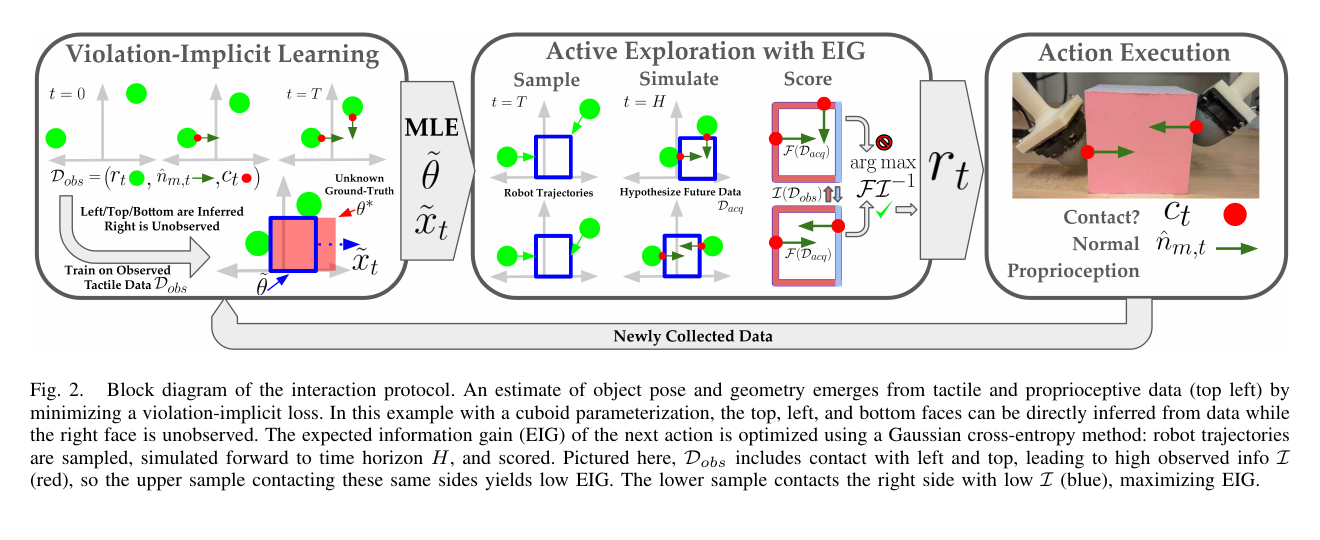
Using only touch and robot proprioception, this work jointly estimates the current pose and shape of an unknown convex rigid object that moves when touched. Expected Information Gain (EIG) selects the next contact direction so limited actions prioritize uncertain surfaces.
Why It Is Difficult
Touch observes only directly contacted local surfaces, yielding sparse data, while each contact can move the object. Assuming a stationary object misaligns subsequent contacts; end-to-end differentiation through rigid-contact simulation encounters nearly discontinuous or flat gradients at contact transitions. Active exploration must also predict future information gain, while belief propagation for moving objects is often multimodal and expensive.
Method overview
Observations comprise contact booleans, contact normals, and robot proprioception. Objects are represented by three cuboid side lengths or a 20-vertex convex polytope, with pose trajectories and shape parameters optimized jointly.
A violation-implicit loss treats states at every trajectory time as decision variables and penalizes violations of dynamics, complementarity, maximum power dissipation, nonpenetration, and inelasticity, rather than enforcing exact contact dynamics step by step. Inner contact impulses are solved with a friction-constrained QP.
After obtaining the current maximum-likelihood estimate, the system approximates observed information from the loss Hessian, simulates candidate actions, and computes Fisher information. It uses
logdet(FfutureIobserved−1+I)
to approximate EIG. A Gaussian cross-entropy method iteratively selects candidate two-finger straight-line approaches.
Original paper, Figure 2: Jointly estimate shape / pose trajectories from existing tactile data, simulate candidate contacts, compute additional information, and execute the best action. Source: Original paper. Image copyright belongs to the authors; shown here solely for academic analysis.
Key Experiments
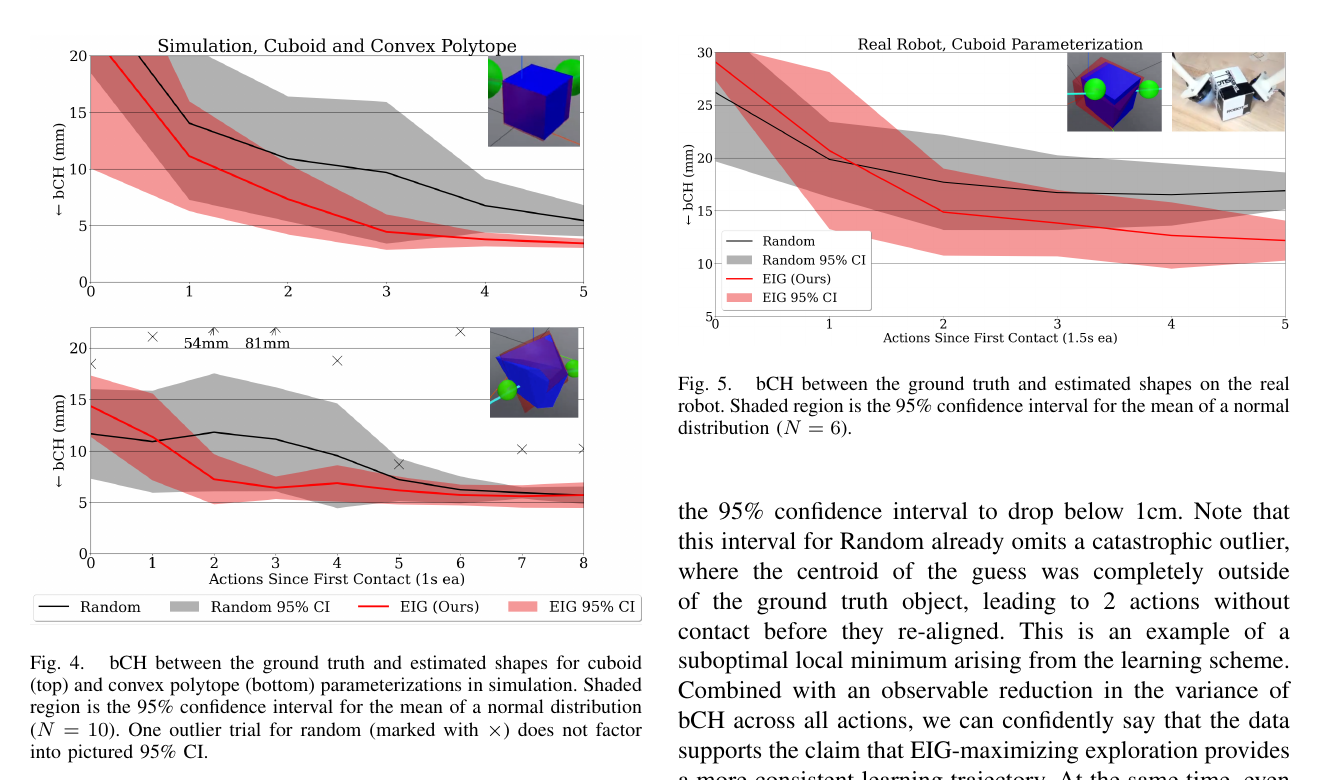
Simulated cuboids: After 5 actions, random exploration reaches around 5 mm bCH, while EIG remains below 4 mm. The step-5 difference remains significant after Bonferroni correction (N=10,p<0.05).
Simulated 20-vertex polytopes: Both methods reach around 5 mm within 8 actions, but EIG is faster and more consistent. Random exploration needs roughly 3 additional actions for comparable consistency; statistical significance is weaker than for cuboids.
Real Trifinger + two DenseTact sensors: EIG significantly outperforms random exploration after 5 actions (N=6,p<0.05, Bonferroni-corrected). Absolute errors exceed simulation, attributed to 3–5 mm proprioceptive error per end effector.
Original paper, Figures 4–5: Red EIG curves converge faster in cuboid simulation and real-robot experiments; shading shows 95% confidence intervals for the mean. Source: Original paper. Image copyright belongs to the authors; shown here solely for academic analysis.
Important Boundaries
Unknown objects and end effectors must admit convex geometry, and objects must be moderately heavy and rest on a known ground plane. EIG is local to the current MLE; incorrect local pose / shape minima can also misdirect exploration. Historical-state sensitivity is poorly defined for rigid Coulomb contact, so the implementation approximates the dynamics Jacobian as identity. Real touch sensing misses light contact, requiring objects that are not too light.
Reading Assessment
The contribution decomposes modeling during contact into optimizable state estimation and information-driven action selection. It is useful for unknown-object modeling, active perception, and contact-rich system identification. General 6D pose would additionally need nonconvex representations, global / multimodal beliefs, visual fusion, and more reliable contact and proprioceptive calibration.
Available src/paper-notes/active-tactile-exploration-pose-shape-icra2026/deep.md
In-depth paper notes
Support reproduction, comparison, related-work writing, and identifying opportunities for further research.
Core problem: Touch-only identification of unknown objects provides sparse local observations while contact moves the object. Shape and the entire pose trajectory must be estimated together, with active selection of the next informative contact.
Core approach: Violation-implicit loss avoids poor rigid-contact gradients. Observed / Fisher information around the local MLE approximates EIG, and CEM selects candidate two-finger approaches.
My assessment: System identification and active perception form a complete loop, recovering constrained convex shapes from 5–8 seconds of tactile data. However, local continuous parameters and local Gaussian information do not automatically represent multiple global pose / shape hypotheses.
2. Problem setting
The scene contains:
A known ground plane;
One unknown, freely moving convex rigid object;
Convex robot end effectors with known geometry and poses;
Tactile contact boolean ct and measured contact normal n^t,m;
Robot pose / proprioception rt.
The goal is to estimate current object pose xT and geometry parameters θ with as few actions as possible. Cuboids have three positive side-length parameters; general convex polytopes are convex hulls of 20 vertices. Evaluation transforms the estimated surface into the current pose and computes bidirectional Chamfer distance (bCH) to the ground-truth surface, jointly reflecting pose and shape error rather than separate pose / size components.
FoundationPose and RealSense supply evaluation references only, outside the tactile-only estimator. The estimator uses no vision, but the real-world bCH reference still relies on visual pose.
3. Tactile Likelihood
The signed robot–object distance is ϕt(θ,xt,rt). Contact booleans use a logistic likelihood:
p(ct∣θ,xt,rt)=1+eαϕtct+(1−ct)eαϕt.
When contact occurs, a Gaussian likelihood matches measured normal n^t,m to geometrically predicted normal n^t. The combined negative log-likelihood Lt penalizes:
Inconsistency between contact / noncontact and signed distance;
Inconsistency between measured and predicted normals.
Direct optimization under the rigid-dynamics constraint
xt+1=fθ(xt,rt,λt)
encounters large flat regions and abrupt gradients at contact switches. A graph-distance analogy with a one-dimensional step function motivates finding a nearby point on the function graph instead of comparing values only at the same horizontal coordinate.
4. Violation-implicit loss
The authors treat the entire x0:T trajectory as decision variables and penalize dynamics residuals and physical-constraint violations:
Complementarity: λtnϕt, allowing normal force only during contact;
Maximum power dissipation: Friction opposes tangential sliding;
Nonpenetration: min(0,ϕt)2;
Inelasticity: Normal impulses cannot return energy and create unforced rebounds.
Inner optimization of λt is a QP with second-order-cone friction constraints, solved through CVXPYLayers. By the envelope theorem, outer backpropagation need not explicitly differentiate through optimal λt. Replacing hard physical feasibility with soft penalties can produce nonphysical local minima; multiple trajectory initializations mitigate this.
Original paper, Figure 2: Left, violation-implicit optimization recovers the current MLE; center, candidate actions are simulated and scored by EIG; right, execution adds new tactile data. Source: Original paper. Image copyright belongs to the authors; shown here solely for academic analysis.
5. From Local MLE to EIG
Let ω={θ,xT}. Instead of maintaining a full belief, the method uses a Laplace-like local approximation from the negative-log-likelihood Hessian at MLE ω~:
H[ω∣D]≈21logdetI(D,ω~)+c,
The observed information is
I(Dobs)≈∇ω2t∑Lt
The implementation omits the Hessian-of-logit term, whose expectation is zero although individual samples need not be, retaining the gradient outer-product component.
For future action rT:H, simulation from the current estimate produces a future trajectory and ideal contacts / normals, from which Fisher information F(Dacq) is computed. Finally:
EIG∝logdet(F(Dacq)I(Dobs)−1+I).
This measures expected future information relative to information already available. Repeated contacts with confident surfaces may yield large F, but little gain after normalization by I(Dobs)−1. Unobserved surfaces are more informative.
6. A Critical Approximation: Historical-State Sensitivity
EIG concerns ω={θ,xT}, while past observations Lt depend on historical xt. This theoretically requires backward sensitivities, analogous to xT−1=f−1(xT). Rigid contact is many-to-one: A stationary state may have always been stationary or just stopped after collision, so inverse dynamics is nonunique.
The implementation differentiates each time-step gradient only with respect to its own state and sums them, effectively assuming dynamics Jacobian dxt/dxt−1=I. This suffices for the sliding objects tested, but EIG may become inaccurate under tumbling, bouncing, or major contact-mode changes. The approximation is a central theoretical limit on extending mild sliding to complex manipulation.
7. Action Space and Hardware
Each end effector executes a 1-second straight approach from a fixed radius toward the estimated object centroid. Right ascension and declination parameterize each finger’s action. Bounds are [−π/4,π/4] on hardware and [−2π/5,2π/5] in simulation.
Iterative Gaussian CEM begins with uniformly sampled actions, ranks EIG, fits a Gaussian to the top nbest, and randomly chooses from the final elite set. Search is restricted to a manually defined 4D two-finger approach family, rather than global optimal control over arbitrary robot trajectories.
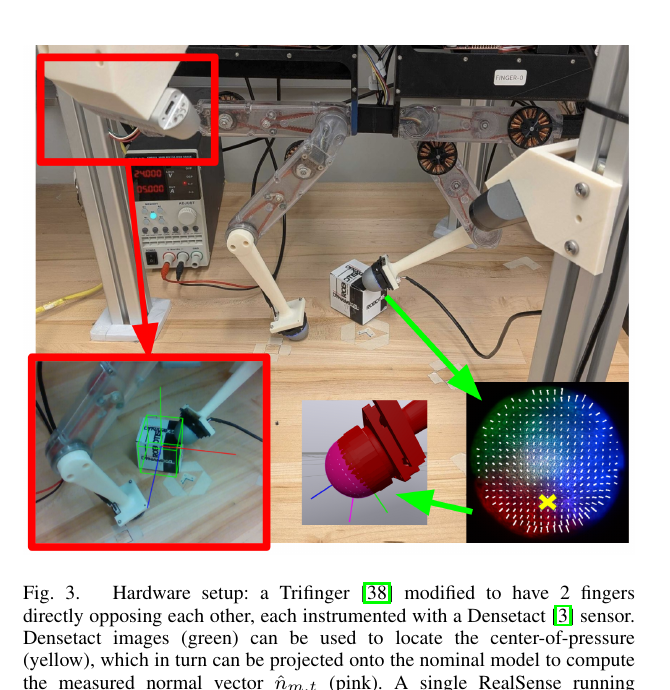
Original paper, Figure 3: Each finger of a modified two-finger Trifinger carries a DenseTact sensor. Projecting tactile center of pressure onto a nominal sensor model yields contact normals. RealSense + FoundationPose is used only for evaluation. Source: Original paper. Image copyright belongs to the authors; shown here solely for academic analysis.
DenseTact produces images at 30 Hz. Optical flow separates normal, shear, and torsional motion, followed by Helmholtz–Hodge decomposition. A weighted center of the irrotational scalar potential gives center of pressure; projection onto the nominal surface yields normals, and a local-potential threshold detects contact.
8. Shape Parameterization
8.1 Cuboid
θ∈R>03 represents three side lengths. With so few parameters, one corner / multiface contact may substantially increase observed information. This tests joint pose–shape–contact optimization but remains far from arbitrary objects.
8.2 Convex polytope
The convex hull of 20 3D vertices defines the shape. Vertices falling inside the hull cease to affect the surface or bCH, permanently reducing representational capacity; the authors randomly replace them on the hull. A regularizer encourages at least three vertices to lie on the ground at trajectory end, preventing the violation loss from accepting unstable shapes.
Nonconvex objects could theoretically use unions of convex parts, but this is unimplemented. Complex topology, recesses, and thin structures are also unvalidated.
9. Simulation Results
Drake simulates at 1 kHz and reports observations at 30 Hz.
9.1 Cuboid
Ground-truth side lengths are sampled from 3–6 cm, with initial guesses of 1–3 cm. Both initial and true poses are randomized within 2 cm of the workspace center. After first contact, 5 actions are executed, with N=10.
Random exploration reaches about 5 mm bCH within 5 steps; EIG consistently falls below 4 mm. An independent two-tailed t-test at step 5 remains significant at p<0.05 after Bonferroni correction over five time points.
9.2 Polytope
Ground truth consists of Platonic solids with 2 cm bounding radius; initialization uses 20 random points on a 1 cm sphere. After first contact, 8 actions follow. Both methods reliably approach 5 mm within 8 steps, with lower variance and faster convergence for EIG. Random exploration takes roughly 3 additional actions for comparable 95% CIs, but differences are less statistically significant than for cuboids.
Original paper, Figures 4–5: Top left, cuboid simulation; bottom left, polytope simulation (N=10); right, real cuboid (N=6). Red denotes EIG and black random exploration. Source: Original paper. Image copyright belongs to the authors; shown here solely for academic analysis.
The random-polytope confidence intervals exclude one catastrophic outlier: The estimated centroid lay entirely outside the object, causing two consecutive no-contact actions before realignment. Exclusion improves readability, but local-optimization failures remain real online-system risks.
10. Real-Robot Results
The real object is a 5.8 × 4.9 × 5.3 cm cuboid weighing about 0.5 kg, moved roughly 1–2 cm during each trial. Initialization matches simulation, with 5 actions after first contact and N=6.
EIG significantly outperforms random exploration at step 5 (independent two-tailed t-test, p<0.05 after Bonferroni correction over five time points). Final bCH nevertheless remains around the centimeter scale, well above simulation. Each end effector has 3–5 mm proprioceptive error; two-finger errors, tactile normals, and visual evaluation references jointly set a lower bound.
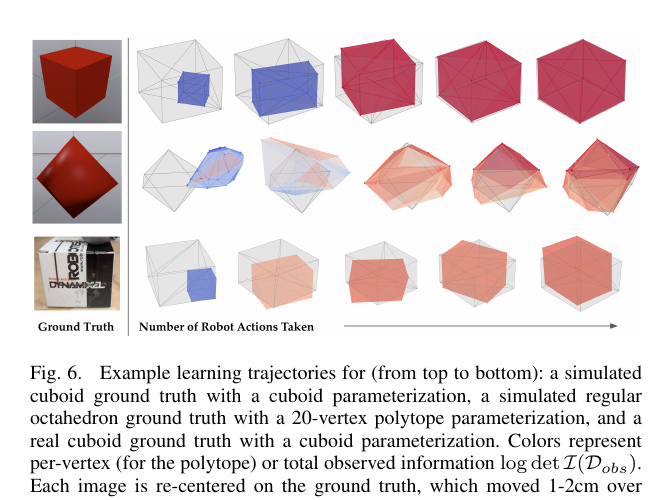
Original paper, Figure 6: Top to bottom, simulated cuboid, simulated regular octahedron, and real cuboid. Color encodes observed information; gray is ground truth. Source: Original paper. Image copyright belongs to the authors; shown here solely for academic analysis.
11. Limitations and Reproduction Risks
Convexity: Both object and end effector must be convex to provide a unique collision point.
Local MLE / EIG: A confident Hessian at the wrong mode misdirects the next action.
Multiple-initialization costs: As data accumulates, multiple trajectory initializations slow online optimization. No complete wall-clock curve is provided.
Insensitivity to light touch: DenseTact struggles with light contact, restricting experiments to moderately heavy objects.
Identity Jacobian: Historical-to-current sensitivity is approximated and validated only under mild sliding.
Ground-plane prior: Objects must rest on a known plane; free-space, in-hand, and unknown-table settings require different models.
Centroid-dependent actions: Large pose errors can make planned straight approaches miss the object entirely.
Small evaluation samples: Simulation N=10 and hardware N=6, with only one real cuboid.
Visual-reference errors: FoundationPose is not motion-capture ground truth; quantify evaluation noise separately.
12. Code and Reproduction
The released code is the DAIR physics-based learning library’s egordon/exploration branch, with migration to a cleaner JAX version in progress. Reproduction requires locking versions and settings for:
Drake / contact geometry;
CVXPYLayers QP and friction-cone parameters;
JAXopt collision normal / distance derivatives;
tactile normal extraction;
CEM sample / elite counts;
Violation-penalty weights and multiple-initialization strategies.
Essential ablations include random versus EIG, removing violation terms, different MLE initializations, identity Jacobians versus differentiable forward sensitivities, and real proprioceptive perturbations.
13. Methodological Insights
Two lessons for 6D-pose research:
Unknown-object pose and shape can be identified jointly along one trajectory through contact physics, without requiring sequential estimation.
Active perception can use local information matrices as an engineering compromise without maintaining a full high-dimensional belief, but mode failures must remain explicit.
Combining this with visual initial models, nonconvex neural implicit shapes, global particle beliefs, and safe closed-loop control would move toward building an actionable model of an unknown object after a few exploratory contacts.