Object Pose Estimation · 2026 · ICRA / IEEE RA-L · CCF B
Aleatoric Uncertainty from AI-based 6D Object Pose Predictors for Object-relative State Estimation
The paper adds independently calibratable heteroscedastic MLPs to PoET's translation and rotation branches. Gaussian NLL predicts six log-variance components as dynamic measurement covariance for a MaRS EKF. Dynamic covariance alone performs similarly to fixed noise; consistent benefits come from uncertainty-based anchor switching and outlier rejection. Mean position RMSE over 7 real flights decreases from 0.172 m to 0.146 m. Symmetric-object rotation coverage is poorly calibrated, and translation–rotation correlations and multimodality are omitted.
single RGB imageIMU for downstream state estimationoptional multiple object observations
Requirements
pre-trained class-specific pose predictorpose-labelled calibration or training dataknown object classescamera and IMU calibration for state estimationGaussian diagonal covariance approximation
Full paper metadataAuthors, affiliations, research area, datasets, metrics, method tags, and reading statusExpandCollapse
Authors
Thomas Jantos, Stephan Weiss, Jan Steinbrener
Affiliations
University of Klagenfurt, Control of Networked Systems Group
Original paper terminology:prediction interval coverage probability at 95% / AUC of ADD-S / translation and rotation error / position and orientation RMSE / maximum position error / TensorRT inference latency
pre-trained class-specific pose predictorpose-labelled calibration or training dataknown object classescamera and IMU calibration for state estimationGaussian diagonal covariance approximation
Reading Notes
Overview / Deep Dive
Available src/paper-notes/aleatoric-pose-uncertainty-icra2026/coarse.md
Paper overview notes
Quickly assess the paper's scope, problem setting, core method, experimental findings, and whether to read it in depth.
Paper Overview: Aleatoric Uncertainty from AI-based 6D Object Pose Predictors
Summary in one sentence
This work adds two independently trainable uncertainty heads to existing 6D pose networks and passes per-prediction translation and rotation variances to a visual-inertial EKF. Dynamic covariance alone does not necessarily outperform fixed noise; the clear gains come from using uncertainty to switch anchor objects or reject outlier observations.
Main approach
Using the RGB-only PoET as an example, a detector and deformable transformer produce object queries, while the original heads output 3D translation and a 6D rotation representation. Two additional class-specific MLPs output log variances for the three translation and three rotation components, respectively. Gram–Schmidt first produces R∈SO(3), which is mapped to axis–angle form through the matrix logarithm, allowing rotation error to be modeled in the three-dimensional tangent space of the Lie algebra so(3).
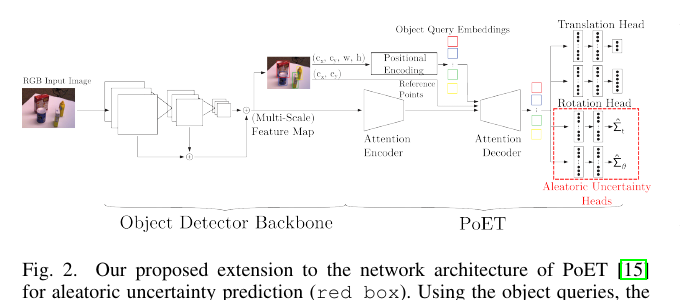
Original paper, Figure 2: The added uncertainty branches are outlined in red. They read the object queries but remain separate from the pose heads, allowing independent calibration with the original network frozen. Source: original paper. Copyright belongs to the paper's authors; reproduced here solely for academic discussion.
For each error component ei, the network predicts si=logσi2 and uses a heteroscedastic Gaussian NLL loss:
L=21i∑[exp(−si)ei2+si].
The model predicts only diagonal covariances, with translation and rotation also independent. After a coordinate transformation, this 6×6 block-diagonal covariance becomes the per-frame measurement noise in the MaRS EKF. The system can also select the object with the lowest total uncertainty as its navigation anchor or apply uncertainty-based outlier rejection using a threshold.
Key results
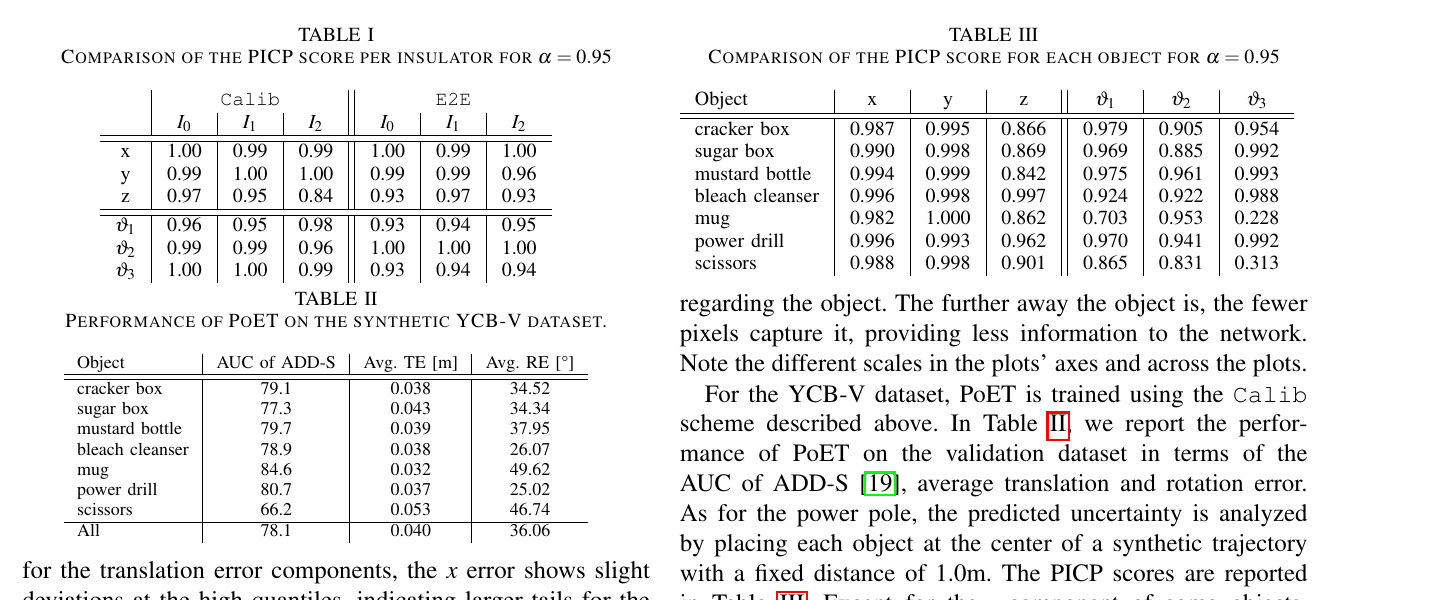
At the 95% prediction level, most PICP components exceed 0.9 on the power-pole insulator data, indicating overall conservative intervals. Translation coverage is generally high on YCB-V, but two mug rotation components reach only 0.703 / 0.228, and one scissors rotation component reaches 0.313, revealing a mismatch involving symmetry.
TensorRT FP deployment on Jetson Orin AGX increases PoET latency from 106.73 ms to 107.43 ms, an overhead of approximately 0.6%.
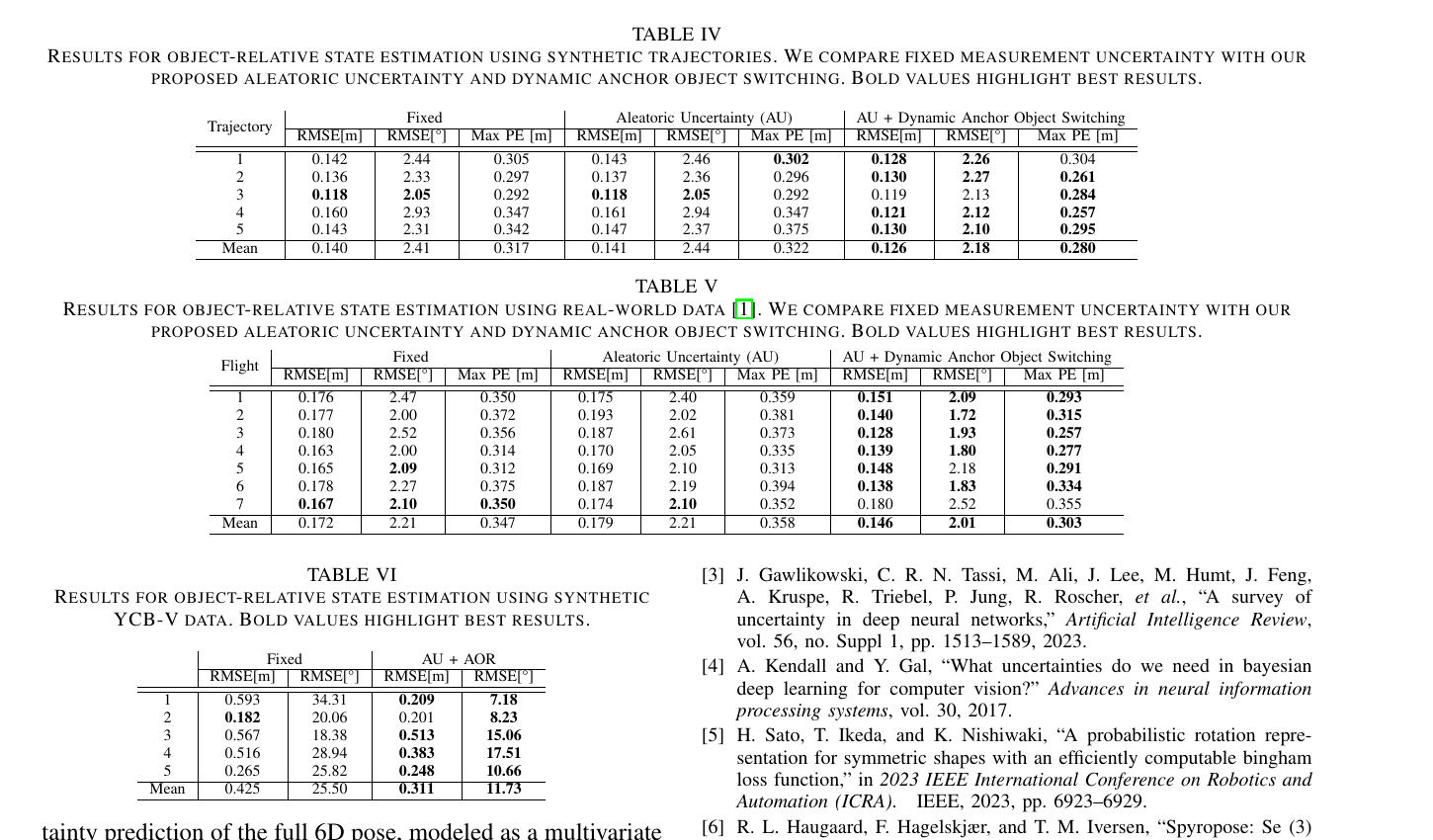
Across 5 simulated trajectories, mean position RMSE is 0.140 / 0.141 / 0.126 m for fixed noise / dynamic uncertainty / dynamic uncertainty with anchor switching.
Across 7 real flights, the corresponding values are 0.172 / 0.179 / 0.146 m. Replacing covariance alone is slightly worse; anchor switching provides consistent improvement.
Across five simulated YCB-V trajectories, fixed noise yields position / rotation RMSE of 0.425 m / 25.50°. Uncertainty with outlier rejection reduces these to 0.311 m / 11.73°.
Original paper, Tables IV–VI: AU alone performs similarly to Fixed; the main gains require AU + Dynamic Anchor Switching or AU + AOR. Source: original paper. Copyright belongs to the paper's authors; reproduced here solely for academic discussion.
Important boundaries
The predicted quantity is aleatoric uncertainty arising from data noise, rather than epistemic uncertainty under out-of-distribution inputs. A diagonal Gaussian cannot express translation–rotation correlations, multimodal rotations, or symmetry-equivalent solutions. PICP already reveals severe undercoverage of mug and scissors rotation intervals. It is therefore better viewed as an observation-reliability signal than a complete SE(3) posterior.
Reading assessment
The most useful lesson is to test uncertainty within a decision pipeline. Merely replacing a fixed R with per-frame Rt gives limited gains. Switching anchors and rejecting outlier observations are what turn calibration information into improved trajectory accuracy.
Available src/paper-notes/aleatoric-pose-uncertainty-icra2026/deep.md
In-depth paper notes
Support reproduction, comparison, related-work writing, and identifying opportunities for further research.
Deep Reading Notes: Aleatoric Uncertainty from AI-based 6D Object Pose Predictors for Object-relative State Estimation
1. What problem does the paper address?
A typical 6D pose network outputs a single T^CO∈SE(3), whereas a robot state estimator also needs a measurement covariance R. Common engineering approaches compute one global constant from a validation set or rely on expert tuning. Yet the same model clearly has different reliability for a close, unoccluded, richly textured view and a distant, occluded, symmetric view. A fixed R treats all these observations equally.
The paper pursues two objectives:
Predict a data-dependent aleatoric variance for every object and each 6D pose component in a single forward pass.
Show that these variances support more than plots: they can serve as dynamic measurement noise for object-relative visual-inertial state estimation and drive anchor selection and outlier rejection.
This setting is practical. It does not require converting the original pose predictor into a large sampling model or performing multiple forward passes for MC dropout, making it suitable for edge devices such as Jetson.
2. Network extension and rotation parameterization
The authors build on PoET. Scaled-YOLOv4 and a multiscale backbone first extract features, and a deformable transformer produces object queries carrying category and contextual information. The original model has translation and rotation heads. Two MLPs are added separately from these pose heads:
Translation uncertainty head: Outputs Σ^t∈R3×3.
Rotation uncertainty head: Outputs Σ^ϑ∈R3×3.
Original paper, Figure 2: Uncertainty heads run alongside the pose output heads. They can be trained end to end or calibrated independently with the pose predictor frozen. Source: original paper. Copyright belongs to the paper's authors; reproduced here solely for academic discussion.
Translation is handled directly in R3. Rotation-matrix elements should not be treated as independent Gaussian variables. The authors first orthogonalize the network’s continuous 6D rotation representation into R∈SO(3) using Gram–Schmidt, then take the matrix logarithm:
log(R)=θ[v]×∈so(3),ϑ=θv∈R3.
The error between ground-truth and predicted rotations can then be written as a local axis–angle vector. This is three-dimensional, continuous, and locally Euclidean, but remains a local representation: one Gaussian cannot fully cover rotations near π, symmetric objects, or multimodal posteriors.
3. What does the heteroscedastic loss learn?
Let y denote a 3D translation or rotation vector. The pose head predicts a mean y^, and the uncertainty head predicts a diagonal covariance:
Σ^y=diag(σ^y,12,σ^y,22,σ^y,32).
Assuming a Gaussian likelihood and taking its negative logarithm gives the loss for one object:
Ly=21i=1∑3(σ^i2ei2+logσ^i2),ei=yi−y^i.
In practice, predicting si=logσ^i2 yields a more numerically stable form:
Ly=21i∑[exp(−si)ei2+si].
The first term prevents variance from being too small when errors are large; the second prevents the network from inflating all variances without bound. Here, aleatoric means that, given the current image, the model tries to learn the typical residual size for similar observations in the training data.
The paper describes two training strategies:
Calib: Freeze the original pose predictor and train only the uncertainty heads for approximately 10 epochs.
E2E: Train means and variances together for approximately 50 epochs.
Their coverage is similar, supporting the feasibility of adding a confidence layer to an existing pose system. However, as e→0, NLL drives σ→0. The authors also observe steep gradients near zero error and error distributions that are not strictly zero-mean. This loss does not automatically guarantee calibration; independent reliability / coverage checks remain necessary.
4. From network coordinates to state-estimation covariance
The network separately predicts translation covariance and rotation tangent-space covariance in the camera frame. The authors combine them into:
Σpose=[Σt00Σϑ],
They then rotate / transform the covariance into the object-relative frame used by the MaRS EKF, according to the measurement direction and object–camera coordinate relationship. The IMU propagates the system state at 200 Hz, while RGB pose updates arrive at 15 Hz.
The paper compares three strategies:
Fixed: Set a fixed covariance from average validation-set errors.
AU: Directly use the predicted aleatoric covariance for every frame.
AU + Dynamic Anchor Switching: Use dynamic covariance and select the visible object with the lowest total predicted uncertainty as the current navigation anchor.
The YCB-V experiments also use AU + AOR: Reject observations when predicted uncertainty or the innovation relative to the estimated state indicates inconsistency.
A key engineering insight is that variance can drive discrete decisions as well as continuous filter weights: which object to trust now, and whether to use this frame. Such decisions suppress erroneous observations more effectively.
5. Calibration: Generally useful, with limits exposed by symmetric rotations
The paper checks each component using 95% prediction interval coverage probability (PICP). The ideal value is 0.95; substantially higher values indicate overly broad intervals, while substantially lower values indicate overconfidence.
Original paper, Tables I–III: Most components for power-pole objects approach or exceed 0.95; rotation coverage is markedly lower for the YCB-V mug and scissors. Source: original paper. Copyright belongs to the paper's authors; reproduced here solely for academic discussion.
For power-pole insulators, most PICP components fall within 0.93–1.00, indicating that intervals cover the errors but tend to be conservative. On synthetic YCB-V, most translation or rotation components for objects such as the cracker box, mustard bottle, and power drill behave well. Exceptions include:
Mug: ϑ1=0.703,ϑ3=0.228.
Scissors: ϑ3=0.313.
Depth z coverage of approximately 0.84–0.90 for several objects.
The paper attributes the mug / scissors failures to approximate symmetry and visibility. When a mug handle is hidden, several yaw angles are plausible; local scissor geometry can also create rotation ambiguity. A diagonal unimodal Gaussian compromises between such equivalent modes and cannot simultaneously provide an accurate mean and correct coverage.
On this YCB-V subset, PoET achieves mean AUC ADD-S of 78.1, mean translation error of 0.040 m, and mean rotation error of 36.06°. The latter two values show why high coverage does not imply accurate pose. Even an inaccurate predictor can attain high coverage by producing wide intervals; sharpness and task metrics must be reported alongside coverage.
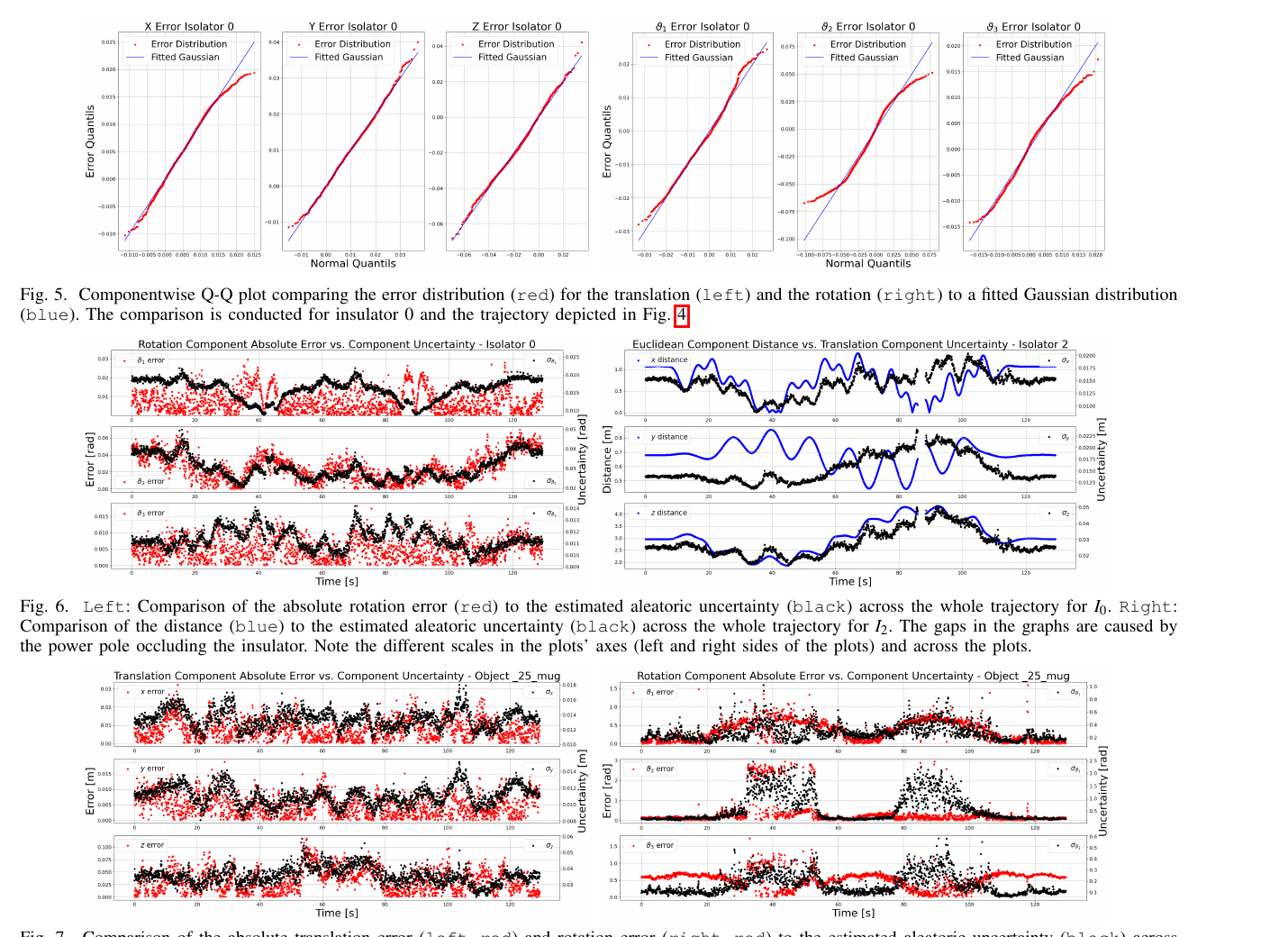
Original paper, Figures 5–7: Q–Q plots examine the Gaussian assumption. Insulator uncertainty varies with distance and error, while occluded mug rotations exhibit stronger non-Gaussian behavior. Source: original paper. Copyright belongs to the paper's authors; reproduced here solely for academic discussion.
The time series show a strong correlation between translation uncertainty along z and camera–object distance, while rotation uncertainty grows for side views and occlusions. This matches the intuition that fewer informative image pixels imply greater observation noise. However, some error peaks lack a corresponding increase in uncertainty. The uncertainty is a statistical association, not an upper bound on individual prediction errors.
6. Interpreting the state-estimation results
Original paper, Tables IV–VI: Three downstream experiments separately compare fixed covariance, AU, anchor switching, and AOR. Source: original paper. Copyright belongs to the paper's authors; reproduced here solely for academic discussion.
Power-pole simulation (5 trajectories)
Strategy
Position RMSE
Orientation RMSE
Maximum position error
Fixed
0.140 m
2.41°
0.317 m
AU
0.141 m
2.44°
0.322 m
AU + dynamic anchor
0.126 m
2.18°
0.280 m
Real AIVIO flights (7 flights)
Strategy
Position RMSE
Orientation RMSE
Maximum position error
Fixed
0.172 m
2.21°
0.347 m
AU
0.179 m
2.21°
0.358 m
AU + dynamic anchor
0.146 m
2.01°
0.303 m
Synthetic YCB-V trajectories (5 trajectories)
Mean position / orientation RMSE is 0.425 m / 25.50° for Fixed and 0.311 m / 11.73° for AU + AOR. The improvement primarily comes from rejecting failed poses, rather than softly downweighting every failed observation.
These results do not support the strong claim that learned covariance is inherently better than fixed covariance. AU alone matches or slightly underperforms Fixed in the two power-pole experiments. A more accurate conclusion is that per-observation uncertainty provides a decision signal unavailable from fixed noise. It translates consistently into trajectory gains when the system uses that signal to switch anchors or reject anomalies.
7. Computation and deployment
On Jetson Orin AGX with TensorRT full precision:
Original PoET: 106.73 ms.
With uncertainty heads: 107.43 ms.
The approximately 0.70 ms / 0.6% overhead is small because the new modules are merely MLPs operating on object queries, without an ensemble or repeated sampling. This is a direct advantage over more complex Bayesian pose estimators.
8. Limitations and reproduction risks
Strong unimodal, diagonal assumptions. The six independent components ignore translation–rotation coupling. Symmetric objects require multimodal or symmetry-aware densities.
Only aleatoric uncertainty is modeled. The authors exclude epistemic uncertainty because synthetic data can be generated in large quantities. This does not establish the absence of model uncertainty in the real domain or under unfamiliar lighting or occlusion.
Coverage alone is insufficient. Overly wide intervals can yield high PICP. Interval width, NLL, ECE, or a proper scoring rule should also be reported.
State-estimation gains are confounded by strategy changes. The best rows also add anchor switching / AOR, so the entire improvement cannot be attributed to more accurate covariance values.
Class-specific heads. The current implementation targets known categories. Unknown objects or open-vocabulary detection require a generalizable uncertainty representation.
Local rotation modeling. A Lie-algebra Gaussian is natural for small errors but insufficient for large angles and topology-induced multimodality.
9. Implications for 6D pose research
The paper offers a useful evaluation framework: uncertainty methods should go beyond plotting distributions and answer questions at three levels:
Statistical level: Are coverage / calibration correct?
Estimation level: Does dynamic covariance improve filtering?
Decision level: Can it change anchor selection, outlier rejection, or action planning?
The strongest evidence is at the third level. Replacing unimodal variance with a symmetry-aware mixture, Bingham / matrix-Fisher distribution, or pose hypotheses while retaining low single-pass overhead would be more valuable than simply enlarging the network.