Instance-Adaptive and Geometric-Aware Keypoint Learning for Category-Level 6D Object Pose Estimation
For category-level RGB-D 6D pose estimation, the method learns instance-adaptive sparse keypoints and uses local / global geometry-aware feature aggregation to establish keypoint-level NOCS correspondences. It avoids category shape priors and improves unseen-instance generalization on REAL275 and CAMERA25.
Task: Category-level 6D object pose estimation for unseen instances within known categories
AG-Pose’s central idea is to move beyond dense NOCS correspondence over all observed points. It first learns a sparse set of keypoints adapted to the current instance, encodes local neighborhood geometry and global relations between keypoints into their features, and uses keypoint-level NOCS correspondence to regress category-level pose and size.
1. Positioning in one sentence
AG-Pose addresses category-level 6D pose estimation from RGB-D. Within the NOCS / REAL275 / CAMERA25 framework, it estimates rotation, translation, and size, while shifting the focus from dense point-wise correspondence to sparse instance-adaptive keypoint correspondence. The problem it targets is substantial shape variation within a category: dense correspondence can generalize poorly to unseen instances, boundary points, and outliers.
Method inputs and outputs
Item
Content (compiled for this site)
Inference inputs
A single RGB-D frame and camera intrinsics; an upstream Mask R-CNN provides instance masks and category labels. The pose network receives the target RGB crop and target point cloud back-projected from depth.
Final outputs
Rotation R, translation t, and three-axis dimensions s∈R3 of an unseen instance from a known category, expressed in the camera frame. The output includes size as well as 6D pose.
Requirements
Depth, target segmentation, and category-level training are required. Inference needs neither the test instance’s CAD model nor a category shape template. Training uses instance models and pose / size / NOCS supervision, so the entire process should not be called model-free.
2. Guide to the paper’s figures and tables
Figure or table
What to examine
Why it matters
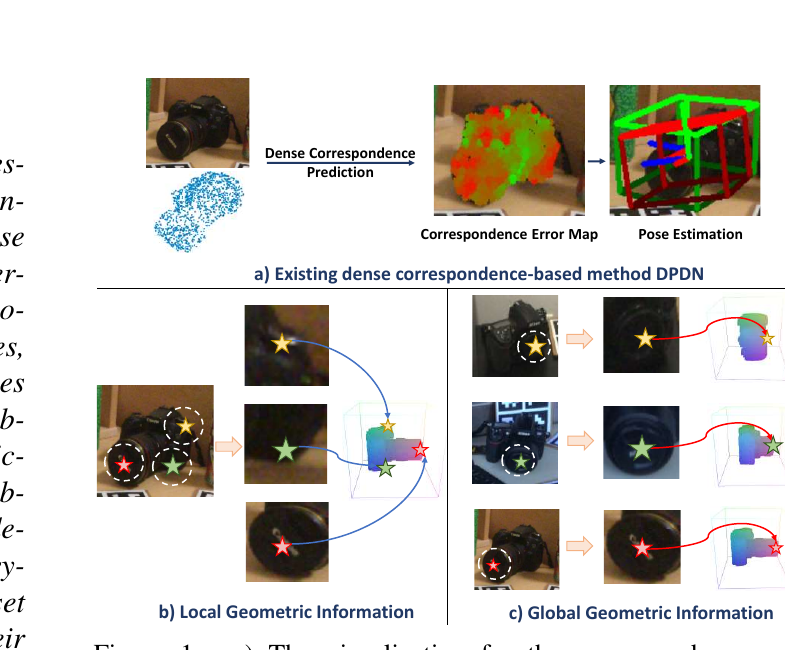
Figure 1
Dense correspondence failures on unseen instances and the motivation for local/global geometric information
Understand why the authors move to keypoint-level correspondence
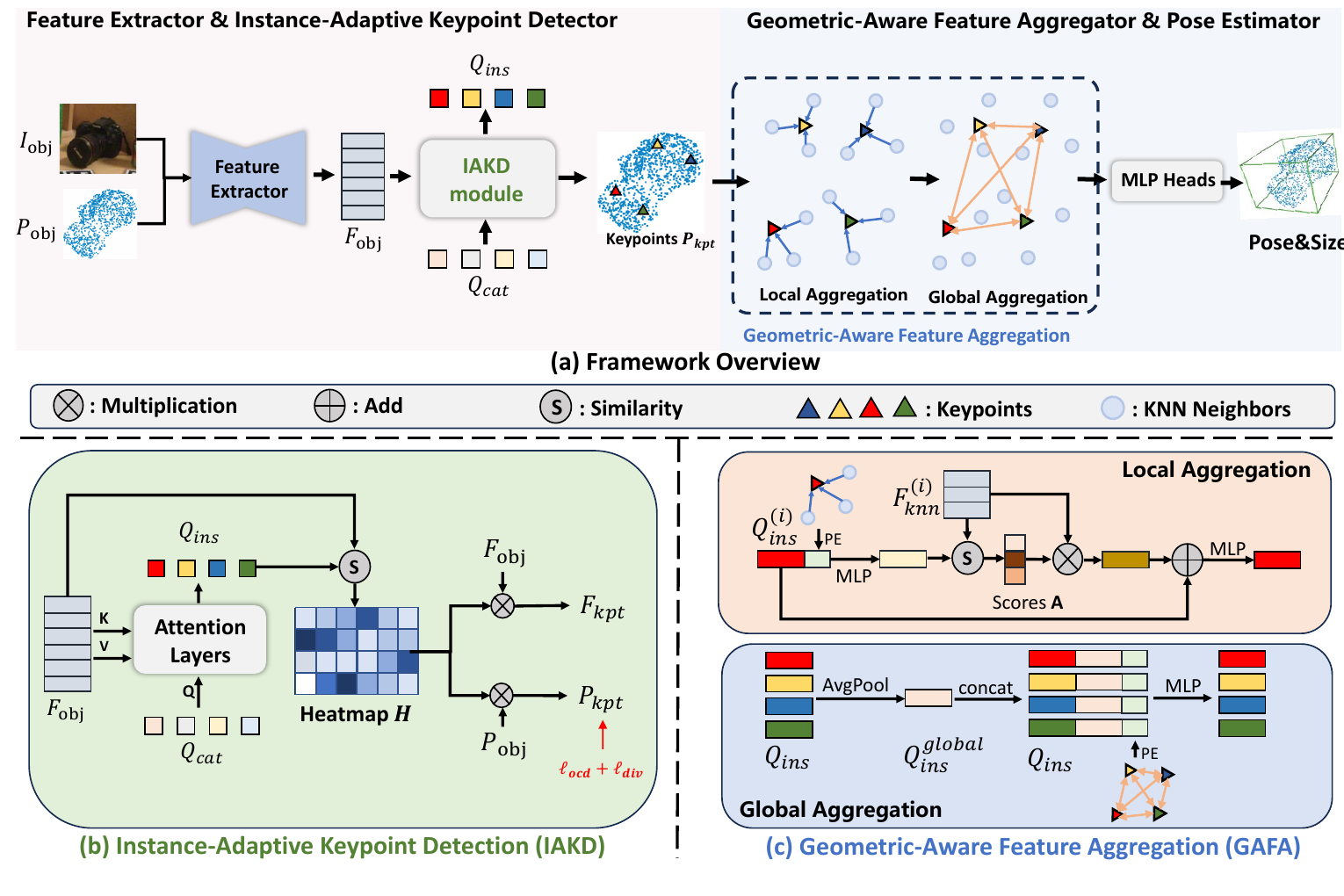
Figure 2
The AG-Pose framework, IAKD, and GAFA
The main method is summarized in this figure
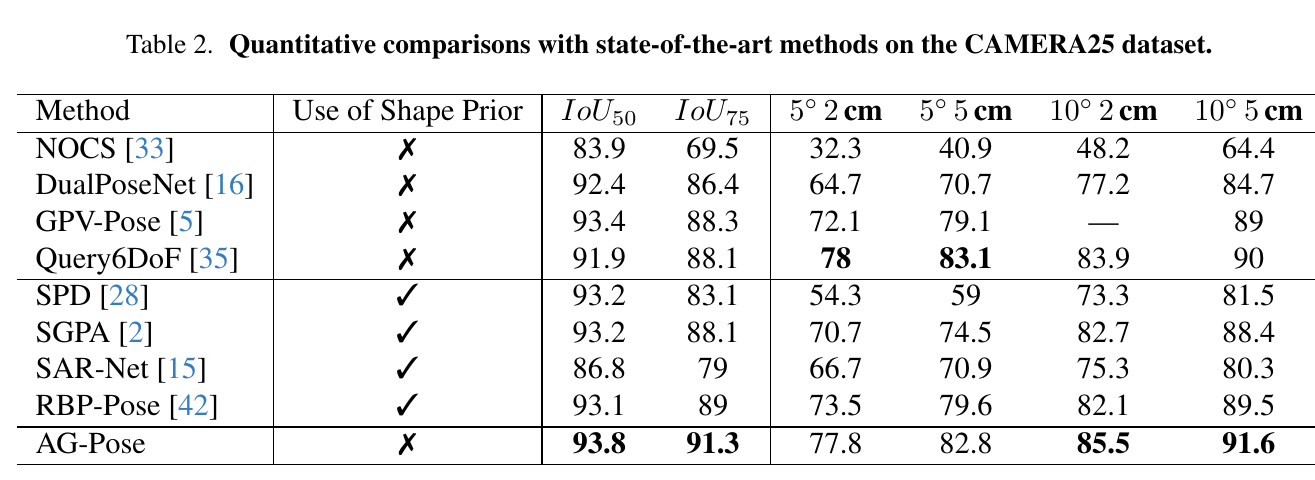
Table 2
Main results on CAMERA25
Assess overall performance on the synthetic benchmark
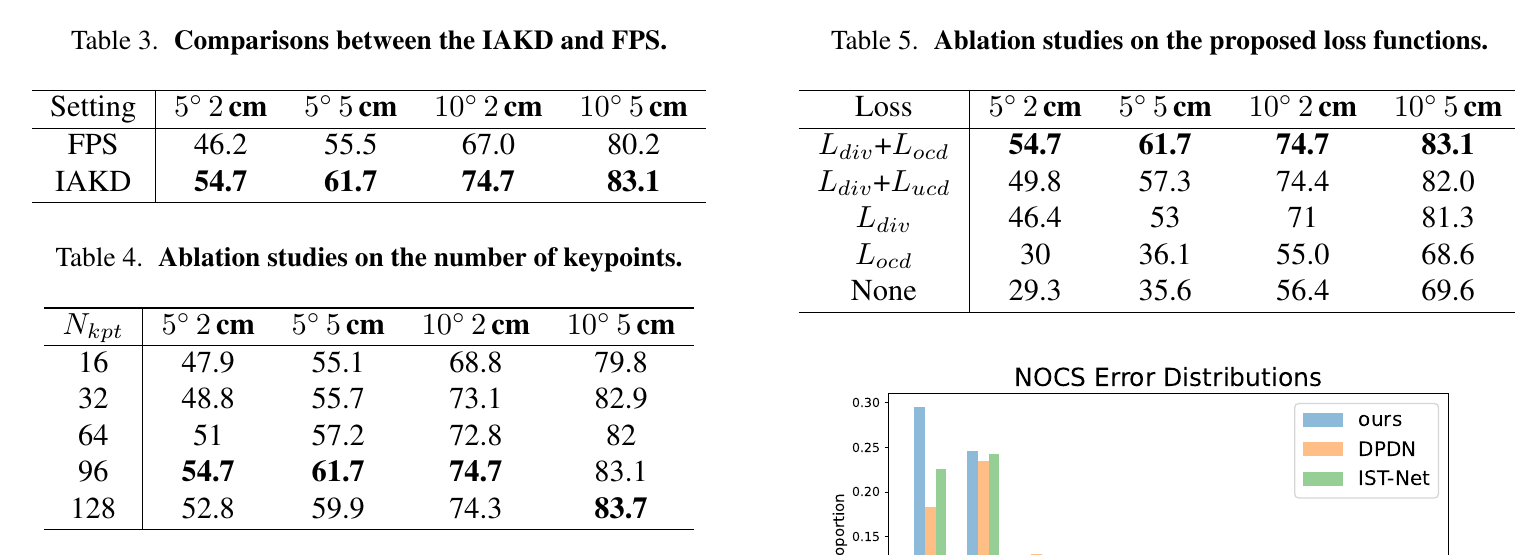
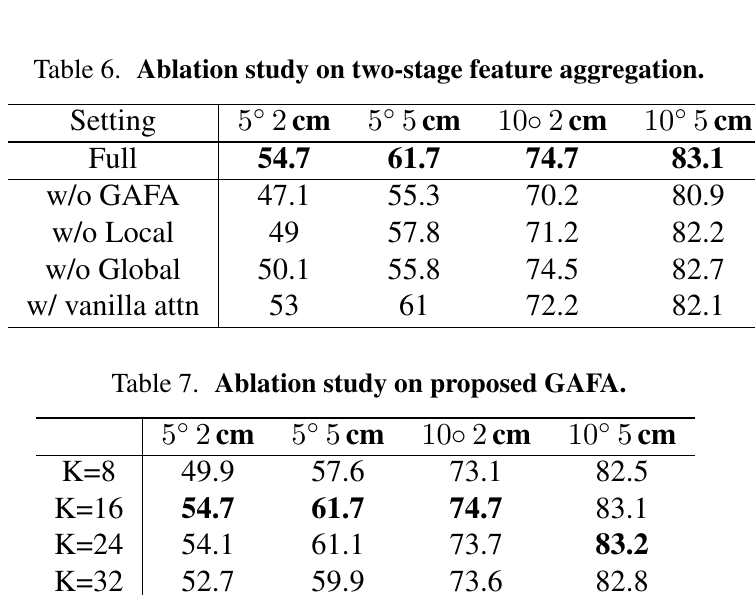
Tables 3-7
Ablations on keypoint count, losses, and GAFA
Check whether the two modules make clear contributions
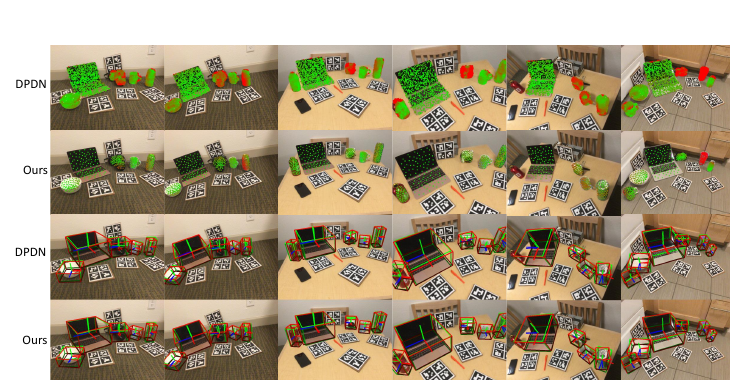
Figure 5
Qualitative comparison with DPDN
Visually compare the stability of NOCS error maps and pose boxes
Original paper, Figure 1: Failures of dense correspondence-based methods in correspondence error maps and pose estimation, motivating local / global geometric information for category-level correspondence. Source: arXiv. Copyright belongs to the paper's authors and publisher; reproduced here solely for paper discussion.Original paper, Figure 2: AG-Pose extracts object features from an RGB crop and point cloud, generates instance-adaptive keypoints with IAKD, aggregates local neighborhood and global keypoint geometry with GAFA, and finally regresses pose and size. Source: arXiv. Copyright belongs to the paper's authors and publisher; reproduced here solely for paper discussion.
3. Method at a glance
The inputs are an RGB-D image, an object mask, and a category label supplied by an external segmenter. Camera intrinsics back-project depth into an object point cloud, while the RGB image is cropped to extract appearance features. PointNet++ extracts point-cloud geometry features, and PSPNet/ResNet-18 extracts image features; these are concatenated into object features.
IAKD (Instance-Adaptive Keypoint Detection) starts from category-shared learnable queries and uses attention to incorporate the current instance’s object features, producing instance-adaptive detectors. It predicts keypoint heatmaps and computes keypoint coordinates and features as weighted sums. Additional diversity and object-aware Chamfer distance losses spread keypoints over the object surface and reduce outlier interference.
GAFA (Geometric-Aware Feature Aggregation) aggregates geometry at two levels. Local aggregation lets each keypoint attend to relative positions and local features of its K neighboring points; global aggregation exchanges overall geometric relations between keypoints. Camera-space keypoint coordinates, features, and predicted NOCS coordinates are then used to regress rotation, translation, and size.
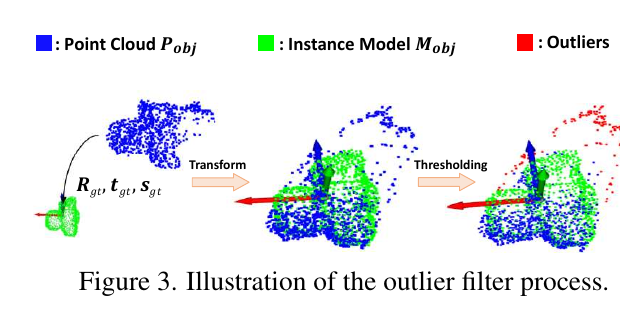
Original paper, Figure 3: Outlier filtering for the object-aware Chamfer distance. The observed point cloud is transformed into NOCS space, and the instance model filters points that do not belong to the object surface, preventing outliers from pulling keypoints away. Source: arXiv. Copyright belongs to the paper's authors and publisher; reproduced here solely for paper discussion.
4. Experimental findings
On REAL275, AG-Pose outperforms previous methods on all reported metrics. It reaches 54.7% on the strictest 5° 2cm metric, compared with 46.0 for DPDN and 49.0 for Query6DoF. The paper emphasizes that it uses no category-specific shape prior.
On CAMERA25, AG-Pose achieves IoU50 / IoU75 of 93.8 / 91.3 and 10° 2cm / 10° 5cm of 85.5 / 91.6. It exceeds Query6DoF on IoU and the 10° metrics, but trails by 0.2 / 0.3 points on 5° 2cm and 5° 5cm. The strongest supported claim is therefore that keypoint-level geometric correspondence generalizes more reliably to unseen instances and performs better on most metrics, rather than leading at every strict threshold.
Original paper, Table 2: Quantitative results on CAMERA25. AG-Pose leads or is strongly competitive on IoU50, IoU75, 10° 2cm, and 10° 5cm, while its 5° results are close to Query6DoF. Source: arXiv. Copyright belongs to the paper's authors and publisher; reproduced here solely for paper discussion.
5. Reading the ablations
IAKD clearly outperforms direct FPS keypoint sampling: 5° 2cm improves from 46.2 to 54.7. Performance generally rises as the keypoint count increases from 16 to 96; the authors choose 96 as an accuracy–efficiency tradeoff. The loss ablation favors Ldiv + Locd. Without the diversity loss, keypoints cluster in a few regions and 5° 2cm drops sharply to around 30.
Original paper, Tables 3-5 / Figure 4: IAKD versus FPS, keypoint count, loss combinations, and NOCS error distributions. These results support the authors' choices concerning keypoint distribution and keypoint-level correspondence. Source: arXiv. Copyright belongs to the paper's authors and publisher; reproduced here solely for paper discussion.
6. My initial assessment
Authors’ claim: Category-level 6D pose should move beyond dense correspondence by explicitly modeling sparse keypoints adapted to the current instance and local/global geometry.
My analysis: This claim is supported, particularly by REAL275 and multiple ablations. AG-Pose is best read alongside the category-level RGB-D pose lineage of NOCS, SPD, SGPA, DPDN, and Query6DoF. Its limitations are clear: it still requires depth, camera intrinsics, instance masks/categories, NOCS supervision, and category-instance data during training. It is not an open-vocabulary, depth-free, or unsupervised category-level pose method.
Available src/paper-notes/ag-pose/deep.md
In-depth paper notes
Support reproduction, comparison, related-work writing, and identifying opportunities for further research.
Deep Reading Notes: Instance-Adaptive and Geometric-Aware Keypoint Learning for Category-Level 6D Object Pose Estimation
Affiliations: University of Science and Technology of China; Jianghuai Advance Technology Center
Datasets: CAMERA25, REAL275
AG-Pose is a category-level RGB-D method for 6D object pose estimation. It replaces dense correspondence, where every point predicts NOCS coordinates, with a small set of learned instance-adaptive keypoints and their NOCS correspondences. Local neighborhood geometry and global geometry between keypoints are explicitly encoded into keypoint features.
Method inputs and outputs
Item
Content (compiled for this site)
Inference inputs
RGB-D, camera intrinsics K, and instance masks / categories from an upstream detector. The core network receives Iobj∈RH×W×3 and a camera-frame point cloud Pobj∈RN×3.
Final outputs
R∈SO(3) and t∈R3 mapping the category-canonical object frame to the camera frame, plus three-axis object dimensions s∈R3. Test instances may be unseen during training, but their categories are known.
Training inputs
RGB-D target observations from the training categories, masks / categories, ground-truth pose and size, instance models, and NOCS alignment information. Instance models filter outliers for the object-aware Chamfer loss; they are not test inputs.
Training objectives
Pose and size regression, supervision of keypoint NOCS coordinates, and constraints that spread keypoints out and keep them on the object surface. Keypoint coordinates / features and NOCS correspondences are intermediate results.
Output details
The network constructs a rotation matrix from a continuous 6D rotation representation and recovers translation from a residual relative to the point-cloud mean. t and s use length units consistent with depth; NOCS coordinates are normalized.
Requirements
The paper uses a 192×192 RGB crop, 1024 observed points, and 96 learned keypoints. Regression heads produce the final pose / size; the keypoints are not passed directly to PnP.
Source: Paper, Section 3. In this category-level setting, “no shape prior” specifically means that no category shape template is supplied at inference. It does not mean that training avoids 3D model supervision.
1. Problem definition
Category-level 6D pose estimation targets rotation, translation, and size of unseen instances within a known category, rather than a particular CAD instance already observed during training. AG-Pose follows the NOCS setting: RGB-D observations, camera intrinsics, category labels, and instance masks yield a target point cloud and RGB crop, from which the object pose and scale in the camera frame are predicted.
The key background is that methods such as NOCS / SPD / SGPA / DPDN / Query6DoF largely rely on dense coordinates or dense correspondence. This works well for known categories, but with large within-category shape variation, local appearance or geometry often cannot uniquely determine a point’s NOCS correspondence. Boundary points, missing depth, and outliers further amplify errors.
Original paper, Figure 1: DPDN correspondence error maps illustrate errors on unseen instances. Local / global geometric information addresses ambiguity between different parts of one instance and corresponding category parts across different instances, respectively. Source: arXiv. Copyright belongs to the paper's authors and publisher; reproduced here solely for paper discussion.
2. Method overview
The AG-Pose pipeline has four stages:
Feature extractor: The inputs are an RGB crop Iobj and point cloud Pobj. PointNet++ extracts point features, and PSPNet with ResNet-18 extracts RGB features. These are concatenated into object features Fobj.
IAKD: Category-shared learnable queries Qcat and object features generate instance-adaptive queries Qins. Keypoint heatmaps then yield keypoint coordinates Pkpt and features Fkpt.
GAFA: Local KNN aggregation for each keypoint is followed by global keypoint aggregation, encoding local and global geometric relations into keypoint features.
Pose & size estimator: Keypoint NOCS coordinates are predicted, then Pkpt, Fkpt, the predicted NOCS coordinates, and aggregated keypoint features are concatenated to regress R, t, s.
Original paper, Figure 2: Overall AG-Pose architecture. IAKD generates instance-adaptive keypoints from category-shared queries; GAFA supplies geometric context through local and global aggregation; final MLP heads output pose and size. Source: arXiv. Copyright belongs to the paper's authors and publisher; reproduced here solely for paper discussion.
3. IAKD: Why not FPS?
FPS is the most direct way to obtain sparse keypoints. It considers geometric coverage of the point cloud, but does not know which points are more discriminative for pose recovery or necessarily avoid depth noise and outliers. IAKD acts as a learnable keypoint detector: it learns category-shared queries and uses attention to incorporate the current object’s features, making each query an instance-adaptive detector.
IAKD outputs a heatmap H, then uses softmax weights over object points and features to obtain keypoint coordinates/features. Keypoints are thus differentiable weighted combinations of coordinates and features, rather than hard point selections, allowing end-to-end pose supervision to influence them.
The authors introduce two losses to constrain the keypoint distribution:
Ldiv: Encourages keypoints to spread apart, preventing all keypoints from clustering in one local region.
Locd: An object-aware Chamfer distance that pulls keypoints toward the object surface while filtering outliers using the instance model.
Original paper, Figure 3: Outlier filtering in `Locd`. Ground-truth pose/size first aligns the observed point cloud with the instance model; a distance threshold then removes unreliable points so that learned keypoints better follow the true object surface. Source: arXiv. Copyright belongs to the paper's authors and publisher; reproduced here solely for paper discussion.
4. GAFA: Both local and global geometry matter
If IAKD keypoints carry only appearance / point features, they can still form incorrect correspondences in categories with substantial shape variation. GAFA therefore injects geometric context into keypoint features.
Local aggregation finds K neighboring object points for each keypoint and performs attention-like aggregation using relative positions and neighboring point features. It supports fine-grained geometric discrimination between parts of the same instance.
Global aggregation first average-pools all keypoint features into a global geometric summary, then fuses it with each keypoint’s features and relative position encoding. This addresses instances with different overall shapes but similar local parts. The ablations show lower 5° 2cm scores when the entire GAFA module, local aggregation, or global aggregation is removed.
Original paper, Tables 6-7: GAFA ablations. Full GAFA reaches 54.7 on 5° 2cm; removing GAFA reduces this to 47.1, and removing either local or global aggregation also lowers performance. The paper uses K=16 for local aggregation. Source: arXiv. Copyright belongs to the paper's authors and publisher; reproduced here solely for paper discussion.
5. Training objectives and implementation details
The total loss is Lall = lambda1 Locd + lambda2 Ldiv + lambda3 Lnocs + lambda4 Lpose. Lnocs supervises keypoint NOCS coordinates, while Lpose supervises rotation, translation, and size. The method uses a 6D rotation representation and predicts translation as a residual relative to the point-cloud mean.
Implementation settings include a crop resized to 192x192, N=1024 sampled points, Nkpt=96 keypoints, K=16 local neighbors, and main feature dimensions of 128/256. Training uses Adam, a triangular2 learning-rate schedule, batch size 24, and one RTX 3090Ti.
Although inference does not require the target instance’s CAD model, training uses category data, NOCS supervision, and constraints involving instance models. Inference still requires depth, camera intrinsics, an object mask, and a category label.
6. Experimental setup
CAMERA25 is a synthetic dataset covering 6 categories, commonly used to train and evaluate category-level NOCS pose estimation. REAL275 is a real RGB-D dataset whose validation set includes unseen instances in each category, making it a more important test of category-level pose generalization.
The metrics include:
3D IoU: Evaluates pose and size using 3D bounding-box IoU thresholds of 50 / 75.
n° m cm: A prediction is correct only if rotation error is below n degrees and translation error is below m cm.
7. Main results
On REAL275, AG-Pose achieves IoU50 / IoU75 / 5°2cm / 5°5cm / 10°2cm / 10°5cm of 83.7 / 79.5 / 54.7 / 61.7 / 74.7 / 83.1. The paper highlights a 5°2cm improvement of 8.7 points over the shape-prior-based DPDN and 5.7 points over the prior-free Query6DoF.
On CAMERA25, AG-Pose achieves IoU50 / IoU75 / 5°2cm / 5°5cm / 10°2cm / 10°5cm of 93.8 / 91.3 / 77.8 / 82.8 / 85.5 / 91.6. It leads Query6DoF on IoU and the 10° metrics but scores slightly lower on the 5° metrics. Distinguish leadership on most metrics from leadership at every threshold when reading this table.
Original paper, Table 2: Quantitative comparison on CAMERA25. Without a shape prior, AG-Pose performs best on IoU and the 10° metrics, while its 5° results are very close to Query6DoF. Source: arXiv. Copyright belongs to the paper's authors and publisher; reproduced here solely for paper discussion.
8. Ablation studies
IAKD versus FPS provides the most direct evidence: with the same number of keypoints, FPS reaches 46.2 on 5°2cm and IAKD reaches 54.7. This indicates that learnable, instance-adaptive keypoints suit pose recovery better than sampling for geometric coverage alone.
The keypoint-count experiment reaches 47.9 on 5°2cm with only Nkpt=16, showing that few keypoints can carry substantial geometric information. Nkpt=96 gives the best overall performance; Nkpt=128 does not consistently improve it further.
The loss ablation favors Ldiv + Locd. Replacing Locd with ordinary Chamfer distance lowers 5°2cm from 54.7 to 49.8. Keeping only Locd or removing these keypoint-distribution constraints causes substantial degradation. Spreading keypoints out and placing them on the object surface are therefore critical to the method.
Original paper, Tables 3-5 / Figure 4: IAKD, keypoint count, loss combinations, and NOCS error distributions. AG-Pose's NOCS errors are more concentrated between 0 and 0.1; the authors interpret this as evidence that keypoint-level correspondence generalizes better than dense correspondence. Source: arXiv. Copyright belongs to the paper's authors and publisher; reproduced here solely for paper discussion.
9. Qualitative results
Figure 5 compares AG-Pose and DPDN using NOCS error maps and final pose boxes. DPDN produces more incorrect correspondences on instances with stronger shape variation, such as cameras and cups. AG-Pose has fewer erroneous regions and predicted boxes closer to ground truth. This figure alone cannot establish superiority, but together with the REAL275 results and Figure 4’s error distributions, it supports more reliable keypoint-level geometric correspondence.
Original paper, Figure 5: Qualitative comparison of AG-Pose and DPDN on REAL275. Green/red indicate smaller/larger errors and ground-truth/predicted bounding boxes, respectively. Source: arXiv. Copyright belongs to the paper's authors and publisher; reproduced here solely for paper discussion.
10. Relationship to other approaches
Method
Approach
How AG-Pose differs
NOCS
Dense NOCS coordinates
AG-Pose retains NOCS supervision but establishes correspondences at sparse keypoints
SPD / SGPA
Shape-prior adaptation
AG-Pose emphasizes that it uses no category-specific shape prior
DPDN
Dense correspondence + depth
AG-Pose addresses poor generalization of dense correspondence to shape variation in unseen instances
Query6DoF
Sparse queries + dense feature updates
AG-Pose explicitly models geometry using sparse keypoints and establishes keypoint-level correspondences
PVNet
Instance-level keypoints + PnP
AG-Pose uses category-level RGB-D; its keypoints are not fixed CAD keypoints
11. Suitable use cases
AG-Pose is a strong baseline for category-level RGB-D pose estimation, especially for:
Category-level 6D pose within the NOCS / REAL275 / CAMERA25 framework.
Generalization to unseen instances, especially when objects in the same category vary substantially in shape.
Method designs that move from dense correspondence to sparse geometric keypoints.
Settings that avoid an explicit category shape prior but can use RGB-D and category supervision.
It should not be treated directly as:
An RGB-only pose method.
A mask-free / open-vocabulary perception frontend.
A fully CAD-free / model-free training method.
An instance-level BOP CAD pose method.
12. My assessment
Authors’ claim: Instance-adaptive keypoints and geometric-aware aggregation improve correspondence generalization to unseen instances in category-level 6D pose estimation.
My analysis: The evidence is fairly strong. Gains on strict REAL275 metrics are substantial, most CAMERA25 metrics improve, and the IAKD / GAFA / loss ablations align with the claims. The most useful lesson is to combine learning the keypoint distribution with aggregating geometric context, rather than simply downsampling dense correspondences into sparse points.
The limitations are also clear. AG-Pose still relies on RGB-D, instance masks, category labels, and NOCS-style training supervision. Locd also uses instance-model information to filter outliers. It therefore addresses correspondence generalization in category-level pose, rather than open-world perception or unsupervised category discovery.
13. Possible research directions
Replace the fixed Mask R-CNN frontend with a stronger open-vocabulary segmenter and test how mask noise affects keypoint learning.
Connect AG-Pose’s keypoint-level correspondences to a refinement or render-and-compare backend and examine improvements at strict accuracy thresholds.
Explore an RGB-only version using monocular depth or learned geometry instead of measured depth.
Estimate keypoint uncertainty so the pose regressor can downweight unreliable keypoints.
Combine AG-Pose’s sparse keypoint representation with newer foundation features or 3D representations for more open unseen-object pose estimation.