AlignPose: Generalizable 6D Pose Estimation via Multi-view Feature-metric Alignment
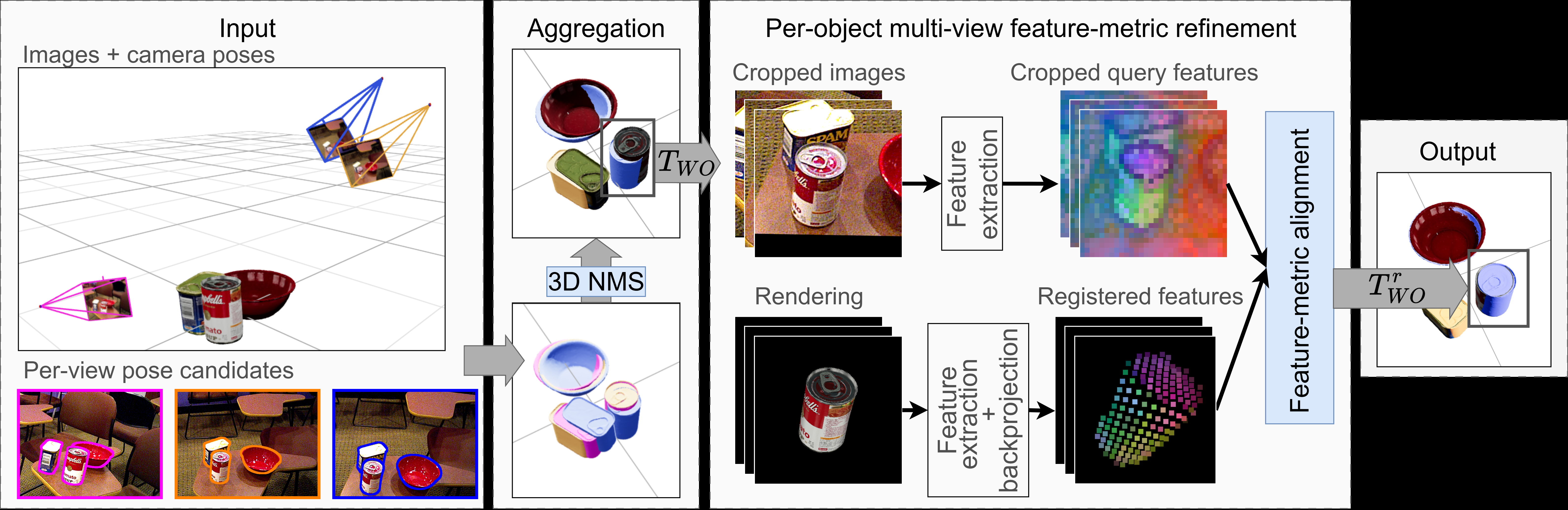
AlignPose converts candidate poses from multiple calibrated RGB images into a shared world frame, then jointly optimizes one SE(3) pose in frozen visual feature space. Discrepancies between rendered-object and observed features drive generalizable refinement.
AlignPose transforms pose candidates from multiple extrinsically calibrated RGB images into a common world frame, then jointly optimizes a single object pose in a frozen foundation-feature space to reduce occlusion and appearance ambiguity.
2.1 Guide to the paper’s figures and tables
Figure / table
Purpose
Overview reading tips
Figure 1
Multi-view candidate aggregation and feature-metric alignment
Understand why a common world-frame pose is needed
Figure 2
Two-view feature-metric refinement
See how on-the-fly rendering propagates gradients
Table 1
Main YCB-V and T-LESS results
Focus on multi-view gains over single-view estimation
Table 2 / 3
HouseCat6D and industrial datasets
Check textureless, metallic, and transparent scenes
Table 6
Feature ablations including DINOv3 and SIFT
Assess the role of foundation features
Relevant region of the original paper's method diagram: AlignPose aggregates multi-view pose candidates and performs feature-metric refinement in a common world frame. Source: project page / CVF Open Access. Copyright belongs to the paper's authors and publisher; reproduced here solely for paper discussion.
3. Problem setting
Inputs are a known object’s 3D mesh and multiple calibrated RGB images.
Objects may be unseen during training; no object-specific training or symmetry annotation is required.
The output is one consistent world-frame object pose, avoiding disagreement between estimates made independently for each view.
4. Method overview
Generate candidates for each view using a single-view pose estimator.
Transform candidates into common world coordinates and aggregate them by geometric consistency.
Freeze foundation features such as DINOv3 and render object features at the current pose.
Jointly minimize rendered-versus-observed feature discrepancies across all views.
5. Experimental overview
Six BOP datasets: YCB-V, T-LESS, HouseCat6D, ITODD-MV, IPD, and XYZ-IBD.
Reported multi-view AR values for Ours on YCB-V / T-LESS include 83.9 / 83.2; improvement over the baseline exceeds 14% on industrial datasets.
Evaluation emphasizes textureless, metallic, reflective, and transparent objects, plus multi-view occlusion.
6. Quick assessment
Contribution: Extends feature-metric refinement from a single view to multi-view pose estimation with a shared world frame.
Strengths: No target-specific network training is required, and complementary views alleviate occlusion and ambiguity.
Limitations: Requires a mesh, camera calibration, and multi-view acquisition; initial candidate quality still affects refinement.
Recommended audience: Readers interested in BOP, multi-view RGB pose, foundation features, and industrial vision.
Available src/paper-notes/alignpose-2026/deep.md
In-depth paper notes
Support reproduction, comparison, related-work writing, and identifying opportunities for further research.
Deep Reading Notes: AlignPose: Generalizable 6D Pose Estimation via Multi-view Feature-metric Alignment
Key assessment: AlignPose optimizes just one world-frame pose, while receiving losses from multiple cameras. It turns multi-view estimation from voting over several outputs into a shared geometric explanation.
2. Positioning in one sentence
Given calibrated RGB observations, AlignPose first aggregates per-view pose candidates, then jointly refines them by comparing frozen foundation features with on-the-fly renders of the current mesh.
2.1 Guide to the paper’s figures and tables
Figure / table
Deep-dive questions
Figure 1
How do world-frame conversion and NMS of pose candidates affect subsequent optimization?
Figure 2
How do feature discrepancies across views share one SE(3) parameter?
Table 1
Does multi-view estimation consistently outperform CosyPose MV on YCB-V and T-LESS?
Table 2
Do the metallic / glass subsets of HouseCat6D benefit?
Table 3
Are industrial gains on ITODD-MV, IPD, and XYZ-IBD due to multiple views or the feature model?
Table 6
Does the gap between DINOv3 and dense SIFT indicate that semantic features are key?
Relevant region of the original paper's method diagram: Multi-view candidates are transformed into a common world frame, then feature-metric alignment yields a consistent object pose. Source: project page / CVF Open Access. Copyright belongs to the paper's authors and publisher; reproduced here solely for paper discussion.
3. Problem setting and task boundaries
Inputs are a known object mesh, camera intrinsics/extrinsics, and multiple RGB images. The object pose is represented as TWO∈SE(3).
The test object need not have appeared during training, and no symmetry annotations are required. Symmetry is handled through multiple hypotheses / BOP evaluation.
An upstream frontend supplies object detections / masks. Industrial datasets use external detectors and components such as SAM2.
This is a model-based but generalizable approach: it avoids target-specific fine-tuning but needs a mesh at inference.
4. Research context
Single-view render-and-compare is vulnerable to occlusion, appearance ambiguity, and low texture.
Multi-view methods typically fuse pose candidates or perform multi-view reconstruction. Candidate fusion may produce inconsistencies; reconstruction requires a heavier geometry pipeline.
Feature-metric refinement moves image alignment from pixel intensities to feature space, suiting lighting changes and textureless objects. AlignPose extends this idea to joint multi-view optimization.
5. Research motivation
Industrial settings often already have several fixed cameras, making multiple views an available resource rather than an added burden.
Independent estimates produce different candidates under occlusion and symmetry; these must be constrained to one world pose.
Pixel-level photometric error is unreliable under reflections, transparency, and lighting changes. Foundation features better capture structural and semantic similarity.
Rendering features directly from a mesh and differentiating with respect to pose avoids manually matched points and retraining a refinement head.
6. Method details
6.1 Candidate aggregation
An existing single-view estimator first generates candidates for each view.
Camera-frame poses are transformed into the world frame and aggregated using positional, rotational, and projection consistency.
Multi-view NMS / hypothesis filtering retains candidates that may describe the same object state.
6.2 Feature-metric refinement
A frozen image foundation model generates a feature map for each observation.
Differentiably render the object mesh under the current TWO to obtain a rendered feature map.
Align rendered and observed image features through projection, then compute their discrepancy.
All views share one TWO, and the total loss aggregates their discrepancies.
6.3 Why symmetry annotations are unnecessary
Training and refinement use visual features and geometric projection without requiring preannotated symmetry axes for each object.
Optimization may still have multiple local optima, so candidate count and initialization quality remain important.
7. Experimental analysis
7.1 Datasets and metrics
BOP-Classic: YCB-V and T-LESS. HouseCat6D also reports metallic / glass subsets. Industrial evaluation covers ITODD-MV, IPD, and XYZ-IBD.
YCB-V / T-LESS multi-view inputs are sampled as 4-view groups within each scene; industrial datasets use predefined views.
BOP-Classic reports AR, while industrial datasets mainly report AP because BOP-Industrial does not provide the same AR evaluation.
7.2 Main results
Table 1: Ours reaches AR of 83.9 / 83.2 on YCB-V, depending on the single-view candidate source, and 84.1 / 88.6 on T-LESS, consistently exceeding the corresponding multi-view baseline.
On HouseCat6D, feature-metric refinement also improves metallic and glass objects, indicating that it does not rely solely on texture.
On industrial datasets, the paper reports over 14% improvement relative to public RGB baselines, supporting the value of world-frame multi-view refinement for occluded and reflective objects.
Frozen foundation features outperform dense SIFT. Table 6 indicates the importance of feature semantics and cross-domain generalization.
Single-view refinement underperforms multi-view refinement because the latter constrains one pose jointly using several views.
8. Critical analysis
Strength: Uses the multiple cameras already present in real industrial settings, with a clear and interpretable optimization objective.
Initialization dependence: If all single-view candidates fall on an incorrect symmetry branch, feature refinement may also fail to recover.
Engineering dependencies: Requires a mesh, camera calibration, detections / masks, and differentiable rendering. Camera-extrinsic drift can masquerade as pose error.
Computational cost: Each candidate and view requires rendering and feature alignment. Real-time performance depends on view count and optimization iterations.
9. Implications for my research
Multi-view pose estimation can replace output fusion with joint optimization of a shared world pose, naturally enforcing cross-view consistency.
Combining visual foundation features with geometric rendering can provide a general-purpose refiner without target-specific training.
Visibility-aware weighting could reduce the influence of heavily occluded or reflective views on the overall pose.
10. Open questions
How can camera and object poses be jointly optimized when camera extrinsics are unknown or cameras are moving?
How can uncertainty-aware candidate aggregation prevent incorrect hypotheses from dominating refinement?
How can multi-view feature-metric alignment be extended to deformable / articulated objects?
11. Further analysis: Multi-view candidates are only the starting point
11.1 Joint optimization objective
AlignPose takes calibrated RGB images, per-image camera poses, an object mesh, and per-view pose candidates. Candidates are first transformed into a common world frame through TWO. Feature-metric refinement then uses a shared object-to-world pose: DINO / foundation features rendered from the mesh are compared with frozen features from real crops to optimize the SE(3) pose, rather than optimizing each view independently.
The key distinction is that single-view candidate aggregation only votes among hypotheses. The real multi-view gain comes from requiring every view to explain the same TWO. Visibility / feature weighting can reduce the influence of invisible, reflective, or incorrectly segmented regions, but the current method still requires good candidates, masks, meshes, and camera calibration.
11.2 Main results
Two cross-dataset examples from Table 1: On YCB-V / T-LESS, CosyPose MV achieves AR / AP of 79.2 / 76.1 and 66.4 / 63.0; adding AlignPose yields 83.9 / 83.2 and 84.1 / 88.6. Other datasets likewise show consistent gains from refinement following candidate aggregation.
In BOP-Industrial, FoundPose achieves AP of 31.4 / 32.5 / 41.2, increasing to 79.8 / 66.5 / 76.8 with AlignPose for IPD, XYZ-IBD, and ITODD-MV, respectively. The authors therefore report an overall industrial improvement exceeding 14%. Here AP is BOP’s pose-aware detection metric, not ordinary classification AP.
11.3 Foundation-feature ablation
Table 6 shows modest but consistent differences across DINOv3 backbones / layers. On two example datasets, DINOv3-L layer 18 reaches AR / AP of 84.5 / 84.1 and 89.0 / 92.0; layer 23 reaches 84.1 / 83.9 and 89.6 / 91.6. Both improve clearly over DINOv2-S layer 9 at 80.8 / 80.7 and 87.6 / 90.7. The dense SIFT comparison also suggests that frozen semantic features generalize across domains better than local texture as a refinement objective.
Supported by YCB-V / T-LESS and industrial AP, but gains depend on meshes, calibration, and initial candidates.
Foundation features outperform traditional dense SIFT
Supported by the layer ablation; feature confidence for backgrounds, metallic objects, and transparent objects still needs reporting.
Refinement is more effective than simple pose averaging
Sharing TWO across views is a plausible explanation, but per-iteration optimization residuals and recovery rates from poor initializations should be reported.
12. Reproduction and engineering boundaries
Mesh scale, camera extrinsics, crop coordinates, renderer, feature layer, optimization steps, and visibility masks must be fixed. Extrinsic drift can be interpreted as object pose by the optimizer, producing apparent convergence in the wrong coordinate frame. A real-time system could first aggregate a small number of candidates and apply multi-view feature refinement only to highly uncertain objects. Dynamic / articulated objects require per-part or time-varying poses.