Betsu-Betsu: Multi-View Separable 3D Reconstruction of Two Interacting Objects
Betsu-Betsu represents interaction scenes with a shared multiresolution hash grid, decoding separate object SDFs and radiance fields. Alpha-blending regularization suppresses geometric interpenetration at mutual-occlusion boundaries.
Betsu-Betsu reconstructs separate geometry and appearance for two closely interacting objects from calibrated, instance-segmented multi-view RGB images. Its key components are a shared hash-grid encoding, two SDF heads, and alpha-blending regularization that discourages both SDFs from having high opacity simultaneously.
3. Task boundaries
Inputs: Calibrated multi-view RGB images and segmentation masks for each object.
Outputs: Two separate SDFs / meshes, renderings of each object’s visible parts, and joint scene appearance.
Supports human–object, hand–object, object–object, and human–human contact. It does not directly output object-to-camera 6D pose.
Its relevance to this topic is a geometric representation that discourages object interpenetration under heavily occluded interactions.
4. Method overview
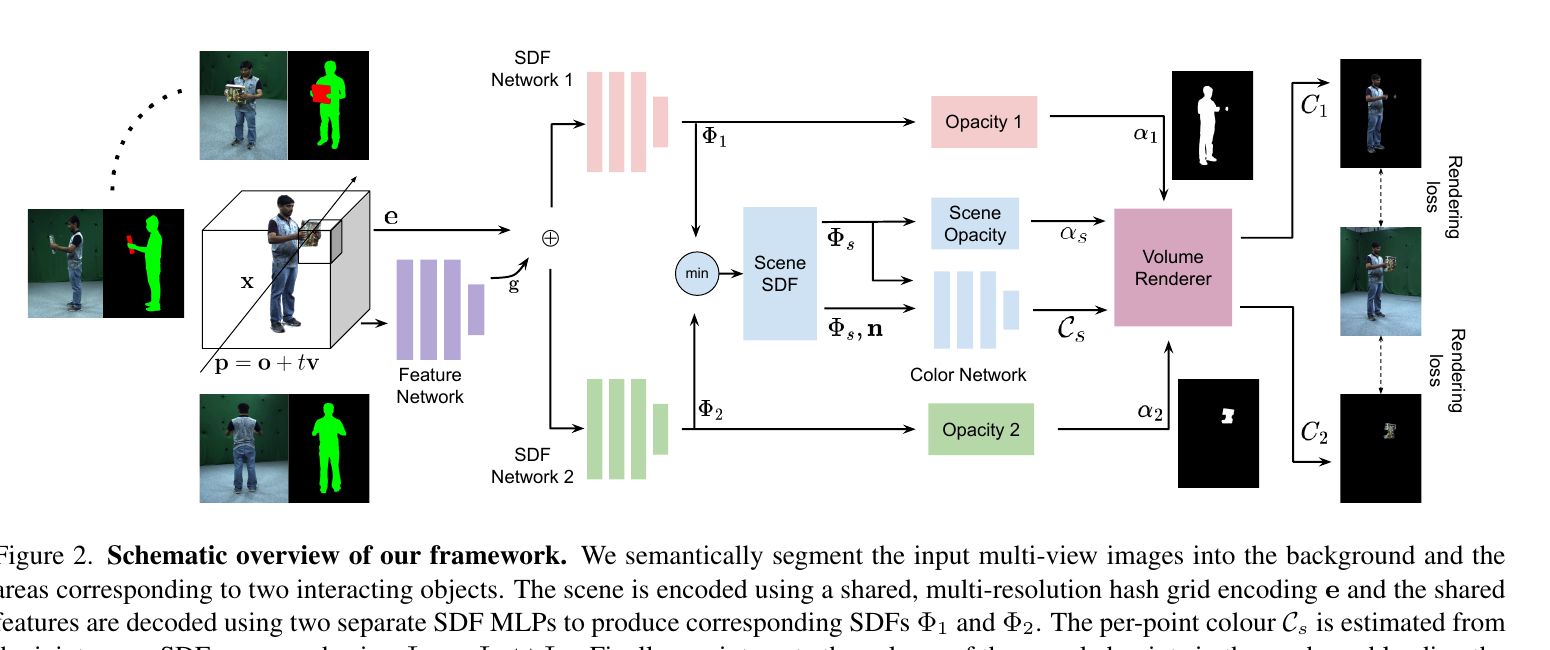
Encode scene positions with a shared multiresolution hash grid.
Decode objects 1 and 2 with two separate SDF MLPs; combine them by a pointwise minimum to form the joint scene SDF.
Supervise visible-surface rendering using each instance’s RGB / mask.
Use an alpha-blending constraint to reduce α1α2, encouraging each location to belong to only one opaque object and reducing spurious overlap in contact zones.
5. Experiments at a glance
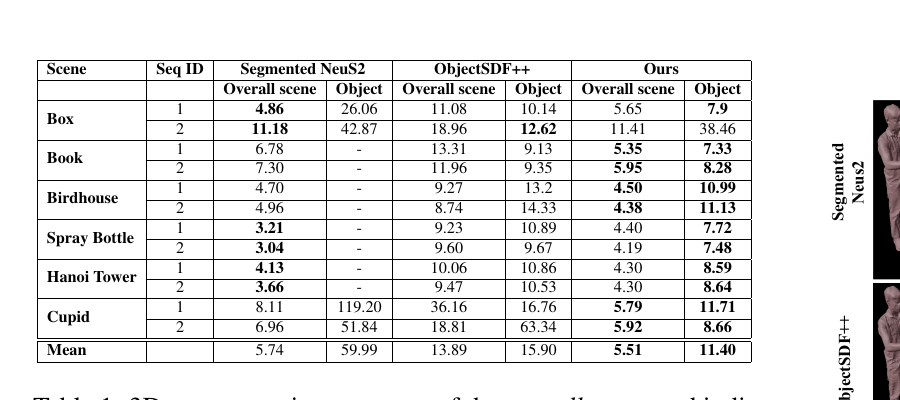
On newly captured human–object data, the reported mean object Chamfer is 11.40, versus ObjectSDF++ at 15.90; overall scene Chamfer is 5.51.
On AffordPose hand–object data, mean hand / object Chamfer is 5.87 / 3.80, outperforming the compared methods.
On held-out human–object views, mean PSNR / SSIM / LPIPS is 32.42 / 0.97 / 0.06, versus ObjectSDF++ at 28.02 / 0.95 / 0.08.
6. Strengths, limitations, and reading assessment
Strengths
Requires no object templates, SMPL, or markers; applies to static multi-view capture of arbitrary object pairs.
Provides direct, interpretable regularization against geometric interpenetration at contact boundaries, beyond separating colors.
Reports geometry, novel-view synthesis, and results across interaction types.
Risks / boundaries
Requires dense multi-view capture, camera calibration, and instance masks, placing it in an offline reconstruction setting.
The opaque-object assumption excludes glass and translucent materials; the number of objects is fixed at two.
Occluded surfaces remain unobserved, so separation depends on neural implicit priors and regularization weights.
7. Research takeaways
For downstream pose estimation of contacting objects, resolving surface ownership is more fundamental than directly optimizing rigid transforms. Separable SDFs or explicit ownership regularization can provide more reliable visibility and contact constraints for pose refinement.
Available src/paper-notes/betsu-betsu-3dv2025/deep.md
In-depth paper notes
Support reproduction, comparison, related-work writing, and identifying opportunities for further research.
Deep Reading Notes: Betsu-Betsu: Multi-View Separable 3D Reconstruction of Two Interacting Objects
1. Basic information
Method: Betsu-Betsu
Authors / affiliations: Suhas Gopal, Rishabh Dabral, Vladislav Golyanik, Christian Theobalt; Saarland University, Max Planck Institute for Informatics
Betsu-Betsu performs separable neural implicit reconstruction of two objects from static multi-view captures. Shared scene features explain occlusion, while two SDF heads and an alpha-blending regularizer discourage a 3D point from belonging to both opaque objects, suppressing geometric interpenetration in contact zones.
2.1 Guide to the paper’s figures and tables
Figure / table
Content
Reading focus
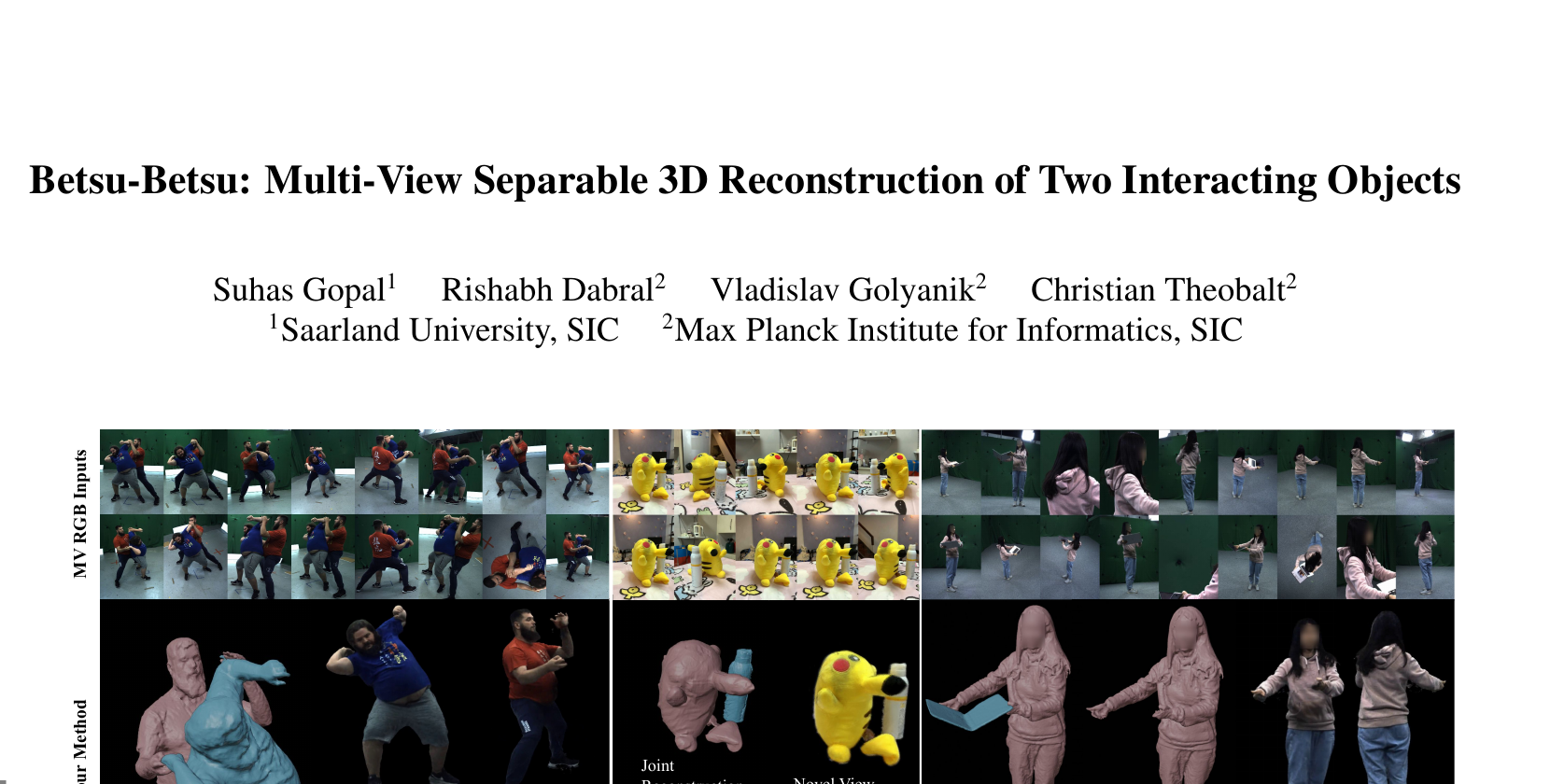
Figure 1
Multi-view inputs and separable outputs
The objective is independent geometry and renderings for each object, beyond a joint mesh
Figure 2
Shared hash grid, two SDFs, and alpha blending
Separation is constrained at the opacity / volume-rendering level, beyond 2D semantic labels
Table 1
Overall / object Chamfer on human–object data
Examine the whole scene and the small object separately; human geometry can dominate overall scores
Tables 2, 5
AffordPose and novel-view synthesis
Check whether separation improves geometry and appearance together
Original paper, Figure 1: Separate geometry and novel-view renderings of two interacting objects reconstructed from segmented multi-view RGB inputs. Source: arXiv PDF. Copyright belongs to the paper's authors and publisher; reproduced here solely for paper discussion.Original paper, Figure 2: Shared hash-grid features, two SDF branches, a joint scene SDF, and alpha-blending separation. Source: arXiv PDF. Copyright belongs to the paper's authors and publisher; reproduced here solely for paper discussion.Original paper, Table 1: Overall-scene and individual-object Chamfer Distance on human–object capture data (lower is better). Source: arXiv PDF. Copyright belongs to the paper's authors and publisher; reproduced here solely for paper discussion.
3. Problem setting and boundaries
Inputs are Kcalibrated multi-view RGB images and segmentation masks M1,M2 for the two interacting objects.
Outputs are separate SDFs / meshes for objects 1 and 2, joint scene appearance, and individual novel-view renderings.
Pose is not a predicted variable; camera poses are given. The method addresses a geometric prerequisite for pose / interaction refinement: maintaining nonoverlapping surface ownership when objects touch and occlude one another.
Both objects are assumed opaque and the scene static throughout multi-view capture. Each scene requires lengthy optimization.
4. Research motivation
Training a separate NeRF / SDF for each object creates conflicts in occluded regions: a single-object model may misinterpret invisibility caused by another object as geometry that should be carved away. Training one joint scene instead loses object ownership. ObjectSDF++ also predicts multiple SDFs, but the authors argue that opacity supervision alone may still produce interpenetrating phantom geometry inside objects.
The key insight is that, for two opaque objects, both opacities should not be high at the same sampled point. This constraint can penalize overlap through α1α2 without knowing which object should own that point.
5. Method details
5.1 Shared encoding, separate shape heads
Given a spatial point x, a multiresolution hash-grid encoding h(x) and a feature network generate shared scene features g. Two separate MLPs output Φ1(x),Φ2(x). The joint scene SDF is combined as:
Φs(x)=min(Φ1(x),Φ2(x))
A color network then predicts scene color from position, viewing direction, normals, and Φs. Shared encoding gives both objects access to the same scene context, while separate SDF heads preserve instance boundaries.
5.2 Why alpha blending reduces interpenetration
A NeuS-style mapping converts each SDF to α1,α2. Their joint opacity is combined as:
αs=α1+α2−α1α2
The defined Lalpha penalizes simultaneous opacity in both objects, encouraging each point to be opaque for only one object. The total loss includes individual-object color, scene color, Lalpha, and Eikonal regularization.
A critical detail is that this is not a hard SDF nonoverlap constraint. It softly constrains opacity at rendering sample locations. Separation in unobserved interiors is therefore induced by regularization, rather than directly supervised by true geometry.
Module
Input / output
Purpose
Difference from single-object reconstruction
Shared hash grid + feature network
Position → shared features
Encode common scene information
Keep occlusion relationships within shared context
Two SDF heads
Shared features → Φ1,Φ2
Give each object independent geometry
Produce surfaces with instance ownership
Scene SDF / color
Two SDFs → joint rendering
Explain occlusion and overall RGB
Keep color at scene level rather than blindly duplicating it
Alpha regularizer
α1,α2
Reduce interpenetration in contact zones
Constrain ownership inside objects
6. Experimental analysis
6.1 Datasets and metrics
The paper captures close human–object interactions in a capture dome and also evaluates on AffordPose (hand–object), WildRGB-D (object–object), NeuralDome (human–object), and ReMoCap (human–human). Geometry is evaluated with bidirectional Chamfer Distance (lower is better); appearance uses PSNR, SSIM, and LPIPS on held-out views. 3D IoU additionally measures overlap between the two objects.
Read overall-scene human–object scores carefully. Humans are usually much larger than the interacting object, so human reconstruction quality can dominate overall Chamfer. Table 1 therefore also reports individual-object CD, which is more informative about whether separation actually works.
6.2 Key results
Task / result
Segmented NeuS2
ObjectSDF++
Betsu-Betsu
Interpretation
Human–object overall CD mean
5.74
13.89
5.51
Joint-scene quality matches or slightly exceeds separately trained NeuS2
Human–object object CD mean
59.99
15.90
11.40
Separating individual-object geometry provides the main gain
AffordPose hand CD mean
7.00
6.18
5.87
Hand reconstruction also improves
AffordPose object CD mean
9.26
6.79
3.80
Small objects benefit more strongly
Novel view mean
—
28.02 / 0.95 / 0.08
32.42 / 0.97 / 0.06
PSNR / SSIM / LPIPS all improve
The ablations in Figures 7–9 further show that removing alpha regularization or sharing the SDF head can leave apparently normal renderings while phantom blobs / interpenetration appear inside surfaces when viewed transparently. This is the paper’s most convincing point: rendered RGB alone struggles to penalize invisible interior errors, motivating an ownership-oriented prior.
6.3 Boundaries of the evidence
“Better separated geometry than ObjectSDF++”: Supported by object-level Chamfer, novel-view synthesis, and qualitative comparisons.
“Template-free and applicable to arbitrary objects”: Demonstrated across interaction types, but still limited to two objects, offline multi-view capture, mask supervision, and static scenes.
My analysis: Reducing interpenetration could improve downstream visibility / contact reasoning, but a differentiable rigid transform or explicit pose head is still needed. Betsu-Betsu itself does not produce online 6D pose.
7. Limitations and potential failures
Demanding capture conditions: Camera intrinsics/extrinsics, multiple views, and per-object masks are required inputs. Continuous pose estimation in online video is not addressed.
Fixed object count: Two SDF heads and two-object alpha composition directly constrain the main method. More objects introduce combinatorial complexity, identity swaps, and growing resource requirements.
Material assumptions: Transparent, translucent, and specular objects violate the assumption of one opaque object per point.
Occluded interior surfaces: Alpha regularization reduces overlap but cannot observe persistently occluded geometry. Results still depend on neural-field priors.
8. Implications for object pose and interaction geometry
Pose refinement can adopt per-point ownership: allocate rendering residuals by object visibility / occupancy to prevent two models from jointly explaining the same pixel.
For contact manipulation, a physical nonoverlap prior on the joint objects can be combined with 6D rigid pose, contact distances, and symmetry-aware losses.
Further evaluation should measure whether separable reconstruction improves pose/contact errors, beyond Chamfer and novel-view synthesis.