Reading Notes
Overview / Deep Dive
Available src/paper-notes/boxdreamer/coarse.md
Paper overview notes
Quickly assess the paper's scope, problem setting, core method, experimental findings, and whether to read it in depth.
Paper Overview: BoxDreamer: Dreaming Box Corners for Generalizable Object Pose Estimation
1. Basic information
- Title: BoxDreamer: Dreaming Box Corners for Generalizable Object Pose Estimation
- Authors / affiliations: Yuanhong Yu, Xingyi He, Chen Zhao, Junhao Yu, Jiaqi Yang, Ruizhen Hu, Yujun Shen, Xing Zhu, Xiaowei Zhou, Sida Peng; Zhejiang University, Xiangjiang Laboratory, Ant Group, EPFL, Chongqing University, Northwestern Polytechnical University, Shenzhen University
- Year / venue: 2025 / ICCV
- Paper: arXiv:2504.07955
- Code / project: Project / Code
- Reading mode: Overview
2. Positioning in one sentence
BoxDreamer reformulates unseen-object 6D pose estimation as recovering a 3D bounding box from sparse reference RGB images, predicting the 2D projections of its 8 corners in the query image, and solving pose with PnP. This compact semantic geometry replaces dense point clouds / view retrieval to improve generalization with sparse views and occlusion.
Method inputs and outputs
| Item | Content (compiled for this site) |
|---|---|
| Inference inputs | One query RGB image, a few reference RGB images of the same target, target detections / masks, and camera intrinsics. Offline reconstruction first recovers reference poses and an object 3D bounding box, which is projected into reference corner heatmaps. |
| Final outputs | Target rotation and translation in the query camera frame. The network directly predicts 2D heatmaps for the 8 bounding-box corners; PnP solves the final pose. |
| Requirements | No target CAD model or sensor depth is needed, but reference-database construction and coarse geometry are required. Translation inherits the reconstructed box’s scale; RGB-only reconstruction does not automatically provide known metric dimensions. |
2.1 Guide to the paper’s figures and tables
| Figure / table | Purpose | Overview reading tips |
|---|---|---|
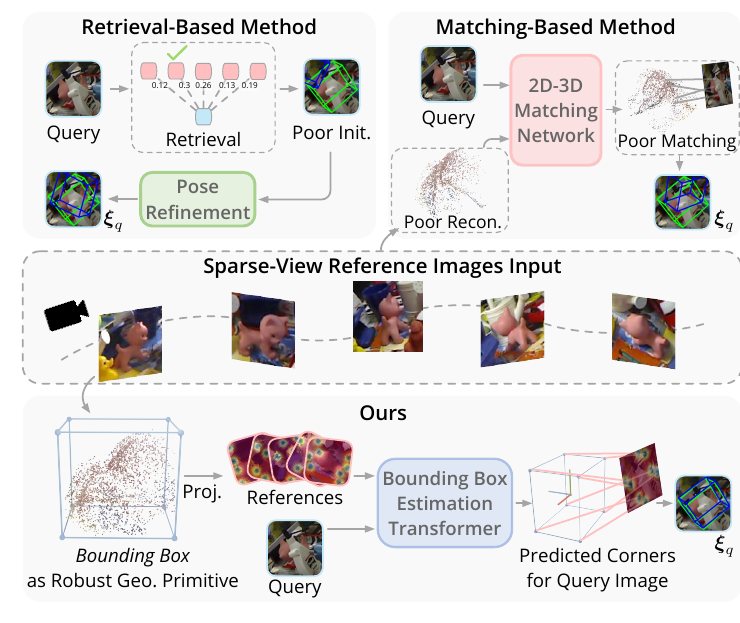
| Figure 1 | Retrieval-based, matching-based, and BoxDreamer paradigms for generalizable pose | Understand why the authors choose box corners |
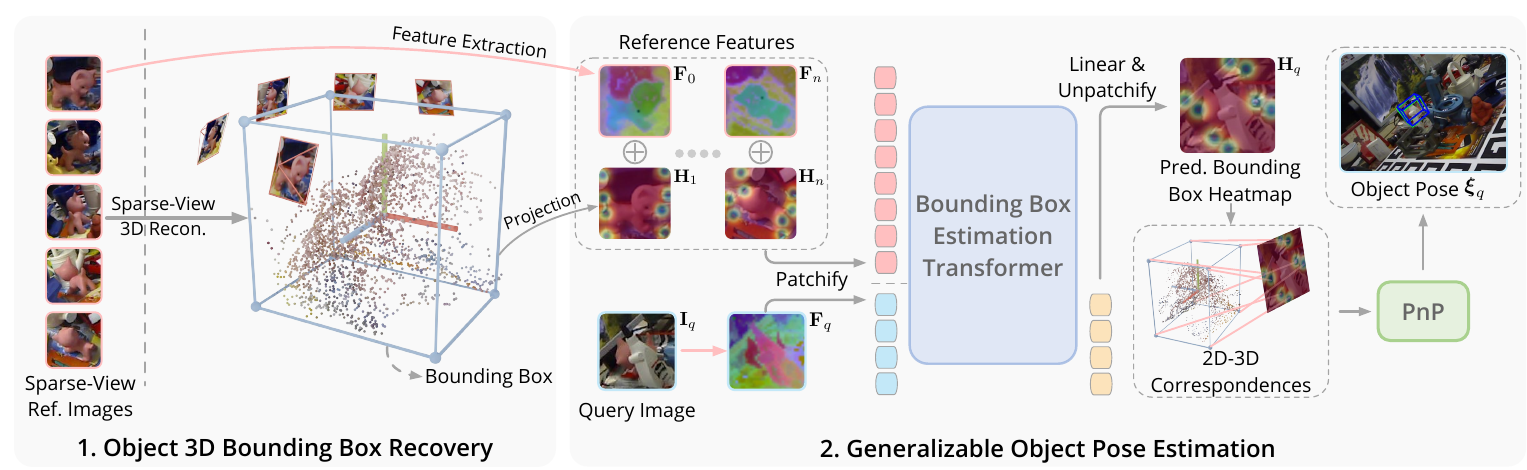
| Figure 2 | Complete pipeline: 3D box recovery, heatmap transformer, and PnP | Refer back to this figure throughout the method |
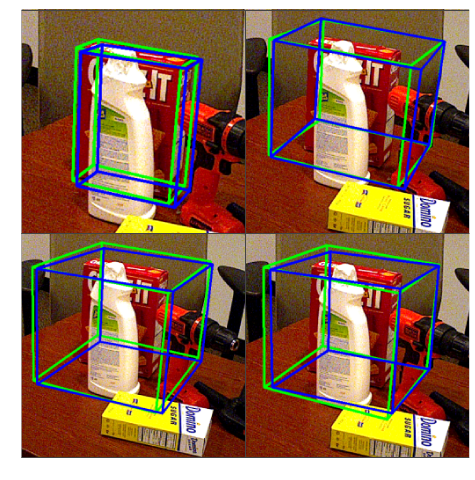
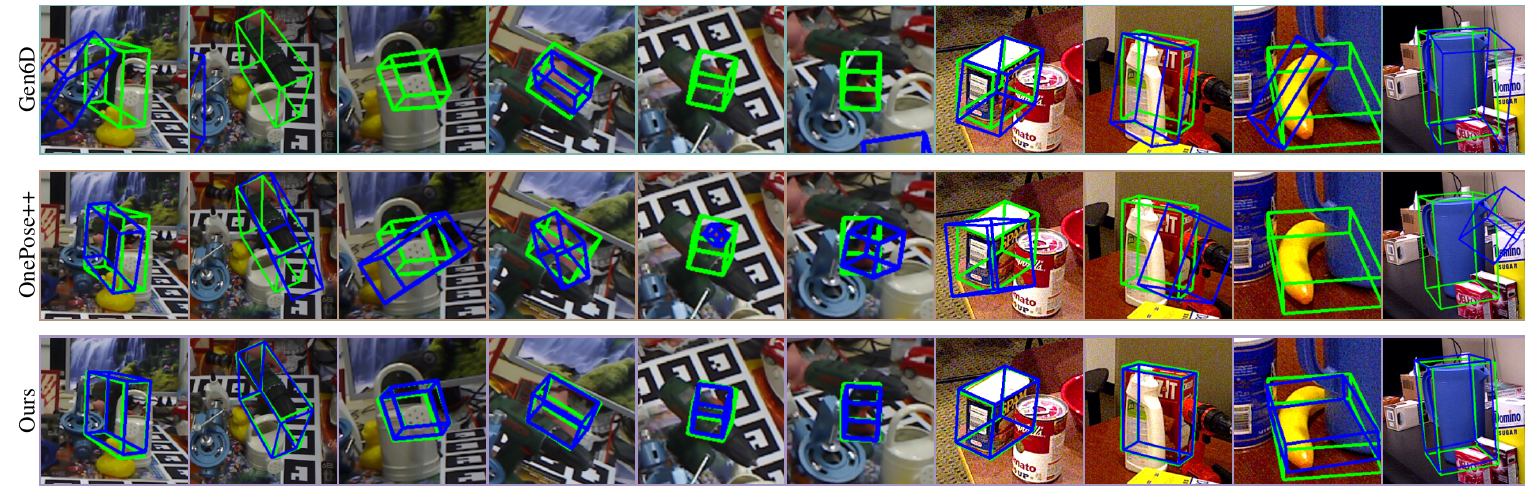
| Figure 3 | Qualitative comparisons on Occluded-LINEMOD and YCB-Video | Read alongside the main results to assess robustness under occlusion |
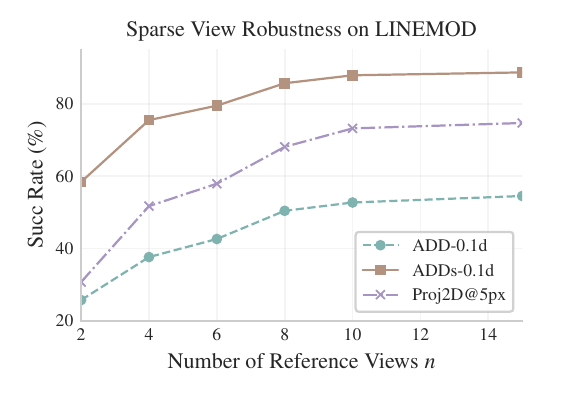
| Figure 4 / Figure 5 | Effects of reference count and noisy boxes | Assess the evidence for sparse-view performance and robustness |
3. Problem setting
- Task: Generalizable RGB-based object pose estimation, using a few reference images of an unseen target to estimate its 6D pose in a query image.
- Inputs:
- query RGB image;
- Sparse-view reference RGB images of the same target object.
- Detections or masks locating the object in reference/query images.
- camera intrinsics;
- A rough point cloud, reference camera poses, and a 3D bounding box obtained through offline sparse-view reconstruction.
- Output: Target 6DoF pose in the query view.
- Key assumptions / priors:
- Requires neither a CAD model nor depth.
- Requires target reference images and detections/segmentation to identify object regions.
- A usable 3D bounding box must be recoverable offline from sparse reference views; the experiments mainly use DUSt3R.
- Final pose recovery relies on 2D–3D corner correspondences + PnP.
- Applications: Unseen-object pose for robot grasping, AR, and rapid real-object onboarding, where no CAD is available but a few reference images can be captured.
4. Core motivation
- Problems addressed:
- Retrieval-based methods such as Gen6D rely on dense reference views. Sparse views can retrieve an unsuitable viewpoint, causing initialization and subsequent refinement to fail.
- Matching-based methods such as OnePose / OnePose++ rely on reasonably complete reconstructed point clouds and robust 2D–3D matching. Sparse views, occlusion, and low texture yield incomplete point clouds and weaker matches.
- Why this matters:
- Capturing dense views for every object is time-consuming in practice, and CAD / depth may be unavailable.
- Occlusion is common in 6D pose estimation; local visible pixels and dense matching alone are often unreliable.
- Main limitations of prior approaches:
- Retrieval-based: Requires sufficiently similar reference images.
- Matching-based: Requires high-quality point clouds and matching in visible regions.
- Sparse-view NVS / Gaussian approaches: Representation construction may be slow or sensitive to generation quality.
5. Method overview
- Overall pipeline:
- Reconstruct sparse reference images offline to obtain a rough point cloud and reference camera poses.
- Filter nonobject points using detections / masks and transform the cloud into an object-centric coordinate system to obtain the object’s 3D bounding box.
- Project the 3D box corners into reference images and generate a 2D heatmap for each corner.
- Extract reference/query image features using DINOv2 and fuse reference heatmap tokens with image features.
- Predict an 8-channel bounding-box heatmap for the query view with a transformer decoder.
- Extract 2D corners from the heatmaps, pair them with 3D box corners, and use PnP to output the query pose.
- Key modules:
- 3D bounding box as object representation: Replaces a dense point cloud with a coarse 3D box.
- 2D heatmap as box representation: Smooth heatmaps provide denser supervision for the transformer than directly regressing sparse corner coordinates.
- Reference-based point synthesizer / bounding-box estimation transformer: Synthesizes query corner heatmaps from reference demonstrations.
- PnP pose recovery: Turns the 8 semantic corners into an interpretable geometric solution.
- Foundation models / techniques: DUSt3R, DINOv2-base, transformer decoder, Smooth L1 loss, and PnP.
- Training requirements: Not training-free. The network is trained on Objaverse synthetic data and OnePose real data. New objects require no retraining at inference, but do require offline reference reconstruction.
6. Experimental overview
- Datasets:
- Training: Objaverse synthetic objects + OnePose real objects, totaling 45k+ synthetic objects, 50 real objects, and 2.9M+ images.
- Testing: LINEMOD, Occluded LINEMOD, YCB-Video, and OnePose-LowTexture. OnePose results are mainly in the supplementary material.
- Evaluation metrics:
- LINEMOD / Occluded LINEMOD / OnePose-LowTexture: ADD(s)-0.1d, Proj2D@5px.
- YCB-Video: ADD-AUC, ADD-S AUC.
- Main baselines: Gen6D, OnePose++, GS-Pose, Cas6D, and instance-level methods such as PoseCNN / PVNet.
- Main results:
- LINEMOD subset: With 5 references, ADD(s)-0.1d is 53.1, well above GS-Pose at 25.6, Gen6D at 18.0, and OnePose++ at 1.1. With more references, BoxDreamer and GS-Pose reach comparable performance, while BoxDreamer is faster.
- Occluded LINEMOD: Mean ADD(s)-0.1d is 26.5 with 5 references and 43.6 with 25. OnePose++ nearly fails or scores poorly under the same settings, while Gen6D remains clearly below BoxDreamer even with ground-truth detections.
- YCB-Video Sparse Database: With 16 references, BoxDreamer achieves ADD-S / ADD of 66.6 / 40.0, above Gen6D+GT detection at 55.2 / 28.6. With 5 references, it still reaches 59.8 / 31.8.
- OnePose-LowTexture: With 10 references, mean ADD-0.1d is 86.6, above OnePose++ at 58.0 and Gen6D+GT detection at 21.2, and competitive with or above PVNet’s 62.7.
| Setting | Representative result | Initial interpretation |
|---|---|---|
| LINEMOD, 5 refs, ADD(s)-0.1d | BoxDreamer 53.1 vs GS-Pose 25.6 | Clear advantage with few reference views |
| Occluded LINEMOD, 25 refs, ADD(s)-0.1d | BoxDreamer 43.6 vs Gen6D+GT 25.5 | Box corners are more reliable than retrieval/matching under occlusion |
| YCB-Video Sparse, 16 refs, ADD-S / ADD | 66.6 / 40.0 | Clear improvement over Gen6D+GT detection |
| OnePose-LowTexture, 10 refs, ADD-0.1d | 86.6 | Strong generalization to low-texture objects |
| Runtime, 5 refs | Approximately 17 ms online inference; approximately 5.3 s offline reconstruction | Fast inference, with an offline cost for onboarding new objects |
- Are the authors’ conclusions broadly supported by the experiments?
- Authors’ claim: Bounding-box corners are an effective intermediate representation for sparse-view generalizable pose, improving robustness under occlusion and sparse references.
- My analysis: The main results, qualitative figures, reference-count curves, and noisy-box analysis broadly support this claim. However, the method still depends on detections/masks, camera intrinsics, and offline reconstruction. It does not provide open-world pose from an arbitrary single image alone.
7. Strengths and limitations
Strengths
- Clear representation choice: The 8 box corners connect sparse 3D priors to PnP, avoiding the fragility of dense point-cloud matching.
- Particularly suitable for sparse references, with strong results from 5 reference images.
- RGB-only, CAD-free, and depth-free, making real-object onboarding more attractive.
- Fast runtime: The paper reports approximately 17 ms online pose inference with 5 references.
- Code is public, with a CLI, Gradio demo, and model-setup instructions.
Limitations / risks
- Not prior-free: Still requires reference images, camera intrinsics, detections/masks, and offline reconstruction.
- Symmetric objects remain an acknowledged weakness because box corners do not naturally accommodate symmetry-equivalent poses.
- 2D detection and pose estimation are separate; corner prediction struggles to recover from incorrect detection.
- Dense reference inputs can improve potential accuracy but increase memory use.
- A 3D bounding box is coarse geometry and may provide insufficient constraints for nonbox-shaped, highly symmetric, slender, or deformable objects.
8. Research takeaways
- Useful ideas to adopt:
- Replace dense correspondence with global semantic geometric points to simplify matching under sparse views / occlusion.
- Encode the 3D prior as reference heatmap demonstrations and transfer it to the query view through a transformer.
- Randomly rotate 3D boxes during training to weaken fixed associations between corner channels and object semantics, supporting generalization.
- Suitability as a baseline:
- A valuable baseline for CAD-free, RGB-only, sparse-reference unseen-object pose estimation.
- Not a directly comparable baseline for the traditional BOP seen-object CAD setting.
- Is a deep reading worthwhile?
- Yes, particularly for 3D box recovery, heatmap representation, reference/query token fusion, reference count, and box-noise analysis.
- Questions for follow-up:
- Actual local runtime costs of the official code, especially DUSt3R, DINOv2, PnP, and demo-pipeline input formats.
- Whether symmetry-aware pose heads or multiple-solution hypotheses could support highly symmetric objects.
- Whether detections/masks from SAM2 or an open-vocabulary detector provide sufficient end-to-end stability for real deployment.