Breaking the 3D Dataset Bottleneck: Fast Scalable Generation of Aligned 3D Assets from Scratch for Category 6D Pose Estimation and Robotic Grasping
This work mass-produces canonically aligned object assets and complete annotations through a text-to-image-to-3D pipeline. It supports category-level 6D pose, shape completion, and robotic grasping while reducing the time and manual effort required for high-quality 3D data.
text promptsdepth-conditioned generationaligned meshsynthetic rendering
Reading Notes
Overview / Deep Dive
Available src/paper-notes/breaking-3d-dataset-bottleneck/coarse.md
Paper overview notes
Quickly assess the paper's scope, problem setting, core method, experimental findings, and whether to read it in depth.
Paper Overview: Breaking the 3D Dataset Bottleneck
1. Basic information
Title: Breaking the 3D Dataset Bottleneck: Fast Scalable Generation of Aligned 3D Assets from Scratch for Category 6D Pose Estimation and Robotic Grasping
Authors / affiliations: Duret Guillaume, Danylo Mazurak, Florence Zara, Jan Peters, Liming Chen; Centrale Lyon / LIRIS / TU Darmstadt
This work generates canonically aligned 3D meshes directly from category prompts using text-to-image-to-3D and depth-conditioned generation, then produces category-level 6D pose, shape-completion, and grasping data at scale through mixed-reality rendering.
2.1 Guide to the paper’s figures and tables
Figure / table
Purpose
Overview reading tips
Figure 1
Text prompts, image generation, depth conditioning, and alignment
Understand generation from scratch without existing 3D assets
Figure 2
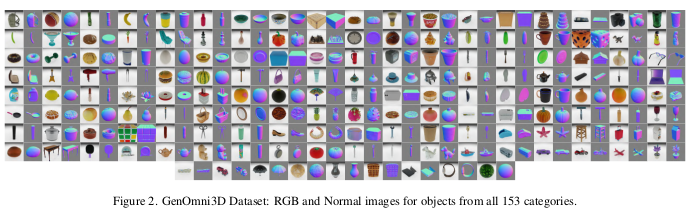
GenOmni3D assets across 153 categories and rendered examples
Examine scale and category coverage
Table 1
Scale, quality, and production time of 3D mesh datasets
Understand the dataset bottleneck
Tables 6 / 7
Grasping and shape-completion results
Check whether aligned meshes produce downstream gains
Figure 10
Real grasping and pose / shape visualizations
Examine sim-to-real transfer
Relevant region of the original paper's figures: Category geometry prompts and image generation lead to depth-conditioned texture variation and automatic canonical alignment. Source: project page / CVF Open Access. Copyright belongs to the paper's authors and publisher; reproduced here solely for paper discussion.
3. Dataset statistics
153 categories with over 1000 instances each, totaling 153,000 aligned meshes.
Approximately 1.2M fully annotated category-level 6D pose images.
Approximately 96% canonical pose consistency and less than 3 minutes of generation per object, 5–20 times faster than conventional scanning.
Approximately 87.8% robot grasp success and shape-completion IoU of 0.475, versus a 0.314 baseline.
4. Method overview
Use category prompt engineering to produce geometry-aware text.
Generate high-quality textured meshes through text-to-image-to-3D.
Constrain canonical orientation and alignment across instances through depth-conditioned generation.
Generate complete RGB-D / pose annotations through mixed-reality rendering.
Validate the data on NOCS, shape completion, and grasping.
5. Quick assessment
Contribution: Addresses a major engineering bottleneck for category-level pose: producing aligned 3D training assets at scale.
Strengths: Large scale, fast generation, broad downstream validation, and public code and data.
Limitations: Generated-asset quality depends on text / depth conditioning; sim-to-real transfer still requires validation.
Recommended audience: Researchers interested in category-level pose data, generative 3D, sim-to-real transfer, and robotics datasets.
Available src/paper-notes/breaking-3d-dataset-bottleneck/deep.md
In-depth paper notes
Support reproduction, comparison, related-work writing, and identifying opportunities for further research.
Deep Reading Notes: Breaking the 3D Dataset Bottleneck
Key assessment: This paper treats dataset creation itself as a 3D perception research problem. Rather than introducing a pose head, its generative pipeline jointly addresses asset collection, canonical alignment, pose annotation, and downstream validation.
2. Positioning in one sentence
Starting from category text, image generation, depth-conditioned 3D reconstruction, canonical alignment, and mixed-reality rendering produce a data ecosystem for category-level 6D pose / grasping / completion training at scale.
2.1 Guide to the paper’s figures and tables
Figure / table
Deep-dive questions
Figure 1
How does depth conditioning introduce alignment during generation?
Figure 2
Are shape and texture diversity sufficient across the 153 mesh categories?
Table 1
How are scale, quality, and time balanced against ShapeNet, GSO, and Objaverse?
Tables 3 / 4
How do asset-generation and texturing choices affect pose consistency?
Tables 6 / 7
Do aligned meshes improve shape completion and grasping beyond increasing dataset size?
Relevant region of the original paper's figures: Category geometry prompts, text-to-image generation, and depth-conditioned generation produce canonically aligned 3D assets. Source: project page / CVF Open Access. Copyright belongs to the paper's authors and publisher; reproduced here solely for paper discussion.
3. Problem setting and data objectives
Category-level 6D pose requires instances within a category to align in a shared canonical frame. A large mesh collection alone does not make it suitable for NOCS / pose learning.
The paper targets three bottlenecks: Slow asset collection, difficult mesh alignment, and difficult real-world pose annotation.
Starting from text categories, the aim is to produce meshes, normals / textures, canonical transforms, RGB-D renders, and 6D annotations usable for robot grasping.
4. Research context
Synthetic sources such as ShapeNet are large but limited in realism and category coverage. Scanned sources such as GSO and OmniObject3D offer high quality at high acquisition cost.
Objaverse is very large but has inconsistent mesh quality and sparse category coverage.
Generative 3D work often emphasizes individual-object quality without necessarily providing category-level canonical alignment and complete pose annotations.
This paper combines text-to-image-to-3D, depth-conditioned alignment, and mixed-reality rendering into a task-oriented data-production pipeline.
5. Method details
5.1 From category prompts to aligned meshes
Geometry prompts specify category, structure, parts, and viewpoint requirements.
Text-to-image generation produces reference images with diverse appearances, followed by image-based 3D mesh reconstruction / generation.
Canonical depth / normal conditioning constrains generated views to a consistent orientation, reaching approximately 96% pose consistency.
Each object is generated in less than 3 minutes, emphasizing production throughput.
5.2 Large-scale 6D pose data
Assets are rendered in mixed-reality scenes with randomized cameras, backgrounds, occlusions, and object arrangements.
Complete RGB, depth, mask, NOCS / pose, and related annotations are produced together.
Over 1000 instances per category across 153 categories yield approximately 153K aligned meshes; GenOmni6D provides approximately 1.2M images.
5.3 Downstream validation
Train a category-level pose estimator and test zero-shot sim-to-real transfer on NOCS REAL275.
Create grasping scenes in SAPIEN and compare grasping / shape completion using general-purpose models, category-specific models, and generated assets.
Execute on real objects and a real robot to validate physical usefulness of aligned meshes.
6. Experimental analysis
6.1 Generation quality and scale
Pose consistency of 96% exceeds the previous alignment rate of approximately 57%, highlighting the importance of depth conditioning for category-level pose data.
Less than 3 minutes per object versus conventional 15–60 minute scanning gives a 5–20 times speedup.
The release contains 153K meshes and 1.2M images, substantially increasing per-category instances and reducing the need for inter-class transfer.
6.2 Pose / completion / grasping
Competitive zero-shot sim-to-real results on NOCS support using generated assets for category-level pose learning.
Shape-completion IoU reaches 0.475 versus CenterGrasp’s 0.314, supporting practical benefits from aligned shapes and texture / geometry diversity.
Grasp success reaches approximately 87.8%. On 36 real objects, category-specific models exploit generated data better than one general-purpose model.
6.3 Results requiring care
Gains from generated data reflect alignment, instance count, scene augmentation, and category-specific training together. They cannot all be attributed to one module.
Interpret real NOCS and grasping results alongside mesh quality, real textures, and collision settings.
7. Critical analysis
Contribution: Evaluates production speed, alignment consistency, and downstream performance within one complete loop.
Risk: Topology errors, missing thin structures, nonphysical materials, and canonical biases in generated 3D assets can be replicated at scale.
Scale trap: 153K meshes do not automatically ensure long-tail category coverage. Prompt distributions and generator bias still require auditing.
Robotics boundary: The 87.8% grasp result depends on a particular gripper, scene, and object set. Cross-robot transfer and complex contacts require further evaluation.
8. Implications for my research
Canonical consistency matters more than simply increasing mesh count when training a 6D pose foundation model.
Pose consistency, mesh quality, and uncertainty can serve as data-selection signals for generated assets.
Rapid aligned-asset generation for new categories could support an active curriculum: Begin with distinctive geometry, then add appearance and occlusion variation.
9. Open questions
How can topology / scale / canonical errors in generated meshes be detected and repaired?
How can real scans, generated meshes, and robot tactile feedback be combined into a closed-loop assessment of data quality?
How can consistent 6D / articulation annotations be generated for nonrigid, articulated, and transparent objects?
11. Further analysis: Generation stages and downstream gains
11.1 GenOmni3D pipeline
The paper goes beyond invoking text-to-3D by making the canonical alignment required for category-level pose a generation objective: Category / geometry prompt → text-to-image appearance → 3D mesh → depth-conditioned alignment → texture variation → mixed-reality rendering. Depth conditioning constrains orientation and structure across instances; complete RGB-D, NOCS / pose, and robot-grasping data are then generated automatically.
11.2 Scale and quality figures
Metric
Reported value
Categories
153
Assets per category
>1,000
Aligned meshes
Approximately 153,000
Downstream pose images
Approximately 1.2M
Pose consistency
Approximately 96% (approximately 57% in prior work)
Generation time per object
<3 min
Compared with conventional scanning
Approximately 5–20× faster
grasp success
87.8%
shape completion IoU
0.475 vs CenterGrasp 0.314
These figures cover three distinct aspects: Asset scale, canonical quality, and downstream performance. Scale alone does not ensure alignment quality, and alignment alone does not ensure real grasping performance. Connecting all three is more valuable than simply releasing a mesh collection.
11.3 Interpreting downstream results
NOCS / category-level pose: Aligned meshes provide shared category coordinates and extensive appearance variation for sim-to-real validation. Check whether pose consistency is actually responsible for the performance gains.
Shape completion: Custom-CG-tex-val-tex reaches IoU of 0.475 versus CenterGrasp’s 0.314. Complete meshes and texture variation aid shape understanding, but this does not establish correctness of all thin structures.
Grasping: Real-world / SAPIEN evaluation on 36 unique objects reaches 87.8% success. Specify the gripper, collision model, object set, and action policy rather than presenting this as a universal robot success rate.
11.4 Authors’ claims and my analysis
Authors’ claims
My assessment
Fast generation of aligned 3D assets at scale from scratch
153 categories, 153K meshes, and <3 min/object support scale and speed.
Depth conditioning improves canonical consistency
Pose consistency of 96% versus 57% directly supports this; category, thin-structure, and symmetric-object breakdowns remain necessary.
Assets improve pose / completion / grasping
IoU of 0.475 and grasp success of 87.8% provide downstream evidence, with joint contributions from data quantity, material augmentation, and alignment quality.
12. Data quality and reproduction checklist
Check each asset’s watertightness, scale, up-axis, canonical frame, thin structures, material physics, and texture leakage. Retain pose consistency, rendered silhouettes, depth residuals, and downstream success during training. Filter meshes with systematic canonical bias before they enter pose training. Articulated / transparent objects still require new structural representations and physical validation beyond the current text-to-image-to-3D pipeline.