C3PO: Canonicalization of 3D Pose from Partial Views with Generalizable Correspondence Features
C3PO formulates partial-view category canonicalization as cross-video correspondence and registration. Features generalizable to unseen categories support pairwise registration and global optimization to align multiple partial shapes.
C3PO reformulates category-level pose from partial views as aligning several partial object observations in one canonical frame. Generalizable Correspondence Features establish correspondences, followed by pairwise registration and global optimization to obtain a common coordinate system.
3. Problem setting
Inputs: Partial point clouds reconstructed from short object videos using SfM, together with their 2D image features.
Outputs: Position and orientation of each partial reconstruction in a common canonical frame.
Setting: Objects are incompletely observed and may belong to categories unseen during training. This is not direct single-image 6DoF regression.
4. Method overview
Reconstruct partial point clouds from object-centric videos and associate each point with image-extracted features.
GCF learns more viewpoint-aware correspondences, reducing DINOv2 feature ambiguity on repeated parts.
Assess pairwise registration between partial scans, then obtain a common canonical space through global optimization.
5. Experimental overview
Partial-view benchmarks on synthetic ShapeNet and real CO3Dv2, with 30° canonicalization accuracy as the main metric.
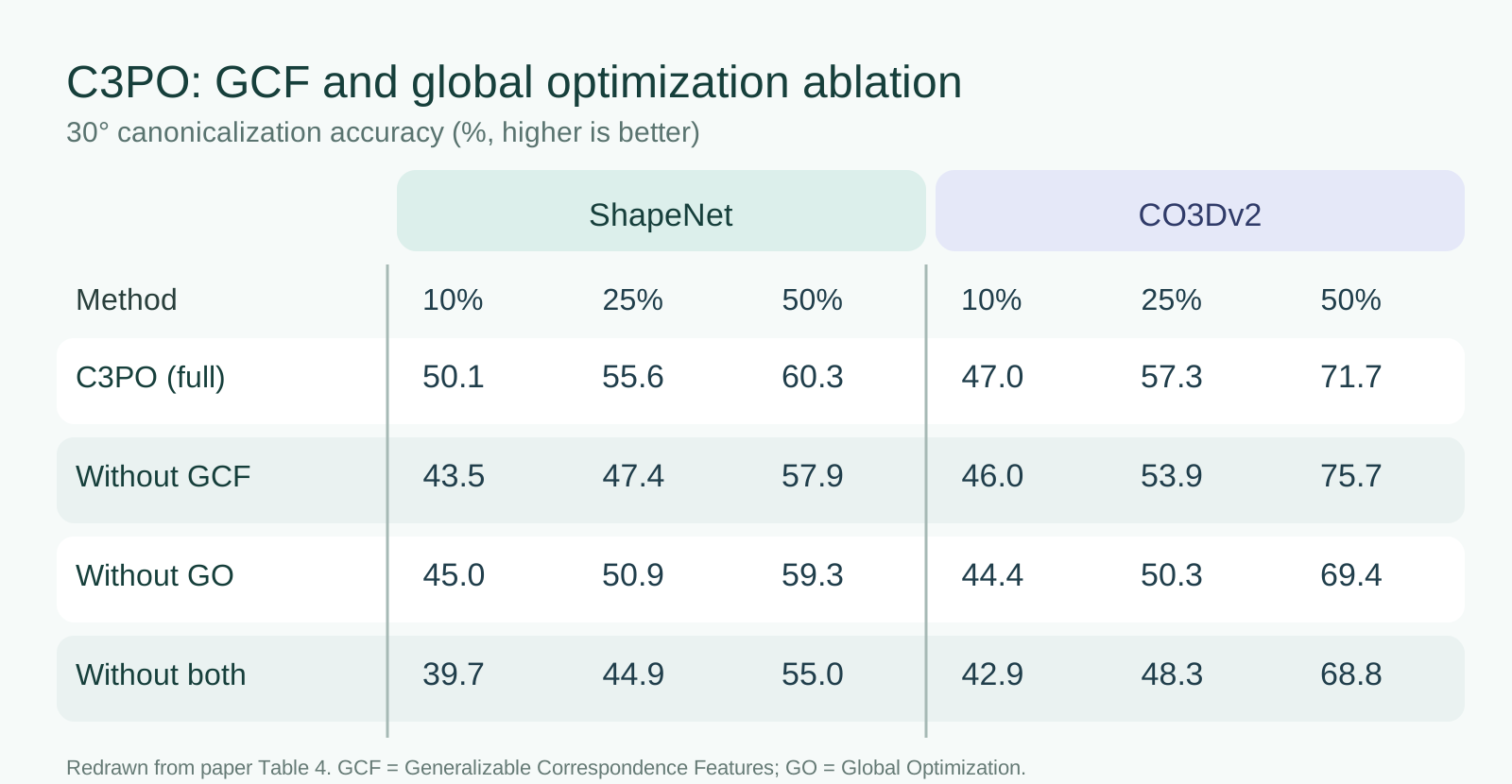
Table 4, as indexed from the official paper, reports full-method results of 50.1 / 55.6 / 60.3 on ShapeNet with 10 / 25 / 50% supervision, and 47.0 / 57.3 / 71.7 on CO3Dv2.
Removing GCF or global optimization reduces results, supporting the need for both local correspondence quality and global consistency.
6. Evidence scope and implications
At the time these notes were prepared, the public OpenReview PDF triggered automated verification. These notes use the official abstract, public author pages, and indexed paper tables, without inventing unverified training hyperparameters or additional results. The main insight is that category-level pose generalization requires correspondence and reference-frame selection together, beyond local rotation error alone.
Available src/paper-notes/c3po-3dv2026/deep.md
In-depth paper notes
Support reproduction, comparison, related-work writing, and identifying opportunities for further research.
Deep Reading Notes: C3PO: Canonicalization of 3D Pose from Partial Views with Generalizable Correspondence Features
1. Basic information
Authors / affiliations: Yu Chi, Leonhard Sommer, Olaf Dünkel, Dominik Muhle, Daniel Cremers, Christian Theobalt, Adam Kortylewski; TUM, University of Freiburg, MPI-INF, CISPA.
Reading mode: Deep reading (see evidence scope below).
2. Positioning in one sentence
C3PO automatically organizes multiple partial object reconstructions into one canonical coordinate frame, rather than estimating an image’s pose relative to a CAD model. Its key components are correspondence features that generalize to unseen categories and global registration across scans.
2.1 Guide to the paper’s figures and tables
Figure / table
Content
Reading focus
Figure 1
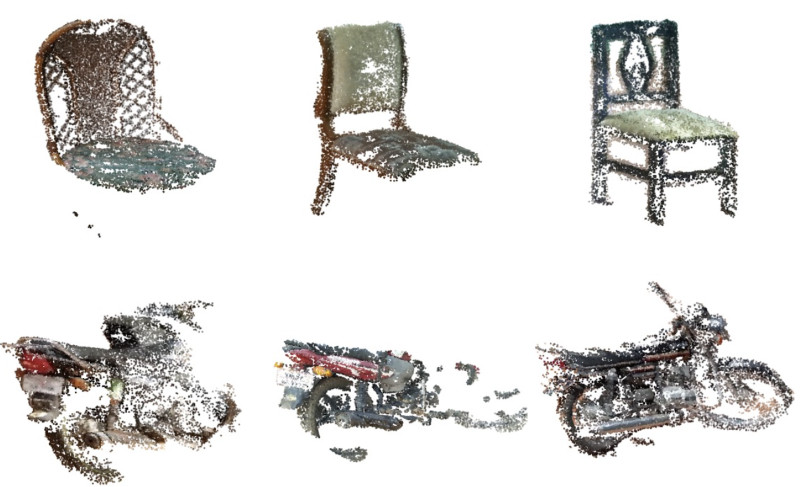
Partial 3D reconstructions before and after canonicalization
Establish that the output is a common cross-instance frame, rather than local registration of one rigid object
Table 3
Different supervision ratios on ShapeNet
Examine canonicalization accuracy as partial coverage / supervision decreases
Table 4
GCF and global-optimization ablations
Correspondence quality and global consistency are complementary
C3PO thumbnail from the authors' public publication page: Partial object reconstructions brought into a consistent canonical space. Source: authors' public laboratory page. Copyright belongs to the paper's authors and publisher; reproduced here solely for paper discussion.
3. Evidence scope
When these notes were generated, the public OpenReview PDF triggered automated site verification, preventing reliable full-text download. The following is strictly based on the official OpenReview abstract, public author pages, publication metadata, and indexed figure/table excerpts. Training architecture, loss coefficients, runtime, and other details that could not be checked against the full paper are omitted. This preserves the distinction between available evidence and a complete deep reading.
4. Problem setting and method
Inputs: Partial point clouds obtained by SfM from short object-centric videos, with each 3D point associated with a feature extracted from 2D images.
Outputs: Alignment / orientation of partial scans relative to a shared canonical frame; target objects may belong to unseen categories.
Challenges: Objects are often only partly captured; repeated parts and similar appearances cause feature mismatches; fixing one noisy partial scan as the reference accumulates bias.
Stage
Mechanism
Purpose
Partial reconstruction
Recover partial shapes using multi-view geometry
Use actual incomplete observations instead of assuming complete CAD models
GCF
Learn viewpoint-aware, generalizable correspondence features
Reduce false correspondences of foundation features on repeated parts
Pairwise registration
Estimate relative poses and their quality for overlapping partial scans
Create edges for global optimization
Global optimization
Jointly combine pairwise relations
Form a globally consistent canonical frame without fixing one reference
5. Experimental analysis
Datasets: Synthetic ShapeNet and real CO3Dv2; the main metric is 30∘ canonicalization accuracy.
Indexed Table 4 reports full-model results of 50.1 / 55.6 / 60.3 on ShapeNet at 10% / 25% / 50% supervision and 47.0 / 57.3 / 71.7 on CO3Dv2.
Without GCF, ShapeNet results are 43.5 / 47.4 / 57.9; without global optimization, they are 45.0 / 50.9 / 59.3. All three ShapeNet settings decline, supporting the combined design of local correspondence and global consistency.
Officially indexed descriptions of Figures 5–6 indicate visual comparisons with UOP3D under partial coverage of laptops, hydrants, cars, bicycles, backpacks, and other objects, including mixed annotated and unannotated sequence collections.
Site redraw of original Table 4: 30° canonicalization accuracy for full C3PO, without Generalizable Correspondence Features, without Global Optimization, and without both. Numerical source: public 3DV 2026 paper PDF. This figure is redrawn by this site; copyright in the original experiments and table belongs to the paper's authors and publisher.
The table also contains a counterexample that should be acknowledged. On CO3Dv2 with 50% supervision, removing GCF yields 75.7, above the full model’s 71.7. A more accurate conclusion is that GCF is generally effective on ShapeNet and under low supervision, but does not dominate monotonically in the high-supervision real-data setting. Possible explanations include small category sample sizes, different partial-overlap distributions, or a mismatch between GCF’s viewpoint prior and that setting. Multiple-seed variance is needed to determine whether this 4.0-point gap is a stable reversal or sampling fluctuation.
Global optimization shows a more consistent trend: Removing it reduces results in all six settings. Full-model gains over w/o GO are 5.1 / 4.7 / 1.0 and 2.6 / 7.0 / 2.3, respectively. The largest gain is on 25% CO3Dv2, consistent with a medium-scale pairwise graph having enough connections while a single reference remains vulnerable to accumulated errors.
6. Critical analysis
Strengths: Frames pose as canonicalization, better suited to multiple instances and videos; explicitly addresses partial views and unseen categories; ablations provide evidence for both GCF and global registration.
Limitations: Inputs are already SfM point clouds, so SfM failures, camera-pose drift, and nonoverlapping videos can fail before C3PO. All-to-all pairwise relations may create scaling and incorrect-edge management problems. A 30° metric does not fully characterize downstream translation, scale, or symmetry-related usefulness.
Research implications: Category-level pose should go beyond predicting rotation relative to a reference. View overlap, correspondence uncertainty, and graph connectivity can form part of pose confidence. A useful next step is testing whether canonicalization improves 6D fitting on BOP / real manipulation sequences.