Reading Notes
Overview / Deep Dive
Available src/paper-notes/caoa-3dv2026/coarse.md
Paper overview notes
Quickly assess the paper's scope, problem setting, core method, experimental findings, and whether to read it in depth.
Paper Overview: CAOA: Completion-Assisted Object-CAD Alignment
1. Basic information
- Authors / affiliations: Hiranya Garbha Kumar, Minhas Kamal, Balakrishnan Prabhakaran; University at Albany.
- Year / venue: 2026 / 3DV.
- Paper: OpenReview; arXiv PDF.
- Code: MinhasKamal/CAOA.
- Reading mode: Overview.
2. Positioning in one sentence
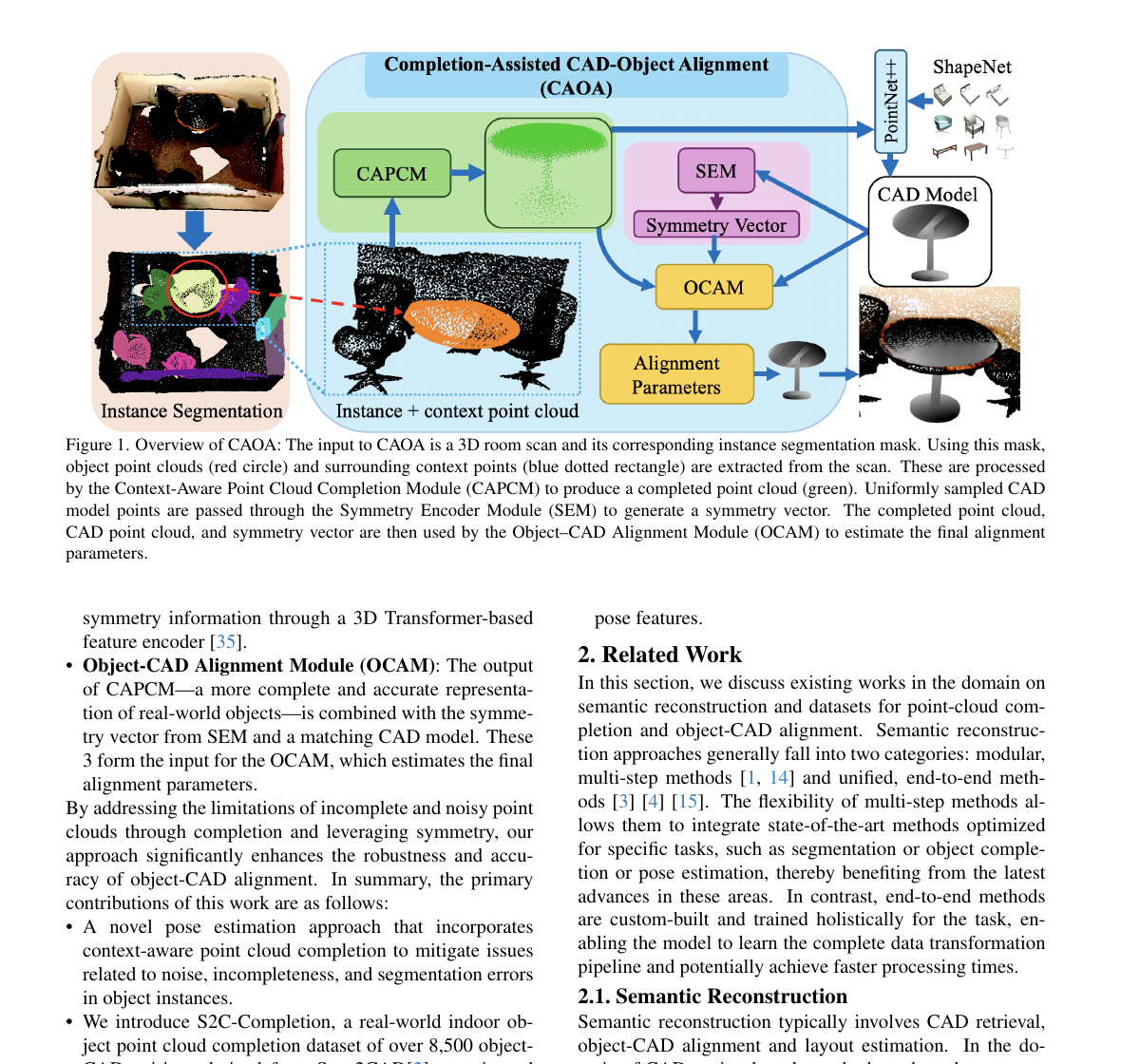
CAOA first completes object point clouds from noisy / partial indoor scans, then passes completion and symmetry features to an object–CAD alignment network to predict translation, rotation, and per-axis scale as a 9DoF alignment.
3. Problem setting
- Inputs: Segmented object point clouds from indoor RGB-D scans, nearby scene context, and a CAD model.
- Output: A 9DoF pose aligning the CAD object to the real scan.
- This is Scan2CAD-style semantic reconstruction rather than single-image BOP 6DoF. Scale and instance segmentation are key variables.
4. Method overview
- CAPCM completes the object point cloud using the target and 100 cm of scene context.
- SEM learns symmetry vectors from canonical CAD models to resolve rotation ambiguity.
- OCAM encodes object / CAD point clouds with a Siamese 3D CNN and regresses , , and through separate MLP heads.
5. Experimental overview
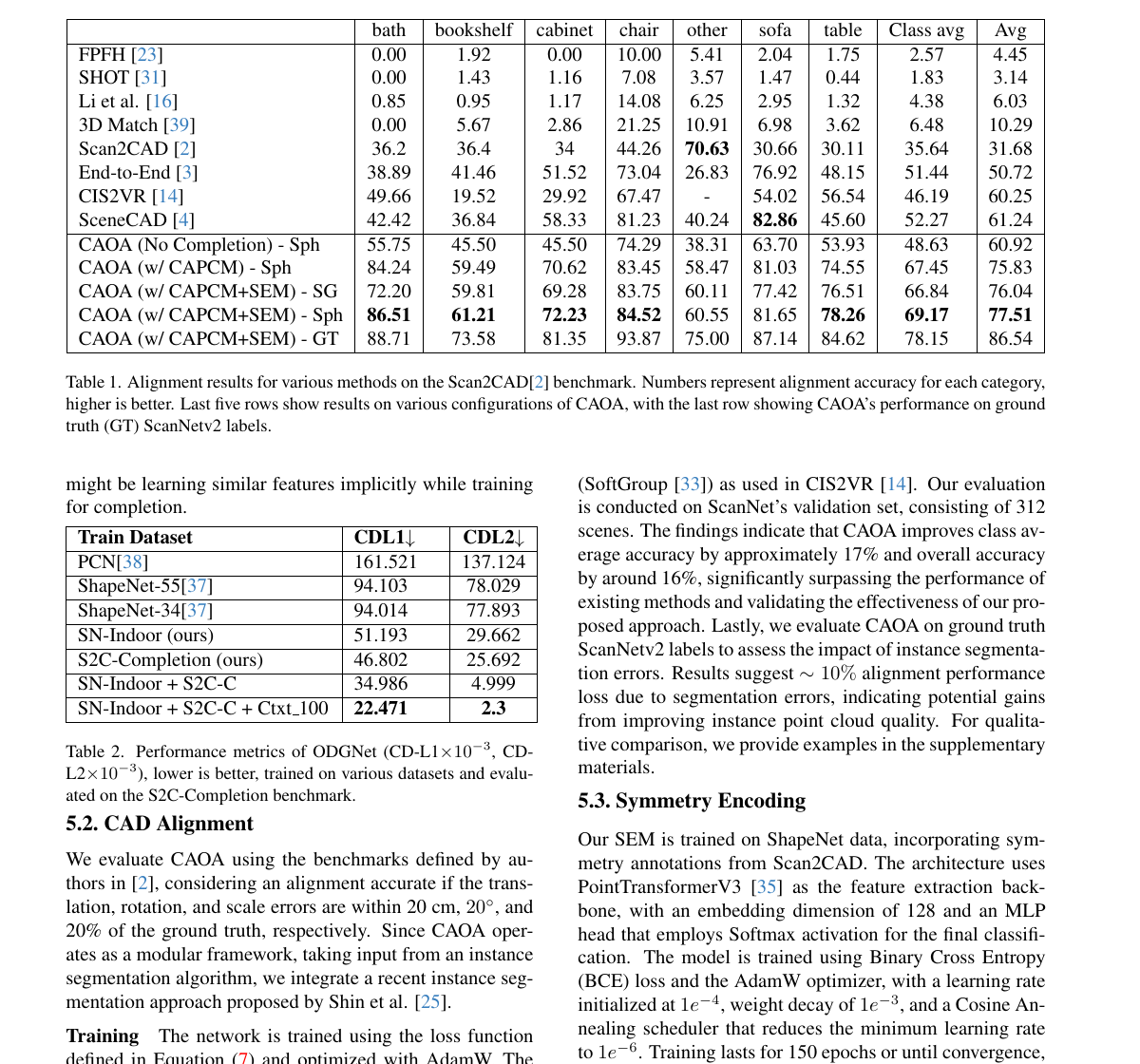
- Scan2CAD correctness requires translation ≤20 cm, rotation ≤20°, and scale error ≤20%.
- Full CAOA (CAPCM+SEM) reaches class / weighted accuracy of 69.17 / 77.51 with predicted segmentation, versus 48.63 / 60.92 without completion.
- Ground-truth ScanNet labels raise accuracy to 78.15 / 86.54, indicating approximately 10% performance loss from instance segmentation.
- The full pipeline takes approximately 0.58 s / scene (0.56–0.59 s for 20 objects, depending on the segmentation backend).
6. Strengths, limitations, and implications
Strengths
- Treats input geometry quality as a central alignment problem, supported by S2C-Completion / SN-Indoor.
- Explicit symmetry and 9DoF scale handling suit real indoor scans.
Limitations / risks
- Completion, SEM, and pose heads are trained separately, without fully end-to-end objectives.
- Still requires reliable instance segmentation and a matching CAD model; errors in either frontend can be amplified.
7. Worth examining in depth
Point completion contributes far more than the symmetry head. A useful follow-up is letting pose uncertainty guide completion, beyond producing a visually complete point cloud.