Reading Notes
Overview / Deep Dive
Available src/paper-notes/capellm-iccv2025/coarse.md
Paper overview notes
Quickly assess the paper's scope, problem setting, core method, experimental findings, and whether to read it in depth.
Paper Overview: CapeLLM: Support-Free Category-Agnostic Pose Estimation with Multimodal Large Language Models
1. Basic information
- Year / venue: 2025 / ICCV; reading mode: Overview.
- Task: Category-agnostic keypoint pose / correspondence, rather than BOP-style object 6D pose.
- Paper: ICCV Open Access; code: GitHub.
2. Positioning in one sentence
CapeLLM replaces annotated support images with a query image and a textual description of the target keypoint. It expresses category-agnostic keypoint localization as coordinate-token generation by an MLLM, using dynamic-round training to improve spatial reasoning.
2.1 Guide to the paper’s figures and tables
| Figure or table | What to examine |
|---|---|
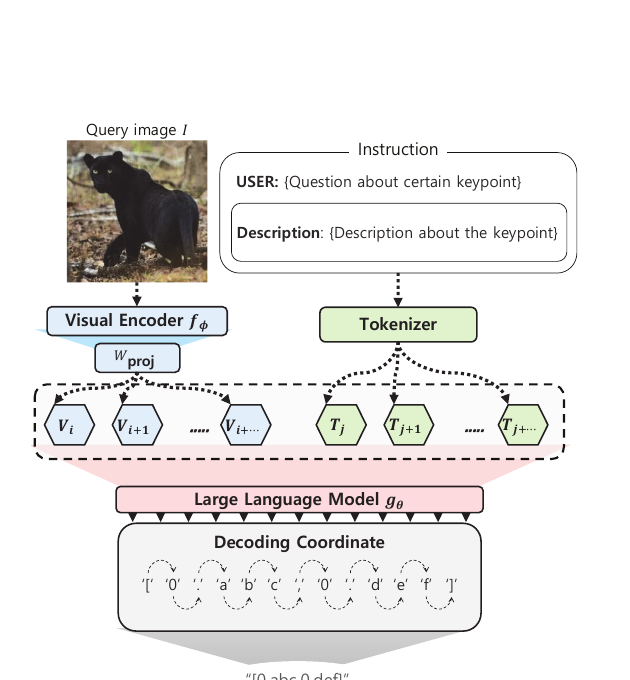
| Figure 2 | How DINOv2 visual tokens and text instructions enter the LLaMA decoder and produce coordinate strings. |
3. Method overview
- DINOv2 extracts image tokens. Tokenized keypoint names, descriptions, and questions are concatenated with visual tokens for LLaMA3.1.
- The decoder generates quantized coordinates as text. The training design includes instructions and dynamic rounds, with inference refinement for unseen keypoints.
- Outputs are 2D keypoint poses. These could feed downstream geometric pose estimation, but the paper does not complete a CAD/PnP 6D pose pipeline.
4. Experimental overview
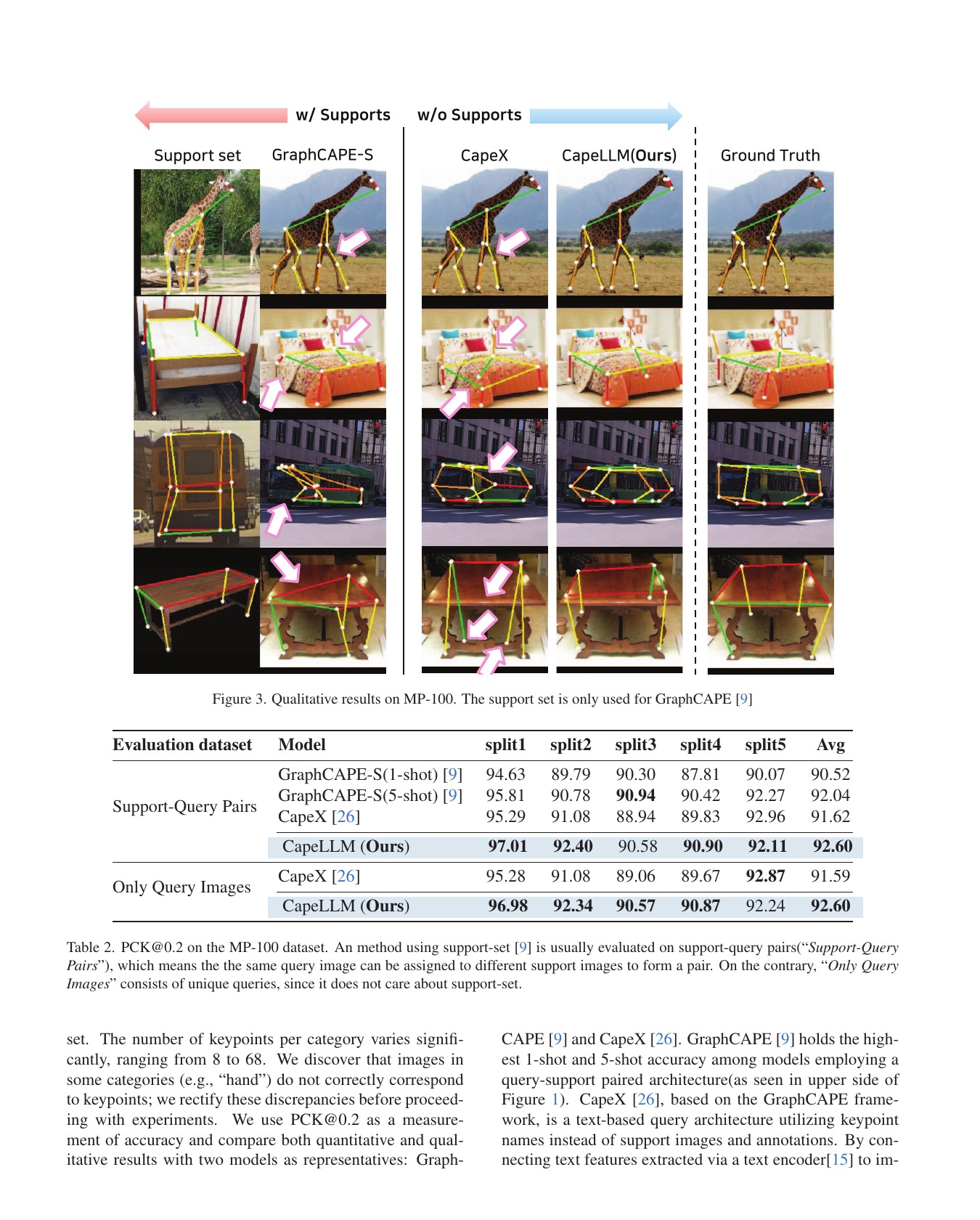
- Dataset: MP-100, comparing 1-shot / 5-shot CAPE using keypoint-localization metrics such as PCK@0.2.
- Authors’ claim: Outperforms earlier CAPE methods in 1-shot and even 5-shot settings without support images.
- My analysis: Language lowers support-annotation costs, but description quality, ambiguity, fine-grained parts, and grounding under occlusion remain key risks.
5. Strengths, limitations, and implications
- Strength: Separates target-keypoint semantics from examples in support images, exploring an open-vocabulary entry point for pose.
- Risks: It does not estimate 6D rigid pose. Coordinate-string quantization and LLM hallucination limit precision.
- Implication: Language can specify objects/keypoints within pose pipelines, beyond detection prompts alone.