Learning to Estimate 6DoF Pose from Limited Data: A Few-Shot, Generalizable Approach using RGB Images
Cas6D uses a self-supervised ViT for robust few-shot object detection, retains top-K reference pose hypotheses, and corrects large initialization errors with multiscale warped feature volumes and progressively narrowed discrete pose bins.
Quickly assess the paper's scope, problem setting, core method, experimental findings, and whether to read it in depth.
Cas6D: Paper Overview
One-sentence conclusion
Cas6D targets novel objects with no CAD model and only a few posed reference images. It connects detection, candidate-view retrieval, and coarse-to-fine pose-residual estimation. Its focus is system failure when references shrink from hundreds to 16/32 views, rather than maximum accuracy under dense coverage.
Problem, inputs, and outputs
Inputs: 16, 32, or all reference RGB images with camera/object poses, plus one query RGB image.
Outputs: Target rotation and translation in the query.
Not required: CAD models, depth maps, or retraining for the test object.
Evaluation: LINEMOD and GenMOP; ADD(S)-0.1d and 5-pixel projection accuracy (Prj-5).
Main method ideas
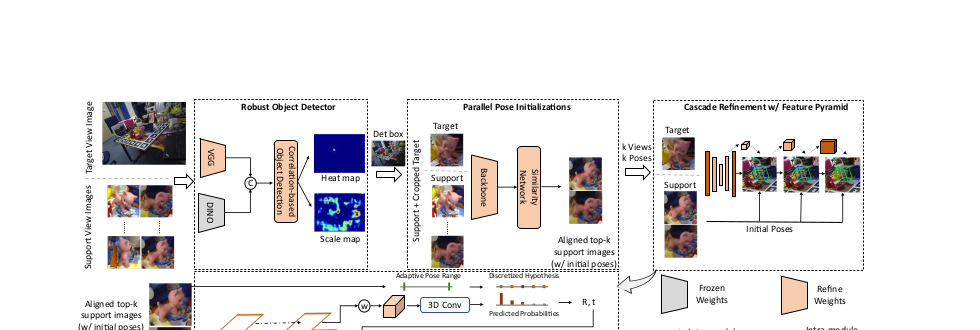
Use self-supervised DINO/ViT features for target-box detection instead of ordinary features that are unstable with few examples.
Retrieve top-K similar reference views and retain multiple initial poses, preventing one incorrect retrieval from determining the result.
Back-project query and nearby reference features into a warped feature volume.
Narrow the search progressively using a multiscale feature pyramid and three stages of discrete pose bins.
Cas6D's three-stage pipeline. The key is to decouple few-shot failures in detection, initialization, and refinement range. Source: Original paper, Figure 2. Copyright belongs to the original authors and 3DV 2024 publisher; reproduced here solely for academic discussion.
Interpreting the results
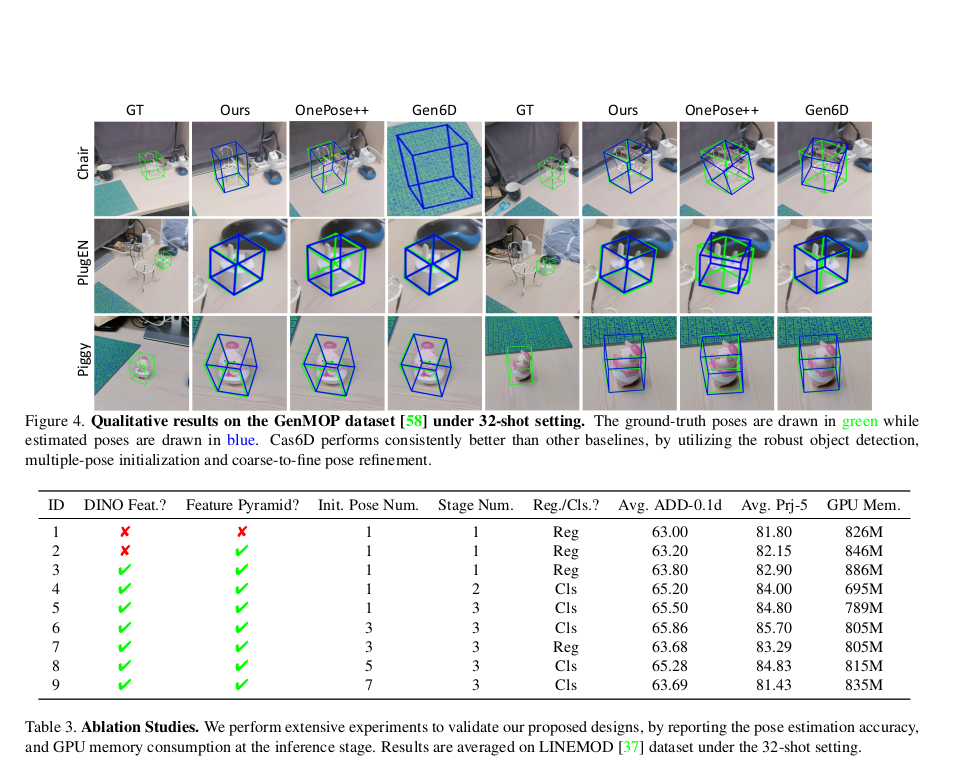
On GenMOP 32-shot, mean ADD(S)-0.1d is 44.00, versus Gen6D’s 41.05; mean Prj-5 is 84.61, versus 76.95. In LINEMOD 32-shot ablations, the full configuration reaches 65.86 ADD-0.1d / 85.70 Prj-5. Replacing continuous regression with discrete pose bins raises Prj-5 from 83.29 to 85.70. Top-3 initialization outperforms a single initialization and excessive candidates.
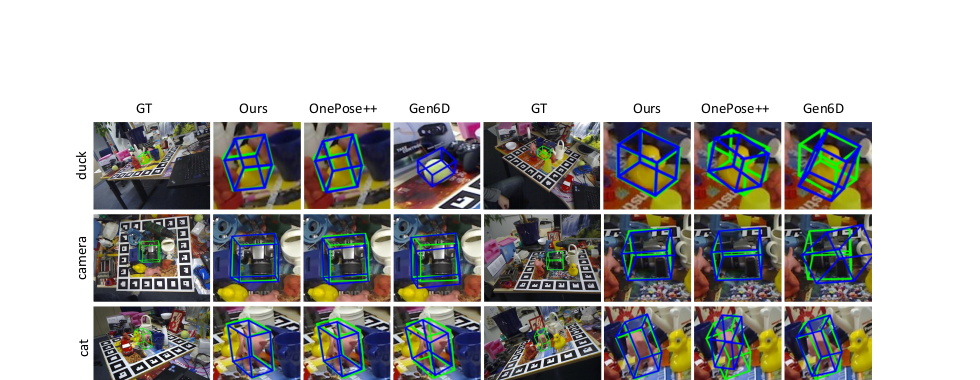
With few reference views, incorrect detection invalidates downstream pose. Cas6D's advantage first comes from more reliable detections, followed by tighter pose boxes. Source: Original paper, Figure 3. Copyright belongs to the original authors and 3DV 2024 publisher; reproduced here solely for academic discussion.
Who should read it?
Prioritize this paper for few-shot novel-object onboarding, reference-template databases, or model-free 6D pose. When high-quality CAD and depth are available, its setting is less advantageous and is not directly comparable with leading BOP RGB-D methods.
Available src/paper-notes/cas6d-3dv2024/deep.md
In-depth paper notes
Support reproduction, comparison, related-work writing, and identifying opportunities for further research.
Cas6D: Deep Reading Notes
1. System-level failure points addressed
Generalizable 6D pose is often described as estimating a novel object’s pose from a few references, but early systems typically need dense reference coverage. OnePose methods depend on sparse reconstruction and 2D–3D correspondences, both of which degrade with too few views. Gen6D retrieves a nearby view before refinement; large initialization errors exceed the capture range of its fixed-resolution feature volume. Cas6D handles these failure modes separately, beyond enlarging the backbone.
2. Method pipeline
2.1 Few-shot detection
Few references provide limited appearance coverage, making similar query-background textures trigger false positives. Cas6D uses self-supervised ViT features for cross-view correlation and aggregates reference masks/regions as detection evidence. On LINEMOD 32-shot, detection mAP@[.5:.95] improves from Gen6D’s 60.83 to 69.70. A substantial share of pose gains therefore comes from frontend localization rather than refinement alone.
2.2 Multiple-candidate initialization
The system passes top-K support views and poses downstream instead of committing to the most similar reference. This is lightweight hypothesis search: Refinement can recover if any initialization enters a correctable basin. Top-3 is most stable in ablations; increasing to 5/7 includes distant candidates and reduces performance.
2.3 Cascaded warped feature volumes
Given a current pose, nearby reference and query features are back-projected into a shared 3D voxel space, with mean/variance aggregation of cross-view consistency. Cas6D uses image features at 16², 32², and 64² resolutions. Coarse levels accommodate larger geometric deviations; fine levels add edges and local textures.
Pose residuals are discretized into progressively narrower bins rather than regressed continuously. Stage t determines the sampling center and range of stage t+1. This coarse-to-fine classification first identifies a broad residual interval, then refines it, reducing the damage of large rotation and depth errors to a single regression step.
Robust detection addresses the wrong object, parallel initialization addresses the wrong reference view, and cascaded volumes address large initialization errors. Source: Original paper, Figure 2. Copyright belongs to the original authors and 3DV 2024 publisher; reproduced here solely for academic discussion.
3. Dissecting the experiments
3.1 Main results
Abstract: In 32-shot settings, Prj-5 improves over OnePose++ / Gen6D by 9.2 / 3.8 percentage points on LINEMOD and GenMOP, respectively.
GenMOP 32-shot: Cas6D reaches 44.00 ADD(S)-0.1d and 84.61 Prj-5; Gen6D reaches 41.05 and 76.95.
GenMOP full-shot: Cas6D’s Prj-5 of 87.52 exceeds Gen6D’s 81.78, but ADD(S)-0.1d does not lead on every object.
Top: GenMOP 32-shot qualitative comparison. Bottom: Ablations show that excessive candidates and continuous regression reduce performance; more modules are not automatically better. Source: Original paper, Figure 4 and Tables 3–4. Copyright belongs to the original authors and 3DV 2024 publisher; reproduced here solely for academic discussion.
3.2 What the ablations establish
The feature pyramid alone raises 63.00/81.80 to only 63.20/82.15; DINO adds approximately 0.6/0.75. Larger gains come from two-/three-stage discrete classification and multiple initializations, ultimately reaching 65.86/85.70. Multiscale features assist, while search-space parameterization is central to refinement robustness under large initialization errors.
Green denotes ground truth and blue estimates. Gen6D often mistakes similar backgrounds/objects for the target, which subsequent pose refinement cannot repair. Source: Original paper, Figure 3. Copyright belongs to the original authors and 3DV 2024 publisher; reproduced here solely for academic discussion.
4. Boundaries and reproduction considerations
Reference poses remain required. Model-free means CAD-free, not free of geometric calibration costs.
Requires reliable target regions in references and sufficient appearance overlap between the visible query and reference database.
LINEMOD/GenMOP are small. Similar background objects, heavy occlusion, and extreme lighting in open real environments require more validation.
Three-stage 3D volumes and multiple candidates increase memory and latency. The paper’s refiner-memory ablation reports approximately 805 MB, but end-to-end deployment must also count detection, feature extraction, and reference retrieval.
5. My assessment
The most reusable idea is to isolate errors caused by sparse onboarding at each stage: Robust cross-view detection features, a limited set of initialization hypotheses, and an explicit coarse-to-fine refinement radius. This division remains relevant to novel-object pose systems using foundation features, retrieval, and render-and-compare.