
Reading Notes
Overview / Deep Dive
Paper overview notes
Quickly assess the paper's scope, problem setting, core method, experimental findings, and whether to read it in depth.
Paper Overview: A Unified End-to-End Network for Category-Level and Instance-Level Object Pose Estimation from RGB Images
1. Basic information
- Abbreviation: CIPE
- Authors: Jiale Ren, Hong Liu, Jinfu Liu, Peifeng Jiang
- Venue / year: IEEE ICRA 2025
- Affiliation: Peking University
- Paper: DOI
- Project: GitHub (placeholder README only, with no code when checked)
- Task: Unified category-level and instance-level 6DoF pose from one RGB image
- Availability: Main text is not open access; the author abstract is public, but the repository had no implementation when checked
2. One-sentence summary
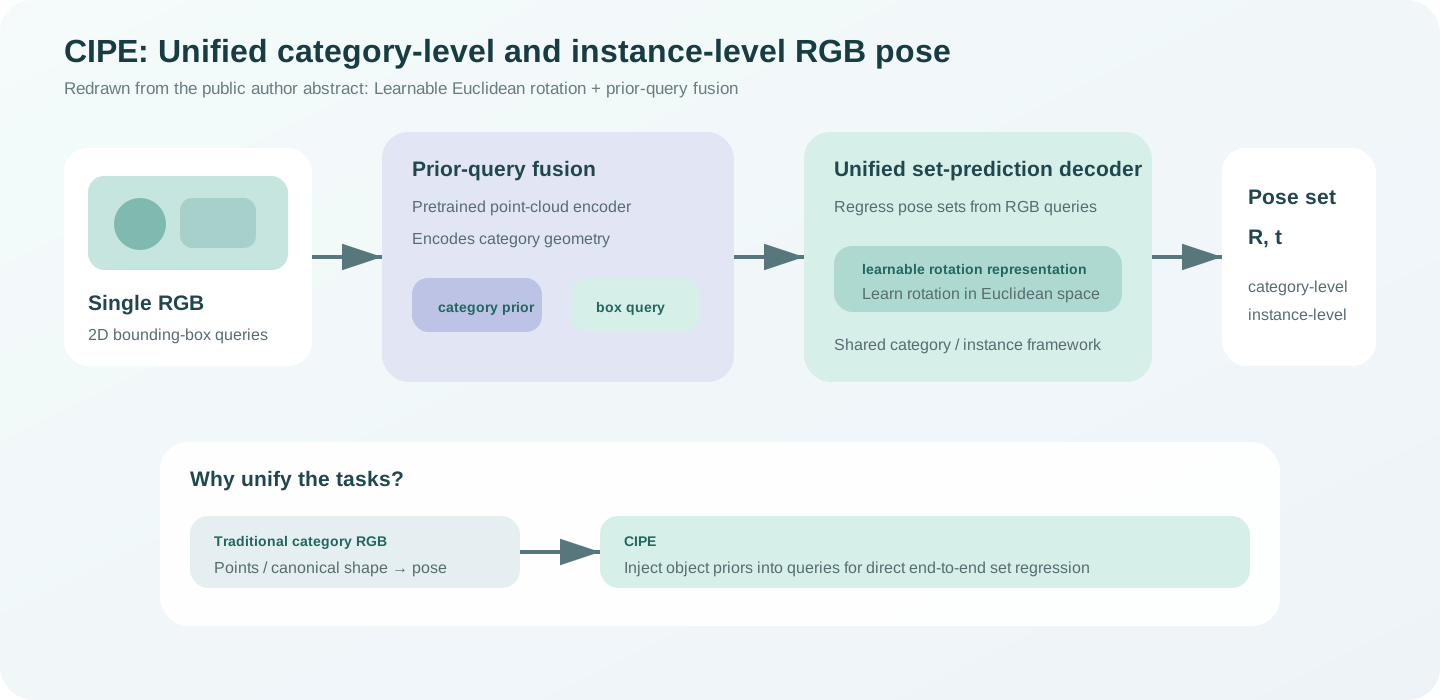
CIPE formulates category-level and instance-level RGB pose as set prediction and directly regresses object poses. A learnable Euclidean rotation representation supports regression, while prior-query fusion injects pretrained category point-cloud features into bounding-box queries. This reduces the staged process of reconstructing point clouds before solving pose in traditional category-level RGB methods.
3. Main approach
- One RGB image and 2D bounding-box queries.
- A pretrained point-cloud extractor encodes category priors.
- Prior-query fusion injects category geometry into queries.
- A unified set decoder directly outputs category / instance poses.
- A learnable rotation representation eases direct regression on .
4. Results and code availability
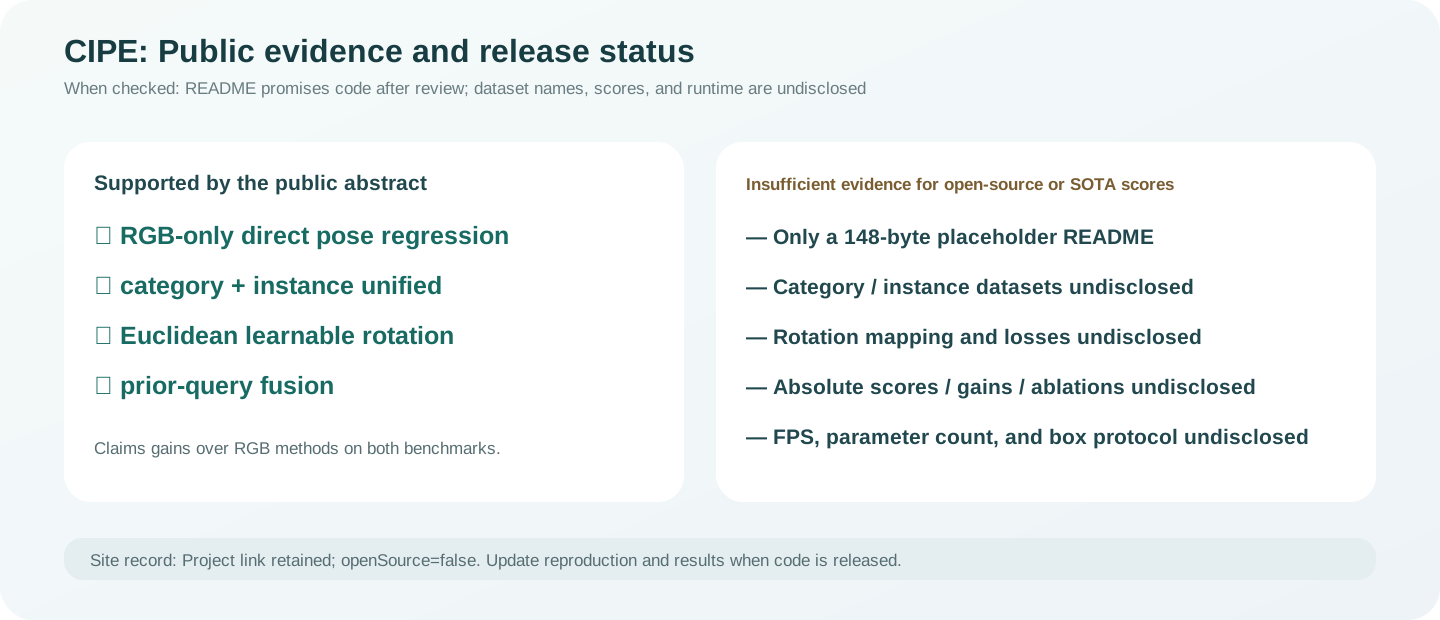
The abstract claims substantial improvement over existing RGB methods on category-level and instance-level datasets, without dataset names, absolute scores, or improvement values.
The public GitHub contained only a 148-byte README stating that code would be released after review. No implementation was available when these notes were checked, so metadata retains openSource: false.
5. Initial assessment
Unifying these tasks is useful: Instance-level pose depends on object identity, while category-level pose depends on category shape distributions, yet both can be expressed as query → pose set. Prior-query fusion supplies category geometry, and learnable rotation addresses their shared optimization difficulty.
Evidence is limited. Category / instance benchmarks, symmetry handling, continuity of the rotation representation, ground-truth box use, runtime, and code cannot be confirmed. This is currently useful as a research-trend entry, not a basis for reproduction or rankings.