Reading Notes
Overview / Deep Dive
Available src/paper-notes/cleanpose-iccv2025/coarse.md
Paper overview notes
Quickly assess the paper's scope, problem setting, core method, experimental findings, and whether to read it in depth.
Paper Overview: CleanPose: Category-Level Object Pose Estimation via Causal Learning and Knowledge Distillation
1. Basic information
- Year / venue: 2025 / ICCV; reading mode: Overview.
- Task: RGB-D category-level 9DoF object pose and metric size estimation.
- Paper: ICCV Open Access; code: GitHub.
2. Positioning in one sentence
CleanPose interprets cross-instance category-level pose failures as data bias. Front-door causal adjustment suppresses confounders, while residual distillation injects ULIP-2’s 3D semantics into an RGB-D pose network.
2.1 Guide to the paper’s figures and tables
| Figure or table | What to examine |
|---|---|
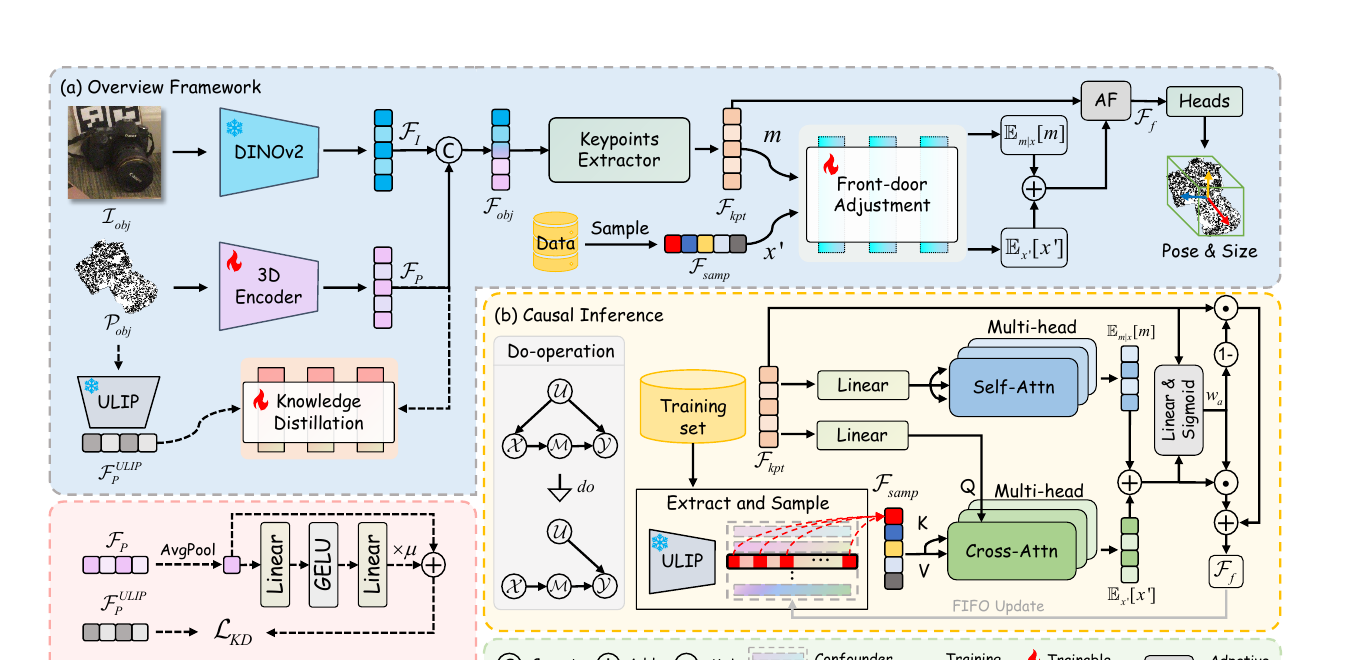
| Figure 3 | How RGB / point-cloud inputs, keypoint mediators, causal inference, and distillation connect to pose & size. |
3. Method overview
- DINOv2 extracts RGB features, and depth is back-projected into point clouds. A keypoint extractor acts as a structural mediator between visual inputs and pose.
- Features sampled from training data approximate front-door adjustment, aiming to suppress shortcuts from hidden confounders such as background, repeated samples, and pose distributions.
- A ULIP-2 teacher supplies 3D features. Residual knowledge distillation transfers only information missing from the student; final heads predict rotation, translation, and size.
4. Experimental overview
- Datasets: REAL275, CAMERA25, and HouseCat6D. Metrics include 3D IoU and success rates at rotation/translation thresholds.
- Authors’ claim: Outperforms existing category-level state-of-the-art methods on all three benchmarks.
- My analysis: Addressing bias as well as stronger features is a reasonable objective. However, confounders are unobserved, and front-door assumptions under real noise and segmentation failures need more cross-domain validation.
5. Strengths, limitations, and implications
- Strength: Causal adjustment targets bias sources while foundation-model distillation addresses semantic limitations, with distinct roles.
- Risks: RGB-D, instance masks/categories, a ULIP-2 teacher, and a training-memory queue create a long engineering pipeline.
- Implication: Keypoints can be structural mediators in category-level pose, beyond final PnP correspondences alone.