Co-op establishes semi-dense correspondences using a small number of CAD-rendered templates. A hybrid classification-plus-offset representation, probabilistic flow, and differentiable PnP enable coarse-to-fine 6D pose estimation of unknown objects.
Task: Estimate a novel object’s 6D pose from its CAD model and one RGB image, without target-specific fine-tuning.
Reading mode: Overview.
2. Positioning in one sentence
Co-op learns semidense query–template correspondences from few templates, then uses probabilistic flow and differentiable PnP to refine coarse poses.
3. Problem and motivation
Many rendered templates improve coverage but slow novel-object onboarding and inference.
Pure coordinate regression produces unreliable correspondences under weak texture, repeated texture, and cross-domain appearance changes.
4. Method overview
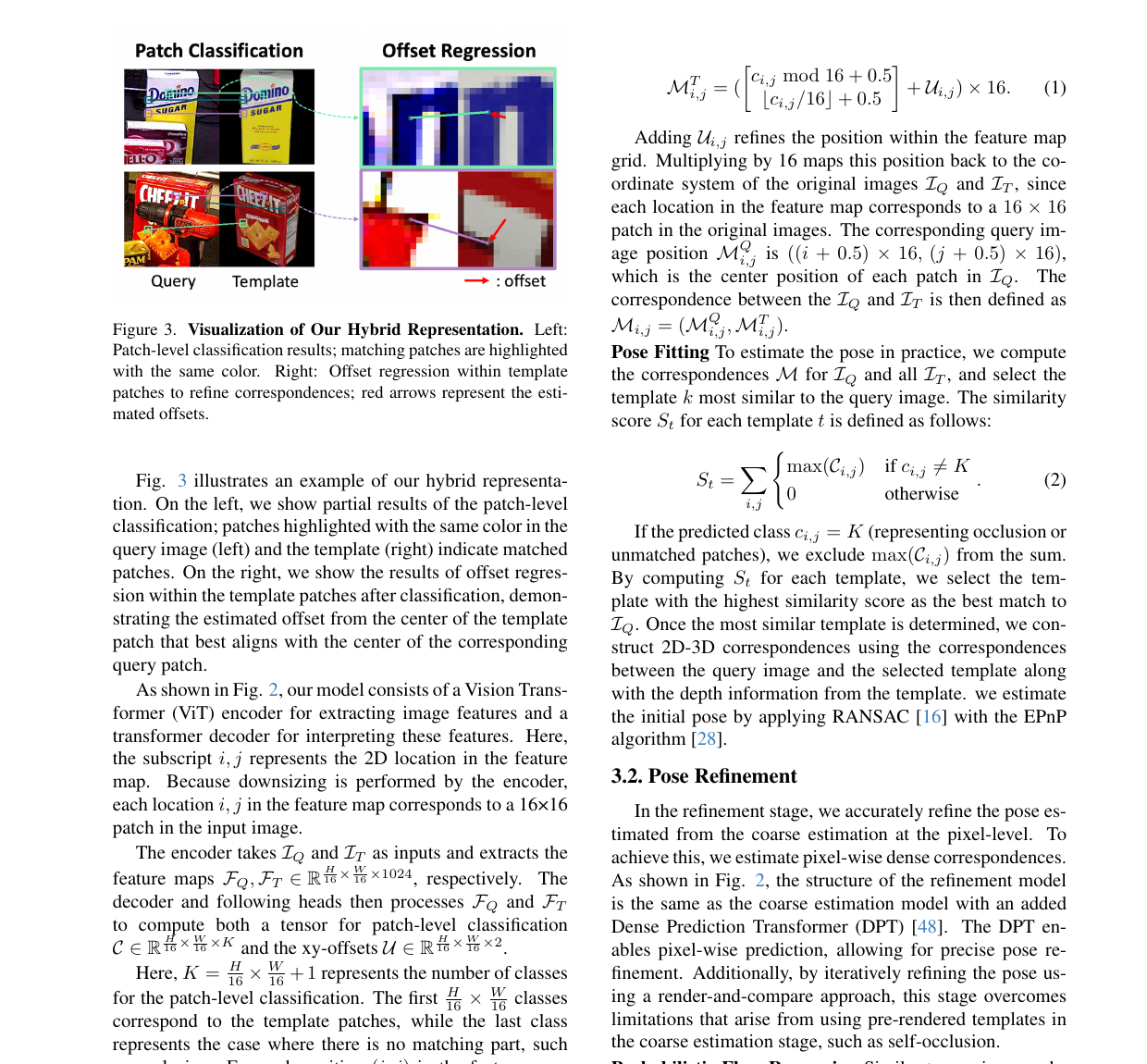
Render a few CAD templates. The coarse stage combines patch classification and offset regression for semidense correspondences.
Recover pose from correspondences with differentiable PnP.
Predict confidence-aware probabilistic flow between the query and a current-pose render, refine iteratively, then select a pose.
5. Experiments at a glance
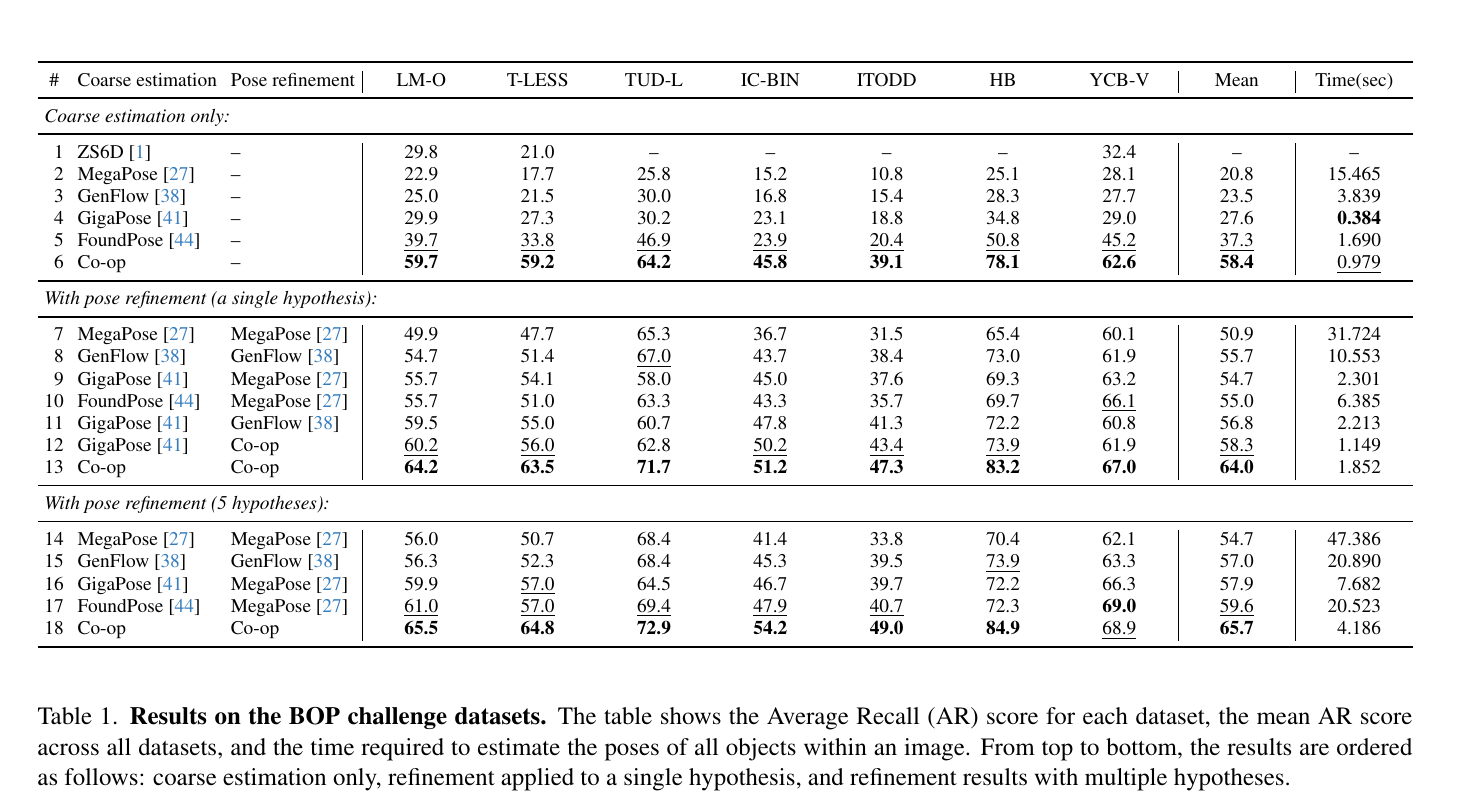
Across seven BOP datasets, single-hypothesis refinement averages AR of 64.0, increasing to 65.7 with pose selection.
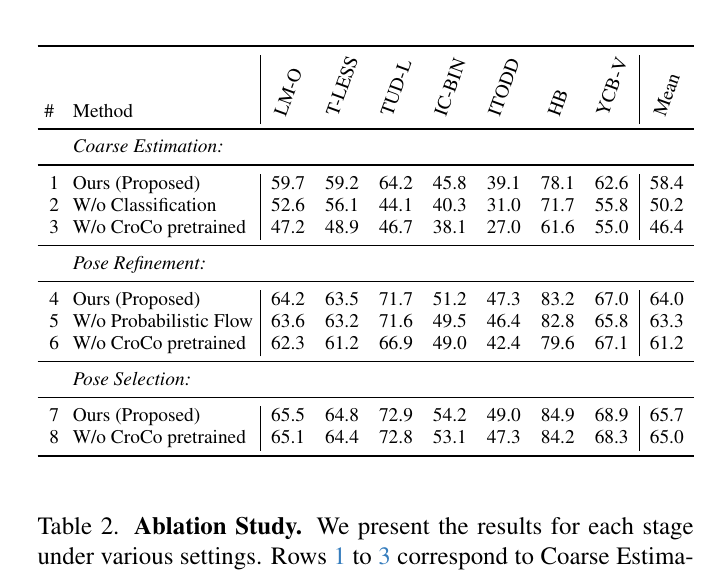
Removing patch classification lowers coarse AR from 58.4 to 50.2, supporting the hybrid representation beyond a collection of engineering additions.
Original Co-op paper, main results: Read coarse estimation, single-hypothesis refinement, and final multiple-hypothesis selection separately rather than quoting only final mean AR. Source: original CVPR 2025 paper. Copyright belongs to the paper's authors and publisher; reproduced here solely for paper discussion.
The key progression is 58.4 → 64.0 → 65.7: Probabilistic-flow single-hypothesis refinement adds 5.6 AR; final hypothesis selection adds another 1.7 AR. Most gains come from the correspondence–PnP–rerendering refinement loop. Multiple-hypothesis selection adds performance with additional inference cost.
6. Quick assessment
Relevant topics: CAD-based unseen-object pose, template budgets, and correspondence-to-PnP pipelines.
Costs: Still requires accurate CAD, detections / crops, and camera intrinsics. The backend cannot automatically remove frontend errors under complex occlusion.
Available src/paper-notes/co-op/deep.md
In-depth paper notes
Support reproduction, comparison, related-work writing, and identifying opportunities for further research.
Deep Reading Notes: Co-op: Correspondence-based Novel Object Pose Estimation
Key problem: Reducing templates in CAD-based generalizable pose requires more reliable correspondences within each template, beyond expanding viewpoint retrieval.
Main answer: Patch classification + offset regression produces coarse semidense correspondences. Probabilistic flow represents uncertainty during refinement, with differentiable PnP updating pose.
2. Positioning in one sentence
Co-op is a CAD-based unseen-object pipeline centered on correspondence, with PnP as its geometric solver and render-and-compare as its refiner.
2.1 Guide to the paper’s figures and tables
Figure / table
What to look for
Figure 3
How do patch classification and offset regression jointly represent semidense correspondence?
Figure 4
How does pose selection choose among hypotheses?
Table 1
How does AR progress from coarse estimation to single- and multiple-hypothesis refinement?
Table 2
How much do hybrid representation, probabilistic flow, and CroCo pretraining contribute?
Original paper, method-diagram region: Semidense correspondences between rendered templates and query images support coarse pose and refinement. Source: CVF Open Access. Copyright belongs to the paper's authors and publisher; reproduced here solely for paper discussion.
3. Problem setting and boundaries
Inputs are query RGB, a few prerendered target-CAD templates, and camera intrinsics. The output is absolute 6D pose in the camera frame.
The target is unseen during training, but the method is not model-free: CAD, target detection, and reasonable crops are test-time prerequisites.
The paper focuses on pose after detection; BOP AR does not measure end-to-end object discovery.
4. Method details
Coarse correspondence: Classify matching patches and regress local offsets for each query–template pair, combining discrete-grid robustness with continuous localization precision.
Geometric solving: Predicted 2D–3D correspondences and confidences define PnP for initial pose, rather than direct rotation / translation regression.
Probabilistic flow refinement: Render the current pose as a reference and predict conditional flow distributions against the query. Reliability enters differentiable PnP to suppress mismatches from occlusion and repeated texture.
Pose selection: Choose among template / hypothesis results so one accidental coarse-retrieval error does not determine final pose.
5. Experimental analysis
5.1 Main results
Mean AR across seven BOP datasets
Value
Coarse only
58.4
+ Single-hypothesis refinement
64.0
+ Pose selection / multiple hypotheses
65.7
These three rows provide the clearest within-paper comparison: Refinement adds 5.6 AR and final selection another 1.7 AR. Final 65.7 should be quoted with its multiple-hypothesis budget.
5.2 Interpreting the ablations
Removing patch classification reduces coarse mean AR from 58.4 to 50.2; removing CroCo pretraining gives 46.4, identifying pretraining as a major contributor.
Without probabilistic flow, refinement reaches 63.3 versus the full 64.0. The modest gain aligns with handling unreliable flow.
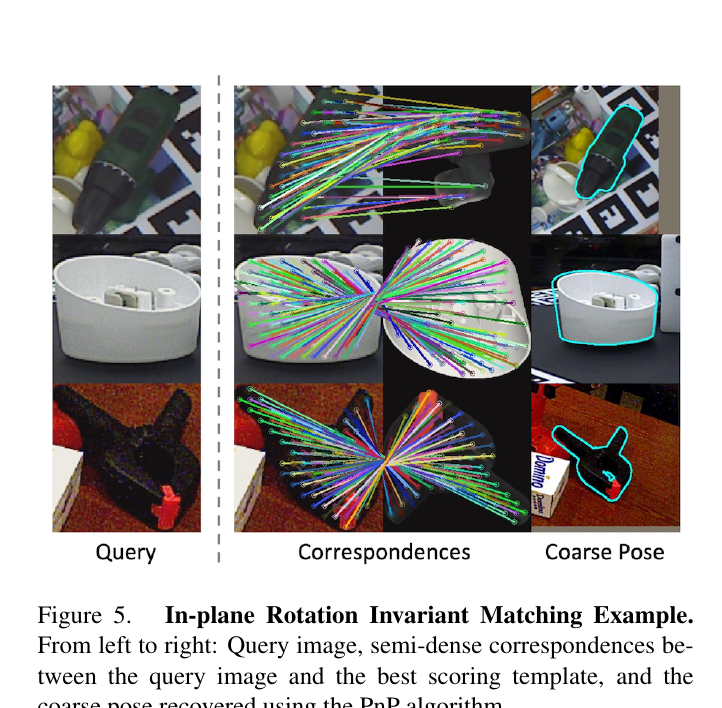
Original paper, correspondence analysis: Classification identifies a template patch, then local offsets recover continuous positions. Right-hand examples show whether matches remain on the object under large in-plane rotation. Source: original CVPR 2025 paper. Copyright belongs to the paper's authors and publisher; reproduced here solely for paper discussion.
This encodes correspondence through discrete retrieval + continuous correction. Patch classification alone sends quantization errors directly into PnP, while continuous coordinates alone can average over ambiguous weak textures or repeated parts. Combining them does not eliminate ambiguity, but first locates a region and then predicts its internal offset, matching template structure.
Original Co-op paper, ablations: Compare hybrid correspondence and CroCo pretraining in the coarse stage, then deterministic versus probabilistic flow in refinement. Source: original CVPR 2025 paper. Copyright belongs to the paper's authors and publisher; reproduced here solely for paper discussion.
The ablations show that CroCo pretraining (46.4→58.4) and hybrid correspondence (50.2→58.4) matter more than probabilistic flow’s 0.7 AR. When reproduction fails, inspect pretrained weights, template-patch definitions, offset normalization, and 2D–3D correspondence construction before repeatedly tuning flow variance. Probabilistic flow mainly strengthens an already reliable correspondence frontend.
6. Authors’ claims and my assessment
Authors’ claims
My assessment
Accurate pose with few templates
Supported by AR and template ablations, but template count, detection quality, and runtime should be reported together.
Probabilistic flow improves refinement
Supported by a 0.7 AR ablation; grouping by occlusion and repeated texture would clarify where it helps most.
7. Reproduction considerations and limitations
Fix CAD coordinates, template-rotation grids, camera intrinsics, and PnP correspondence-confidence definitions.
Common failures include incorrect coarse templates, background contamination of masks/crops, and multiple solutions from symmetry.
Compared with model-free approaches, it reduces template counts rather than removing target 3D priors.
Fair runtime comparisons should include per-object template rendering / storage, hypotheses per query, and refinement iterations per hypothesis. Network-forward time alone underestimates system cost.