COG formulates single-reference unknown-object pose estimation as optimal-transport correspondence with pointwise confidence. Geometry, semantics, and cycle consistency suppress nonoverlapping regions and outliers; weighted SVD then recovers relative 6-DoF pose.
COG formulates cross-view correspondence for single-reference novel-object pose estimation as optimal transport with pointwise confidence marginals. Geometry, semantics, and cycle consistency suppress non-overlapping regions and outliers, after which weighted SVD recovers the relative 6DoF pose.
2.1 Guide to the paper’s figures and tables
Figure / table
Purpose
Overview reading tips
Figure 1
Query / reference RGB-D, confidence, soft correspondences, and pose output
First understand how COG turns matching into confidence-aware transport
Table 1
Single-reference pose comparisons on TUD-L, LM-O, and YCB-V
Focus on occlusion and complex geometry
Table 2
IoU between predicted and ground-truth overlap regions
Check whether confidence actually captures matchable regions
Tables 3 / 4
Ablations of modules, losses, and OT parameters
Check the contributions of semantic priors, cycle loss, and Sinkhorn settings
Relevant region from the paper's figures: COG produces pointwise confidence and cross-view soft correspondences from query / reference RGB-D, then recovers relative pose. Source: CVF Open Access. Image copyright belongs to the authors and publisher; reproduced here for paper commentary.
3. Problem setting
Input: one query RGB-D image and one reference RGB-D image of the same novel object, usually also requiring object masks and camera intrinsics.
Output: relative rotation and translation between the two object frames, which can subsequently be converted into the query camera frame.
The paper emphasizes an unsupervised / novel-object setting, without target-object CAD models or target-specific pose annotations.
4. Method overview
Build similarities between query / reference points using visual features and 3D geometry.
Predict confidence for each point and use it as an optimal-transport marginal mass, reducing the matching weight of non-overlapping regions.
Incorporate semantic priors into the transport kernel, with cycle consistency and geometric consistency assisting training.
Obtain correspondences from the soft transport plan and recover pose using confidence-weighted SVD / Umeyama alignment.
5. Experimental overview
Training uses approximately 2 million RGB-D images and more than 50,000 objects from Google Scanned Objects and ShapeNet.
Evaluation uses BOP-style TUD-L, LM-O, and YCB-V, covering complex shapes, tabletop clutter, and substantial occlusion.
Main metrics are BOP VSD, MSSD, MSPD, and overall Average Recall, alongside predicted-overlap IoU.
6. Quick assessment
Value: unifies confidence, overlap reasoning, and correspondence in a clearly defined OT formulation.
Strengths: a single reference, novel objects, no supervised pose labels, and explicit treatment of occlusion and non-overlapping regions.
Caveats: RGB-D, masks, and reliable 3D points are still required; direct applicability to RGB-only or extremely textureless scenarios is uncertain.
Recommended readers: those interested in novel-object pose, dense correspondence, optimal transport, and unsupervised geometric learning.
Available src/paper-notes/cog/deep.md
In-depth paper notes
Support reproduction, comparison, related-work writing, and identifying opportunities for further research.
Deep Reading Notes: COG: Confidence-aware Optimal Geometric Correspondence for Unsupervised Single-reference Novel Object Pose Estimation
Core assessment: COG’s main contribution is to make the question of which points deserve matching explicit in the OT marginals. This gives overlap reasoning, correspondence, and pose recovery a shared probabilistic structure, beyond simply replacing a matching loss.
2. Positioning in one sentence
Given a single reference RGB-D observation of the same novel object, COG first learns pointwise confidence, then uses confidence as the OT mass distribution to generate soft correspondences and recover relative pose through weighted rigid alignment.
2.1 Guide to the paper’s figures and tables
Figure / table
Deep-dive questions
Figure 1
Does confidence merely identify foreground, or can it also recognize the regions that truly overlap across views?
Table 1
Do COG’s gains reflect overall correspondence quality or only a particular benchmark?
Table 2
Does predicted-overlap IoU change in the same direction as final pose metrics?
Table 3
Are geometric, semantic, and cycle supervision complementary?
Table 4
What accuracy–speed tradeoffs arise from OT iterations, entropy, and the semantic kernel?
Relevant region from the paper's figures: the illustration connects query / reference point clouds, confidence, soft correspondences, and final pose in one pipeline. Source: CVF Open Access. Image copyright belongs to the authors and publisher; reproduced here for paper commentary.
3. Problem setting and task boundaries
Let the query and reference point sets be Pq and Pr; the goal is to estimate the rigid transform from reference to query.
RGB supplies visual semantics, while depth supplies 3D point positions. Masks remove the background, and intrinsics back-project depth points into camera coordinates.
The paper studies relative pose for novel objects, rather than absolute pose regression for fixed CAD objects.
The main difficulty is that viewpoint changes create occlusion and non-overlapping regions; forcing one-to-one matches lets incorrect points contaminate the pose estimate.
Boundary: front-end perception is still required; mask quality, depth quality, and point-cloud sampling affect the inputs to transport.
4. Research context
Traditional correspondence + SVD / PnP pipelines are limited by unstable local descriptors, invisible occluded regions, and incorrect matches that corrupt the global solution.
Recent unsupervised methods use visual foundation models, soft matching, or OT, but can still allocate mass to incorrect regions if the transport mass distribution does not represent visibility.
COG retains the interpretability of a geometric solver, replaces hard one-to-one matching with confidence-aware OT, and introduces semantic priors to mitigate low texture.
5. Research motivation
Correspondences should not be treated as uniformly reliable: non-overlapping regions have no valid matches across the views.
Feature similarity alone can favor points that look alike but are geometrically incorrect.
Direct pose learning requires object- and dataset-level supervision and generalizes poorly to the open world.
The authors therefore use point confidence as the transport marginals, connecting the matching distribution to final geometric recovery.
6. Method details
6.1 Confidence-aware optimal transport
First compute an affinity kernel from RGB-D points and visual features.
A confidence network produces pointwise weights on both query and reference sides. These weights participate in OT’s supply and demand distributions, rather than serving only as post-processing scores.
Sinkhorn iterations yield a soft transport plan. Compared with hard nearest neighbors, the soft plan retains uncertainty and supports subsequent weighted, robust rigid fitting.
A visual foundation model supplies the semantic prior, improving affinity under changes in appearance, local texture, and occlusion.
6.2 Unsupervised Constraints
Geometric consistency: transformed matched points should conform to an approximately rigid transform.
Semantic consistency: points sharing object semantics or local concepts are more likely to form high-quality correspondences.
Cycle consistency: a query-to-reference-to-query cycle should return to the original visible region.
The paper also trains the confidence branch with pseudo-confidence labels to learn overlapping, stable regions, beyond foreground alone.
6.3 Pose recovery
Extract soft or high-confidence correspondences from the transport plan.
Construct weighted point pairs using both confidence and correspondence probability.
Solve rotation and translation with weighted SVD / Umeyama alignment.
Evaluate alignment and overlap regions; use BOP’s symmetry-aware metrics for symmetric objects.
7. Experimental analysis
7.1 Data and Metrics
Training uses approximately 2 million RGB-D images and more than 50,000 objects from Google Scanned Objects and ShapeNet.
TUD-L contains 3 geometrically complex objects and 600 images; LM-O contains 8 objects in cluttered tabletop scenes and 200 images; YCB-V contains 21 everyday objects and approximately 900 evaluation images.
BOP AR aggregates recall over VSD, MSSD, and MSPD errors, making it suitable for occluded and symmetric objects. Overlap IoU directly diagnoses confidence.
7.2 Main Results and Ablations
The paper reports the best overall performance for COG on TUD-L, LM-O, and YCB-V. Unsupervised COG outperforms other unsupervised baselines, while supervised COG approaches or surpasses most supervised methods.
Gains on TUD-L suggest that fine-grained geometric correspondence benefits from confidence and semantic priors; gains on LM-O and YCB-V illustrate the value of filtering non-overlapping points under occlusion.
Module ablations show that softmax or a single similarity alone is insufficient; adding confidence, semantic priors, and cycle consistency makes average performance more stable.
OT parameter analysis shows that a small number of Sinkhorn iterations already produces good transport plans; further iterations offer limited gains with extra overhead.
8. Critical analysis
Method strength: confidence is placed appropriately, both explaining correspondence visibility and supplying continuous weights to the pose solver.
Comparison fairness: RGB-D, masks, and point-cloud quality are strong prerequisites, preventing direct comparisons with RGB-only methods.
Potential failures: depth holes, repeated geometry, minimal overlap, and foreground-mask errors may cause confidence to learn incorrect visibility.
Scalability: OT is sensitive to point count; large point sets, multiple objects, or video tracking require sparsification, hierarchical matching, or caching.
9. Implications for Object-Pose Research
Promote confidence from an auxiliary correspondence score to an observability-modeling module.
In multi-view systems, use each view’s visibility / overlap as OT marginals to jointly optimize poses across frames.
For RGB-only methods, explore semantic confidence from VLMs / VFMs, followed by geometric self-consistency correction.
For robotics, overlap IoU can provide an interpretable pose-uncertainty signal for deciding whether to actively capture another reference view.
10. Open questions
How can confidence remain calibrated without depth or with highly noisy depth?
How can single-reference OT extend to structured transport over multiple objects, frames, and articulated parts?
How can the method output covariance or confidence intervals, rather than only a weighted-SVD point estimate?
11. Deep Reading Supplement: What Confidence in OT Marginals Means
11.1 Training Data and Evaluation Protocol
Item
Information explicitly stated in the paper
Interpretation
Training assets
Google Scanned Objects + ShapeNet; approximately 2 million RGB-D images and more than 50,000 objects
Training emphasizes cross-object correspondence, rather than memorizing a benchmark’s CAD models
TUD-L
600 images and 3 geometrically complex objects
Useful for fine-grained geometry and low texture
LM-O
200 images and 8 objects in cluttered tabletop scenes
Useful for occlusion, non-overlap, and foreground filtering
YCB-V
Approximately 900 evaluation images and 21 everyday objects
Tests stability under symmetry, material variation, and real noise
Metrics
BOP VSD / MSSD / MSPD, Average Recall, overlap IoU
A key fairness detail is that COG takes RGB-D points, masks, and camera intrinsics, rather than raw RGB alone. A single ranking against RGB-only methods hides differences in sensor conditions. Comparing correspondence quality and AR under matching RGB-D and mask protocols is more appropriate.
11.2 Data Flow from Affinity to Pose
An RGB backbone / DINO features provide cross-view semantic similarity, while depth back-projection gives Pq,Pr.
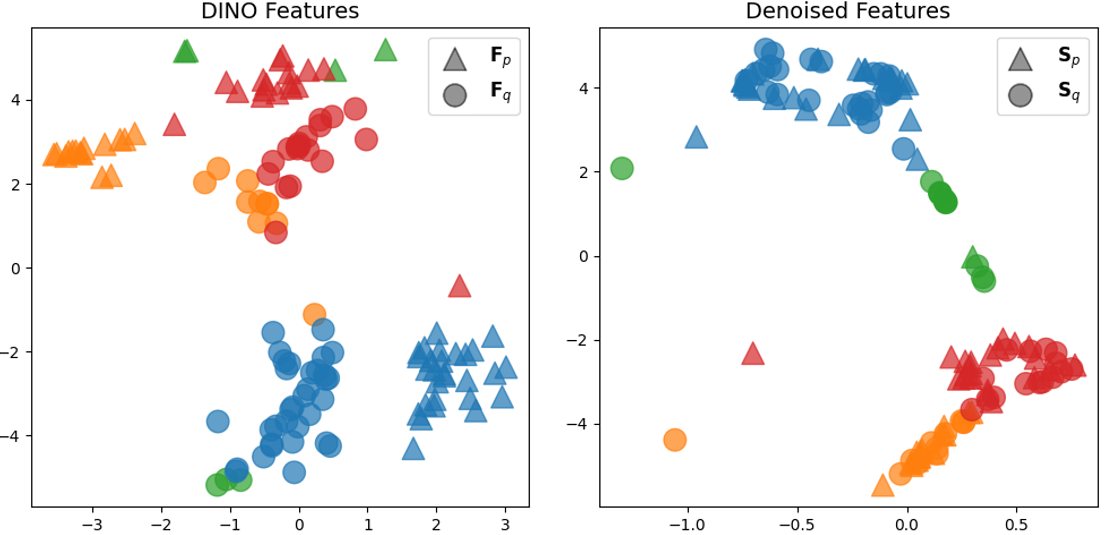
Geometric, semantic, and cycle distances jointly form the matching cost. The paper’s visualizations show that denoised features form cross-view clusters more readily than raw DINO features.
The confidence branch generates aq,ar as OT marginals, rather than a confidence mask multiplied in only at the end.
Sinkhorn produces transport plan T; each row / column represents how a point’s mass is allocated.
Corresponding points jointly weighted by T and point confidence enter Umeyama / weighted SVD to recover relative R,t.
COG thus connects three judgments that are easily separated: whether a point is visible, which point it should match, and whether the resulting rigid transform is reasonable. Their shared transport variable gives the method research value beyond feature matching + RANSAC.
11.3 How to Read the Results
The authors report the best overall BOP performance on TUD-L, LM-O, and YCB-V; unsupervised COG leads the unsupervised methods, and supervised COG also exceeds most supervised baselines.
For LM-O, the useful question goes beyond the mean score: after non-overlapping regions receive low marginal mass, do incorrect points on distant objects still enter SVD?
Overlap IoU and pose AR need not move together. Regions identified by confidence may be geometrically matchable but contain repeated structures; conversely, even with low IoU, a few high-quality correspondences can still recover the correct pose.
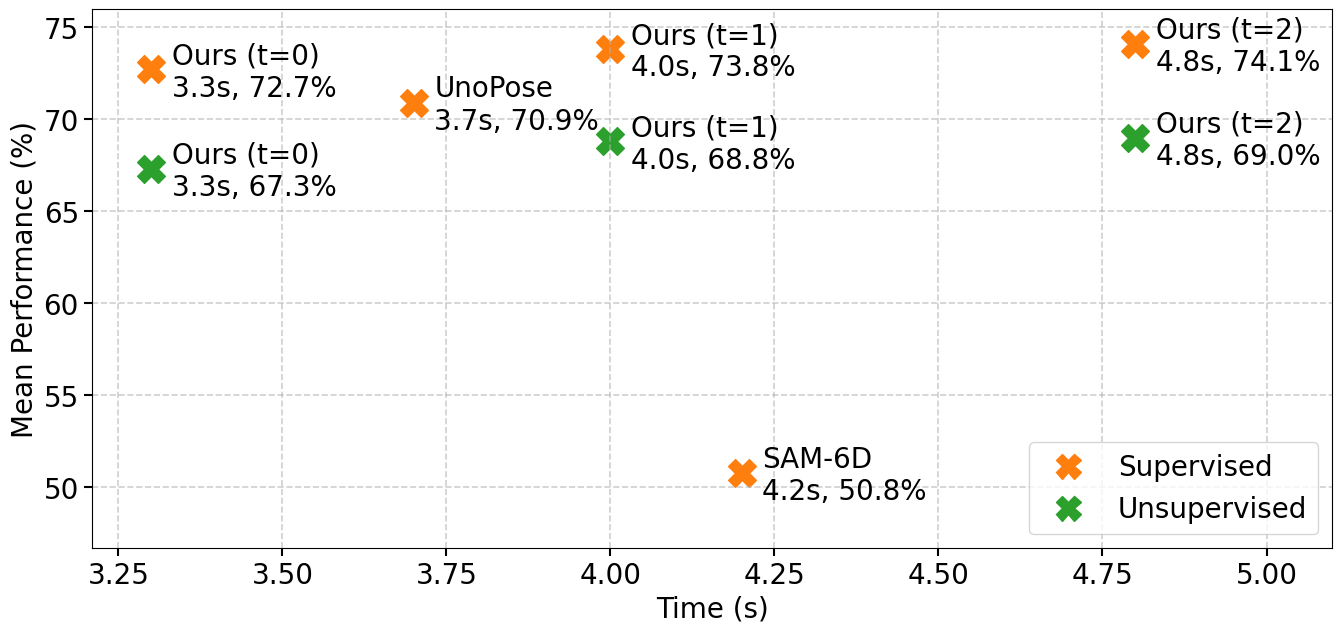
The paper also compares inference times: supervised / unsupervised COG take approximately 3.3–4.8 seconds, versus approximately 3.7 seconds for the earlier UnoPose baseline and 4.2 seconds for SAM-6D. This suggests that OT and confidence gains do not entail a pronounced slowdown in offline processing, but the system is still not real-time.
Runtime–average-performance plot from the paper: supervised and unsupervised COG are reported within a measured range of approximately 3.3–4.8 seconds. Source: CVF Open Access. Image copyright belongs to the authors and publisher; reproduced here for paper commentary.
11.4 Authors’ claims and my assessment
Evidence level
Conclusion
Authors’ claim
Confidence-aware OT improves overlap prediction, correspondence, and pose together; the unsupervised variant also exceeds existing unsupervised baselines.
My analysis
The strongest evidence is the fit between the module’s role and occlusion tasks, particularly LM-O. Final AR alone, however, cannot exclude gains from better DINO / denoising features themselves.
Additional experiments needed
Report calibration curves, correlation between confidence and true overlap, AR under incorrect masks / depth noise, and the effects of point count on OT time and GPU memory.
12. Reproduction Checklist and Failure Modes
Fix RGB-D depth units, camera intrinsics, and object masks; otherwise geometric distances alter the confidence pseudo-labels.
Record sampled point count, Sinkhorn iterations, temperature / entropy regularization, and correspondence threshold; these settings determine whether OT becomes overly smooth.
Save confidence maps, transport matrices, weighted-SVD residuals, and final BOP metrics separately, instead of retaining only the final pose.
The most useful failure taxonomy covers minimal overlap, repeated textures, depth holes, symmetric objects, mask leakage, and excessive query / reference viewpoint differences.
For video transfer, consider making at a temporally smoothed visibility posterior and triggering keyframes with transport residuals, instead of solving the full problem at every frame.