ConceptPose: Training-Free Zero-Shot Object Pose Estimation using Concept Vectors
ConceptPose uses an LLM to generate open-vocabulary concepts, then a VLM produces dense saliency and 3D concept maps. Concept-vector similarity establishes cross-view 3D–3D correspondences, and Umeyama alignment solves zero-shot relative pose.
ConceptPose uses a VLM to generate dense saliency and 3D concept maps from open-vocabulary concepts. Concept-vector similarity establishes cross-view 3D–3D correspondences to estimate relative pose for novel objects, without training, CAD models, or inference-time pose labels.
2.1 Guide to the paper’s figures and tables
Figure / table
Purpose
Overview reading tips
Figure 1
Overview of concept generation, localization, matching, and pose recovery
See how language concepts become geometric correspondences
Figure 3
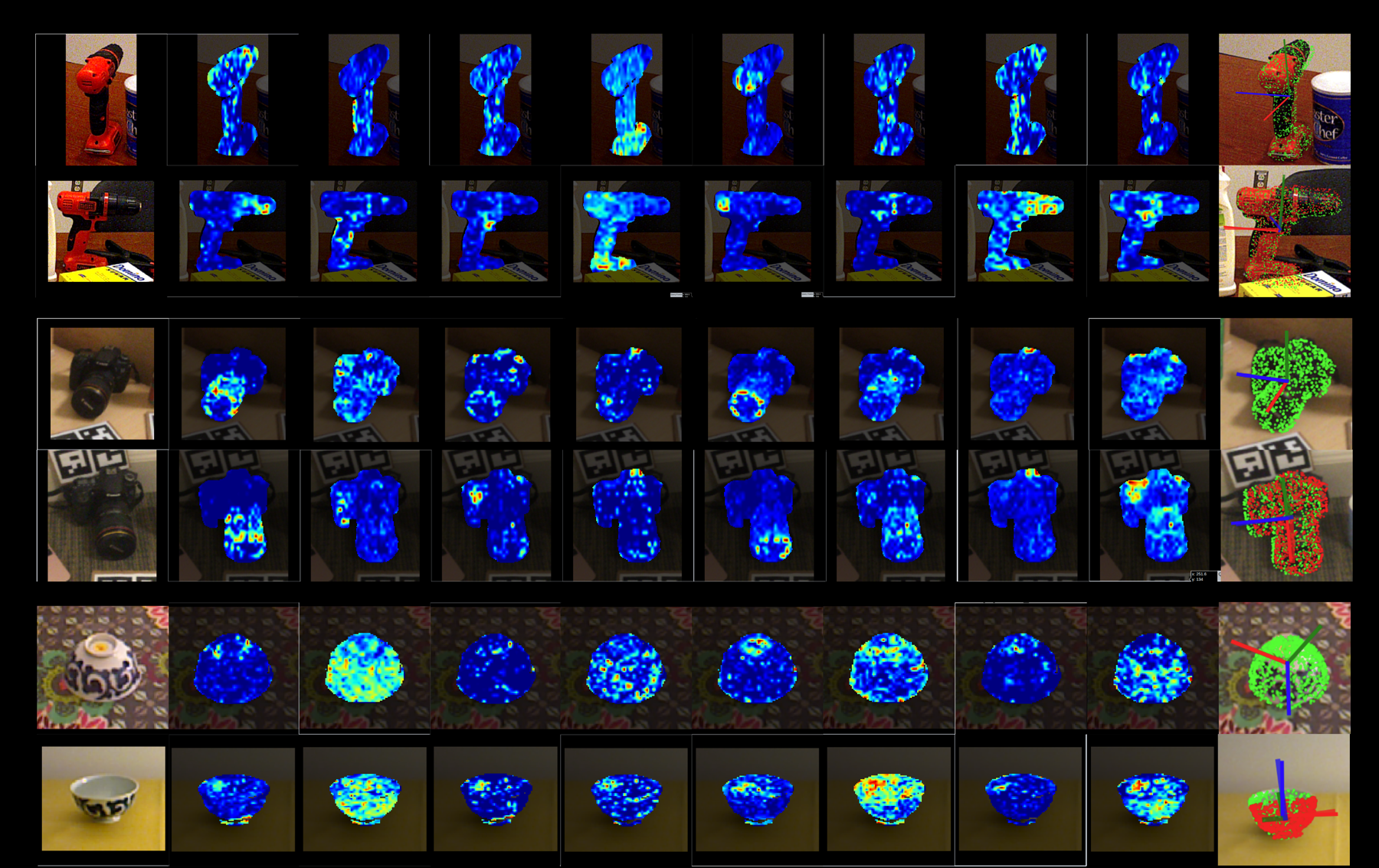
Qualitative results on REAL275, Toyota-Light, and YCB-V
Examine concept localization on simple symmetric objects
Table 1
ADD(-S) and BOP AR on four datasets
Focus on comparisons between training-free and trained baselines
Tables 4 / 5
Ablations of concept prompts, voxelization, and sampling
Determine whether gains come from semantics or point density
Relevant region from the paper's figures: ConceptPose performs zero-shot pose estimation through concept generation, 3D localization, cross-view matching, and Umeyama pose recovery. Sources: project page / CVF Open Access. Image copyright belongs to the authors and publisher; reproduced here for paper commentary.
3. Problem setting
Input: reference and query RGB-D images; the target may be a new instance or category unseen during training.
Inference uses no object-specific / dataset-specific training, CAD models, or ground-truth poses.
Output: relative rotation and translation from reference to query, converted into benchmark absolute poses for evaluation.
4. Method overview
An LLM generates multiple appearance, geometry, and part concepts from the object name.
A VLM generates dense saliency maps for the RGB images according to those concepts.
Saliency and depth points form a concept vector for each 3D point.
Forward KL similarity matches query and anchor concept vectors.
RANSAC + Umeyama recovers relative pose from 3D–3D correspondences.
5. Experimental overview
Datasets: REAL275, Toyota-Light, YCB-Video, and LINEMOD.
2000 anchor–query pairs are sampled per dataset; YCB-V and LINEMOD also use BOP test-target filtering.
The paper reports more than 62% relative improvement in mean ADD(-S) over the strongest baseline, alongside competitive training-free BOP AR.
6. Quick assessment
Value: converts VLM language semantics into an intermediate representation usable for 3D correspondence.
Strengths: no task-specific training, interpretable concepts, and support for objects outside the training distribution.
Limitations: requires object names / prompts, RGB-D, and masks; VLM inference cost and concept quality affect correspondences.
Recommended readers: those interested in zero-shot pose, VLMs / VFMs, open-vocabulary geometry, and training-free vision systems.
Available src/paper-notes/conceptpose/deep.md
In-depth paper notes
Support reproduction, comparison, related-work writing, and identifying opportunities for further research.
Deep Reading Notes: ConceptPose: Training-Free Zero-Shot Object Pose Estimation using Concept Vectors
Core assessment: ConceptPose uses a VLM to produce concept vectors comparable across 3D points, then connects semantic matching to classical geometric recovery, rather than treating the VLM as a black box that directly outputs pose.
2. Positioning in one sentence
Language concepts provide semantic indices for local parts, while depth supplies 3D positions. Together, they enable zero-shot 3D–3D correspondence and relative-pose recovery.
2.1 Guide to the paper’s figures and tables
Figure / table
Deep-dive questions
Figure 1
Do concept generation, saliency localization, and 3D matching form a complete pipeline?
Figure 3
Can concepts find parts more consistently than texture on symmetric objects?
Table 1
Are the training-free method’s gains consistent across all datasets?
Table 2
Do comparisons with Any6D / One2Any use the same pair sampling?
Table 4
Which geometric, semantic, or topological prompts give the most effective concepts?
Table 5
How does voxelization affect accuracy and speed?
Relevant region from the paper's figures: natural-language concepts lead to a 3D concept map, cross-view correspondences, and pose recovery. Sources: project page / CVF Open Access. Image copyright belongs to the authors and publisher; reproduced here for paper commentary.
3. Problem setting and task boundaries
Given anchor / reference image Ia, query image Iq, an object name or concept prompt, and depth and masks for both images.
Sample 3D points from valid pixels and generate a concept vector for each with a VLM; color or texture is no longer the only matching cue.
Estimate a similarity transform from reference frame to query frame; known camera relationships yield absolute benchmark poses.
The method is training-free, but still requires depth, masks, and semantic prompts as inputs.
4. Research context
Traditional model-free pose methods often require dataset-specific training, CAD, or a reference-feature matcher.
Some zero-shot methods directly match VFM features, but lack stability under missing texture, viewpoint changes, and symmetric targets.
ConceptPose observes that language can describe relatively stable cross-view concepts such as spout, handle, and rim. Localizing these concepts to 3D points connects language priors to a geometric solver.
5. Research motivation
Visual-embedding similarity does not necessarily imply semantic agreement between object parts.
Open-world objects often lack training labels and object-specific CAD.
VLMs offer open-vocabulary, part-level descriptions but need a measurable geometric interface.
A 3D concept vector bridges interpretable semantics and geometric solvability.
6. Method details
6.1 Concept generation
An LLM first generates complementary concept labels from the object name.
Geometric prompts describe shape, topology, and spatial relationships; semantic prompts describe appearance and parts. The authors also explore prompt combinations for different objects.
Text embeddings are cached across frames to reduce repeated VLM computation.
6.2 Concept localization
The VLM generates dense saliency maps from its responses to images and text concepts.
Saliency maps are multiplied with the object mask and depth to produce a concept vector for each 3D point.
The same physical part may thus remain matchable across views through similar concept semantics, even when pixel appearance changes.
6.3 3D Correspondence and Umeyama Alignment
For query point pqi, find anchor point paj whose concept vector minimizes KL divergence.
Optional voxelization reduces point count and similarity-computation overhead.
RANSAC filters incorrect 3D–3D pairs, then the closed-form Umeyama solution recovers rotation and translation.
Symmetric objects use ADD-S or symmetry-aware BOP metrics to avoid penalizing equivalent rotations.
7. Experimental analysis
7.1 Data and Metrics
REAL275: 2754 RGB-D test frames covering 6 categories—bottle, bowl, camera, can, laptop, and mug.
Toyota-Light: real objects under clutter, occlusion, and varied illumination.
Reported metrics include ADD(-S) recall, ADD-AUC, ADD-S-AUC, 3D IoU, and BOP VSD, MSSD, MSPD, and AR.
7.2 Main results
Table 1 compares ConceptPose with trained / training-free baselines on four datasets; the paper reports over 62% improvement in mean ADD(-S) relative to the strongest baseline.
The gain has significance beyond its magnitude because ConceptPose uses no dataset-specific training, CAD, or inference-time ground-truth pose.
Figure 3 shows concept localization finding structurally meaningful regions even on semantically simple, highly symmetric objects, although not every concept is stable.
7.3 Ablations and Efficiency
Ablations of prompt combinations suggest that geometric and semantic concepts complement each other; relying on only one description type degrades some categories.
Voxelization reduces point count while preserving most accuracy, providing an engineering tradeoff between VLM inference and 3D matching.
Fixed random seeds for anchor–query sampling are important, especially because YCB-V uses cross-scene pairs whereas LINEMOD uses same-scene pairs.
8. Critical analysis
Strengths: interpretable semantic priors, a verifiable geometric solver, and no task-specific training; a clear interface design for combining VLMs with pose estimation.
Dependencies: object names, prompts, masks, and depth quality act as implicit supervision. If the VLM misses small parts, geometric matching also fails.
Computation: each concept requires saliency generation; multiple concepts, frames, and objects may cost more than a conventional feature matcher.
Experimental boundary: benchmark masks and sampling are relatively controlled. Detection, segmentation, and concept-generation failures in open scenes need separate evaluation.
9. Implications for my research
Fuse concept vectors with NOCS, local surface descriptors, or geometric confidence to construct joint semantic–geometric correspondences.
Language concepts can also guide active observation: when uncertain, choose a view exposing a handle, rim, or connector.
Symmetric objects should produce pose equivalence classes or posteriors rather than being forced into a single rotation label.
10. Open questions
How can the most discriminative concepts be selected automatically for the current object?
How can VLM saliency confidence be calibrated while avoiding prompt bias?
How can training-free 3D concept matching extend to video, articulated objects, and RGB-only scenes without depth?
11. Deep Reading Supplement: From Language Concepts to 3D–3D Correspondence
11.1 Exact Table 1 Results
Dataset
ADD(-S)
BOP AR
Strongest comparator ADD(-S)
Improvement reported in the paper
REAL275
71.5
60.4
53.5 (Any6D)
+33.6%
Toyota-Light
55.0
51.6
32.2 (Any6D)
+59.0%
YCB-Video
41.2
32.8
22.6 (Horyon)
+82.3%
LINEMOD
38.6
31.0
27.6 (Horyon)
+39.9%
Four-dataset mean
51.6
44.0
—
Mean ADD(-S) +62.8%, mean BOP AR +14.3%
The final-row mean does not place all baselines under one training protocol. Any6D / One2Any are not fully evaluated on YCB-Video and LINEMOD, so the authors separately report a fair REAL275 + Toyota-Light mean. On LINEMOD, ConceptPose’s BOP AR of 31.0 is below Horyon’s 34.4, mainly because of severe occlusion. This qualification is more accurate than claiming the best performance on every dataset.
11.2 Prompts and Concept Vectors
A default prompt asks the LLM for common parts such as handle / body; geometric prompts additionally request topology and spatial location; affordance prompts describe functions such as grasping and pouring; adjective prompts add short appearance modifiers.
The VLM generates dense saliency for each concept. Depth back-projects 2D saliency into the point cloud, giving every 3D point a concept vector.
The representation is interpretable: an incorrect pose can be traced to inappropriate LLM concepts, incorrect VLM saliency, or unstable 3D correspondence / RANSAC.
11.3 Engineering Cost and Voxelization
ConceptPose needs saliency inference for multiple concepts per object, with computation growing with concept count and point count. Read the voxelization ablation from both sides: fewer 3D matching points reduce runtime but may remove small parts. If performance on large objects is largely preserved, the main information in concept vectors is structural rather than tied to each individual point.
The paper specifies 2000 sampled anchor–query pairs per dataset and releases generated Oryon-format pairs for YCB-V and LINEMOD. Reproduction must fix pair seeds, same-scene / cross-scene sampling, and BOP target filtering; otherwise mean ADD(-S) can vary substantially.
11.4 Authors’ Claims and My Analysis
Authors’ claim
My analysis
Training-free concept vectors improve on strong baselines by an average of 62.8%
Supported by the main table, with ADD(-S) gains on all four datasets; RGB-D and masks are still used, so this does not mean an absence of all priors.
Prompt design is relatively robust
Small changes across default / geometric / affordance / adjective prompts support robustness, but concept count and VLM version may still affect reproduction.
Semantics help cross-view correspondence
Visualizations show heatmaps and 3D axes; concept-level precision / recall and occlusion-grouped experiments should be added.
12. Interfaces That Transfer to Other Research
ConceptPose concept vectors can be combined with COG confidence: concept agreement assesses whether points semantically resemble the same part, while OT marginals assess whether that part is visible in both views. For symmetric objects, output a symmetry-equivalent pose set or posterior instead of only one Umeyama rotation. For video, cache stable concepts and invoke the VLM again only after substantial viewpoint changes.