CoordAR: One-Reference 6D Pose Estimation of Novel Objects via Autoregressive Coordinate Map Generation
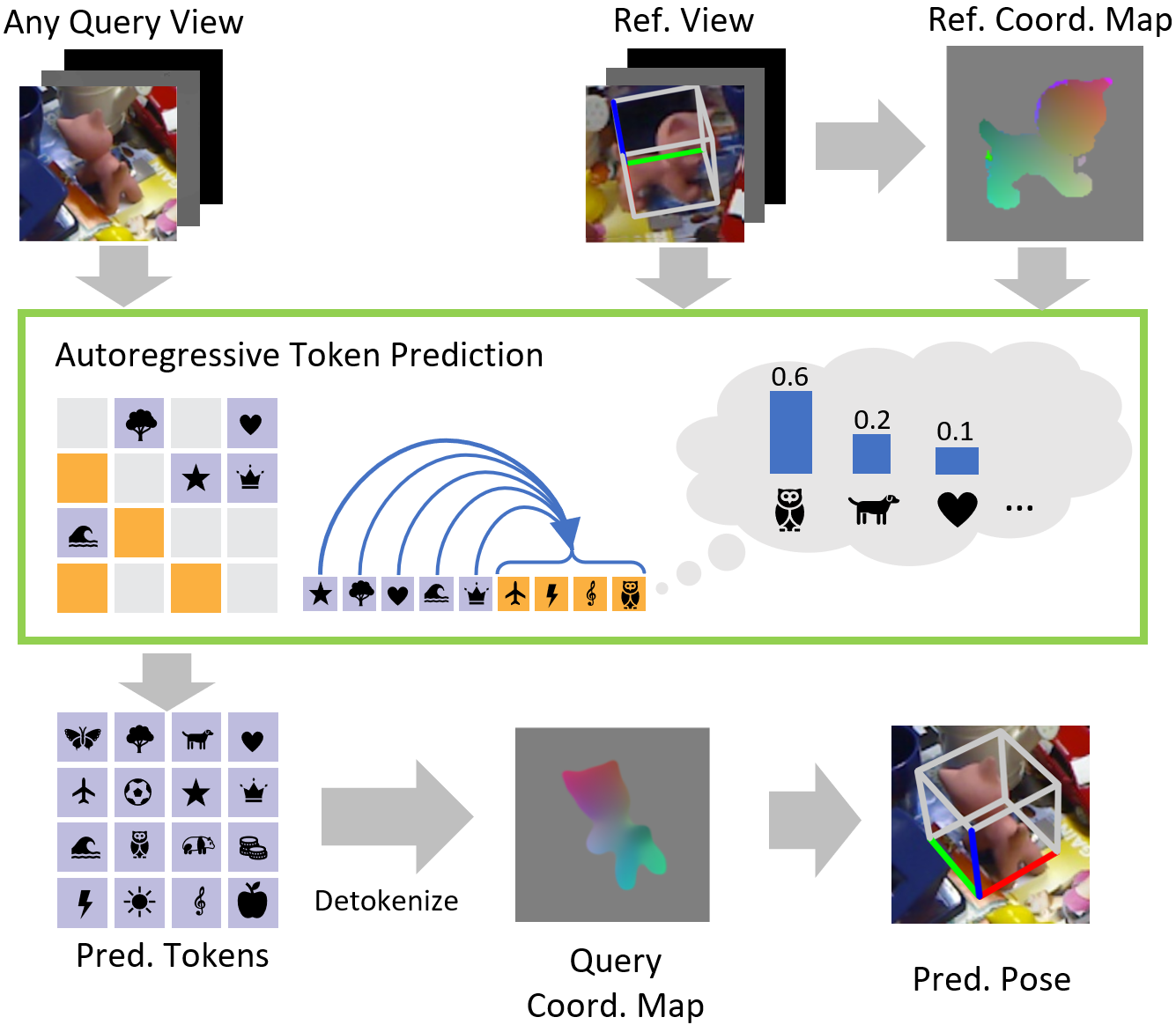
For single-reference 6D pose estimation of unknown objects without CAD, reference / query 3D–3D correspondences are represented as an ROC map. Autoregressive generation of discrete tokens replaces continuous coordinate regression, and Umeyama alignment recovers the relative pose.
Given one RGB-D reference with known pose and an RGB-D query, CoordAR discretizes the query’s ROC 3D coordinate map into tokens and generates them autoregressively. Umeyama alignment then recovers relative 6D pose for the novel object, improving global consistency over conventional continuous-coordinate regression under symmetry, occlusion, and large viewpoint changes.
3. Problem setting
Task: one-reference 6D pose estimation for novel objects.
Input: one reference RGB-D image with a mask, depth, and known object pose, plus a query RGB-D image and mask from an arbitrary viewpoint.
Output: the query’s transform relative to the reference, combined with the reference’s absolute pose to obtain the query object pose.
Key assumption / prior: reference depth can construct a Reference Object Coordinates (ROC) map; inference requires neither a complete CAD model nor multiple reference views.
Applications: pose estimation for novel objects with few references in robotics, AR, and real cluttered environments.
4. Core motivation
Problem addressed: reduce dependence on textured CAD, complete 3D models, and multi-view references for novel-object pose estimation.
Why it matters: new real-world objects often lack usable CAD models. One-reference estimation better suits rapid deployment, but correspondence is vulnerable to missing texture, occlusion, and viewpoint differences.
Main concern with existing methods: methods such as One2Any regress continuous ROC coordinates in parallel. A convolutional decoder’s local receptive field may yield globally inconsistent coordinate maps, without explicitly modeling ambiguity and uncertainty.
Modality-decoupled encoding: separate encoders process RGB images and the reference ROC map; reference / query RGB share the RGB encoder.
Fusion blocks: self-attention, cross-attention, and FFNs fuse reference conditioning with query features.
Autoregressive ROC generation: a pretrained VQ-VAE tokenizer converts ROC maps into discrete patch-level tokens, generated group by group according to conditional probabilities.
Training: required; the core decoder minimizes token-sequence negative log-likelihood.
Pose recovery: first predict 3D–3D correspondences, then recover the rigid transform with Umeyama, rather than directly regressing rotation and translation.
6. Experimental overview
Datasets: Real275, Toyota-Light, LINEMOD, and YCB-Video; training uses the FoundationPose dataset and an OO3D-9D subset.
Metrics: ADD(-S) recall, ADD / ADD-S AUC, BOP-style AR (MSSD, MSPD, VSD), and inference time.
Main baselines: One2Any, Any6D, Oryon, NOPE, FS6D, FoundationPose, OnePose / OnePose++, and others.
Main results: CoordAR obtains AR / ADD(-S) of 71.0 / 82.2 on Real275 and 62.5 / 82.6 on Toyota-Light; occluded YCB-V ADD-S AUC is 95.5, and mean ADD(-S) recall under large LINEMOD viewpoint changes is 75.0.
Speed: with 16 autoregressive steps, the paper reports ADD(-S) 75.0 and approximately 0.25 s per inference. Reducing to 4 or 1 step is faster but slightly less accurate.
Are the authors’ conclusions broadly supported? Yes. Main results cover real novel objects, occlusion, and large viewpoint changes; ablations separately test autoregression, tokenization, test-time AR, and modality-decoupled encoding.
7. Strengths and limitations
Strengths
Converts correspondence prediction from continuous regression into probabilistic discrete-token generation, suited to multiple solutions and structural dependencies.
Requires no complete CAD and only one depth-equipped reference, imposing fewer deployment assumptions than model-based methods.
Separately evaluates symmetry, occlusion, and large LINEMOD viewpoint changes, going beyond a single mean score.
Limitations / risks
Both reference and query require depth, masks, and camera intrinsics; this remains distinct from an RGB-only, fully model-free solution.
Requires a pretrained VQ-VAE tokenizer and relatively large training datasets, making reproduction more expensive than simple correspondence + PnP.
On YCB-V, the paper observes that ADD and ADD-S may disagree on symmetric objects whose symmetry depends on texture, so metrics need careful interpretation.
8. Research takeaways
Reusable idea: discretize coordinate fields, dense correspondences, or object representations, then model spatial dependencies autoregressively.
Baseline suitability: strong for RGB-D, one-reference, or unseen-object pose research; RGB-only or category-level comparisons first require aligned input settings.
Worth deep reading? Yes. Focus on ROC normalization, VQ-VAE tokenizer training, token-count / speed tradeoffs, and robustness to mask / depth noise.
Questions to investigate: behavior under degraded reference depth; stability on transparent, reflective, and textureless objects; and tokenizer reuse across datasets.
Available src/paper-notes/coordar/deep.md
In-depth paper notes
Support reproduction, comparison, related-work writing, and identifying opportunities for further research.
Deep Reading Notes: CoordAR: One-Reference 6D Pose Estimation of Novel Objects via Autoregressive Coordinate Map Generation
1. Basic information
Title: CoordAR: One-Reference 6D Pose Estimation of Novel Objects via Autoregressive Coordinate Map Generation
Authors / affiliations: Dexin Zuo, Ang Li, Wei Wang, Wenxian Yu, Danping Zou; Shanghai Jiao Tong University, Midea Group
Year / conference or journal: 2026 / AAAI-26 Technical Tracks 16
The paper reformulates one-reference pose estimation as conditional query-ROC-map generation. A discrete tokenizer compresses a continuous 3D coordinate field into tokens; a modality-decoupled Transformer predicts them autoregressively, and a geometric solver recovers relative pose.
2.1 Guide to the paper’s figures and tables
Figure / table
Content
Reading focus
Figure 1
Overview of reference / query inputs, ROC maps, token prediction, and final pose
Understand the split into coordinate-map generation + Umeyama pose recovery
Figure 2
Complete CoordAR network pipeline
See how RGB and ROC are encoded separately, then interact in fusion blocks
Tables 1–3
Main Real275, Toyota-Light, YCB-V, and LINEMOD results
Note input differences between one-reference, multi-view, and CAD-assisted methods
Tables 4–5
Architecture ablations and speed analysis
Examine the actual accuracy and speed effects of autoregressive decoding
Figure 1 from the paper: the overall pipeline from reference / query observations through ROC-map prediction to final pose recovery. Source: official AAAI PDF. Image copyright belongs to the authors and publisher; reproduced here for paper commentary.
3. Problem setting and task boundaries
Target: rigid object instances unseen during training, emphasizing novel objects rather than category-level canonical pose across instances.
Reference input: IR=(CR,DR), with RGB, depth, and an object mask; absolute reference object pose TRO is known.
Query input: IQ=(CQ,DQ) from an unknown viewpoint, also requiring a query mask.
Goal: estimate the query-to-reference relative transform TRQ, then compute TQO=T^RQ−1TRO.
CAD requirement: no complete CAD model is needed; reference depth is required to generate the ROC map.
Multi-view requirement: only one reference is needed at inference, without first reconstructing a 3D model from multiple posed images.
Masks / intrinsics: both are required. Experimental inputs are relatively ideal, making mask quality an important deployment variable.
Output representation: the network outputs a query ROC map rather than quaternions, axis–angle, or translation directly.
4. Research context
Traditional instance-level methods usually require object-specific training or known CAD. Category-level methods improve within-category generalization, which does not imply support for arbitrary new categories.
Model-free approaches include reconstructing objects from multiple posed views before render-and-compare, and directly establishing correspondences from a few references.
CoordAR directly revisits One2Any’s continuous ROC regression. It retains reference object coordinates but predicts coordinate maps through autoregressive generation of discrete tokens.
Unlike conventional diffusion / image generation, the token sequence generates structured 3D coordinates for geometric alignment rather than appearance.
5. Research motivation
Problems the Authors Address
A convolutional decoder’s local receptive field may fail to establish global spatial consistency across patches.
Continuous-coordinate regression lacks an explicit probabilistic representation of ambiguity from symmetry, occlusion, and undefined canonical frames.
Directly concatenating RGB appearance and ROC coordinates mixes modalities with different statistical properties.
My Analysis
The key insight is that pose errors may already arise during correspondence-map generation, before the final Umeyama / PnP solver. The paper therefore retains the geometric solver and reformulates learning as conditional autoregressive modeling that can better represent global dependencies.
6. Method details
6.1 Overall pipeline
Back-project reference depth using the mask, then center and scale-normalize it to obtain reference ROC map XR.
Align query depth to the reference object frame using the relative transform, yielding ground-truth query ROC map XQ for training supervision only.
Encode CR,CQ with a shared RGB encoder and XR with a separate encoder.
Inject reference conditioning into pixel-aligned query features through multiple fusion blocks.
Compress ROC maps into patch-level token sequences with a VQ-VAE codebook; the decoder predicts query tokens autoregressively.
Detokenize to obtain X^Q, then use query depth and inverse normalization to obtain 3D points in the reference frame.
Recover T^RQ with Umeyama and combine it with the absolute reference pose to obtain the absolute query pose.
6.2 Key Modules
Module
Input
Output
Role
Interface to the next module
ROC map construction
Depth, masks, intrinsics
Normalized 3D coordinate map
Converts depth into comparable object-frame geometry
Reference ROC enters a separate encoder
Modality-decoupled encoding
RGB, reference ROC
RGB / geometry features
Avoids imposing one encoding assumption on RGB and 3D coordinates
Same-modality features enter fusion blocks
Fusion blocks
Reference features, query features
Conditioning features
Injects reference conditions through self-attention + cross-attention
Supplies pixel-aligned conditions to the token decoder
VQ-VAE tokenizer
Continuous ROC map
Discrete token sequence
Compresses continuous coordinates into a finite codebook
Decoder predicts token distributions
Autoregressive decoder
Query features, generated tokens
Next-token probabilities
Models long-range token dependencies and uncertainty
Detokenization produces query ROC
Umeyama solver
Predicted / observed 3D correspondences
SE(3) transform
Recovers a rigid transform by least squares
Composes with reference pose
6.3 Training and supervision
Training is required. The ROC tokenizer first compresses continuous coordinate maps into a discrete codebook; the main model learns conditional token distributions.
The autoregressive decoder objective is:
LAR=−k∑logp(Sk∣S<k,CF).
During training, query depth constructs ground-truth ROC maps; inference uses generated ROC maps and query depth for recovery.
Training data include the FoundationPose dataset and an OO3D-9D subset; testing covers Real275, Toyota-Light, LINEMOD, and YCB-V.
The training objective and final metrics differ: token NLL constrains discrete coordinate-map generation, while final ADD(-S) also depends on masks, depth, normalization, and Umeyama stability.
6.4 Inference and engineering complexity
Autoregressive token decoding dominates inference cost; the paper compares accuracy / speed at 64, 16, 4, and 1 steps.
16 steps achieve ADD(-S) 75.0 in approximately 0.25 s; 4 steps take approximately 0.13 s and 1 step approximately 0.10 s, with small accuracy drops.
The decoder configuration in the paper’s table has approximately 0.37B parameters, excluding the tokenizer. Model / tokenizer memory and preprocessing costs need separate evaluation.
Reproduction challenges include VQ-VAE codebook training, mask / depth preprocessing, dataset-specific reference protocols, and symmetric-object evaluation.
7. Experimental analysis
7.1 Datasets and Input Settings
Real275: 42 real objects in 6 categories, evaluating novel objects.
Toyota-Light: 21 rigid household objects under 5 lighting conditions.
YCB-Video: occluded scenes, with emphasis on ADD / ADD-S AUC when both reference and query are occluded.
LINEMOD: textureless objects, testing large viewpoint changes.
Evaluation uses the first frame as reference or randomly samples 2K reference–query pairs. Compared methods differ in input modality and reference count; read the tables accordingly.
7.2 Main results
Setting
CoordAR result
Interpretation
Real275
AR 71.0, ADD(-S) 82.2
Exceeds One2Any’s AR 54.9 and ADD(-S) 41.0
Toyota-Light
AR 62.5, ADD(-S) 82.6
Strong generalization across lighting conditions
Occluded YCB-V
ADD AUC 78.5, ADD-S AUC 95.5
Symmetry-aware evaluation favors results on geometrically symmetric objects
LINEMOD
ADD(-S) recall 75.0
Strong results with one reference and large viewpoint changes
The tables broadly support the authors’ state-of-the-art claim, but multi-view methods and CAD-assisted FoundationPose use richer inputs; these are not all strictly matched-setting comparisons.
7.3 Ablation studies
Ablation
Reported result
My assessment
Convolutional vs. autoregressive ROC decoder
Full autoregressive ADD(-S) 73.6, convolutional decoder 70.9
Supports the benefit of global token dependencies
Remove training- and test-time autoregression
ADD(-S) falls to 60.7 / 68.0 in the corresponding settings
Links progressive generation with spatial coherence
Remove tokenization and directly regress real-valued ROC
ADD(-S) falls to 60.7
Supports discretization for ambiguity modeling
Role-specific vs. modality-decoupled encoding
61.6 vs. 73.6 ADD(-S)
Supports separate RGB and ROC encoding
Test-time steps
Equal accuracy at 64 and 16 steps, with slight drops at 4 / 1 steps
Offers a useful speed-control parameter
7.4 Robustness and Failure Cases
Occlusion: good ADD-S performance on YCB-V when reference and query are both occluded.
Symmetry: ADD and ADD-S differ in sensitivity to texture-defined symmetry; the paper highlights discrepancies caused by evaluation metrics.
Large viewpoints: LINEMOD experiments show good recovery from top / side / back views.
Dependency risks: large mask errors, depth holes, reflective / transparent objects, and extreme low light are not systematically evaluated, leaving important deployment unknowns.
8. Critical analysis
Strengths
Clear reformulation: targets correspondence-generation quality as the main bottleneck rather than adding more final refinement.
Discrete tokens represent multiple solutions and local ambiguity probabilistically, with speed controlled through decoding steps.
ROC maps plus Umeyama retain geometric interpretability, making error sources easier to analyze than direct pose-parameter regression.
Weaknesses and Implicit Assumptions
Requires reference depth and precise masks; one-reference estimation with fewer priors still depends on sensors.
Reference pose is known, so practical systems must first acquire and calibrate the reference.
Autoregressive generation may depend on token order, codebook quality, and error accumulation. Token count and codebook-training details are crucial for reproduction.
Some baselines use CAD or more references. Research comparisons must clearly distinguish model-free, one-reference, and multi-view settings.
Practical Deployment Feasibility
This is a candidate module for RGB-D robot perception, but still needs a front end independent of ground-truth masks, missing-depth handling, a low-latency decoder, transparent / reflective-object stress tests, and long-term tracking with real acquired references.
9. Future Work and Improvement Directions
Extend ROC-map generation to RGB-only input or monocular-depth uncertainty.
Use confidence-aware token decoding under occlusion and limited visibility.
Combine autoregressive maps with 3DGS / neural-rendering refinement for a coarse-to-fine pose pipeline.
Study codebook transfer across categories, sensors, and datasets.
Add object symmetry groups or uncertainty-aware pose metrics to reduce misinterpretation from texture-related ADD / ADD-S inconsistencies.
Essential baselines: One2Any, FoundationPose, and Any6D, with strictly aligned reference counts, CAD use, depth sources, and mask sources.
Potential research direction: combine this site’s focus on unseen-object / category-level pose with tokenized 3D representations, studying uncertainty calibration under noisy depth and imperfect masks.
11. Open questions
On what data distribution is the VQ-VAE tokenizer trained, and can low texture or new categories cause codebook collapse?
Do training masks / depth resemble real test inputs, or are there strong oracle conditions?
Is 16-step decoder latency acceptable at robot-control frequencies?
For symmetric objects, is the predicted ROC map actually unique, or only equivalent under ADD-S?