Models consistency across multiple objects and views, emphasizing a complete system from detection and single-view estimation to joint multiview optimization.
This paper connects single-view RGB 6D pose hypotheses, multi-view object-level matching, and object-level bundle adjustment. Given known CAD models but unknown camera extrinsics, it jointly recovers object counts, object 6D poses, and camera poses in multi-object scenes with multiple instances.
2.1 Visual Overview
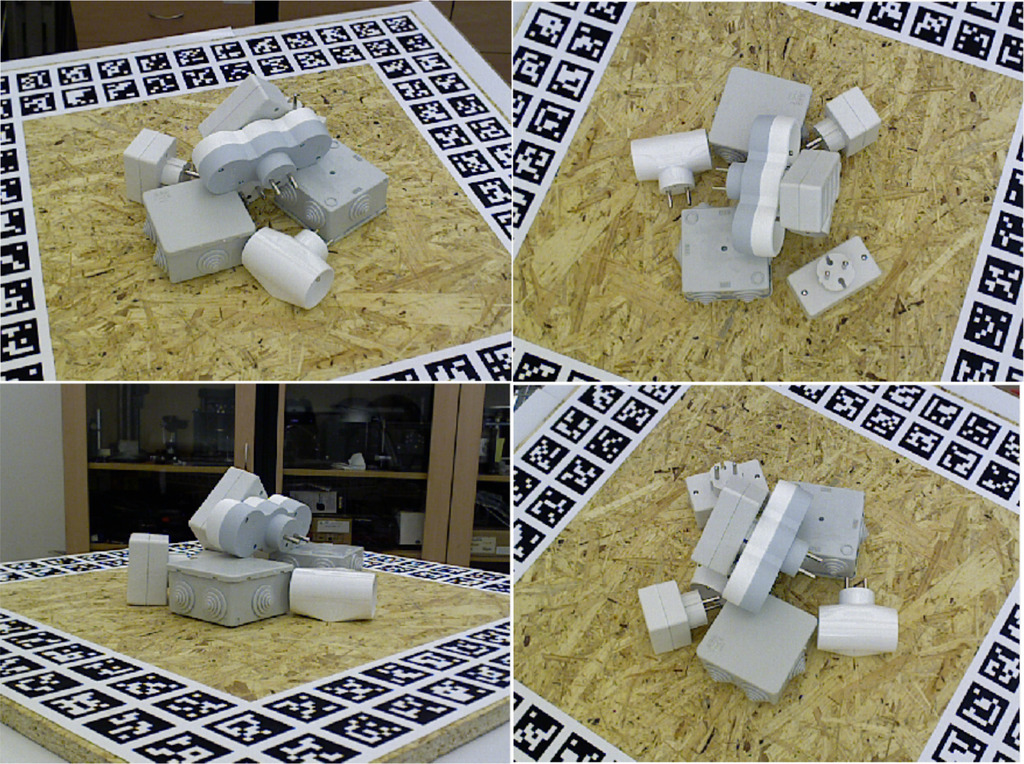
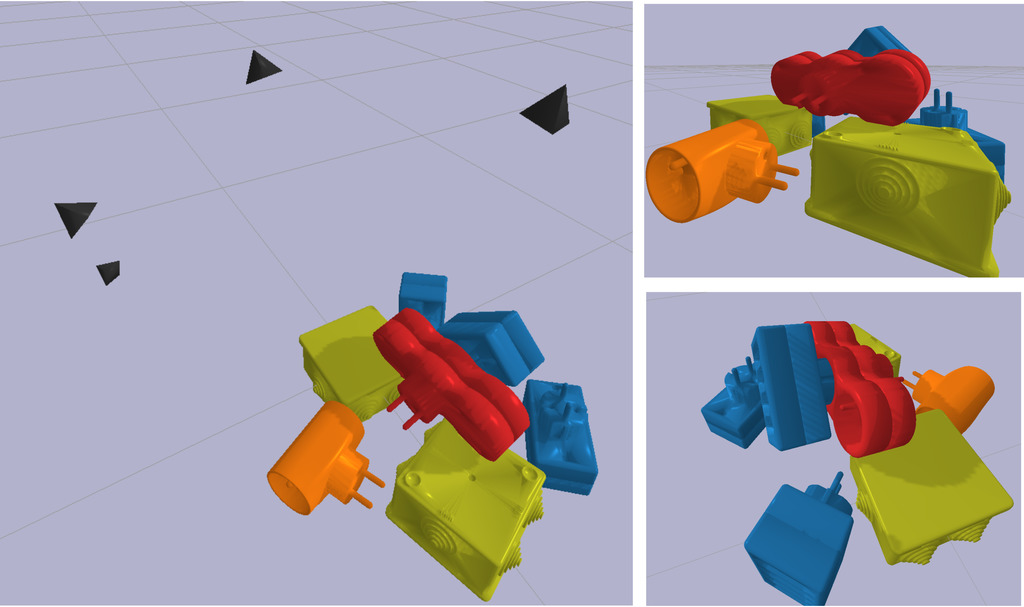
Figure 1(a) from the paper: input consists of multiple RGB images of the same scene, with unknown viewpoints. Sources: ar5iv HTML / arXiv. Image copyright belongs to the authors and publisher; reproduced here for paper commentary.Figure 1(b) from the paper: output is a complete scene model including object and camera poses. Sources: ar5iv HTML / arXiv. Image copyright belongs to the authors and publisher; reproduced here for paper commentary.
3. Problem setting
Task: multi-view, multi-object 6D pose estimation for known object instances.
Input: multiple RGB images of one scene, camera intrinsics, and known 3D / CAD object models; the single-view stage also needs 2D object detections.
Output: a consistent scene model containing object-instance classes, counts, 6D poses, and the camera pose of each view.
Key assumptions / priors:
instance-level, seen-object setting.
Known 3D object models and camera intrinsics.
No depth or known camera extrinsics between input views are required.
Enough cross-view-consistent object candidates must exist to estimate camera relationships.
Applications: cluttered scenes of known objects captured by moving or multiple cameras for robotics, especially textureless, symmetric, and occluded objects.
4. Core motivation
Problems addressed:
Single-view RGB pose estimation suffers from depth ambiguity, occlusion, false positives, and missed detections.
Multi-view information is often available, but traditional methods frequently require known camera extrinsics, local-feature matching, depth, or temporal continuity.
Why this matters:
Real robot scenes usually contain multiple objects; consistent scene-level poses support more reliable grasping, navigation, and interaction planning.
Main concerns with existing methods:
Most single-view methods process each detection independently, without scene-level consistency.
Earlier object-level SLAM / RGB-D methods depend on depth or consecutive frames.
Traditional SfM / COLMAP-style camera estimation becomes unstable with textureless scenes, wide baselines, and failed local features.
5. Method overview
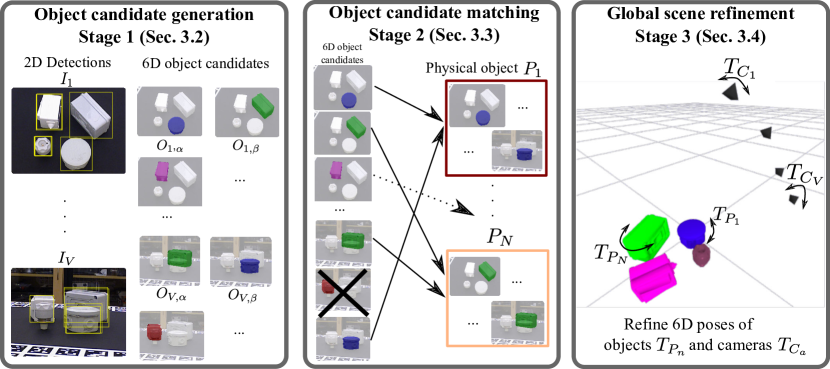
Figure 2 from the paper: a three-stage pipeline generates object candidates independently per view, matches them across views into a consistent scene, and finally performs global scene refinement. Sources: ar5iv HTML / arXiv. Image copyright belongs to the authors and publisher; reproduced here for paper commentary.
Overall pipeline:
Independently detect objects in each view and generate object-level 6D pose hypotheses.
Use RANSAC to match object candidates between view pairs, estimate relative camera pose, and filter inconsistent candidates.
Build a graph from cross-view matches, with connected components representing physical object instances.
Jointly optimize all object and camera poses through object-level bundle adjustment.
Key modules:
Single-view pose estimator: DeepIM-inspired render-and-compare refinement with an EfficientNet-B3 backbone.
Symmetry-aware distance: explicitly enumerates / discretizes object symmetries to avoid inappropriate pose-error definitions for symmetric objects.
RANSAC object matching: samples two candidate pairs to hypothesize a camera transform and validates it with at least a third inlier pair.
Scene refinement: minimizes multi-view object reprojection error rather than the point reprojection error of conventional bundle adjustment.
Training requirements: single-view detection and pose / refinement networks require training; multi-view matching and global refinement are geometric optimization procedures.
6. Experimental overview
Datasets: YCB-Video and T-LESS.
Metrics: ADD-S, ADD(-S), AUC of ADD-S / ADD(-S), VSD recall, ADD-S 0.1d, mAP@ADD-S0.1d, and others.
Main baselines: PoseCNN, PVNet, DeepIM, Pix2Pose, Implicit, and MCN / A Unified Framework for Multi-view Multi-class Object Pose Estimation.
Main results:
Single view: YCB-Video AUC of ADD-S 89.8 and AUC of ADD(-S) 84.5, slightly above DeepIM; T-LESS SiSo VSD recall 63.8, substantially above Pix2Pose 29.5 and Implicit 26.8.
Multiple views: YCB-Video AUC of ADD-S reaches 93.4 with 5 views, exceeding MCN’s 80.2 without ground-truth camera poses.
T-LESS ViVo: AUC of ADD-S, ADD-S 0.1d, and mAP@ADD-S0.1d improve from 1 view to 4 / 8 views.
Scene refinement: mean ADD-S errors of inlier candidates fall from 6.40 / 4.43 mm to 5.05 / 3.19 mm on YCB / T-LESS.
Paper table
Setting
Key numbers
Coarse-reading conclusion
Table 1(a)
YCB-Video single-view AUC of ADD-S
89.8
The single-view refiner already exceeds DeepIM’s 88.1
Table 1(b)
T-LESS SiSo VSD recall
63.8
Substantial gains on textureless objects with strong symmetries
Table 2(a)
YCB-Video multi-view AUC of ADD-S
93.4
5 views substantially exceed MCN’s 80.2 without ground-truth camera poses
Table 2(b)
T-LESS ViVo mAP@ADD-S0.1d
55.0 → 69.0
Overall detection + pose quality improves from 1 to 8 views
Table 3
Scene refinement ADD-S error
YCB 6.40 → 5.05 mm; T-LESS 4.43 → 3.19 mm
Object-level bundle adjustment reduces error
Are the authors’ conclusions broadly supported?
Authors’ claim: multi-view consistency substantially improves multi-object 6D pose without depth or known camera extrinsics.
My analysis: comparisons and ablations broadly support the claim, but remain limited to known models, benchmark data, and offline multi-view input; they do not establish arbitrary open-world operation.
7. Strengths and limitations
Strengths
Valuable setting: jointly handles multiple objects, multiple instances, multiple views, and unknown camera poses.
Clear design: single-view hypothesis generation, RANSAC matching, and object-level BA have explicit module boundaries.
Systematic symmetry handling: symmetry-aware distances enter both matching and optimization.
No depth dependency, making it relevant to RGB-only scenes.
Public code, models, and data-processing scripts make it a useful multi-view 6D pose baseline.
Limitations / risks
Depends on a 2D detector and single-view pose estimator; the back end cannot fully repair persistent front-end failures.
Requires CAD / 3D models; this is neither open-vocabulary nor category-level estimation.
Candidates must match across views; an object correctly detected in only one view may be lost.
Errors consistent across similar views may survive RANSAC / graph matching.
A long engineering pipeline: detection, rendering, pose refinement, RANSAC, and global optimization must all work together.
8. Research takeaways
Reusable ideas:
Treat single-frame pose predictions as object-level measurements, followed by scene-level optimization.
Put symmetry into matching, losses, and refinement as well as evaluation.
Use multi-view constraints to filter false positives / distractors.
Baseline suitability:
Highly relevant for known CAD, multi-view RGB, and multi-object scenes.
Not a direct baseline for single-frame monocular, category-level, or open-world settings.
Worth deep reading?
Yes, especially Stage 2 object-candidate matching, Stage 3 object-level bundle adjustment, and appendix failure modes.
Questions for further investigation:
Current code maintenance and runnable environments.
Whether later multi-view 6D pose methods have replaced CosyPose’s matching / refinement design.
Whether SAM, foundation detectors, or modern pose refiners can be combined with CosyPose’s scene-consistency framework.
Available src/paper-notes/cosypose/deep.md
In-depth paper notes
Support reproduction, comparison, related-work writing, and identifying opportunities for further research.
Deep Reading Notes: CosyPose: Consistent Multi-view Multi-object 6D Pose Estimation
CosyPose is an RGB-only, instance-level, seen-object system for multi-view, multi-object 6D pose estimation. It generates 6D object candidates per view, estimates unknown camera relationships through symmetry-aware object matching, and jointly optimizes camera and object poses through object-level bundle adjustment to obtain a consistent 3D scene reconstruction.
2.1 Guide to the paper’s figures and tables
Figure / table
Role in the paper
Reading guidance
Figure 1
Inputs / outputs: multiple RGB images → complete scene model
Establish the task boundary; CosyPose is more than a single-frame pose estimator
Figure 2
Method overview: candidate generation → matching → scene refinement
Refer back to it throughout the method
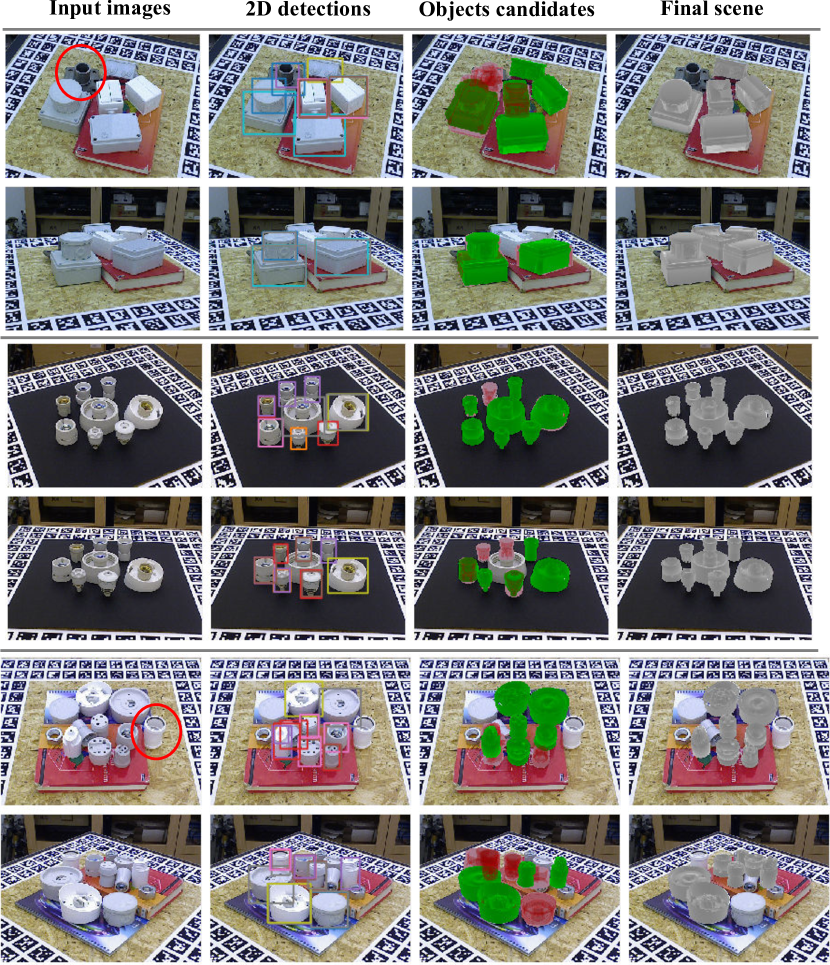
Figure 3
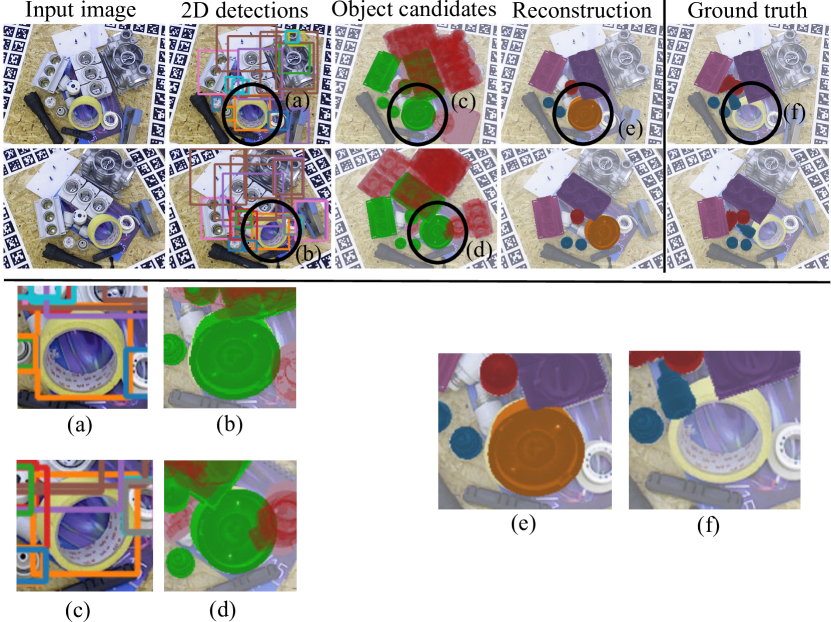
Qualitative candidates and final reconstruction
Read alongside Tables 2 / 3 to understand why multiple views help
Table 1
Single-view pose-estimator results and ablations
Check whether the Stage 1 front end is strong enough
Table 2
Main multi-view results
Supports the central claim that multi-view consistency improves results
Table 3
ADD-S error before / after refinement
Direct evidence for Stage 3 object-level BA
Figure 16
Failure cases: consistent mistakes
Essential for limitations: consistency constraints can consistently preserve errors too
3. Problem setting and task boundaries
Task definition:
Given multiple RGB images of the same static scene, estimate 6D poses of multiple known object instances and the camera pose of each view.
The paper defines the problem as recovering a compact scene model: object counts, classes, object poses, and camera poses.
Inputs:
Multiple RGB images.
Camera intrinsics for each image.
3D / CAD models corresponding to known object labels.
A 2D detector supplies boxes and classes for the single-view stage.
Outputs:
Class and 6D pose of each physical object instance.
Pose of each camera / view.
Per-view object-pose predictions obtained by projecting the global scene into each image.
Training inputs / outputs:
Training the single-view pose estimator requires real or synthetic RGB crops, object models, and ground-truth poses.
The network takes a real crop + rendered crop and predicts a pose update.
Multi-view matching and scene refinement are not learned and require no training.
Inference inputs / outputs:
Inputs are multiple RGB images, camera intrinsics, CAD models, and a detector / pose estimator.
Output is one consistent scene rather than independent per-image predictions.
Masks: no explicit masks in the main pipeline, but 2D detection is required.
Camera intrinsics: required.
Camera extrinsics: not required as input; estimated by the method.
Renderer: required for single-view render-and-compare and projection during optimization.
Multiple views: required for the core setting; the single-view pose estimator can also operate independently.
Key assumptions:
The scene is static, with input views observing the same set of objects.
Object candidates have sufficient cross-view consistency; camera-pose validation generally needs at least three inlier object-candidate pairs.
Objects belong to a known database with reliable 3D models and symmetry annotations / handling.
Fairness of baseline settings:
Single-view YCB-Video comparisons use the same PoseCNN detections / coarse estimates as DeepIM, making the setting relatively fair.
Single-view T-LESS comparisons use the same RetinaNet detections as Pix2Pose, helping isolate pose-estimator differences.
In multi-view comparisons, CosyPose does not use ground-truth camera poses, whereas MCN uses known camera poses; the authors emphasize better results with fewer priors.
My analysis: directly comparable baselines are scarce for this relatively new setting. The claim relies jointly on single-view ablations, MCN comparisons, and experiments varying view count.
4. Research context
Is this a pioneering work in a subfield?
It did not originate 6D pose or multi-view pose estimation.
It is an early representative system that jointly handles RGB-only input, unknown camera extrinsics, multiple views, and multiple objects.
Main foundations:
The single-view refiner clearly builds on DeepIM’s render-and-compare / iterative-refinement approach.
The multi-view stage adopts robust matching and global optimization from SfM / bundle adjustment, replacing local points with object-level pose hypotheses.
Related method designs or paper structures:
DeepIM: single-object pose refinement.
MCN / A Unified Framework for Multi-view Multi-class Object Pose Estimation: multi-view pose aggregation, but with known camera poses and stronger restrictions.
Object-level SLAM: joint object–camera state estimation, often dependent on depth or temporal continuity.
Main differences from prior work:
Does not directly depend on local-feature matching for camera extrinsics.
Requires neither a depth sensor nor continuous-motion assumptions.
Handles multiple instances of the same class and automatically recovers object counts.
Uses object-pose hypotheses as cross-view geometric constraints instead of first recovering point clouds or keypoint tracks.
Subsequent developments:
The project page and repository show subsequent use in the BOP Challenge 2020 and models for multiple datasets.
Whether later work comprehensively exceeds it under the same setting still needs verification. Later multi-view pose work may move toward feature-metric alignment, foundation-model detection, and category-level / novel-object settings.
5. Research motivation
Problems addressed:
Ambiguity, false positives, missed detections, and pose noise in single-view RGB 6D pose.
Unknown camera poses and difficult object association across views.
Scene-level consistency under symmetry, weak texture, multiple instances, and occlusion.
Reduced assumptions / dependencies:
Known camera extrinsics are unnecessary, unlike many multi-view methods.
No depth is required, unlike RGB-D object-level SLAM.
Views need not be consecutive video frames; temporal continuity is unnecessary.
Application value:
Robots can capture multiple RGB images with moving or multiple cameras for more stable object poses and scene explanations.
Particularly relevant to textureless industrial objects / T-LESS-style objects.
Core approach:
Accept that single-view networks produce noisy / incorrect hypotheses.
Use cross-view object-level geometric consistency to filter errors and aggregate correct candidates.
Globally optimize all objects and cameras in a common coordinate frame.
6. Method details
6.1 Overall pipeline
Figure 2 from the paper: the three-stage CosyPose pipeline. Stage 1 generates object candidates independently in each view; Stage 2 establishes a consistent scene through cross-view object-level matching; Stage 3 minimizes multi-view reprojection error through global scene refinement. Sources: ar5iv HTML / arXiv. Image copyright belongs to the authors and publisher; reproduced here for paper commentary.
Stage 1: object candidate generation
Run the detector on each image to obtain 2D boxes / labels.
Run the single-view pose estimator for each detection, producing TCaOa,α.
Each candidate contains a view index, candidate index, label, pose, and score.
Stage 2: object candidate matching
Run RANSAC for every view pair.
Sample object-candidate pairs with the same label to estimate relative camera pose.
Identify inlier pairs using a symmetry-aware distance.
Build a graph of all pairwise matches; connected components represent physical object instances.
Stage 3: scene refinement
Initialize camera and object poses in a shared world frame.
Minimize object-level reprojection error.
Jointly optimize all physical objects and cameras with Levenberg–Marquardt.
6.2 Key Modules
Module
Input
Output
Role
Interface to the next module
2D detector
RGB image
Object boxes / labels / scores
Supplies crops and classes to the single-view pose estimator
Each detection generates a pose candidate
Single-view pose estimator
Real crop, rendered crop, object model, initial pose
Refined 6D pose
Generates object-pose hypotheses per view
Stage 2 treats them as object-level measurements
Symmetry-aware distance
Object label, two poses, model points, symmetry set
Pose distance
Handles equivalent poses of symmetric objects
Used in candidate matching, loss, and refinement error
2-view RANSAC matching
Candidates from two views
Relative camera pose, inlier candidate pairs
Estimates view relationships and filters inconsistent candidates
Inlier edges from view pairs enter a graph
Scene-level graph matching
Pairwise inlier edges
Connected components / physical objects
Groups candidates across views into physical objects
Each component becomes one object to optimize
Object-level bundle adjustment
Physical-object groups, camera intrinsics, candidate poses, CAD points
Global camera and object poses
Jointly optimizes one consistent scene
Produces the final multi-object scene reconstruction
6.3 Underlying Models and Methods
CNN / detector:
The paper mentions detectors such as Faster R-CNN and RetinaNet. Experiments use RetinaNet for T-LESS and PoseCNN detections / coarse estimates for YCB-Video.
Pose refiner:
Inspired by DeepIM, but uses EfficientNet-B3 and removes auxiliary flow / mask predictions.
Takes a real crop and synthetic rendered crop, then predicts a pose update.
Rotation representation:
Uses a 6D rotation representation: two predicted 3D vectors are orthogonalized into a rotation matrix.
Geometric solver:
Stage 2 uses RANSAC.
Stage 3 uses Levenberg–Marquardt optimization.
Does it use newer methods such as DINO, CLIP, SAM, NeRF, 3DGS, or VGGT?
This 2020 paper does not use these foundation-model / neural-rendering methods.
6.4 Training and supervision
Is it training-free?
The overall system is not training-free: single-view detection and pose estimation require training.
Multi-view matching / BA are geometric optimization without training.
Training data:
Real training images supplied by YCB-Video and T-LESS.
Approximately one million additional synthetic images rendered for each dataset.
CAD models for T-LESS and reconstructed models for YCB-Video.
Alignment between training objectives and final metrics:
The loss is closely related to ADD-S / symmetry-aware pose error, but is not identical to BOP VSD / mAP.
My analysis: training targets single-view pose quality; final multi-view quality also depends on detector recall, matching consistency, and BA initialization.
6.5 Inference and engineering complexity
Inference steps:
Run the detector on each image.
Run the coarse / refinement pose network on each detection.
Perform object-level RANSAC for each view pair.
Build a graph, remove isolated vertices, and form physical objects.
Initialize global camera / object poses.
Perform object-level BA.
Optionally apply 3D NMS to remove duplicate physical objects.
Test-time optimization / refinement:
Required: both single-view pose refinement and final scene refinement are test-time computations.
Speed / memory / dependencies:
The paper reports approximately 320 ms for a common configuration with 4 views and 6 detections per view.
Stage 1 takes approximately 190 ms, Stage 2 approximately 40 ms, and Stage 3 approximately 90 ms.
Requires PyTorch, a renderer, BOP toolkit, CAD models, and dataset-specific detectors / models.
Reproduction challenges:
The environment is old; the original repository states that it is no longer maintained and points users with issues to Simple-Robotics/cosypose.
Multi-dataset BOP formatting, CAD-model paths, rendering setup, and pretrained-weight downloads constitute the main engineering costs.
Reproduction requires more than running the network: detection, candidate filtering, RANSAC thresholds, and BA initialization must match the paper.
7. Experimental analysis
7.1 Datasets
Datasets used:
YCB-Video: 92 scenes with approximately 1000 images each; 80 training and 12 test scenes; 21 YCB objects with noise, lighting variation, and occlusion.
T-LESS: 20 scenes and 30 textureless industrial objects, mostly symmetric and visually similar. Images captured around scenes provide richer multi-view observations.
Custom dataset construction and scale:
No new benchmark is introduced, but the authors generate many synthetic training images.
Synthetic generation: randomly sample 3-9 objects in a 50 cm box, half floating and half placed through physics simulation; cameras face the box center, with background / color domain randomization and augmentation.
7.2 Evaluation Metrics
Metrics:
ADD, ADD-S, ADD(-S).
AUC of ADD-S / ADD(-S).
VSD recall.
ADD-S 0.1d, ADD(-S) 0.1d.
mAP@ADD-S0.1d.
Interpretation:
ADD: mean model-point distance under predicted and ground-truth poses, mainly for asymmetric objects.
ADD-S: nearest-neighbor / closest-point distances reduce penalties for equivalent poses of symmetric objects.
VSD: accounts for visible-surface differences, making it appropriate for T-LESS symmetry / visibility issues.
mAP@ADD-S0.1d: combines pose correctness with detection ranking, closer to object-detection precision–recall evaluation.
Do these metrics sufficiently reflect practical performance?
Authors’ claim: the metrics demonstrate improved single-view and multi-view pose accuracy.
My analysis: they reflect benchmark accuracy, while robotics also requires grasp tolerances, real-time performance, transparent / reflective-object handling, dynamic scenes, camera-motion control, and failure recovery.
7.3 Compared Methods
Method
Type
Input setting
Main characteristics
Relationship to this paper
PoseCNN
Single-view 6D pose
RGB-D / RGB detections + pose
Representative YCB-Video baseline
CosyPose uses its YCB detections / coarse estimates for fair comparison
DeepIM
Single-view refinement
RGB + initial pose + CAD render
Iterative render-and-compare refinement
Direct design basis of the CosyPose single-view refiner
PVNet
Keypoint voting + PnP
RGB + CAD keypoints
Single-view keypoint method
Single-view YCB baseline
Pix2Pose
Dense correspondence
RGB
RGB-only method on T-LESS
Single-view T-LESS baseline
Implicit
Implicit orientation learning
RGB
RGB-only method on T-LESS
Single-view T-LESS baseline
MCN / Unified multi-view framework
Multi-view pose
Multiple views + known camera poses
Multi-view aggregation
Main multi-view baseline; CosyPose does not use ground-truth camera poses
Object-level SLAM
Scene-level object / camera estimation
Usually RGB-D / temporal
Joint object–camera state optimization
Similar goal, with more sensor or consecutive-frame requirements
7.4 Main results
State of the art at publication:
Authors’ claim: substantially exceeds the contemporary state of the art in both single-view and multi-view 6D object-pose estimation.
The project page also identifies CosyPose as the BOP Challenge 2020 winner.
Improvements over contemporary methods:
Single-view YCB-Video: AUC of ADD-S 89.8 versus DeepIM 88.1; AUC of ADD(-S) 84.5 versus DeepIM 81.9.
T-LESS SiSo: VSD recall 63.8 versus Pix2Pose 29.5 and Implicit 26.8.
Multi-view YCB-Video: 5-view AUC of ADD-S 93.4 versus MCN 80.2.
Multi-view T-LESS: with 1, 4, and 8 views, AUC of ADD-S rises from 72.1 to 76.0 to 78.9; mAP@ADD-S0.1d rises from 55.0 to 61.6 to 69.0.
Gap to the current best under the same setting, if needed:
Requires further verification. This is a 2020 method; the latest results for multi-view, RGB-only, known-object estimation with unknown extrinsics need a separate check of current BOP / arXiv / benchmarks.
7.4.1 Main Results Reorganized
Source table
Dataset / task
Method or view count
Metric
Result
Interpretation
Table 1(a)
Single-view YCB-Video
PoseCNN
AUC of ADD(-S)
61.3
Earlier RGB-D / detection baseline
Table 1(a)
YCB-Video single-view
PVNet
AUC of ADD(-S)
73.4
keypoint + PnP baseline
Table 1(a)
Single-view YCB-Video
DeepIM
AUC of ADD-S / ADD(-S)
88.1 / 81.9
Directly related render-and-compare baseline
Table 1(a)
Single-view YCB-Video
CosyPose
AUC of ADD-S / ADD(-S)
89.8 / 84.5
Stage 1 is already a strong front end
Table 1(b)
T-LESS SiSo
Implicit / Pix2Pose
VSD recall
26.8 / 29.5
Older methods struggle with texturelessness and symmetry
Table 1(b)
T-LESS SiSo
CosyPose
VSD recall
63.8
Substantial contributions from single-view refinement and training
Table 2(a)
Multi-view YCB-Video
MCN, 5 views
AUC of ADD-S
80.2
Multi-view baseline using known camera poses
Table 2(a)
Multi-view YCB-Video
CosyPose, 5 views
AUC of ADD-S
93.4
Substantially higher without ground-truth camera poses
Figure 3 from the paper: three qualitative examples show inputs / object candidates on the left and final scene reconstructions on the right. They illustrate how multi-view consistency aggregates noisy single-view candidates into a more complete scene explanation. Sources: ar5iv HTML / arXiv. Image copyright belongs to the authors and publisher; reproduced here for paper commentary.
7.5 Ablation studies
Ablation
Claim tested
Result
Sufficiency
T-LESS w/o loss
Symmetric disentangled loss helps
63.8 falls to 60.1
Broadly sufficient, but tested only in this setting
T-LESS w/o network
EfficientNet / the new architecture improves on the earlier design
63.8 falls to 59.5
Supports this component’s value
T-LESS w/o rotation parametrization
The 6D rotation representation is more stable
63.8 falls to 61.0
Supportive, with a moderate gain
T-LESS w/o data augmentation
Augmentation is crucial for the domain gap
63.8 falls to 37.0
Strong evidence of a substantial synthetic-to-real gap
Before / after scene refinement
Object-level BA improves accuracy
YCB 6.40 mm falls to 5.05 mm; T-LESS 4.43 mm falls to 3.19 mm
Supports the core optimization module
Number of views
Multiple views improve scene-level pose
T-LESS metrics increase over 1/4/8 views
Supports multi-view consistency
Camera pose vs. COLMAP / ground-truth camera poses
Object hypotheses recover camera poses
COLMAP succeeds on only 4% of T-LESS 8-view cases, versus approximately 74% for CosyPose; ground-truth camera poses improve results only slightly
Supports the importance of the unknown-extrinsics setting
7.6 Robustness and Failure Cases
Occlusion:
Multiple views compensate for missed detections in some views; the final scene can recover an object if it is visible and matched elsewhere.
An object correctly detected in only one view may be discarded without a cross-view match.
Textureless / weakly textured objects:
T-LESS specifically covers textureless industrial objects, and CosyPose performs strongly on it.
Its advantage comes from object-level hypotheses rather than local-feature matching.
Symmetric objects:
Explicit object symmetries enter matching and distance measures.
Continuous axial symmetry is approximated in practice with 64 discrete rotation angles.
Depth noise / mask errors / domain gap:
No depth is used, so there is no depth-noise dependency.
Masks are not directly required, but a 2D detector is.
Domain gaps remain; data augmentation is a crucial T-LESS ablation.
Failure cases:
Consistent mistakes: incorrect candidates consistent across at least two similar views enter the final reconstruction.
Missing final objects: correct candidates appearing in only one view cannot be validated across views and are removed.
Incorrect camera pose: too few inliers can cause camera-pose estimation to fail.
Duplicate objects: visually similar objects can generate overlapping physical-object hypotheses, requiring 3D NMS.
Figure 16 from the paper: a limitation case in which incorrect candidates consistent across similar views can preserve a wrong reconstruction. Multi-view consistency filters random errors, but may retain errors that are themselves consistent across views. Sources: ar5iv HTML / arXiv. Image copyright belongs to the authors and publisher; reproduced here for paper commentary.
7.7 Are the Contributions Experimentally Supported?
Matching: graph neural networks or probabilistic data association.
Optimization: robust loss + uncertainty weighting + differentiable renderer.
Additional experiments:
Stability curves versus object count, shared visibility, and camera baseline.
Failure analysis as detector recall decreases.
Engineering-cost / accuracy tradeoffs against calibrated-camera and RGB-D settings.
Real-robot grasp success rather than pose metrics alone.
10. Implications for my research
Directly reusable ideas:
Treat per-view poses as noisy object-level measurements and integrate them through global geometric consistency.
Go beyond independent per-object prediction by explicitly recovering scene graphs / physical-object components.
Handle symmetry throughout losses, matching, and evaluation rather than correcting only at the end with ADD-S.
Reusable code / modules / data processing:
Multi-view object-candidate matching.
object-level bundle adjustment.
synthetic data generation pipeline.
BOP-format data preparation and evaluation logic.
Essential baselines:
CosyPose is a core baseline for known CAD + multi-view RGB + multi-object pose research.
For single-view pose refinement, its refiner represents a major successor to DeepIM.
Potential research entry points:
Reduce missed / incorrect detections with a stronger front end while retaining CosyPose’s scene-consistency back end.
Extend object-level consistency to novel objects / category-level pose.
Add active view selection based on current scene uncertainty.
Use uncertainty-aware optimization for pose-hypothesis confidence and detector scores.
11. Open questions
Conceptual questions:
Does each matching-graph connected component always represent one physical object? How does the graph split or merge when similar objects are close together?
Object-level BA uses pose-induced reprojection without directly using image appearance; could this limit final accuracy?
Formula questions:
How are truncated L2 thresholds set in Eqs. 5 / 6, and how sensitive is outlier robustness to them?
Are 64 angles sufficient to discretize a continuous symmetry axis, and can this affect high-precision optimization?
Experimental questions:
T-LESS multi-view ViVo lacks a strong direct baseline; how should later methods be compared fairly?
When benchmark metrics do not penalize certain false positives, is mAP@ADD-S0.1d a sufficient supplement?
The gap between CosyPose-related models and modern methods on the current BOP leaderboard needs further verification.
Reproduction questions:
The original repository is no longer maintained; environment dependencies, pretrained-model downloads, and renderer configuration need particular attention.
Can the multi-view back end be reproduced independently by supplying candidates from another method?
With a modern segmentation / foundation-model detector, how should candidate scores enter the original RANSAC + graph + 3D NMS pipeline?