Cov2Pose: Leveraging Spatial Covariance for Direct Manifold-aware 6-DoF Object Pose Estimation
Cov2Pose compresses image features into SPD matrices through spatial covariance pooling. A manifold-aware pose head encodes rotation and translation, addressing inconsistencies of direct Euclidean regression under occlusion and across rotation representations.
Quickly assess the paper's scope, problem setting, core method, experimental findings, and whether to read it in depth.
Overview Notes: Cov2Pose: Leveraging Spatial Covariance for Direct Manifold-aware 6-DoF Object Pose Estimation
1. Basic information
Title: Cov2Pose: Leveraging Spatial Covariance for Direct Manifold-aware 6-DoF Object Pose Estimation
Authors / affiliations: Nassim Ali Ousalah, Peyman Rostami, Vincent Gaudillière, Emmanuel Koumandakis, Anis Kacem, Enjie Ghorbel, Djamila Aouada; University of Luxembourg and collaborators
Cov2Pose constructs an SPD representation from the spatial covariance of convolutional features, then directly regresses continuous 6DoF pose on the SPD manifold through BiMap layers and Cholesky pose encoding.
2.1 Guide to the paper’s figures and tables
Figure / table
Purpose
Overview reading tips
Figure 1
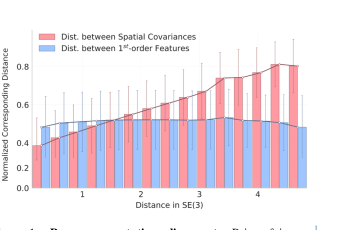
Covariance distance versus flattened-feature distance as pose distance changes
Distinguish the backbone, covariance pooling, and pose decoding
Tables 1 / 2 / 3
LINEMOD, Occ-LINEMOD, and YCB-V results
Compare direct regression with PnP baselines
Tables 4 / 5
Rotation-representation, SPD-head, and loss ablations
Examine the need for continuous pose encoding
Table 6
Speed–accuracy comparison
Assess the deployment value of a direct method
Relevant region from the paper's figures: spatial covariance distance grows with SE(3) pose distance, whereas flattened-feature distance remains approximately constant. Source: CVF Open Access. Image copyright belongs to the authors and publisher; reproduced here for paper commentary.
3. Problem setting
Input: one RGB object image / crop; output: camera-relative rotation and translation.
CAD-free direct pose regression, without intermediate 2D keypoints, PnP, or iterative render refinement.
Focuses on instance-level LINEMOD, Occluded LINEMOD, and YCB-Video, including partial occlusion.
4. Method overview
EfficientNet-B6 extracts a spatial feature map.
Covariance pooling produces an SPD matrix from spatial features.
Geometry-preserving BiMap / ReEig layers reduce dimensions and transform features on the SPD manifold.
Differentiable Cholesky decoding converts the SPD pose code into continuous 6D rotation and translation.
Compute pose loss on SO(3) × R³.
5. Experimental overview
LINEMOD, Occluded LINEMOD, YCB-Video.
Strong ADD(-S) among end-to-end methods on LINEMOD; mean LM-O ADD(-S) is approximately 76.8, with competitive YCB-V AUC.
Approximately 41.4M parameters, with a reported speed–accuracy tradeoff for direct regression.
6. Quick assessment
Value: introduces spatial second-order statistics and manifold representations for direct pose estimation without PnP.
Strengths: end-to-end, CAD-free, continuous rotation encoding, and a novel architecture.
Limitations: requires seen-object training; covariance is sensitive to background, crops, and backbone-feature quality.
Recommended readers: those interested in direct pose regression, SPD manifolds, rotation representations, and real-time estimation.
Available src/paper-notes/cov2pose/deep.md
In-depth paper notes
Support reproduction, comparison, related-work writing, and identifying opportunities for further research.
Deep Reading Notes: Cov2Pose: Leveraging Spatial Covariance for Direct Manifold-aware 6-DoF Object Pose Estimation
Core assessment: Cov2Pose jointly addresses two common direct-regression problems: global pooling discards spatial second-order statistics, and Euclidean regression does not naturally represent SPD / SO(3) geometry.
2. Positioning in one sentence
Spatial covariance serves as the image-to-pose intermediate representation; SPD-aware layers preserve matrix structure, while Cholesky coding provides a differentiable map from SPD to continuous 6D pose.
2.1 Guide to the paper’s figures and tables
Figure / table
Deep-dive questions
Figure 1
Does correlation between covariance distance and pose geodesic distance hold across objects?
Figure 2
What interfaces connect covariance pooling, BiMap, Cholesky, and SO(3) loss?
Table 1
Are comparisons with direct / PnP methods on LINEMOD fair?
Table 2
Does covariance better handle Occluded LINEMOD occlusion?
Table 3
Do YCB-V ADD(-S) and AUC both improve?
Tables 5 / 6
What gains and costs arise from Euclidean heads, SPD heads, and runtime?
Relevant region from the paper's figures: spatial covariance distance correlates with true SE(3) pose distance, whereas flattened features are relatively insensitive. Source: CVF Open Access. Image copyright belongs to the authors and publisher; reproduced here for paper commentary.
3. Problem setting and task boundaries
For RGB object crop I, the network learns I→P∈SE(3).
Direct regression skips intermediate 2D keypoints / dense coordinates / PnP. It is usually faster but more sensitive to representation and loss design.
Training object instances are known. “CAD-free” means no CAD is needed at inference; it does not imply unseen-object generalization.
YCB-V uses training images and publicly available PBR images; LINEMOD / LM-O follow standard training / validation splits.
4. Research context
PnP methods are accurate but first require 2D–3D correspondences. Direct regression is faster but often uses flattened features and discontinuous rotation representations.
Covariance descriptors capture pairwise feature co-activation, texture, and shape distributions, naturally residing on an SPD manifold.
Cov2Pose combines this representation with Riemannian deep learning and continuous 6D rotation representations.
5. Research motivation
Global average / max pooling discards second-order relationships between spatial positions.
Pose changes affect feature-map spatial covariance, potentially making it more discriminative than first-order means.
Direct quaternion, Euler-angle, or discrete-bin regression encounters discontinuity / normalization issues.
SPD matrices and Cholesky pose codes can represent continuous rotation / translation while preserving positive-definite structure.
6. Method details
6.1 Spatial covariance pooling
The backbone outputs a C×H×W feature map, treating each spatial position as a feature sample.
Covariance of channels or spatial descriptors yields a symmetric positive-definite matrix.
Figure 1 shows that Log-Euclidean covariance distance between image pairs grows with ground-truth SE(3) distance, while flattened-feature cosine distance changes little.
6.2 SPD manifold layers
BiMap reduces SPD-matrix dimensions while preserving geometry, avoiding positive-definiteness violations from ordinary Euclidean linear layers.
ReEig raises very small eigenvalues into a numerically stable range.
Multiple SPD-processing layers produce a compact latent SPD code.
6.3 Pose Encoding and Loss
A Cholesky layer decodes the latent SPD matrix into a lower-triangular matrix, then obtains continuous 6D rotation and translation.
Continuous 6D rotation maps into SO(3), avoiding direct optimization in a discontinuous parameter space.
Pose loss is measured on SO(3) × R³, retaining rotation’s geometric meaning.
7. Experimental analysis
7.1 Data and Metrics
LM / LINEMOD, LM-O / Occluded LINEMOD, YCB-V.
Metrics include ADD(-S) recall, ADD-S AUC, ADD(-S) AUC, and inference time; symmetric objects use ADD-S.
7.2 Main results
On LINEMOD, Cov2Pose achieves best or near-best ADD(-S) among end-to-end direct methods, trailing the strongest PnP method only slightly.
Occluded LINEMOD mean ADD(-S) is approximately 76.8, above compared direct-regression methods. YCB-V ADD(-S) is approximately 72.3, with ADD-S / ADD(-S) AUC around 91.5 / 87.0.
Table 6 shows a favorable speed–accuracy tradeoff: the covariance head retains the speed advantage of direct methods.
7.3 Ablations
Removing covariance pooling or using ordinary flattened features lowers accuracy, supporting spatial second-order statistics.
Replacing the SPD-manifold head with Euclidean regression reduces accuracy; matrix geometry contributes more than a cosmetic module.
Replacing continuous 6D rotation with other parameterizations causes clear degradation.
Preserve full covariance structure and pose encoding during training, avoiding destruction of SPD information before decoding.
8. Critical analysis
Strengths: explicit representation assumptions, comprehensive SPD / SO(3) geometry, and engineering appeal from direct regression.
Limitations: training / testing still rely on known object categories; unseen-object and open-world generalization are not directly guaranteed.
Input sensitivity: covariance aggregates all crop features; background, masks, occlusion, and object-scale changes can contaminate statistics.
Interpretability: Figure 1 diagnoses covariance–pose correlation, but the final network’s specific spatial structure remains difficult to interpret.
9. Implications for my research
Covariance / SPD codes can combine with correspondence confidence, pose uncertainty, or feature-metric refinement.
A direct head can retain PnP / render refinement as a fallback in a speed-oriented coarse-to-fine pipeline.
Model equivalent solutions for symmetric objects in an SPD pose posterior, rather than relying only on ADD-S after prediction.
10. Open questions
How can covariance representations generalize to unseen objects and categories?
How can spatial covariance incorporate local visibility and mask uncertainty?
How can video recursively update SPD pose codes while preserving temporal consistency on the manifold?
11. Deep Reading Supplement: Evidence for Cov2Pose Manifold Regression
11.1 Key Configuration
Cov2Pose uses an EfficientNet-B6 backbone with approximately 41.4M parameters. YCB-V training / validation follows a 90 / 10 split, with 20 epochs on 4 NVIDIA A100 GPUs. One RGB object image / crop produces continuous 6D rotation + translation without CAD, PnP, or iterative rendering.
Covariance pooling of spatial feature maps produces an SPD matrix. BiMap / ReEig perform manifold dimensionality reduction and regularization, followed by differentiable Cholesky decomposition to obtain a 4×4 SPD pose code and decode rotation / translation. Cholesky is part of the differentiable pipeline rather than post-processing.
11.2 Main Results and Speed
Mean ADD(-S) is 76.8 on LM-O and 72.3 on YCB-V; Table 3 also reports ADD(-S) / AUC metrics. The LM-O Table 2 Ours row is 64.0, 96.4, 74.1, 96.3, 55.8, 57.9, 93.6, and 76.7, averaging 76.8 and exceeding its direct-regression comparators.
Inference takes 22.6 ms for the backbone, 0.5 ms for covariance pooling, and 23.8 ms for the SPD head + pose regression, totaling 46.9 ms. This is not exceptionally fast, but offers a balanced speed–accuracy point among direct-pose methods without PnP / render refinement.
11.3 Structural Interpretation of Ablations
The 6D + Gram–Schmidt rotation representation achieves mean 76.8, supporting greater stability for direct regression.
Euclidean regression, removal of SPD head / BiMap / ReEig, or disruption of covariance structure reduces performance, supporting second-order spatial statistics and manifold constraints.
Figure 1 shows spatial covariance distance increasing with ground-truth SE(3) distance while flattened first-order feature distance is flatter. This diagnoses the representation hypothesis, without establishing causality for the final model.
Supported by Figure 1 and LM-O / YCB-V results, but background / mask-noise breakdowns are needed.
SPD manifolds improve direct-pose accuracy
Supported by ablations; a same-backbone Euclidean head still needs strictly matched parameter counts and training duration.
CAD-free direct estimation has deployment value
46.9 ms and the end-to-end design are attractive, but seen-object benchmarks do not establish unseen-object performance.
12. Limitations and Transfer
Covariance aggregates every feature in the crop; background contamination, occlusion, and scale changes alter its statistical structure. Symmetric objects also need symmetry-aware training / posteriors. A practical hybrid could generate coarse poses with Cov2Pose, use COG / AlignPose correspondences or feature refinement as a fallback, and treat the SPD residual as an uncertainty signal.