Reading Notes
Overview / Deep Dive
Available src/paper-notes/deterministic-pose-confidence-iccv2025/coarse.md
Paper overview notes
Quickly assess the paper's scope, problem setting, core method, experimental findings, and whether to read it in depth.
Overview Notes: Deterministic Object Pose Confidence Region Estimation
1. Basic information
- Year / venue: 2025 / ICCV; reading mode: coarse reading.
- Task: provide a confidence region with specified coverage for 6D pose, beyond a point estimate alone.
- Paper: ICCV Open Access.
2. Positioning in one sentence
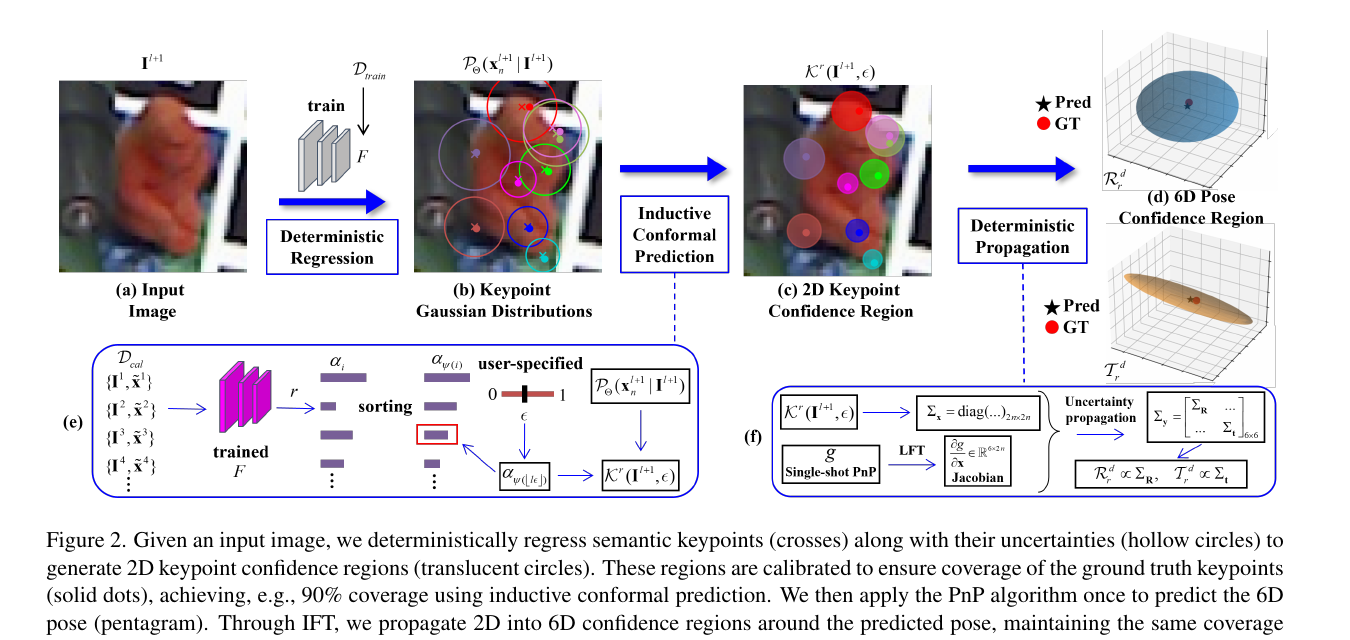
The paper deterministically regresses Gaussian keypoint distributions, calibrates them into 2D regions through inductive conformal prediction, and propagates them in one step to 6D pose regions using the implicit function theorem, avoiding slow sampling / ensembles and overly broad regions.
2.1 Guide to the paper’s figures and tables
| Figure / table | What to examine |
|---|---|
| Figure 2 | The complete chain: image → Gaussian keypoints → conformal 2D regions → single-shot PnP / IFT → 6D pose region. |
3. Method overview
- A CNN outputs a 2D Gaussian mean / variance for each semantic keypoint, without heatmap sampling.
- Calibration-set nonconformity scores construct 2D keypoint regions at the user-specified coverage.
- Single-shot PnP yields a point pose; the IFT Jacobian locally propagates keypoint covariance / regions into rotation and translation confidence regions.
4. Experimental overview
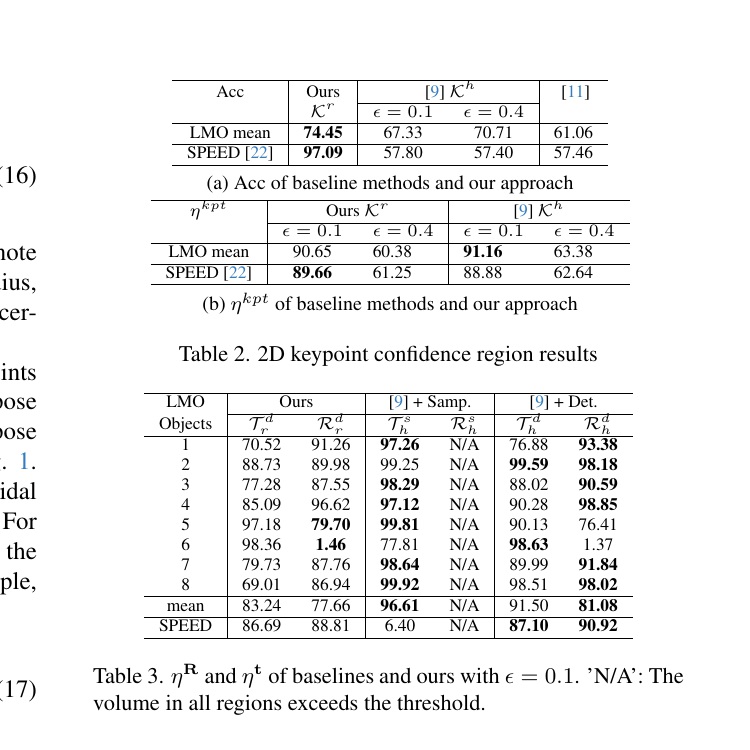
- Datasets: Occlusion LINEMOD and SPEED; evaluation focuses on coverage, region volume, time, and pose accuracy.
- Authors’ claim: at equal coverage, rotation / translation confidence volumes shrink by up to 99.9% / 99.8%, with faster computation than sampling methods.
- My analysis: an uncommon 6D pose work that makes uncertainty itself an output. Propagation relies on local linearity and properly calibrated keypoint models; severe occlusion, symmetric multimodality, and PnP degeneracy need additional treatment.
5. Strengths, Risks, and Implications
- Strengths: confidence has coverage semantics rather than being only a heuristic score, and aligns with the PnP geometry pipeline.
- Risks: requires a calibration set and definable keypoints; confidence regions do not automatically solve incorrect detections or wrong-object predictions.
- Implication: robot systems should pass pose uncertainty to downstream grasp planning rather than selecting only the highest-confidence pose.