DiffusionNOCS: Managing Symmetry and Uncertainty in Sim2Real Multi-Modal Category-Level Pose Estimation
DiffusionNOCS generates multiple dense NOCS maps with conditional diffusion, then uses depth–NOCS 3D correspondences and TEASER++ to recover scale and 6D pose. Multimodal conditioning and multiple noise hypotheses address symmetry-induced alternatives, missing depth, and synthetic-only training's transfer to real environments.
DiffusionNOCS conditionally generates one or more dense NOCS coordinate maps, then recovers pose from NOCS–depth correspondences, rather than directly regressing one deterministic 6D pose. This generative representation retains multiple solutions for symmetric objects and supports flexible combinations of RGB, surface normals, and DINOv2 features according to sensor availability.
3. Guide to the paper’s figures and tables
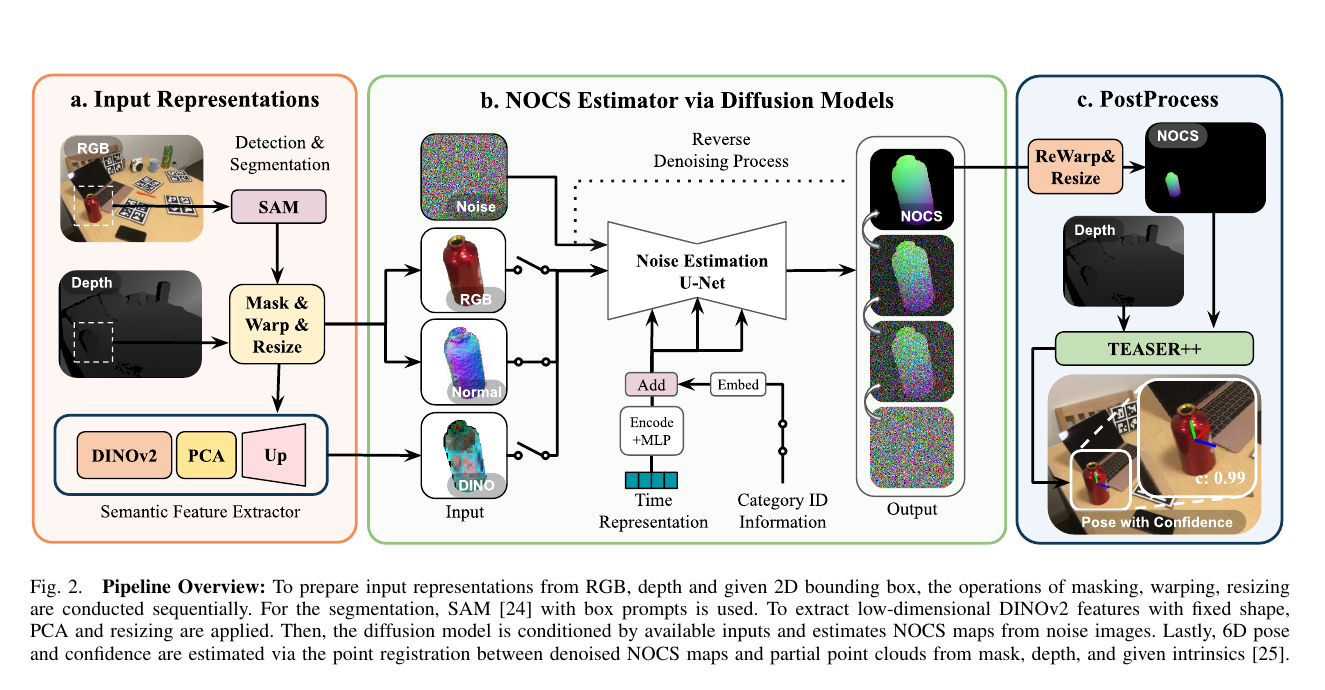
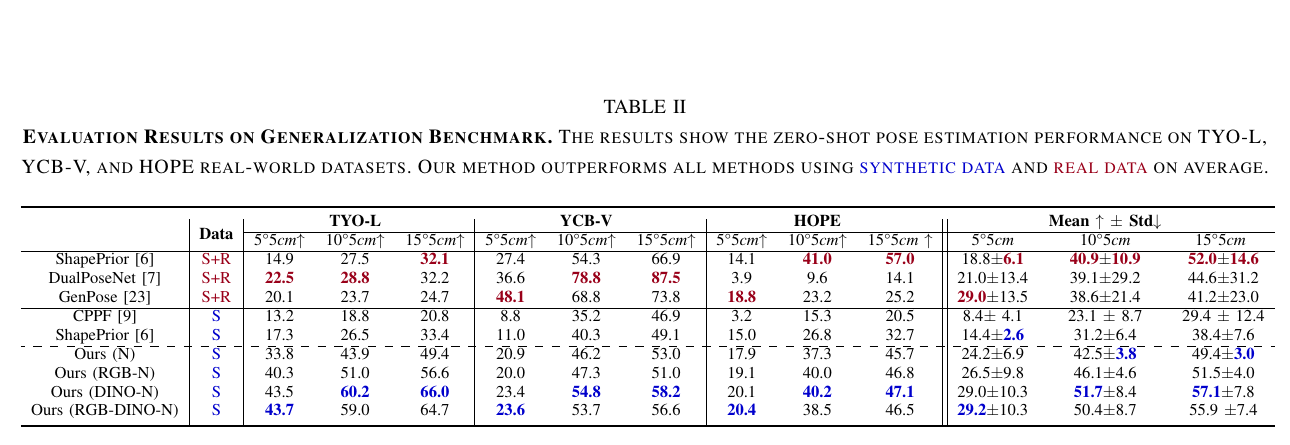
Figure 2 from the paper: cropped and normalized RGB, depth normals, and DINOv2 features provide optional conditions. A diffusion U-Net generates NOCS maps, followed by depth correspondences and TEASER++ pose recovery. Source: public author manuscript. Image copyright belongs to the authors and IEEE; reproduced here for paper commentary.Table II from the paper: zero-shot results on three real datasets after synthetic-only training. Compare under matched inputs and training-data protocols rather than only reading column maxima. Source: public author manuscript. Table copyright belongs to the authors and IEEE; reproduced here for paper commentary.
4. What Problem Does It Address?
Single-frame category-level 6D pose and scale estimation for unseen instances of known categories.
Inference needs at least a target box, category ID, and depth; available RGB can also supply raw appearance and DINOv2 semantic features.
Training uses only synthetic renders of ShapeNet models, emphasizing sim-to-real transfer across real environments.
Two key challenges: symmetric or occluded objects admit multiple plausible poses, and real sensors can suffer depth holes, illumination changes, or missing modalities.
5. Method overview
Convert depth into surface normals less entangled with scale, translation, and camera parameters, and extract DINOv2 features from RGB.
Condition the U-Net on available inputs, category embeddings, and diffusion timesteps to denoise Gaussian noise into NOCS maps.
Sample multiple NOCS hypotheses from different initial noises; each pixel’s NOCS coordinate and observed depth provide a 3D–3D correspondence.
Recover a similarity transform with TEASER++ and select the result by inlier-ratio confidence.
6. Experiments at a glance
Datasets: NOCS REAL275 and the authors’ cross-domain TYO-L, YCB-V, and HOPE protocols.
Metrics: 5°5cm, 10°5cm, and 15°5cm mAP; equivalent axial rotations are ignored for axially symmetric objects.
Mean 5°5cm mAP over three generalization datasets is 29.2; DINO-N mean 10°5cm is 51.7.
The paper’s 6-noise-sample, 6D-PCA, 10-step DPM-Solver configuration takes 0.855 s on Tesla V100. One sample takes approximately 0.386 s but loses substantial accuracy.
7. Quick assessment
Key reading point: represent symmetry uncertainty in a NOCS distribution instead of designing category-specific symmetry regression losses.
Engineering value: one model supports different input combinations; RGB can restore canonical coordinates when reflective-object depth is missing.
Main limitations: still needs reliable boxes, category IDs, masks, and at least some valid depth; repeated diffusion sampling limits real-time use.
Recommended readers: researchers in category-level pose, generative geometry, NOCS, symmetry, and sim-to-real transfer.
Available src/paper-notes/diffusionnocs-iros2024/deep.md
In-depth paper notes
Support reproduction, comparison, related-work writing, and identifying opportunities for further research.
Deep Reading Notes: DiffusionNOCS
1. Key assessment
DiffusionNOCS changes the random variable itself, beyond replacing pose regression with diffusion: it generates image-aligned dense NOCS maps. This representation carries local shape, 2D–3D correspondences, and a multimodal distribution of symmetric poses, while retaining a classical geometric solver for scale and 6D pose recovery.
The authors claim that synthetic-only training, multiple diffusion hypotheses, and selectable multimodal conditions yield greater stability across real environments than deterministic category-level methods. Cross-dataset results provide strong evidence, but gains jointly depend on diffusion, DINOv2 semantics, normal preprocessing, and a new synthetic-training protocol; they cannot all be attributed to diffusion alone.
2. Problem setting and task boundaries
Given a target’s 2D box, category ID, and observations, estimate camera-relative rotation R, translation t, and scale s for an unseen instance within a known category. Depth is assumed available; RGB, surface normals, and DINOv2 features provide optional conditions.
Category-level means the training categories are known but test instances are unseen. Zero-shot generalization means training only on the authors’ synthetic data and directly evaluating real datasets such as TYO-L, YCB-V, and HOPE; arbitrary categories outside the training vocabulary are not supported.
System prerequisites:
A front end supplies correct target boxes, category IDs, and segmented regions.
Camera intrinsics are known and depth contains enough valid pixels.
ShapeNet models are available for training categories.
The final output selects one point estimate from multiple samples, rather than a complete pose posterior or calibrated covariance.
3. Why a NOCS Distribution Instead of Direct Pose Generation?
NOCS normalizes instances into a category-shared canonical space [0,1]3. Each foreground pixel corresponds to one canonical 3D coordinate, so predicting a NOCS map predicts dense observed-surface-to-canonical-surface correspondences.
Three advantages:
Geometric interpretability: NOCS and depth form 3D–3D correspondences, allowing robust registration rather than black-box pose regression.
Partial-shape recovery: the output is a canonical map of visible surfaces rather than only 6 or 9 global parameters.
Natural multiple solutions: different noise samples can produce equivalent NOCS maps / poses for bowls, cans, and other axially symmetric objects, avoiding an average that forms an invalid rotation.
Generating high-dimensional image-like variables is slower than direct regression. Category canonicalization also still needs consistently oriented synthetic models.
4. Method details
4.1 Constructing Multimodal Conditions
The paper uses four information sources:
Surface normals: computed directly from depth and less entangled with scale, translation, and camera parameters than raw depth, making useful geometric conditions.
RGB: supplies material, texture, and part appearance; cues such as visible handles can break geometric symmetry.
DINOv2 features: high-dimensional RGB semantic features compressed by PCA. The final choice is 6 dimensions, with the same projection at training and inference.
Category ID: an embedding tells the diffusion network which category’s canonical-coordinate distribution to generate.
Training drops an input representation with 25% probability, enabling one network to support N, RGB-N, DINO-N, and RGB-DINO-N. This modality-dropout-like training is central to optional inputs, beyond simply zeroing missing channels at inference.
Figure 2 from the paper. Input representations, conditional-diffusion NOCS estimation, and geometric post-processing form three stages; this figure shows the data flow more precisely than the front-page illustration. Source: public author manuscript. Image copyright belongs to the authors and IEEE; reproduced here for paper commentary.
4.2 Conditional-Diffusion NOCS Estimation
A 2D U-Net concatenates conditioning inputs with the current noisy NOCS map. Sinusoidal timestep encoding + MLP and category embeddings are injected into the U-Net. Training uses standard per-pixel noise prediction:
L=MSE(ϵk,ϵθ(I,C,N0+ϵk,k)),
Here I denotes available image conditions, C the category, N0 the ground-truth NOCS map, and k the diffusion timestep.
Training uses a 1000-step DDPM noise schedule; inference uses 10-step DPM-Solver rather than all 1000 steps. By default, 6 independent Gaussian noises produce 6 candidate NOCS maps.
4.3 From NOCS Maps to 6D Pose
For every valid pixel inside the detection box:
Back-project depth through intrinsics into camera-frame points.
Use diffusion outputs for corresponding NOCS 3D points.
Pair observed and NOCS points into 3D–3D correspondences with outliers.
Recover a robust, scale-inclusive similarity transform with TEASER++.
Use the resulting inlier ratio as sample pose confidence.
Select the highest-confidence noise sample.
Diffusion generates hypotheses, while TEASER++ handles rigid-geometric consistency. This division explains the depth requirement: RGB helps recover NOCS, but final alignment depends on real camera-frame points.
5. Synthetic Data and Generalization Protocols
For each target category, the authors select 20 ShapeNet models and sample camera views over an icosahedron. Each instance yields 162 renders at 160×160, with RGB, depth, normals, NOCS, and category labels. Training covers the NOCS bottle, bowl, camera, can, laptop, and mug categories.
Cross-domain evaluation uses:
TYO-L: real industrial / everyday objects with freer pose distributions.
YCB-V: real tabletop scenes, with several NOCS-like categories, often upright objects, and relatively stable illumination.
HOPE: real household objects with varied occlusion and lighting.
Only objects overlapping NOCS categories are selected. For cans with both axial and reflection symmetry, the rotation error is adjusted to equate opposite symmetry-axis directions. This is reasonable, but differs from simply applying all datasets’ default protocols; reproduction must retain these symmetry definitions.
6. How to Read the Results
6.1 NOCS REAL275
With synthetic-only training:
Configuration
5°5cm
10°5cm
15°5cm
Normal only
28.7
56.3
65.5
RGB + Normal
33.5
62.8
72.2
DINO + Normal
34.5
66.7
77.0
RGB + DINO + Normal
35.0
66.6
77.1
Appearance or semantic features clearly improve on normals alone, but DINO-N slightly exceeds the full combination at 10°5cm. More modalities do not guarantee monotonic gains at every threshold.
6.2 Cross-Dataset Generalization
Table II from the paper. Red marks the best synthetic + real training methods; blue marks the best synthetic-only methods. DiffusionNOCS mainly benefits average stability across three environments, without leading every individual dataset. Source: public author manuscript. Table copyright belongs to the authors and IEEE; reproduced here for paper commentary.
RGB-DINO-N averages 29.2±10.3 at 5°5cm across three datasets, versus synthetic-only ShapePrior’s 14.4±2.6.
DINO-N averages 51.7 / 57.1 at 10°5cm / 15°5cm.
Real-data-trained DualPoseNet and GenPose are substantially stronger on YCB-V; the authors attribute this to training domains closer to YCB-V’s upright, nearby objects and illumination.
The precise claim is strong mean cross-environment generalization under synthetic-only training, rather than superiority over real-data-trained methods on every real benchmark.
6.3 Multiple Hypotheses and Speed
Noise samples
PCA dimensions
5°5cm
10°5cm
15°5cm
Time
1
6
30.0
54.1
63.4
0.386 s
3
6
34.5
65.0
75.2
0.522 s
6
6
35.0
66.6
77.1
0.855 s
9
6
35.3
66.6
77.1
1.147 s
Increasing samples from 1 to 6 improves loose-threshold scores by approximately 13 points; 6 to 9 largely saturates. Multiple hypotheses help, with an explicit accuracy–latency tradeoff rather than a free improvement.
7. Symmetry and Uncertainty: What Is Established?
The authors visualize 20 samples:
Bowl rotations form a continuous distribution along the symmetry axis.
A mug with a visible handle forms a clear single mode.
With the handle hidden, candidates spread across possible handle directions.
The generated distribution qualitatively agrees with observability. However, final selection still uses maximum inlier ratio, without reporting negative log-likelihood, coverage, expected calibration error, or multi-hypothesis recall. The supported statement is that diffusion generates symmetry-consistent candidates, rather than calibrated pose uncertainty.
8. Critical analysis
Strengths
Appropriate random variable: NOCS connects generative modeling to geometric recovery more naturally than direct pose.
Symmetry handling avoids category-by-category enumerated losses and is potentially easier to extend.
Modality dropout lets one model support different sensor combinations.
Optional modalities do not imply RGB-only pose; the default recovery pipeline requires depth.
Detection, classification, and segmentation are supplied by a front end; full end-to-end errors are not included.
Training remains limited to six NOCS categories, without direct open-category generalization.
The 0.855 s figure covers the pose stage on the specified V100 setup. Without detection, SAM, DINOv2 extraction, and all data transfers included, it cannot directly represent full-system frame rate.
Uncertainty is illustrated through sample structure and candidate selection, without calibration or failure-probability analysis.
9. Reproduction Checklist
Fix ShapeNet model subsets, category coordinate frames, and icosahedral view sampling.
Record depth-to-normal computation and boundary handling.
Save the DINOv2 version, PCA fitting data, and 6D projection matrix.
Reproduce 25% modality dropout and the 1000-step DDPM schedule.
Record DPM-Solver steps, noise-sample count, and random seed at inference.
Specify TEASER++ thresholds, inlier-ratio definition, and scale recovery.
Use the paper’s category subsets and can-symmetry error on TYO-L / YCB-V / HOPE.
10. Extensions
Retain multiple pose hypotheses instead of only the highest-confidence solution, then disambiguate through grasp collision checks or active multi-view observation.
Explicitly modulate conditioning strength with depth-validity masks rather than relying only on random training-time modality dropout.
Extend NOCS diffusion to part-level canonical coordinates and joint states of articulated objects.
Report calibratable uncertainty metrics and study sample diversity against true-pose coverage.
Compress multi-step diffusion into few-step real-time prediction through consistency / distillation.
11. Overall assessment
DiffusionNOCS is a representative IROS 2024 category-level pose work that unifies symmetric solutions, missing modalities, and synthetic-to-real transfer in a generative correspondence pipeline. Its NOCS-distribution + robust-geometric-recovery division is the most reusable design; calibrated uncertainty and true latency including detection and feature extraction remain key questions.