RGB-Based Category-Level Object Pose Estimation via Decoupled Metric Scale Recovery
DMSR decouples correspondence learning from metric-scale recovery for RGB-only category-level pose. Monocular depth / normals provide local geometry, while a separate scale branch prevents scale errors from contaminating PnP, jointly recovering pose and size for unseen category instances.
DMSR separates scale-free NOCS correspondences from metric size for single-RGB category-level pose. Pretrained monocular depth / normals serve only as local geometry features; an independent branch regresses scale from category priors, followed by RANSAC-PnP for 6D pose.
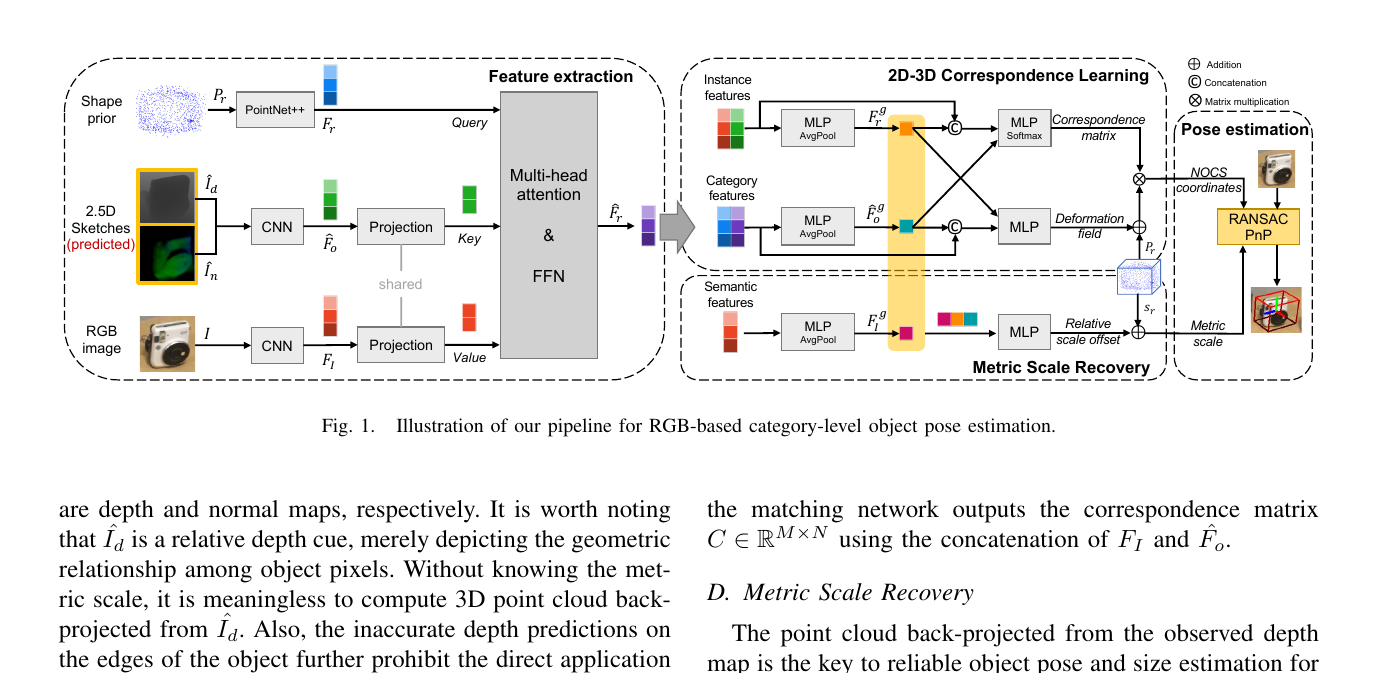
Figure 1 from the paper: the upper branch learns NOCS correspondences between image points and a deformed category prior; the lower branch independently regresses metric scale. They meet only before final PnP. Source: arXiv. Image copyright belongs to the authors and publisher; reproduced here for paper commentary.
3. Problem setting
Task: category-level 6D pose and metric size for unseen instances.
Input: one RGB image, target crop / mask, category mean shape, and camera intrinsics.
Auxiliary information: Omnidata-predicted relative depth and surface normals.
Output: R,t and 3D scale.
Key distinction: no real depth at test time, and predicted depth is not directly treated as metric depth.
4. Core motivation
RGB-only methods often predict absolute depth and reuse an RGB-D 3D–3D alignment pipeline. Metric-depth bias then corrupts scale, translation, and rotation together. DMSR explicitly decouples rigid-pose correspondence from metric scale because their learning difficulties differ.
5. Method overview
Extract and fuse separate RGB, relative-depth, and normal features.
Adapt a category-shape prior to the instance through a deformation field.
A correspondence matrix associates 2D image points with deformed NOCS points.
An independent MLP predicts scale offsets from category statistics.
Restore metric scale to NOCS points and recover pose through RANSAC-PnP.
6. Experimental overview
Datasets: CAMERA25 and REAL275.
Metrics: 3D IoU and joint n∘ / m cm criteria.
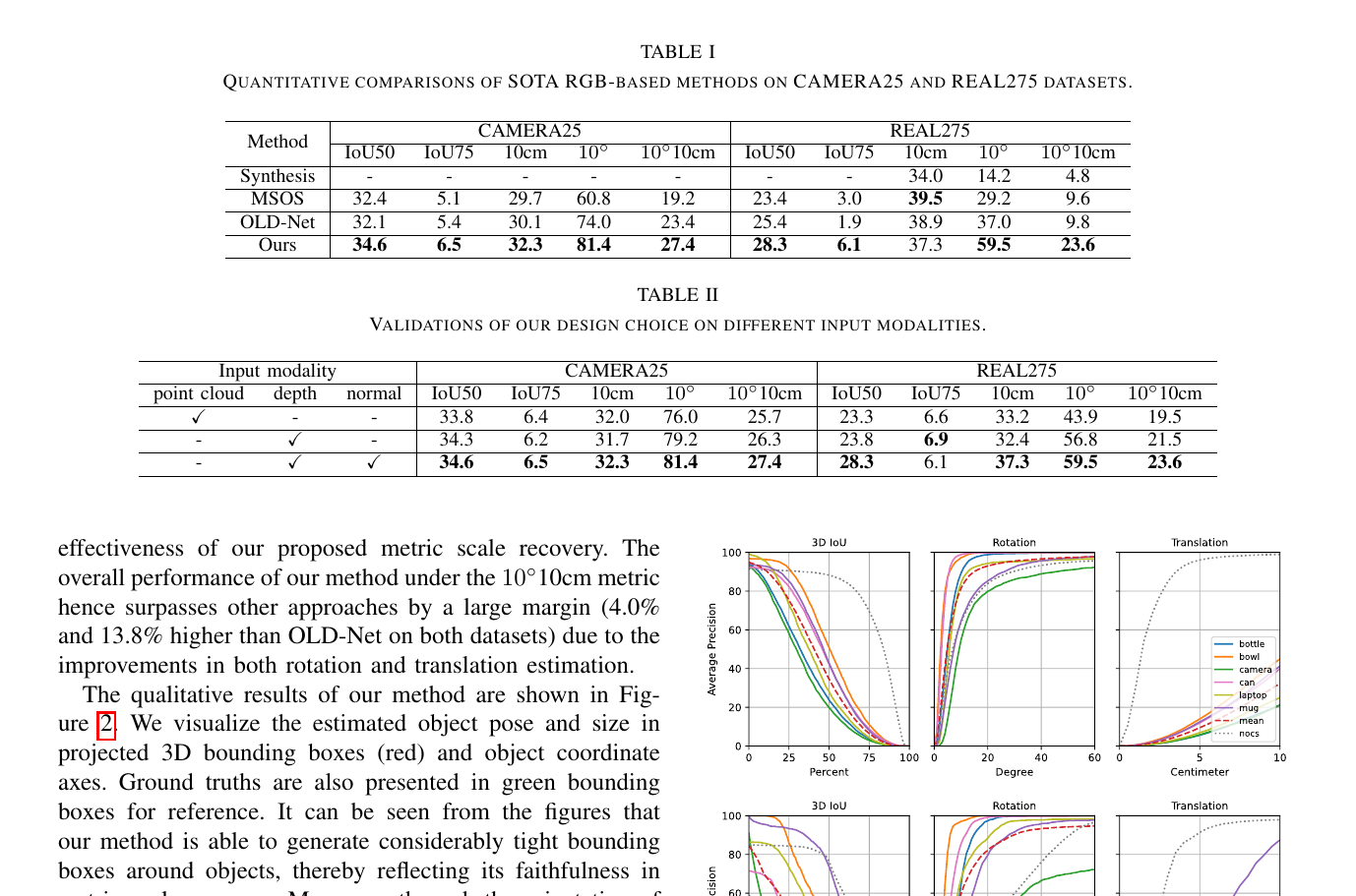
Results: clear gains on rotation-sensitive metrics over contemporary RGB-only methods; real-data scale prediction remains affected by synthetic-to-real category-size distribution shifts.
Ablations: depth + normal 2.5D sketches improve over RGB alone or a single geometry channel; independent scale offsets improve over entangled scale / correspondence.
7. Strengths and limitations
Strengths
Clearly explains how monocular scale ambiguity propagates.
Final pose remains constrained by correspondence + PnP.
No test-time real depth, with public code.
Limitations / risks
Still requires masks, category labels, mean shapes, and training NOCS / pose supervision.
Bias in category mean-scale statistics directly affects translation / size.
Monocular depth / normals are not metric measurements; domain shifts can still damage correspondence.
8. Research takeaways
Intermediate geometry with different reliability should not all enter one similarity-transform solver. Separating rotation-friendly correspondence from metric scale reduces error coupling.
Available src/paper-notes/dmsr-icra2024/deep.md
In-depth paper notes
Support reproduction, comparison, related-work writing, and identifying opportunities for further research.
Deep Reading Notes: RGB-Based Category-Level Object Pose Estimation Via Decoupled Metric Scale Recovery
1. Basic information
Abbreviation: DMSR
Authors / affiliations: Jiaxin Wei (ShanghaiTech), Xibin Song, Weizhe Liu, Pan Ji (Tencent), Laurent Kneip (ShanghaiTech), Hongdong Li (Tencent / ANU)
DMSR uses pretrained relative depth / normals as correspondence features rather than demanding reliable absolute monocular depth. It learns 2D–3D correspondences in normalized category space and independently recovers metric scale from category priors. Perspective PnP then solves R,t, structurally limiting propagation of scale errors into rotation.
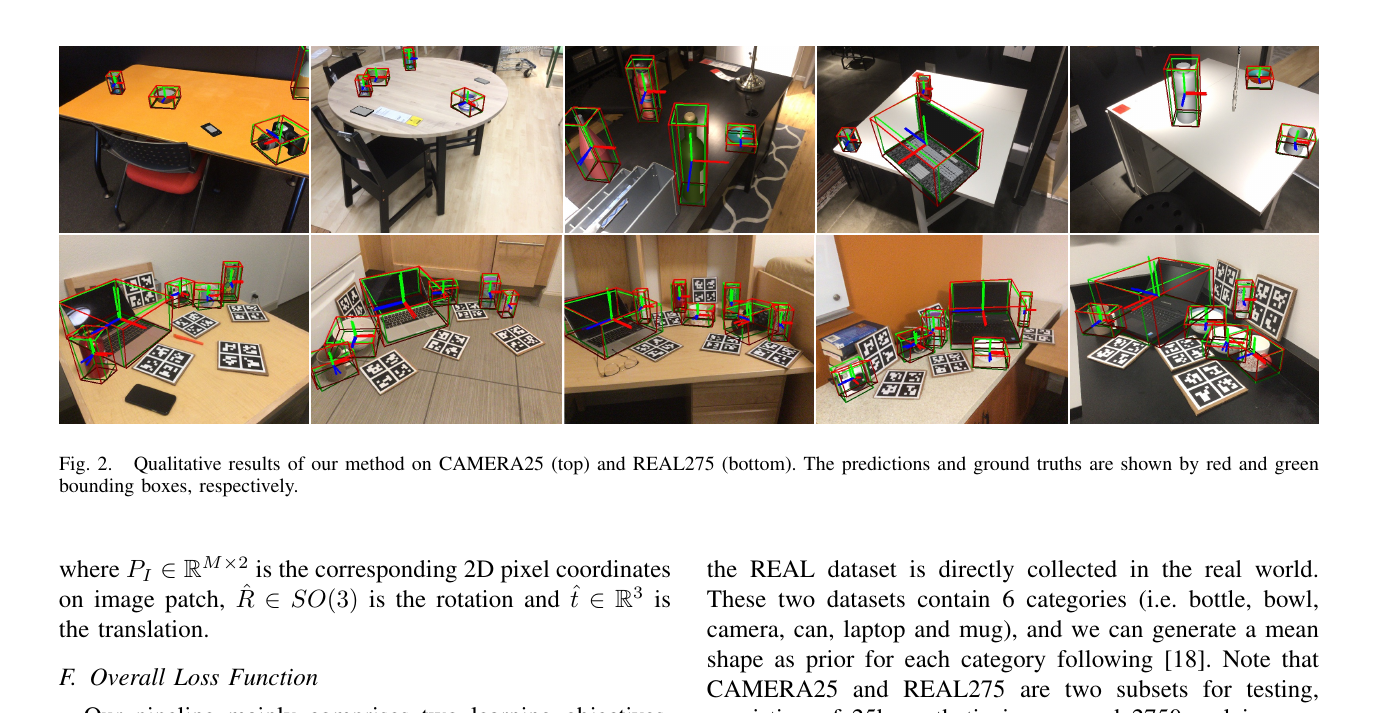
Boxes / axes broadly align under real clutter, with remaining scale bias
Tables I–III
Main results, input-modality and scale-strategy ablations
2.5D geometry and decoupled scale contribute independently
Figure 1 from the paper: RGB and Omnidata 2.5D sketches supply instance features; prior deformation produces NOCS 3D points. A correspondence matrix maps image points to NOCS, while metric-scale recovery predicts size separately. Source: paper PDF. Image copyright belongs to the authors and publisher; reproduced here for paper commentary.
3. Problem setting and task boundaries
Attribute
Setting
Task
Category-level 6D pose + metric size
Test objects
Unseen instances within known categories
Observation
One RGB crop; no real test-time depth
Geometric assistance
Pretrained Omnidata relative depth and surface normals
DMSR is not prior-free: instance CAD is unnecessary, but category mean shapes are required. Unlike RGB-D category-level methods, it does not directly obtain reliable metric point clouds.
4. Research context
NOCS / SPD / SGPA typically align observed depth clouds to normalized category priors through Umeyama / Procrustes for joint pose and scale.
RGB-only methods such as OLD-Net first recover object-level absolute depth and return to an RGB-D pipeline, propagating metric-depth errors into rigid transforms.
DMSR treats relative depth / normals as correspondence cues rather than metric coordinates.
5. Method details
5.1 2.5D Geometric Features
For crop I, preprocessing gives
D^=fd(I),N^=fn(I),
where D^ is relative depth and N^ surface normals. Omnidata pretrained models are used without retraining metric-depth supervision inside DMSR.
RGB, depth, and normals pass through separate CNNs / projections to produce semantic and geometric features. Relative-depth values are not directly back-projected: even with incorrect global scale, useful local ordering and surface directions can still support correspondence.
5.2 Category-Prior Deformation and Correspondence
Feature interactions on category prior Pr predict deformation field ΔPr:
P~r=Pr+ΔPr.
Between image points and P~r, the network predicts soft correspondence matrix C, yielding normalized object coordinates for each 2D point. These 3D coordinates reside in NOCS without metric scale.
5.3 Decoupled Metric Scale Recovery
An independent MLP predicts offset Δs from category mean size using instance / category features. With mean scale sr:
s^=sr+Δs.
Correspondence learning does not depend on accurate s^. Only before PnP are NOCS points multiplied by s^ to recover metric object coordinates.
5.4 Perspective PnP
Given image points Pi, metric 3D points s^P~i, and intrinsics K:
R^,t^=PnP(Pi,s^P~i,K).
RANSAC suppresses correspondence outliers. Compared with 3D–3D Procrustes, PnP fits RGB perspective observations without treating pseudo-depth as true scene coordinates.
6. Training and Engineering
Correspondence and scale offsets train jointly with supervised losses but explicitly separate branches.
The external pretrained 2.5D estimators’ domain robustness affects DMSR.
Queries still need masks / crops; open-world detection is not evaluated.
Computation includes Omnidata, PSPNet / ResNet18 features, prior interactions, and RANSAC-PnP.
Public code supports reproduction as an RGB-only category-level baseline.
7. Experimental analysis
7.1 Data and Metrics
CAMERA25: synthetic NOCS test set with 25k images.
REAL275: real NOCS test set with 2,750 images across six everyday categories.
Metrics: 3D IoU25 / 50 / 75 and 5∘2 cm, 5∘5 cm, 10∘2 cm, 10∘5 cm.
These metrics jointly depend on rotation, translation, and size. AP curves across error thresholds additionally show rotation / translation behavior more continuously.
Tables I–III from the paper: Table I compares RGB category-level pose; Table II tests RGB / predicted-depth / normal combinations; Table III compares mean-scale and scale-offset recovery strategies. Source: paper PDF. Image copyright belongs to the authors and publisher; reproduced here for paper commentary.
7.2 Main Conclusions
Stronger rotation-sensitive CAMERA25 / REAL275 criteria than Synthesis, MSOS, and OLD-Net.
The paper summarizes approximately 50% lower REAL275 rotation error than MSOS with only approximately 5.1% of its parameter count.
Quantitative gains are more consistent on synthetic CAMERA25; REAL275 metric size is affected by category-instance distribution shifts.
7.3 Interpreting Ablations
Ablation
Claim tested
My assessment
RGB only → + depth / + normal
2.5D geometry improves correspondence
Supported, but external estimator cost should be reported
Depth only vs. depth + normal
Normals add local surface orientation
Particularly plausible for rotation
Mean scale → learned scale offset
Category statistics cannot cover all instance sizes
Supported
Joint scale vs. decoupled branch
Scale errors should not contaminate pose features
The central structural evidence
Figure 2 from the paper: CAMERA25 above and REAL275 below; predicted boxes are red and ground truth green. Local translation / scale deviations remain in real scenes. Source: paper PDF. Image copyright belongs to the authors and publisher; reproduced here for paper commentary.
8. Critical analysis
Strengths
A structural treatment of monocular category-level scale ambiguity, beyond changing the backbone.
Restrained use of relative geometry: helps matching without presenting it as metric depth.
PnP explicitly restores the camera model to the pipeline.
Weaknesses and Implicit Assumptions
RGB-only still runs two pretrained 2.5D estimators, rather than relying on a single network.
Category priors, masks, and NOCS supervision are strong assumptions.
Mean-scale residuals assume similar training / test category-size distributions; REAL275 already reveals shifts.
Validation mainly covers six NOCS categories, without demonstrating long-tail extension.
Symmetry handling in training / evaluation does not provide separate multi-solution modeling.
9. Improvement Directions
Output pose / size distributions through metric-depth uncertainty rather than one scale offset.
Replace Omnidata with foundation monocular geometry and evaluate cross-domain calibration.
Propagate mask uncertainty into correspondence weights and PnP covariance.
Retrieve open-category shape priors to reduce fixed-mean-shape dependence.
The reusable principle is to assign unreliable geometry only the roles it can support. Relative depth provides ordering and local shape, while metric scale needs independent statistics or measurements. Forcing both into pseudo-point clouds can increase rotation error.
11. Open questions
How do scale-offset errors quantitatively propagate into PnP translation?
Can DMSR preserve correspondence without category mean shapes?
How do Omnidata failures appear on transparent, reflective, or textureless objects?
How does DMSR compare with FAP-Net under identical detectors, masks, and training data?