DynamicPose: Real-time and Robust 6D Object Pose Tracking for Fast-Moving Cameras and Objects
DynamicPose uses VIO to remove ROI and rotation changes caused by camera ego-motion, and 2D box centers with median depth to compensate for large object translations. World-frame Kalman covariance adaptively generates 1–27 rotation hypotheses, hierarchically filtered by the FoundationPose refiner and fed back into the next frame. High-speed Isaac Sim trajectories of 13 YCB objects yield mean ADD-S / ADD AUC of 88.9 / 75.8.
known object CAD and metric scalecalibrated and synchronized RGB-D–IMUcamera intrinsics and VIOinitial mask / posepre-trained FoundationPose refiner2D object tracker
Full paper metadataAuthors, affiliations, research area, datasets, metrics, method tags, and reading statusExpandCollapse
Authors
Tingbang Liang, Yixin Zeng, Jiatong Xie, Boyu Zhou
Affiliations
Sun Yat-Sen University / Xi’an Jiaotong University / Southern University of Science and Technology / Differential Robotics
known object CAD and metric scalecalibrated and synchronized RGB-D–IMUcamera intrinsics and VIOinitial mask / posepre-trained FoundationPose refiner2D object tracker
Reading Notes
Overview / Deep Dive
Available src/paper-notes/dynamicpose-iros2025/coarse.md
Paper overview notes
Quickly assess the paper's scope, problem setting, core method, experimental findings, and whether to read it in depth.
Overview Notes: DynamicPose
1. Basic information
Title: DynamicPose: Real-time and Robust 6D Object Pose Tracking for Fast-Moving Cameras and Objects
Authors: Tingbang Liang, Yixin Zeng, Jiatong Xie, Boyu Zhou
Affiliations: Sun Yat-Sen University; Xi’an Jiaotong University; Southern University of Science and Technology; Differential Robotics
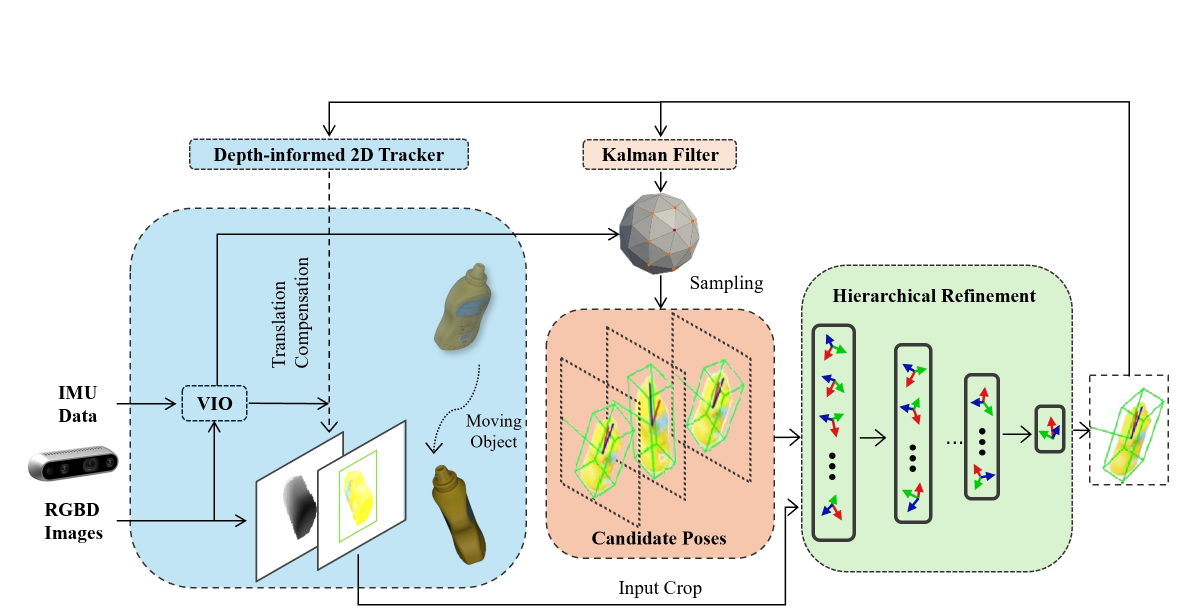
DynamicPose tracks known CAD objects from RGB-D when both the camera and object move rapidly: VIO first compensates for camera-induced ROI and rotation changes; a depth-informed 2D tracker compensates for object translation; a VIO-guided Kalman filter then generates up to 27 candidates according to rotational uncertainty. The FoundationPose refiner progressively selects among them and feeds the result back to initialize the next frame.
3. Guide to figures and tables
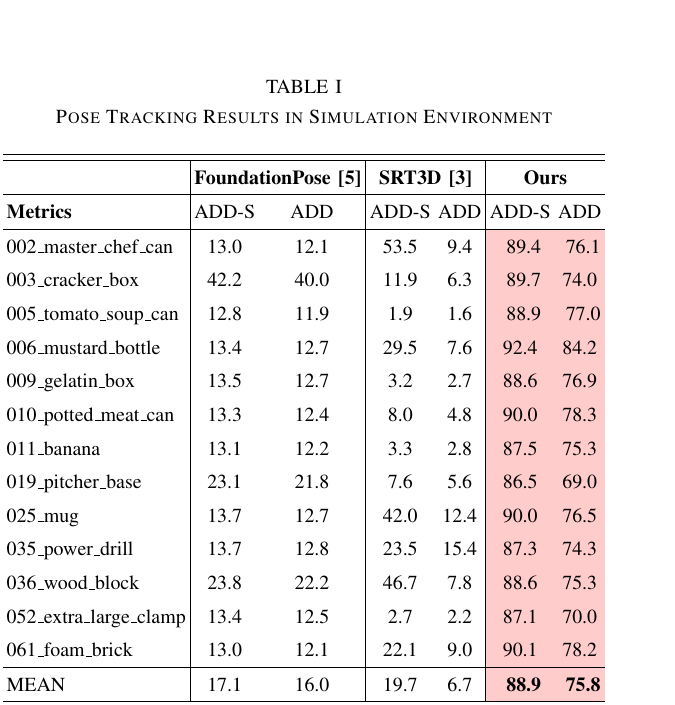
Original Figure 2: VIO, a depth-informed 2D tracker, Kalman-based multiple hypotheses, and hierarchical refinement form a feedback loop; the previous pose is no longer the only basis for initializing the current frame. Source: authors’ public manuscript; image copyright belongs to the paper’s authors and IEEE. Shown here for paper analysis.Original Table I: in Isaac Sim scenes with relative linear velocity above 1.5 m/s and angular velocity above 3.0 rad/s, DynamicPose achieves mean ADD-S / ADD AUC of 88.9 / 75.8, substantially above FoundationPose at 17.1 / 16.0 and SRT3D at 19.7 / 6.7. Source: authors’ public manuscript; table copyright belongs to the paper’s authors and IEEE. Shown here for paper analysis.
4. Problem setting
Task: continuous 6D pose tracking of an object with a known CAD model, rather than independent detection in each frame.
Inputs: RGB-D sequences, camera IMU / VIO, camera intrinsics, the target CAD model, and a first-frame object mask and initial pose.
Output: the object’s 6D pose relative to the camera in each frame.
Object setting: a new CAD object unseen by the network requires no retraining, but its identity, CAD model, and first-frame initialization must still be supplied.
Targeted failures: camera motion abruptly shifts the ROI; large object translation shifts it further; large inter-frame rotation exceeds the local refiner’s convergence basin.
5. Method overview
Initialize the first frame using a SAM2 mask, median depth, and FoundationPose global candidates / scoring.
VIO estimates the inter-frame camera transform, compensating the previous object translation and rotation into the current camera frame.
A 2D tracker follows the RGB bounding box; back-projecting its center with median depth provides a new 3D translation hypothesis for large object motion.
Anchor object rotation in the world frame and build a Kalman filter over Tait–Bryan angles and angular velocities; increase process noise with angular acceleration.
For each roll / pitch / yaw axis, use only the mean when variance is low, or μ−σ,μ,μ+σ when it is high, yielding at most 33=27 rotation candidates.
Iteratively update candidates with the FoundationPose refiner, using a smaller rotation update ∥ΔR∥2 as a heuristic for proximity to the observation, and prune hierarchically to one candidate.
Project the final pose to update the next frame’s 2D tracking template and use it as a Kalman measurement, closing the loop.
6. Experiments at a glance
Setting: Isaac Sim with 13 YCB-Video objects; both camera and object follow prescribed fast trajectories.
Main setting: relative linear velocity >1.5 m/s and angular velocity >3.0 rad/s.
Mean main results: DynamicPose 88.9 ADD-S AUC / 75.8 ADD AUC.
FoundationPose: 17.1 / 16.0; SRT3D: 19.7 / 6.7.
Aggressive ablation setting: relative linear velocity >3 m/s and angular velocity >8 rad/s; removing either translation compensation or rotation estimation causes severe degradation.
Speed: approximately 10 Hz on an Intel i7-13700F + RTX 3060.
Real-world experiment: a moving robot arm carries the object while a person rapidly moves the camera; only qualitative sequences are provided, without success rates or error statistics.
7. Quick assessment
Strength: a specific problem setting, with three modules addressing fast-motion failures in ROI, translation, and rotation, respectively; the design goes beyond adding a temporal network.
Strongest evidence: substantially higher mean AUC than FoundationPose / SRT3D on common fast trajectories across 13 objects; the full system also clearly outperforms module-removal variants under more aggressive motion.
Avoid misreading: “retraining-free” means that the pretrained refiner can serve new CAD models; it does not remove the need for CAD or initialization, imply an open-world setting, or establish quantitative real-world accuracy.
Main limitations: strong dependence on synchronized, well-calibrated RGB-D–IMU, VIO, and valid depth range. Motion blur, median-depth bias, and depth noise beyond 3 m can still cause failure.
Code status recorded in the source notes: part of the official implementation was public, integrating FoundationPose, MixFormerV2, Grounding DINO, and VINS-Mono. Reproduction requires ROS and multiple integrated modules, rather than a single plug-and-play checkpoint.
Available src/paper-notes/dynamicpose-iros2025/deep.md
In-depth paper notes
Support reproduction, comparison, related-work writing, and identifying opportunities for further research.
Deep Reading Notes: DynamicPose
1. Key assessment
DynamicPose addresses three initialization failures of FoundationPose-style tracking under fast motion, rather than designing another temporal network that directly regresses pose from video:
Camera motion shifts the ROI projected from the previous pose away from the target;
Even after camera compensation, large object translation still causes ROI drift;
A correct ROI is insufficient if large inter-frame rotation exceeds the local refiner’s convergence basin.
The authors address these with VIO, a depth-informed 2D tracker, and VIO-guided Kalman multiple hypotheses, respectively, then reuse the pretrained FoundationPose refiner to update and select candidates. The main value lies in connecting existing robot RGB-D / IMU / VIO with a foundation pose model in a feedback loop, rather than the novelty of an individual module.
2. Task boundaries and priors
Original Figure 2. Blue modules compensate translation and ROI, orange modules generate rotation candidates, and green modules refine them hierarchically. The final pose feeds back to both the 2D tracker and Kalman filter. Source: authors’ public manuscript; image copyright belongs to the paper’s authors and IEEE. Shown here for paper analysis.
This is CAD model-based, instance-level, unseen-object tracking. It assumes:
The target’s accurate CAD model and identity;
A continuous, calibrated, time-synchronized RGB-D stream;
An onboard IMU and inter-frame camera motion from visual-inertial odometry;
Camera intrinsics;
A first-frame object mask / initial pose.
“Unseen / retraining-free” only means that FoundationPose’s pretrained refiner and scorer need not be retrained for each new CAD model. It does not imply category-level estimation, a model-free setting, or automatic object discovery in arbitrary video. The problem definition explicitly requires an initial pose; the implementation can obtain it with a SAM2 mask, median depth, and FoundationPose global candidate search.
3. Why the previous pose fails under fast motion
FoundationPose tracking typically uses the previous pose as the current coarse pose, projects the CAD model to obtain an ROI, and predicts Δt,ΔR with a local refiner. This implicitly requires:
The current target to remain near the previous projection;
The current rotation to stay within the refiner’s local correction range.
Sudden camera or object motion first breaks the ROI assumption, leaving insufficient target information in the refiner’s crop. Even with an adequate ROI, large rotation can create excessive mismatch between the rendered object and observation. An incorrect pose then produces a worse ROI in the next frame, causing cascading drift. DynamicPose’s feedback loop aims to interrupt this chain.
4. First-frame initialization and the FoundationPose refiner
Given a SAM2 object mask in the first frame:
Initialize translation with median depth inside the mask and crop RGB-D;
Uniformly sample Ns viewpoints on an icosahedron centered on the CAD model;
Sample Ni in-plane rotations per viewpoint to form NsNi poses;
Iteratively refine them with FoundationPose;
Use the scorer to select the candidate that best matches the current image.
Tracking reuses only the refiner: the CAD rendering at the coarse pose and the current RGB-D crop pass through a shared encoder, residual convolutions, and a transformer to produce translation and rotation updates. DynamicPose’s central task is to provide translation, ROI, and rotation candidates sufficiently close to ground truth.
5. Translation and ROI compensation
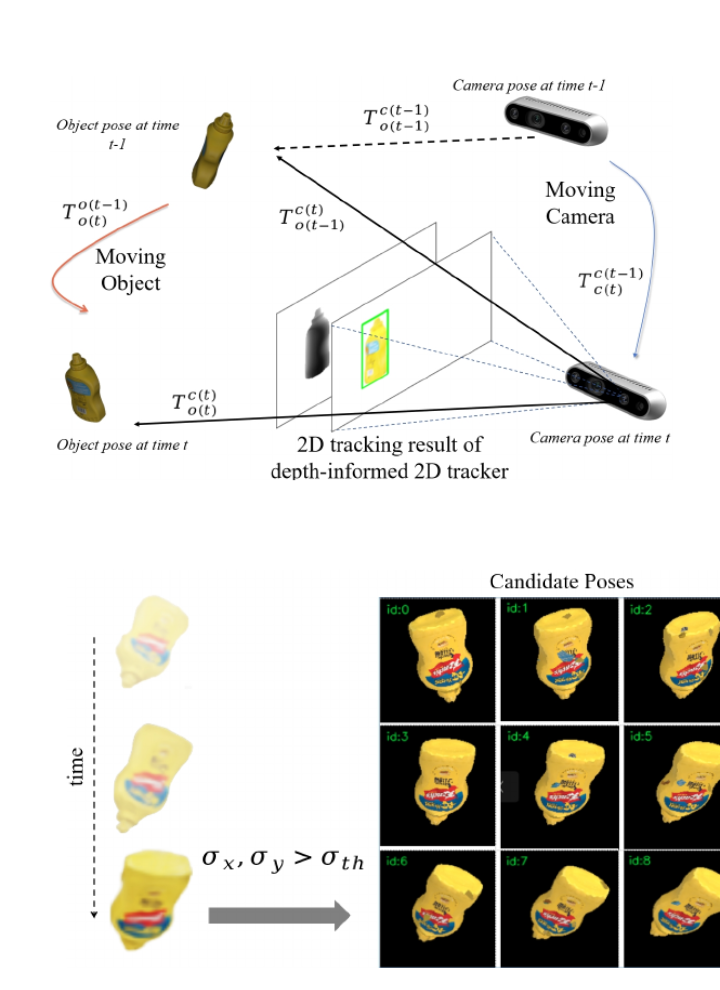
Combined crops from original Figures 4–5. Top: VIO first compensates camera motion, then the 2D bounding-box center and median depth handle object translation. Bottom: high-variance rotation axes receive three candidates, while low-variance axes retain only the mean. Source: authors’ public manuscript; image copyright belongs to the paper’s authors and IEEE. Shown here for paper analysis.
5.1 Camera-motion compensation
Let the previous object pose relative to the previous camera be To(t−1)c(t−1), and let VIO provide the transform from the previous camera to the current camera, Tc(t−1)c(t). Temporarily assuming no object translation, transform the previous object translation into the current camera frame to remove the ROI shift caused purely by camera motion.
This handles a change in the camera coordinate frame, rather than predicting independent object motion. Significant object translation therefore leaves a residual after VIO compensation alone.
5.2 Depth-informed 2D tracking
The 2D tracker obtains the current RGB bounding box from its previous location. Take its center (u,v) and the median depth z of the bounding box / target region, then use
toc(t)=K−1[u,v,1]⊤z
to back-project a current 3D translation hypothesis. This combines the large-displacement tolerance of 2D appearance tracking with metric depth. The paper treats the specific tracker as replaceable; the public repository, as recorded in the source notes, integrated MixFormerV2 and additional frontends such as Grounding DINO.
This is not a precise 3D object-motion estimate: the bounding-box center need not correspond to the object-frame origin, and median depth may lie on the front surface, an occluder, or an incorrect region. Its role is to bring coarse translation back into the refiner’s convergence basin.
6. World-frame anchoring and Kalman rotation prediction
Estimating object angular velocity directly in a moving camera frame mixes in camera rotation. The authors use VIO’s world–camera rotation to anchor object rotation in world coordinates:
Row(t)=Rcw(t)Roc(t)(t).
Rotation is then represented by Tait–Bryan angles
θ=[θroll,θpitch,θyaw]
and predicted using constant angular velocity:
ω(t)=Δtθ(t)−θ(t−1),θ(t+1)=θ(t)+ω(t)Δt
The Kalman process noise is set to
Q=∥ω˙(t)∥I,
so greater angular acceleration yields higher predicted covariance. The refiner’s final rotation serves as the observation for the filter update; measurement covariance is fixed at 0.05 in the experiments.
This model is lightweight, but Tait–Bryan angles are not a globally nonsingular state representation of SO(3), and independent Gaussian axes ignore coupling between axes. It is suitable for generating coarse candidates and should not be interpreted as rigorous manifold filtering.
7. Variance-aware multiple hypotheses
For each axis i∈{roll,pitch,yaw}, if the predicted standard deviation is below σth, sample only the mean μi; otherwise sample
μi−σi,μi,μi+σi.
This yields:
All three axes stable: 1 candidate;
One unstable axis: 3;
Two unstable axes: 9;
All three axes unstable: up to 27.
This costs less than fixed dense rotation sampling and is less vulnerable to sudden direction changes than using only the Kalman mean. However, candidates extend only one standard deviation from the mean; the threshold, covariance calibration, and angle periodicity can affect coverage. The paper does not systematically report candidate count–accuracy–latency curves.
8. Hierarchical refinement and selection criterion
At level i, the FoundationPose refiner outputs the following for each of Ki candidates:
ti+1=ti+Δti,Ri+1=ΔRi⊗Ri.
The authors use the L2 norm ∥ΔRi∥2 of the refiner’s rotation update as a proximity proxy: a candidate close to the observation should theoretically require only a small update. Each level retains the top-Ki+1 candidates with the smallest updates until KN=1.
No ground truth is used here; “smaller update is better” is a heuristic. Selection can fail if the refiner saturates at an incorrect candidate and predicts a small update, or makes small updates for near-symmetric poses. The main experiments support this strategy on the tested motion distribution, but do not separately compare a learned scorer, rendering residual, or different numbers of levels.
The final pose has two feedback paths:
Project the CAD model to obtain an RGB region and update the 2D tracker’s target template;
Transform it into world coordinates as a Kalman measurement to update the next rotation prediction.
9. Simulation protocol and metrics
Existing benchmarks lack synchronized camera poses / IMU, so the authors do not directly compare on the original YCB-Video sequences. Instead, they place 13 YCB-Video objects in Isaac Sim.
Main test: run each method with the same prescribed object and camera trajectories;
Relative linear velocity >1.5 m/s;
Relative angular velocity >3.0 rad/s;
baselines: FoundationPose, SRT3D;
Use ADD-S for symmetric objects and additionally report ADD for other objects;
Integrate accuracy curves up to a 0.1 m threshold; tables report AUC.
ADD averages the distance between corresponding CAD points transformed by ground-truth and predicted poses. ADD-S finds the nearest predicted point for each ground-truth point to reduce symmetric correspondence ambiguity. These AUC values cannot be directly compared with results using 0.1d, BOP AR, or the real YCB-V protocol.
10. Main results
Original Table I. All three methods are compared on the same fast-motion simulation trajectories; red columns show DynamicPose. Source: authors’ public manuscript; table copyright belongs to the paper’s authors and IEEE. Shown here for paper analysis.
Method
Mean ADD-S AUC
Mean ADD AUC
FoundationPose
17.1
16.0
SRT3D
19.7
6.7
DynamicPose
88.9
75.8
DynamicPose achieves ADD-S AUC of 86.5–92.4 and ADD of 69.0–84.2 across all 13 objects. Compared with FoundationPose, mean gains are ADD-S +71.8 and ADD +59.8; compared with SRT3D, gains are +69.2 and +69.1 absolute points, respectively.
These gaps mainly show that “previous pose + one local update” can fail through cascading errors under the authors’ fast-motion conditions, while additional localization and multiple hypotheses preserve tracking. They do not independently establish higher static accuracy, because the experiment deliberately targets a failure regime of the baselines.
11. Qualitative comparison, ablations, and speed
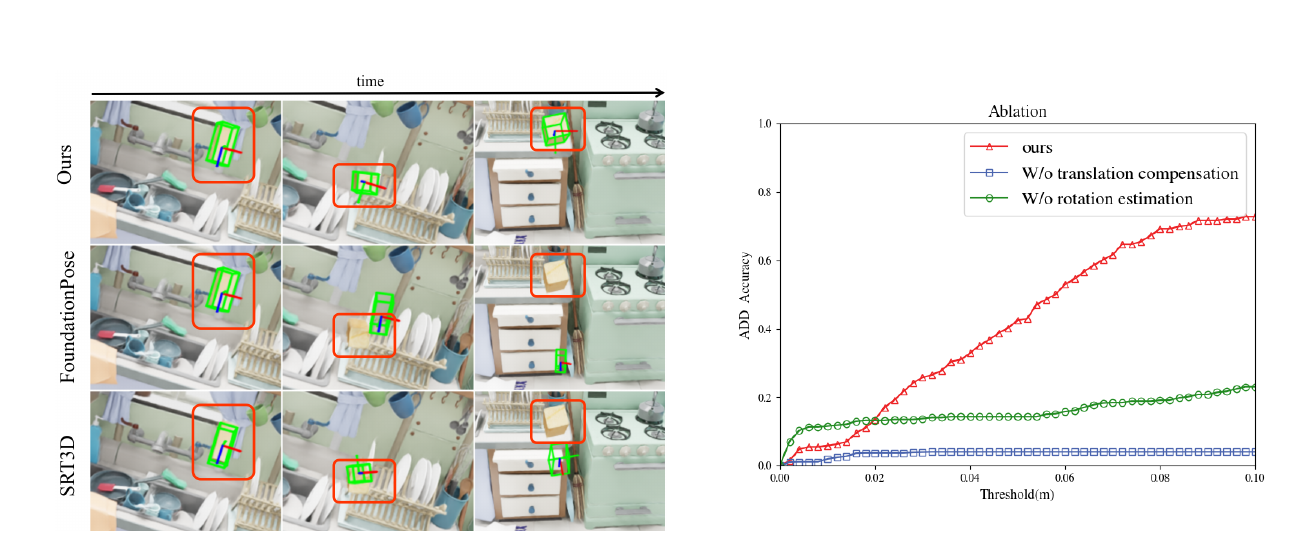
Original Figures 6–7. Left: in the wood-block sequence, FoundationPose fails through ROI initialization and SRT3D loses track under large rotation. Right: in the more aggressive setting above 3 m/s and 8 rad/s, the full system’s ADD curve is substantially above variants removing either compensation module. Source: authors’ public manuscript; image copyright belongs to the paper’s authors and IEEE. Shown here for paper analysis.
The ablation uses harder relative motion: linear velocity >3 m/s and angular velocity >8 rad/s.
W/o translation compensation: remove the depth-informed 2D tracker;
Reading the 0.1 m endpoints in Figure 7 gives approximate ADD accuracy of 0.72 for the full system, 0.23 without rotation estimation, and 0.04 without translation compensation. The paper provides no exact numerical table for these curves, so these are visual approximations only. Translation compensation matters most on this trajectory, which does not establish the same ranking in every dynamic scene.
Mean speed is approximately 10 Hz on an Intel i7-13700F and RTX 3060. The paper gives no timing breakdown for VIO, the 2D tracker, candidate count, or rendering / refinement, and no worst-frame latency. “Real-time” here means approximately 100 ms/frame on the authors’ platform, rather than high-frequency control.
12. Real-world evidence
In the real experiment, the target is rigidly attached to a moving robot arm’s end effector and follows combined translation / rotation trajectories. An experimenter manually moves the RGB-D camera to introduce camera motion. Figure 1 shows pose overlays and third-person views.
This demonstrates operation with real sensors, VIO, and robot communication, but the evidence remains qualitative:
No pose ground truth;
No ADD, drift, success rate, or count of tracking losses;
No quantitative baseline comparison on the same trajectories;
No measured motion-speed distribution;
The target always remains within the camera’s field of view.
The strongest accuracy evidence therefore comes from simulation; the real experiment primarily supports system feasibility.
13. Failure modes and limitations
The authors explicitly identify three limitations:
Rapid camera / object motion causes RGB motion blur, removing texture and degrading refinement accuracy;
Median depth within the bounding box / mask can differ from the true object origin, systematically biasing the translation hypothesis;
VIO drift or time-synchronization errors affect both the ROI and world-frame rotation;
The feedback loop provides no guaranteed global redetection after prolonged full occlusion or departure from the field of view;
Tait–Bryan angles with independent Gaussian axes are an imperfect rotation-statistics model for large angles and singular regions;
∥ΔR∥2 is not calibrated pose confidence;
Up to 27 candidates increase refiner computation under extreme uncertainty;
Accurate CAD, reliable depth, and a first-frame mask / pose remain strong dependencies;
Coverage of real robot conditions by simulation trajectories, materials, motion blur, and VIO noise is not quantified.
14. Code and reproduction
At the time recorded in the source notes, the official GitHub repository exposed part of the code and stated an initial release date of 2025-09-30. Visible dependencies included:
The FoundationPose refiner / scorer and their weights;
MixFormerV2 2D tracker;
Grounding DINO;
SAM2-related components;
VINS-Mono VIO;
ROS / catkin, RGB-D–IMU sensor calibration, and demo bags.
The source notes record GPL-3.0 licensing. The main reproduction challenges concern integration rather than training:
RGB, depth, and IMU timing synchronization and extrinsics;
VINS-Mono frame conventions and object / camera transforms;
Bounding-box centers and valid-pixel selection for median depth;
σth, initial Kalman covariance, and process / measurement noise;
Candidate pruning schedule Ki and refiner iteration counts;
FoundationPose weights, CAD scale, and rendering coordinates;
Tracking-loss detection and reinitialization strategies.
A partial code release does not establish one-command reproduction of all paper experiments. In particular, the Isaac Sim trajectories and complete evaluation scripts need checking against the relevant repository version.
15. Overall assessment
DynamicPose is a systems-oriented study with clear failure analysis. It uses VIO to separate camera motion, 2D tracking plus depth to recover translation, and covariance-aware candidates to enlarge the rotation basin, then places an established refiner in a feedback loop. The main simulation table over 13 objects and the aggressive-motion ablations strongly support this design.
Two judgments should be retained together: the method substantially improves tracking robustness under the authors’ fast-motion conditions, while that conclusion depends on simulation, accurate CAD, RGB-D–IMU, and reliable VIO; real-world accuracy has not been quantified. For fast tracking of known objects on mobile robots, it is a useful example of geometry / state estimation first bringing inputs back into a foundation refiner’s convergence basin.