EgoGaussian: Dynamic Scene Understanding from Egocentric Video with 3D Gaussian Splatting
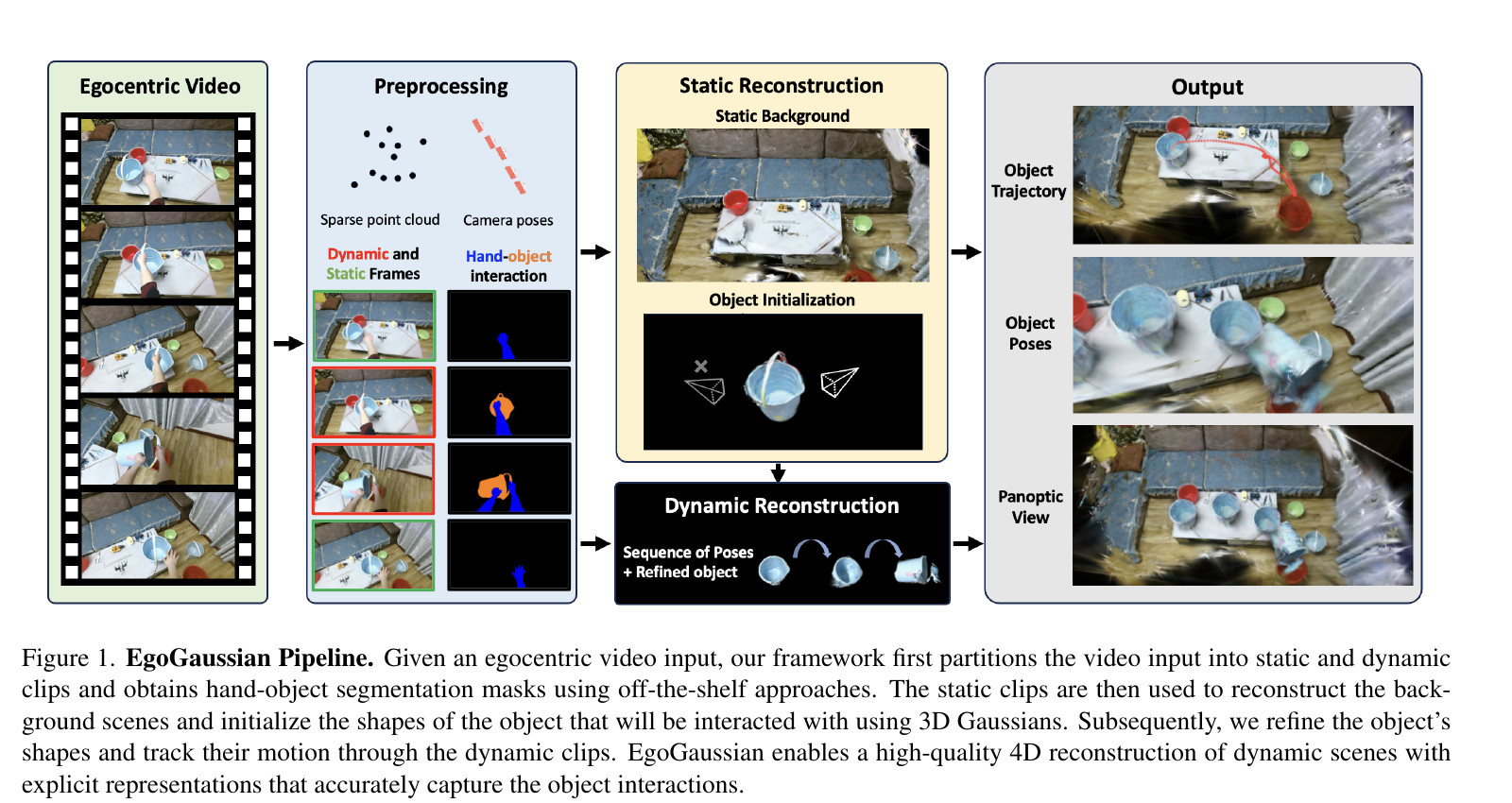
EgoGaussian initializes background and object Gaussians from static segments, alternates rigid-object pose optimization and Gaussian densification during dynamic segments, and jointly fine-tunes an egocentric 4D scene representation with per-frame object poses.
EgoGaussian targets egocentric human–object interaction video: initialize background and object 3D Gaussians from static clips, sequentially estimate rigid object poses and refine shape, then recompose dynamic objects with the background to produce a renderable 4D scene and object trajectories.
3. Problem setting
Input: RGB egocentric video, with preprocessing signals including camera poses / SfM, hand–object segmentation, and interaction onset / offset.
Task: dynamic reconstruction + rigid object tracking, rather than a ready-to-use single-frame 6D pose estimator.
4. Method overview
Split video into static / dynamic clips; obtain hand, body, and object regions with existing models such as EgoHOS and Track-Anything.
Initialize background and object Gaussians from static clips using COLMAP or existing camera poses.
Sequentially estimate 6D rigid object transforms during dynamic clips, transforming the previous object-Gaussian state for each frame.
Optimize RGB and alpha-mask losses with regularization from randomly revisiting earlier frames; update background areas revealed as the dynamic object moves away.
5. Experiments at a glance
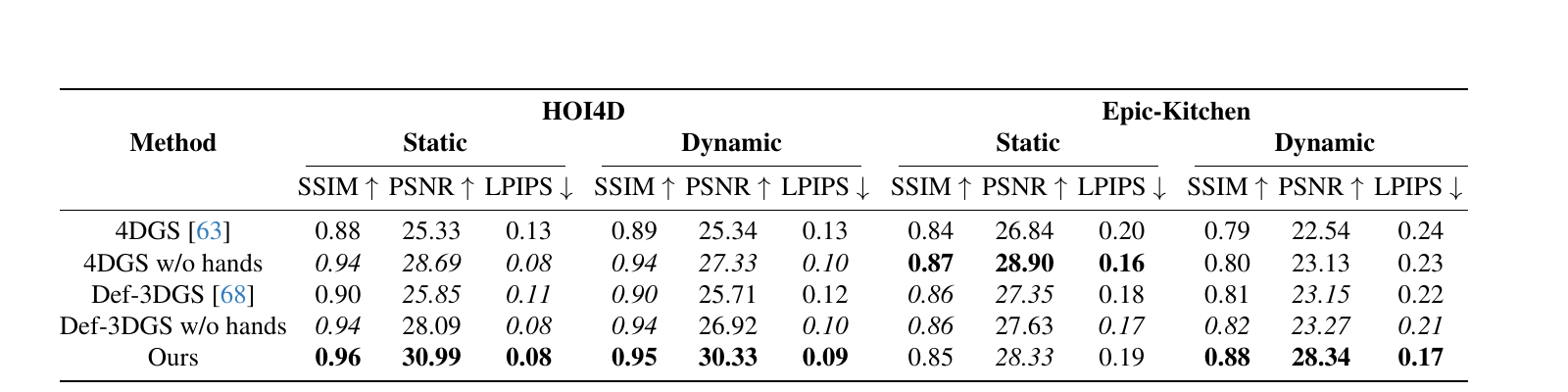
HOI4D: reported SSIM / PSNR / LPIPS are 0.96 / 30.99 / 0.08 for static frames and 0.95 / 30.33 / 0.09 for dynamic frames.
EPIC-KITCHENS: 0.85 / 28.33 / 0.19 for static frames and 0.88 / 28.34 / 0.17 for dynamic frames.
Baselines are 4DGS, Deformable 3DGS, and variants excluding hand-region gradients. Evaluation masks hands / bodies to focus on the environment and manipulated objects.
6. Strengths, limitations, and assessment
Strengths
Explicitly represent an object as a rigidly transformable Gaussian set, allowing trajectory and geometry to constrain each other.
Use static clips for difficult object initialization before dynamic interaction; temporal processing reduces the burden of jointly fitting an entire long video.
Randomly revisiting historical frames helps prevent fitting only the current frame.
Risks / boundaries
Strong preprocessing requirements include segmentation, interaction intervals, and camera poses; upstream errors are not fully incorporated into the main results.
RGB-only observations, rapid motion, leaving and reentering the view, and weak texture can destabilize pose gradients.
Reported rendering / reconstruction metrics do not directly measure ADD, rotation error, or translation error.
7. Research takeaways
For 6D object trajectories in interaction scenes, first constructing a renderable representation and checking pose through multiframe image consistency can offer clearer diagnosis than framewise black-box regression. Frontend mask and camera-motion reliability still require explicit evaluation.
Available src/paper-notes/egogaussian-3dv2025/deep.md
In-depth paper notes
Support reproduction, comparison, related-work writing, and identifying opportunities for further research.
Deep Reading Notes: EgoGaussian: Dynamic Scene Understanding from Egocentric Video with 3D Gaussian Splatting
1. Basic information
Method: EgoGaussian
Authors / affiliations: Daiwei Zhang, Gengyan Li, Jiajie Li, Mickaël Bressieux, Otmar Hilliges, Marc Pollefeys, Luc Van Gool, Xi Wang; ETH Zürich, Google, Microsoft, KU Leuven, INSAIT
EgoGaussian initializes from static clips and updates sequentially through dynamic clips, explicitly maintaining background Gaussians, rigidly moving object Gaussians, and per-frame object poses in egocentric RGB video. Hands and bodies are primarily masked occluders rather than shapes reconstructed jointly with the scene.
2.1 Guide to the paper’s figures and tables
Figure / table
Content
Reading focus
Figure 1
Egocentric video → background / object / trajectory
Preprocessing, static initialization, and dynamic estimation each have external dependencies
Figure 2
Sequential dynamic-object modeling
Pose propagates from the previous object state, with random historical-frame revisits for regularization
Table 1
Static / dynamic rendering on HOI4D and EPIC
Hands / bodies are masked in evaluation; scores are not full-scene 6D pose accuracy
Tables 2–3
Larger time gaps and full-scene fine-tuning ablations
Test sequential-model robustness and the need to couple background and object updates
Original Figure 1: static / dynamic clip segmentation, 3D Gaussian initialization, and object-motion outputs. Source: arXiv PDF. Image copyright belongs to the paper’s authors and publisher; shown here for paper analysis.Original Table 1: PSNR / SSIM / LPIPS comparisons with 4DGS and Deformable 3DGS, reported separately for static and dynamic frames. Source: arXiv PDF. Image copyright belongs to the paper’s authors and publisher; shown here for paper analysis.
3. Problem setting and boundaries
Input: monocular egocentric RGB video; preprocessing also uses camera poses from COLMAP or the dataset, hand–object / body masks, and interaction onset / offset.
Outputs: background Gbg, object Gobj, per-frame rigid object transforms, and a dynamic scene for free-viewpoint rendering.
Object assumption: the manipulated object is approximately rigid within a dynamic clip; masked hands and bodies do not contribute photometric gradients.
Task boundary: the main benchmark concerns novel-view reconstruction. Rendered consistency only indirectly supports object-pose correctness; ADD, rotation error, and translation error are not reported.
4. Motivation: why find static clips first?
Egocentric interaction often involves hand occlusion and rapid object motion, making complete geometry difficult to recover from one frame. EgoGaussian first uses clips before pickup / after placement to build visible object Gaussians and a background, then tracks rigid motion using this better initialized object shape.
Unlike directly fitting a deformable 4D representation, this keeps object shape explicitly separable from pose. My interpretation is that it makes trajectories readable and editable, but shifts difficult requirements to preprocessing: incorrect static clips, masks, or camera poses can yield internally consistent yet displaced trajectories.
5. Method details
5.1 Preprocessing and static reconstruction
Split the video into static and dynamic clips using interaction onset / offset. Objects stay still in static clips, though people may move.
Generate hand masks with EgoHOS and object / body masks with Track-Anything; apply 2-pixel dilation to improve robustness at occlusion boundaries.
Estimate camera poses and sparse points with COLMAP, or directly use dataset poses such as those from EPIC Fields.
Train 3DGS on static clips without color gradients in body-mask regions; trainable labels then divide Gaussians into object / background sets.
Object initialization here obtains an object-labeled set of 3D Gaussians, rather than regressing 6D pose from a single 2D detection. This representation enables subsequent rigid transformation.
5.2 Dynamic stage: sequential pose and shape updates
For a dynamic frame ft, start from the nearby optimized object Gaussians Gobj,t−k, estimate relative translation tt and a 6D rotation representation R~t, and apply the same rigid transform to all Gaussian positions, rotations, and covariances. Optimize using rendered object RGB crops and alpha masks.
To avoid fitting only the current frame, each training iteration uses a random historical frame for regularization with probability 0.5. Background Gbg is also retrained on regions revealed by object motion. Moving objects thus provide both pose updates and opportunities to observe the background again.
Module
Input
Output
Main role
static reconstruction
Static frames, camera poses, masks
Gbg, initial Gobj
Initialize trackable object geometry / appearance
object pose estimation
Previous state, current object crop
Rt,tt
Predict current rigid motion
object shape refinement
Current RGB / alpha
Updated Gobj
Correct local geometry and visibility
static scene update
Regions revealed in dynamic frames
Updated Gbg
Complete previously occluded background
6. Experimental analysis
6.1 Data and evaluation protocol
HOI4D: 4 videos of approximately 20 seconds, at 480×270 and 15 fps.
EPIC-KITCHENS: 4 clips of approximately 10.43 seconds, averaging 455×256 at 60 fps.
Training samples alternate frames. Baselines include 4DGS, Deformable 3DGS, and corresponding variants without hand-region gradients.
Metrics are PSNR↑, SSIM↑, and LPIPS↓. Actor hands / bodies are explicitly masked to reduce human-modeling differences in object / scene comparisons.
The main evidence favors explicitly separating object pose and Gaussians over a general deformation field for preserving interacting objects in dynamic clips. EPIC static is an exception: EgoGaussian does not lead every column. Its strength lies in dynamic modeling and object state under occlusion, rather than superiority on all static views.
6.3 Reading the ablations
Larger pose-estimation time gaps reduce training cost but lower object PSNR. Table 2 supports usable reconstruction under such gaps, rather than lossless robustness to fast motion.
Omitting full-scene fine-tuning substantially degrades results; background and object must be coupled again during training despite their separate representations.
These ablations support pipeline components, but do not directly evaluate camera-pose errors, corrupted masks, or onset/offset annotation errors. Real upstream noise remains a major gap.
7. Limitations, failures, and reproduction conditions
Preprocessing dependence: onset / offset, object masks, hand/body masks, and camera poses are not estimated from scratch within the method. Their errors enter all experiments as implicit priors.
Observability: large motion, leaving and reentering the view, weak texture, and prolonged full occlusion can prevent RGB gradients from stably constraining pose.
Object model: one rigid transform applies to the whole Gaussian set; soft, articulated, or opening / closing objects violate this assumption.
Resources: sequential per-frame optimization and densification/pruning form an offline reconstruction workflow. These results do not establish real-time AR / robotics readiness.
8. Implications for object pose research
With a reliable explicit object representation, pose tracking can become a rendered-object / observation consistency problem.
Human information in interaction should distinguish occlusion to mask from contact / motion priors to exploit. EgoGaussian handles the former; InterTrack attempts the latter.
Useful next evaluations include direct 6D pose metrics, frontend mask / camera-pose perturbations, and uncertainty-aware strategies for dropped frames / reinitialization.