EgoXtreme: A Dataset for Robust Object Pose Estimation in Egocentric Views under Extreme Conditions
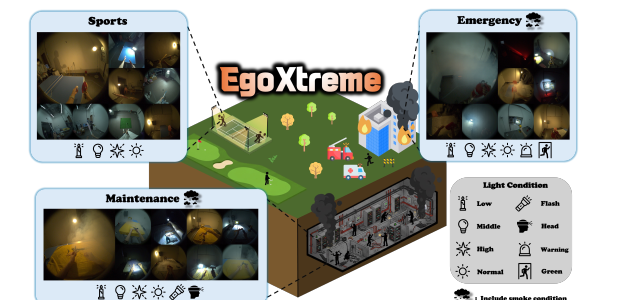
EgoXtreme evaluates egocentric object pose under low light, motion blur, smoke, severe occlusion, and close-range truncation. Industrial maintenance, sports, and emergency-rescue scenarios test the real-world generalization of laboratory methods.
Quickly assess the paper's scope, problem setting, core method, experimental findings, and whether to read it in depth.
Overview Notes: EgoXtreme: A Dataset for Robust Object Pose Estimation in Egocentric Views under Extreme Conditions
1. Basic information
Title: EgoXtreme: A Dataset for Robust Object Pose Estimation in Egocentric Views under Extreme Conditions
Authors / affiliations: Taegyoon Yoon, Yegyu Han, Seojin Ji, Jaewoo Park, Sojeong Kim, Taein Kwon, Hyung-Sin Kim; Seoul National University / University of Oxford
EgoXtreme provides 775.5 minutes of egocentric RGB video captured with Aria glasses by 15 participants, approximately 1.3 million frames, across Sports, Maintenance, and Emergency scenarios with extreme conditions including low light, smoke, and severe motion blur.
2.1 Guide to the paper’s figures and tables
Figure / table
Purpose
Overview reading tips
Figure 1
Dataset scenarios and extreme conditions
Identify concrete differences from YCB-V / HOT3D
Figure 2
Continuous-frame 6D pose annotations
Understand changes in motion and lighting
Table 1
Comparison with existing object pose datasets
Focus on egocentric views, subjects, objects, and frames
Table 2
Three scenarios and lighting configurations
Distinguish standard / extreme / smoke conditions
Tables 3 / 5
Pose estimation and tracking baselines
Examine failures under low light, blur, and smoke
Relevant crop from the original paper’s figures: EgoXtreme uses Aria glasses to capture egocentric Sports, Maintenance, and Emergency scenarios. Source: project page / CVF Open Access. Image copyright belongs to the paper’s authors and publisher; shown here for paper analysis.
3. Dataset statistics
775.5 minutes of egocentric RGB video, 15 participants, Aria glasses, and approximately 1.3 million frames.
13 objects at 30 FPS, covering 8 illumination conditions, with smoke added in some scenarios.
Scenarios: Sports, industrial Maintenance, and Emergency rescue; objects include rackets, bats, tools, and emergency items.
Train / test data are divided by video duration, with mocap-aligned 6D pose annotations.
4. Paper findings
Existing RGB-only zero-shot pose methods substantially degrade under extreme lighting, motion blur, and smoke.
Image restoration such as deblurring, dehazing, and low-light enhancement does not reliably recover pose performance; temporal tracking deserves further study.
The dataset brings hands-busy, eyes-on-task behavior, close-range truncation, and dynamic lighting into standardized evaluation, addressing gaps in laboratory benchmarks.
5. Quick assessment
Value: a real-world benchmark of extreme conditions for egocentric object pose.
Strengths: substantial scale, diverse conditions, continuous pose annotations, and mocap alignment.
Limitations: a limited object set, with scenario bias in some conditions and participant behaviors.
Intended readers: researchers in egocentric vision, real-world deployment, pose tracking, and robust benchmarking.
Available src/paper-notes/egox-treme/deep.md
In-depth paper notes
Support reproduction, comparison, related-work writing, and identifying opportunities for further research.
Deep Reading Notes: EgoXtreme: A Dataset for Robust Object Pose Estimation in Egocentric Views under Extreme Conditions
Key assessment: EgoXtreme combines rapid head motion, close-range truncation, dynamic lighting, and smoke into a real-world stress test covering conditions rarely addressed by existing benchmarks, rather than merely adding videos.
2. Positioning in one sentence
Evaluate object pose and tracking robustness under low light, blur, smoke, and severe occlusion using Aria egocentric video from 15 participants and mocap 6D annotations.
2.1 Guide to the paper’s figures and tables
Figure / table
Deep-dive questions
Figure 1
How do difficulties differ across Sports, Maintenance, and Emergency?
Table 1
What does EgoXtreme add relative to HOT3D, YCB-V, and LM-O?
Table 2
How are Standard and Extreme illumination conditions combined?
Table 3
Do FoundPose, GigaPose, and PicoPose degrade similarly across conditions?
Table 4
Do deblurring, dehazing, and lighting enhancement actually solve pose failures?
Table 5
Which of per-frame, temporal, and hybrid tracking better suits blurred video?
Relevant crop from the original paper’s figures: egocentric Sports, Maintenance, and Emergency scenarios with low light, smoke, and motion blur. Source: project page / CVF Open Access. Image copyright belongs to the paper’s authors and publisher; shown here for paper analysis.
3. Dataset design
Approximately 1.3M frames over 775.5 minutes at 30 FPS; each sequence lasts approximately 55 seconds / 1650 frames.
Aria glasses provide 1408×1408 fisheye RGB; participant head motion and hand manipulation retain realistic egocentric trajectories.
15 participants and 13 objects across 3 scenarios; illumination includes normal, low, head / flash, warning, exit green, and high light.
Mocap markers track the headset and objects; Umeyama alignment of coordinate frames provides continuous 6D pose ground truth.
Approximately 518.8 minutes form the training set; the remainder goes to validation / testing, avoiding leakage from continuous repetitions of the same action.
4. Research context and motivation
YCB-V, LINEMOD, T-LESS, and similar benchmarks mainly control clutter, texture, occlusion, or static lighting, with limited coverage of dynamic egocentric conditions.
HOT3D advances egocentric object understanding but largely features relatively good lighting and moderate motion.
Existing zero-shot RGB methods perform well on standard data, but the authors identify distinct failures from extreme lighting, motion blur, and truncation.
5. Conditions and tasks
Sports: fast object swings, including baseball bats, hockey sticks, ping-pong / tennis rackets, and golf clubs, primarily testing motion blur.
Maintenance: industrial lighting, flashlights, headlights, and local smoke, simulating handheld tools and low-light maintenance.
Emergency: warning lights, exit-green lighting, high light, and smoke, simulating changes in color and visibility during rescue.
Tasks include single-frame pose estimation, pose recall under extreme conditions, and tracking initialized by the t−1 pose.
6. Annotation and evaluation
The main metric is ADD(S) recall at object-diameter thresholds such as 0.1d, 0.2d, and 0.3d.
Real mocap annotations enable evaluation of 6D pose beyond 2D tracking boxes.
Separate low-light, smoke, and blur statistics distinguish illumination, visibility, and temporal failures.
7. Experimental analysis
7.1 Baseline
Baselines include RGB-only zero-shot methods such as FoundPose, GigaPose, and PicoPose; the paper also investigates restoration and temporal tracking.
Under extreme conditions, the model must localize the object and recover orientation and translation within the query crop; failures should not be attributed solely to the pose head.
7.2 Main findings
Baseline recall drops substantially under extreme lighting and smoke. Severe motion blur is among the hardest conditions, often leaving insufficient features or too few matches.
Adding smoke reduces some models’ 0.3d recall by approximately 5 percentage points; motion blur has a stronger effect in Sports.
Conventional deblurring, dehazing, and low-light enhancement do not reliably improve pose and can add noise: visual sharpness does not guarantee geometrically usable features.
Temporal tracking uses the previous pose, but incorrect initialization or prolonged occlusion can cause its temporal prior to accumulate errors.
8. Critical analysis
Contribution: systematically organizes real egocentric conditions into a repeatable benchmark with accurate annotations.
Data bias: 13 objects and 15 participants cannot cover all wearing styles, skin tones, head motions, and object categories.
Annotation boundary: mocap-marker, headset, and object-frame alignment accuracy requires particular scrutiny for small objects / parts.
Algorithmic implication: the next bottleneck may be visibility-aware temporal modeling, uncertainty, and active gaze / head motion, rather than stronger image restoration.
9. Implications for my research
Pose methods should report condition-specific results rather than a single mean recall.
Treating motion blur as temporal integration suggests that events / high-speed sensors or continuous-time models may be more effective than single-frame deblurring.
Egocentric pose can be modeled jointly with hand–object interaction, action intent, and gaze / head trajectories.
10. Open questions
How can head motion actively select a more observable next viewpoint?
How can object-pose uncertainty trigger temporal-tracker reinitialization?
How can the 13-object setting generalize to open categories, small objects, and targets severely truncated by hands?
11. Further analysis: separating real-world difficulties
11.1 Dataset scale and acquisition protocol
EgoXtreme contains 775.5 minutes of egocentric RGB video from 15 Aria-glasses participants: approximately 1.3M frames at 30 FPS, with original fisheye resolution 1408×1408. It covers 13 objects, 8 illumination conditions, and Sports, Maintenance, and Emergency scenarios; training accounts for approximately 518.8 minutes. Mocap provides object / headset-aligned pose annotations, enabling continuous tracking rather than isolated-image evaluation.
Its value lies in combining close-range truncation, hand / body occlusion, head-motion blur, low light, flash, headlights, warning lights, and smoke. Compared with tabletop / fixed-camera distributions in YCB-V and LM-O, these conditions alter the object crop and observability themselves.
11.2 Baseline numbers in Table 3
GT bounding boxes decouple detection errors in comparisons of FoundPose, GigaPose, and PicoPose. Representative results follow (ADD(S) recall):
Scenario
Condition
FoundPose @0.3d
GigaPose @0.3d
PicoPose @0.3d
Sports
Standard
4.72
24.64
24.61
Sports
Extreme
2.42
19.04
17.86
Maintenance
Standard
37.61
52.86
59.87
Maintenance
Extreme
30.03
45.52
52.30
Emergency
Standard
12.88
46.34
67.83
Emergency
Extreme
0.56
21.30
36.23
These values reveal two distinct challenges: egocentric crops plus motion blur in Sports nearly defeat all baselines, while extreme Emergency lighting sharply reduces recall. An average drop of a few points cannot capture both behaviors.
11.3 Counterintuitive restoration and tracking results
PicoPose preprocessing results in Table 4 give Sports 0.3d recall of 23.02 on original images versus 20.99 with combined deblurring / dehazing / lighting enhancement; Maintenance drops from 63.32 to 53.28. Visually clearer images therefore do not guarantee better pose features, and chaining restorations can damage geometric cues.
The paper reports approximately 5 percentage points lower @0.3d recall with smoke for some methods. Motion blur dominates Sports failures; FoundPose often lacks enough sparse feature matches to run PnP-RANSAC. Temporal tracking improves initialization continuity but still accumulates errors during long occlusions.
11.4 Author claims and my analysis
Authors’ claims
My assessment
EgoXtreme better reflects deployment conditions
Supported by 15 participants, 775.5 minutes, continuous mocap, and multiple conditions, though 13 objects remain limited.
Existing zero-shot pose is not robust to extreme conditions
Very low Table 3 recall is persuasive; GT boxes also prevent detection failures from confounding this conclusion.
Restoration is insufficient
Degradation from combined restoration in Table 4 supports this; condition-aware temporal / event models are a next direction.
12. Reproduction and data audit
Record headset intrinsics, fisheye distortion, mocap-to-object calibration, condition labels, and video splits. The source notes suggest leave-one-participant, leave-one-object, and leave-one-scenario splits, counting no pose output explicitly as failure. For robotics / AR, pose uncertainty should trigger reinitialization, active head motion, or another frame rather than silent tracker drift.