6-DoF Object Tracking with Event-based Optical Flow and Frames
Local event triplets generate per-event 2D optical flow. A pixel-depth-dependent interaction matrix recovers object 6D velocity in a Kalman filter, while a quaternion UKF fuses 5 Hz absolute DOPE poses. The method substantially outperforms frame-based flow and RGB-D trackers on high-speed synthetic trajectories of four YCB objects. Real dual-camera sequences lack ground truth, and all experiments are offline.
asynchronous event streamlow-rate RGB framessynchronized depth imagesknown object model
Requirements
calibrated event camera and RGB-D camera paircamera intrinsics and synchronized per-pixel depthknown object identity and DOPE modelobject event / image region of interestfilter noise and event-flow parameters
Full paper metadataAuthors, affiliations, research area, datasets, metrics, method tags, and reading statusExpandCollapse
Authors
Zhichao Li, Arren Glover, Chiara Bartolozzi, Lorenzo Natale
Affiliations
Istituto Italiano di Tecnologia / University of Genoa
calibrated event camera and RGB-D camera paircamera intrinsics and synchronized per-pixel depthknown object identity and DOPE modelobject event / image region of interestfilter noise and event-flow parameters
Reading Notes
Overview / Deep Dive
Available src/paper-notes/event-optical-flow-tracking-iros2025/coarse.md
Paper overview notes
Quickly assess the paper's scope, problem setting, core method, experimental findings, and whether to read it in depth.
Overview Notes: 6-DoF Object Tracking with Event-based Optical Flow and Frames
1. Basic information
Title: 6-DoF Object Tracking with Event-based Optical Flow and Frames
Authors: Zhichao Li, Arren Glover, Chiara Bartolozzi, Lorenzo Natale
Affiliations: Istituto Italiano di Tecnologia; University of Genoa
Estimate 2D optical flow per event, convert it to object 6D velocity using synchronized depth and an image interaction matrix, then fuse it with 5 Hz DOPE absolute poses through a quaternion UKF. This mitigates RGB motion blur and large inter-frame displacement, but still requires RGB-D depth and is not event-only tracking.
3. Guide to figures and tables
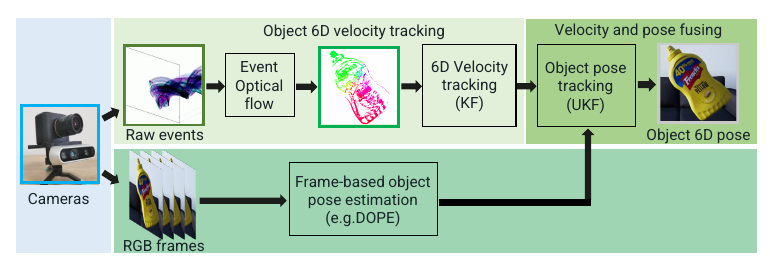
Original Figure 1: event optical flow and a Kalman filter estimate high-rate 6D velocity; DOPE on RealSense images supplies low-rate absolute poses; UKF fuses both. Source: authors’ public manuscript; image copyright belongs to the paper’s authors and IEEE. Shown here for paper analysis.Original Tables II / III: ROFT has lower translation error under regular motion. Under fast motion, this method averages 3.94 cm / 11.56° translation / rotation RMSE, substantially better than both RGB-D baselines. Normal-flow constraints and residual weighting both contribute. Source: authors’ public manuscript; table copyright belongs to the paper’s authors and IEEE. Shown here for paper analysis.
4. Problem setting
Task: continuous instance-level 6D pose tracking of fast-moving rigid objects.
Sensors: calibrated event camera and RealSense RGB-D; events, RGB frames, and synchronized depth all participate.
Global pose: a known-object DOPE model supplies absolute corrections only 5 times per second.
Velocity branch: event optical flow measures motion at high temporal resolution, but conversion from 2D flow to 6D velocity needs corresponding pixel depth.
Objective: maintain trajectories under frame-camera motion blur and excessive inter-frame displacement.
5. Method overview
Search small image regions for event triplets satisfying local constant-velocity constraints, producing per-event 2D flow candidates.
Select a representative flow using robust regional consistency to reduce incorrect event-matching effects.
Represent linear / angular velocity by V=[vo,ω] and predict with a decaying-velocity model (α=0.5).
Project V into predicted flow through an interaction matrix containing intrinsics and pixel depth.
Apply normal-flow constraints for the aperture problem and weight observations by residual deviation from the median.
Integrate event velocities with quaternion UKF; arriving 5 Hz DOPE poses correct absolute translation and rotation drift.
6. Experiments at a glance
Synthetic data: four YCB objects in Unreal Engine, each with regular / faster random 6DoF trajectories.
Blur simulation: generate 500 FPS RGB, average temporally into 60 FPS frames, and derive events from the same high-rate sequence.
Quantitative metrics: position RMSE in cm and rotation RMSE in degrees.
Regular mean errors: this method 2.53 cm / 8.82°; ROFT 1.97 cm / 9.15°.
Faster mean errors: this method 3.94 cm / 11.56°; ROFT 22.27 cm / 36.60°; se(3)-TrackNet 38.88 cm / 38.84°.
Ablations: full model 3.24 cm / 10.19°; without normal-flow constraints 4.93 cm / 12.35°; without measurement weighting 4.10 cm / 10.45°.
Real data: RealSense D415 at 60 FPS and 640×480 plus a 640×480 asynchronous event camera; only two objects and qualitative overlays, without pose GT.
7. Quick assessment
Strength: 2D event flow improves motion observability over previous 1-DoF brightness-change observations, degrading far less on fast synthetic sequences than frame-flow and learned RGB-D trackers.
Avoid misreading: this is not event-only. Translation terms in the interaction matrix explicitly require synchronized RGB-D depth, and low-rate absolute poses come from RGB DOPE.
Evidence: four-object synthetic quantities support fast-motion gains; real overlays cannot establish absolute accuracy.
Real-time status: the authors consider event flow and filters capable of real-time operation, but all experiments are offline, without end-to-end latency, event-processing rate, or measured output frequency.
Main limitations: sparse events weaken rotation observability; stable object-event / ROI selection, cross-sensor synchronization errors, and depth noise lack systematic ablations.
Code status: no official code or dataset repository was found when the source notes were compiled.
Available src/paper-notes/event-optical-flow-tracking-iros2025/deep.md
In-depth paper notes
Support reproduction, comparison, related-work writing, and identifying opportunities for further research.
Deep Reading Notes: 6-DoF Object Tracking with Event-based Optical Flow and Frames
1. Key assessment
Fast objects cause ordinary-camera blur and large inter-frame pose jumps. Event cameras offer frequent motion observations without waiting for full exposures, but lack stable appearance for global recognition of known-object 6D pose. The paper addresses this sensor mismatch.
RGB supplies global anchors: DOPE absolute 6D poses at 5 Hz;
Depth connects 2D and 3D: the interaction matrix uses pixel depth to project 6D velocity into 2D flow;
Two filters fuse over time: KF tracks velocity, quaternion UKF tracks pose.
The main novelty replaces the earlier 1-DoF event-generation observation with a more informative 2-DoF optical-flow residual inside classical state estimation, rather than directly predicting global pose from events.
2. System inputs and boundaries
Original Figure 1. Although the diagram emphasizes events and RGB frames, the method explicitly also inputs synchronized depth for interaction-matrix 6D velocity measurements. Source: authors’ public manuscript; image copyright belongs to the paper’s authors and IEEE. Shown here for paper analysis.
Complete inputs are:
RGB frames {Ii};
Synchronized depth images {Di};
High-temporal-resolution events {Eq};
Calibrated intrinsics and event / RGB-D extrinsics;
A known object and its DOPE estimator; visualizations also use an object mesh.
Foreground-event segmentation / object ROI generation is not fully specified as a separate module. Selecting target events directly affects velocity, especially with multiple objects, camera motion, or strong background edges. Controlled single-object trajectories do not cover these difficulties.
3. Per-event optical flow
Assume approximately constant motion over short intervals in a small image region. Three neighboring events
ei=(xi,ti),ej=(xj,tj),ek=(xk,tk)
satisfying
tj−tixj−xi≈tk−tj+ξxk−xj,
provide flow for event ei:
F(xi)=tk−tixk−xi.
Each event can have several triplets, with wrong matches corrupting 6D velocity. Within small RoIs, select a representative from candidate set M, minimizing the summed nearest distance to each event’s candidate subset Mi:
F⋆=argF′∈Mmini=1∑nFic′∈Mimin∥F′−Fic′∥.
This resembles robust medoid aggregation: select an existing vector consistent with the candidate sets rather than averaging conflicting flows. It is lightweight but assumes local constant velocity, sufficient event density, and correct RoIs.
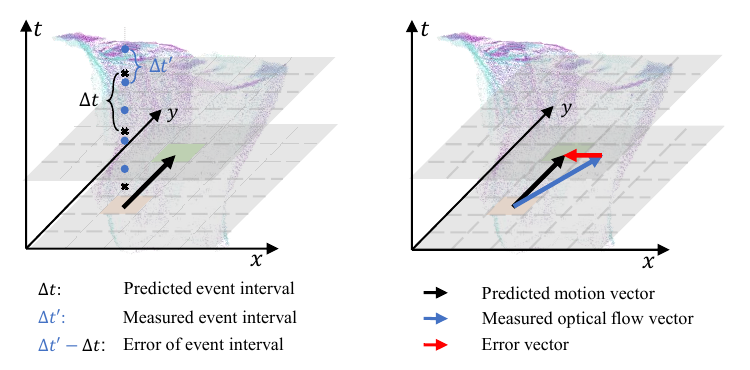
Original Figure 2: earlier work compares event-time intervals at one pixel; this method compares measured / predicted 2D motion vectors, observing direction and magnitude. Source: authors’ public manuscript; image copyright belongs to the paper’s authors and IEEE. Shown here for paper analysis.
Earlier Hybrid Object Tracking with Events and Frames uses a 1-DoF brightness-change timing residual. Full-image camera motion can provide enough events, while local object motion with self-occlusion can lack observability during simultaneous multi-axis motion.
Measured flow F(u,v) contains direction and magnitude. Ours (GE) is the earlier 1D generative-event version; Ours (OF) is generally more stable on fast sequences, supporting improved local object-motion observability from 2D measurements.
5. From 2D flow to 6D velocity
Define velocity state as
Vi=[voi,ωi],
where vo∈R3 is linear velocity of an object-attached point instantaneously at the camera origin, and ω∈R3 is angular velocity.
The motion model uses decaying velocity:
Vi+1=αVi+w,α=0.5.
Events occur only during brightness changes; a stopped object provides no measurement corrections. Using α<1 gradually brings predicted velocity to zero without events, rather than maintaining an incorrect constant velocity.
For pixel (u,v), predicted flow is
F^(u,v)=J(u,v)ViΔT,
where J=[JvoJω] is the image interaction matrix. Its translation block contains
dfx,dfy,du−cx,dv−cy.
where d is corresponding pixel depth. This is not depth-free: translation in 2D flow cannot directly provide metric 3D velocity without synchronized depth. The Discussion explicitly lists removal of RGB-D depth as future work.
6. Normal-flow constraints and measurement weighting
Events frequently arise at edges. With only one local edge, the aperture problem constrains normal flow while leaving tangential flow unobservable. Instead of directly using F−F^, project predicted flow onto the measured-flow direction before comparison:
rk=∥Fk∥∥F^k∥Fk⋅F^kFk−F^k.
An incomplete normal-flow measurement can then constrain the prediction along its observable direction.
Residual weights depend on deviation from median M:
Lk=max(2b1exp[−b∣rk−M∣],10−6).
Event flows far from the residual median contribute less to correction. Table III reports:
Version
Translation RMSE cm ↓
Rotation RMSE ° ↓
w/o normal-flow constraint
4.93
12.35
w/o measurement weighting
4.10
10.45
Full model
3.24
10.19
Normal-flow constraints matter more for both translation and rotation. Weighting clearly helps translation and slightly improves rotation. Grid size, event windows, Laplacian b, and noise-matrix sensitivities are not reported, but matter for reproduction.
7. KF and quaternion UKF
The first Kalman filter predicts with decaying velocity and corrects using accumulated event-flow residuals, outputting frequent Vi.
The second filter’s pose state is
xi=[ti,qi]T,
where qi is a unit quaternion. UKF integrates translation and rotation using Vi; an arriving DOPE pose Ti corrects position p(Ti) and quaternion q(Ti). Without a current global pose, UKF skips correction and propagates using event velocities only.
DOPE is artificially limited to 5 Hz to simulate low-power / small GPUs. The paper mentions 30 Hz on high-end GPUs but does not report this system’s hardware, actual event throughput, filter frequency, or end-to-end energy at 5 Hz.
8. Data generation and metrics
Synthetic experiments use Unreal Engine and four YCB objects:
003 cracker box;
005 tomato soup can;
006 mustard bottle;
010 potted meat can.
Each has regular and faster random 6DoF trajectories. RGB is first rendered at 500 FPS and supplied to an event-camera model, then averaged over fixed windows into 60 FPS frames to introduce motion blur. The simulator supplies object-pose and 6D velocity GT.
Position uses Euclidean translation RMSE against GT; rotation uses se(3) rotation-vector RMSE in degrees. These are not BOP ADD(-S) / AR or symmetry-aware surface metrics.
Real data use calibrated RealSense D415 and event cameras, both 640×480. RealSense runs at 60 FPS; the event camera is asynchronous. Cracker box and mustard bottle move by hand as fast as possible. Without pose GT, evaluation checks CAD-render overlap visually.
9. Main results
Original Tables II / III. The method does not lead every regular-motion metric; gains concentrate on faster motion, matching its focus on blur and large inter-frame movement. Source: authors’ public manuscript; table copyright belongs to the paper’s authors and IEEE. Shown here for paper analysis.
Four-object mean results:
Method
Regular translation cm ↓
Regular rotation ° ↓
Faster translation cm ↓
Faster rotation ° ↓
se(3)-TrackNet
7.69
13.56
38.88
38.84
ROFT
1.97
9.15
22.27
36.60
Ours (OF)
2.53
8.82
3.94
11.56
Interpretation:
Under regular motion, ROFT has lower mean translation error; this method slightly improves rotation;
Under faster motion, both frame-based baselines degrade substantially, while this method changes only from 2.53 / 8.82 to 3.94 / 11.56;
se(3)-TrackNet can be very accurate on individual regular sequences yet fail completely at high speed;
ROFT shares 5 Hz DOPE with this method, helping isolate frame versus event optical-flow stability under blur.
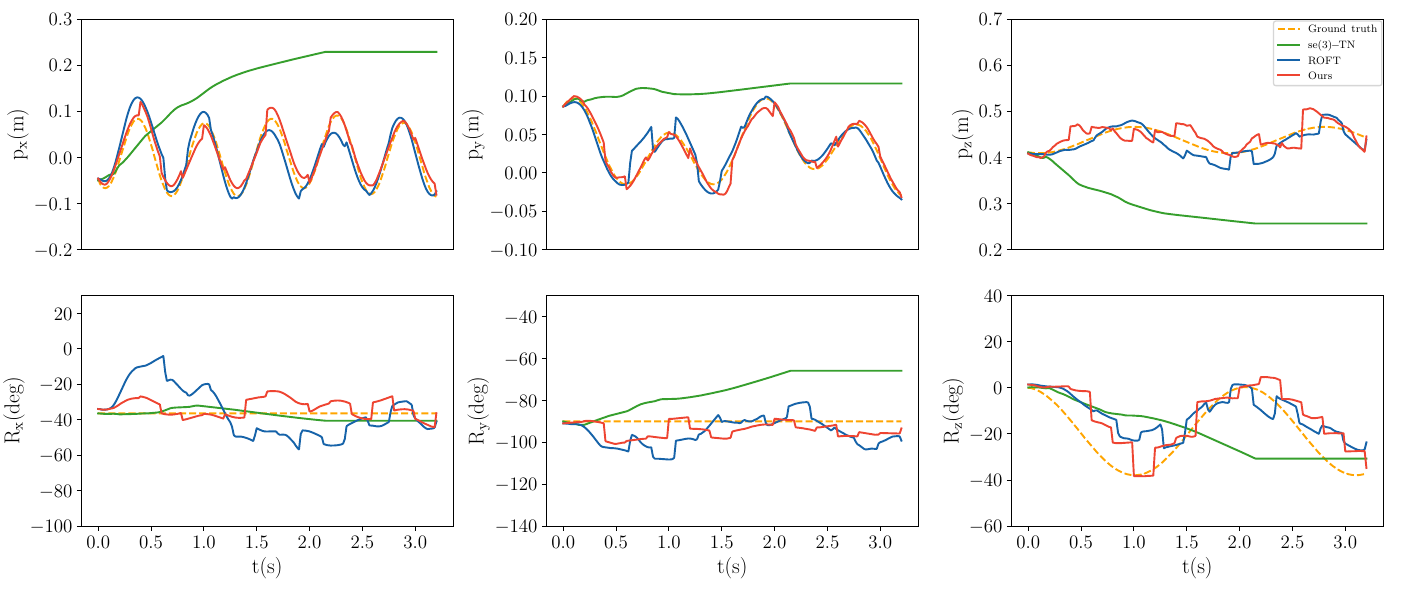
Original Figure 6: three translation and three rotation components for the 005 faster trajectory. se(3)-TrackNet drifts on several axes and ROFT shows large jumps; this method stays generally closer to dashed GT, with remaining rotation errors. Source: authors’ public manuscript; image copyright belongs to the paper’s authors and IEEE. Shown here for paper analysis.
10. Scope of real-world evidence
Real-sequence observations:
se(3)-TrackNet fails during some fast translations / rotations and struggles to recover;
ROFT can recover from periodic global poses but has clear overlay errors under blur;
This method aligns CAD overlays more closely during translation;
Rotation errors remain substantial, attributed to poor observability from sparse events.
Without GT, these support offline operation on real sensors and plausible visual trends, not centimeter / degree accuracy. Faster synthetic averages cannot be transferred directly to real robot scenes.
11. Real-time status and reproduction
The paper describes per-event flow as lightweight and scalable to real time and limits DOPE to 5 Hz, but experiments are explicitly offline. Real-time flow / filter operation is an expectation; live latency and stability remain future tests.
Reproduction requires checking at least:
Event / RGB-D clock synchronization and spatial calibration;
Depth registration to event pixels, holes, and noise handling;
Object RoIs and foreground-event selection;
Event-triplet search radius, timing tolerance ξ, and grid size;
Events accumulated per KF correction;
α=0.5, Qv,Qω,RF;
Exact vector implementation of normal-flow residuals;
Laplacian coefficient b;
UKF Qt,Qq,Rt,Rq;
DOPE 5 Hz scheduling and output delay;
Domain gaps in simulated events, exposure averaging, and real contrast thresholds.
No official code / dataset repository was found when the notes were compiled, and not all parameters above are specified. Reproduction is harder than the classical filter architecture might suggest.
12. Limitations
Synchronized RGB-D depth is required; the pipeline is not fully event-based;
Low-rate absolute poses still require known-object DOPE;
Synthetic quantities cover only four YCB objects under controlled scenes / motion;
Real data cover two objects without GT;
All experiments are offline, without end-to-end real-time measurements;
Sparse events weaken rotation observability;
Object-event segmentation / ROI generation lacks systematic analysis;
Fast camera motion, multiple objects, occlusion, background events, and cross-sensor misalignment are not evaluated;
No same-protocol comparison with learned event-flow / event-pose networks;
Pose-vector RMSE does not handle object symmetry.
13. Overall assessment
The main lesson is that events need not perform full global recognition for fast tracking. Observable, robust 2D motion measurements plus low-rate frame-based poses can remove integration drift and expand the tracker’s speed range. Faster synthetic errors fall from ROFT’s 22.27 cm / 36.60° to 3.94 cm / 11.56°, providing clear evidence for this mechanism.
Fast event-assisted 6D tracking must be stated with three conditions: synchronized depth, 5 Hz known-object DOPE, and no quantitative real-world GT. This is a research prototype for asynchronous event / frame / depth fusion, rather than a comprehensively validated real-time event-pose system.