Object Pose Estimation · 2026 · ICRA / IEEE RA-L · CCF B
Learning 6D Object Pose Estimation With Event Cameras Using Synthetic Data and Domain Randomization
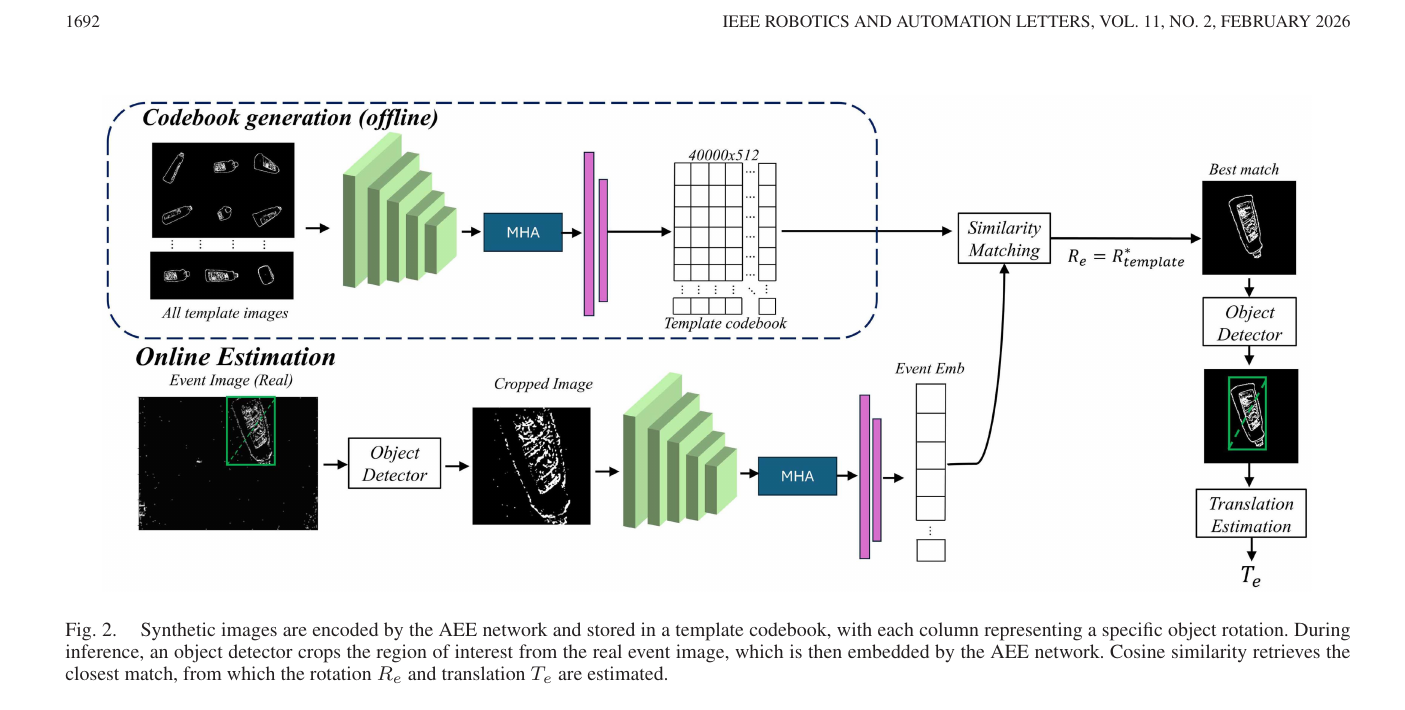
AEE transforms RGB templates from 4,000 hemispherical viewpoints × 10 in-plane angles into an event latent codebook through edge extraction and domain randomization. Real event crops retrieve rotations, while box centers / object scale approximate translation. Retrieval takes around 5 ms, but full-pose 10% ADD-S is highly sensitive to detection boxes: only 2.5% for the wood block versus 86.0% for the cracker box.
object-specific synthetic template codebookYOLOv11 event-image detectorknown camera intrinsicsknown object size or depth proxyseparate per-object training
Full paper metadataAuthors, affiliations, research area, datasets, metrics, method tags, and reading statusExpandCollapse
Authors
Oussama Abdul Hay, Xiaoqian Huang, Muhammad Ahmed Humais, Abdulla Ayyad, Randa Almadhoun, Yahya Zweiri
Affiliations
Advanced Research and Innovation Center / University of Sunderland / Khalifa University
object-specific synthetic template codebookYOLOv11 event-image detectorknown camera intrinsicsknown object size or depth proxyseparate per-object training
Reading Notes
Overview / Deep Dive
Available src/paper-notes/event-pose-synthetic-icra2026/coarse.md
Paper overview notes
Quickly assess the paper's scope, problem setting, core method, experimental findings, and whether to read it in depth.
Publication relationship: RA-L Vol. 11 No. 2 (2026), included in the ICRA 2026 technical program.
Authors / affiliations: Oussama Abdul Hay, Xiaoqian Huang, Muhammad Ahmed Humais, Abdulla Ayyad, Randa Almadhoun, Yahya Zweiri; ARIC, University of Sunderland, Khalifa University.
Task: train only on synthetic RGB / CAD, retrieve object rotation from real event images without an initial pose, and estimate full 6D pose from bounding-box scale.
2. Positioning in one sentence
AEE corrupts 40,000 synthetic pose templates into sparse edges and trains an augmented autoencoder to recover canonical templates from incomplete event-like appearance. Latent cosine retrieval provides rotation rather than direct SE(3) regression from events.
3. Method overview
Per object: Fibonacci hemisphere sampling gives 4,000 viewpoints with 10 in-plane angles each, totaling 40,000 templates.
Sobel edges, random thresholds, gaps / masks, background noise, scale, and translation simulate sparse, discontinuous events from RGB renders.
A 5-layer encoder plus multi-head attention outputs a 512D embedding; an MSE decoder reconstructs the uncorrupted binary template.
Store pose embeddings in an object-specific codebook offline. Online, YOLOv11 crops an event frame, and the nearest cosine template supplies rotation.
Estimate query depth from query / template bounding-box diagonals, focal lengths, and template depth, then recover x,y translation from box centers and intrinsics.
Original Figure 2: offline rotation-indexed codebook above, online event-crop encoding and cosine retrieval below. Box geometry estimates translation separately. Source: original paper. The paper uses CC BY 4.0; image copyright belongs to the authors. Shown here for academic analysis.
4. Experiments at a glance
E-POSE: 10 objects under 12 motion / illumination / speed conditions; accumulate 5,000 events per frame with a 500-event sliding step.
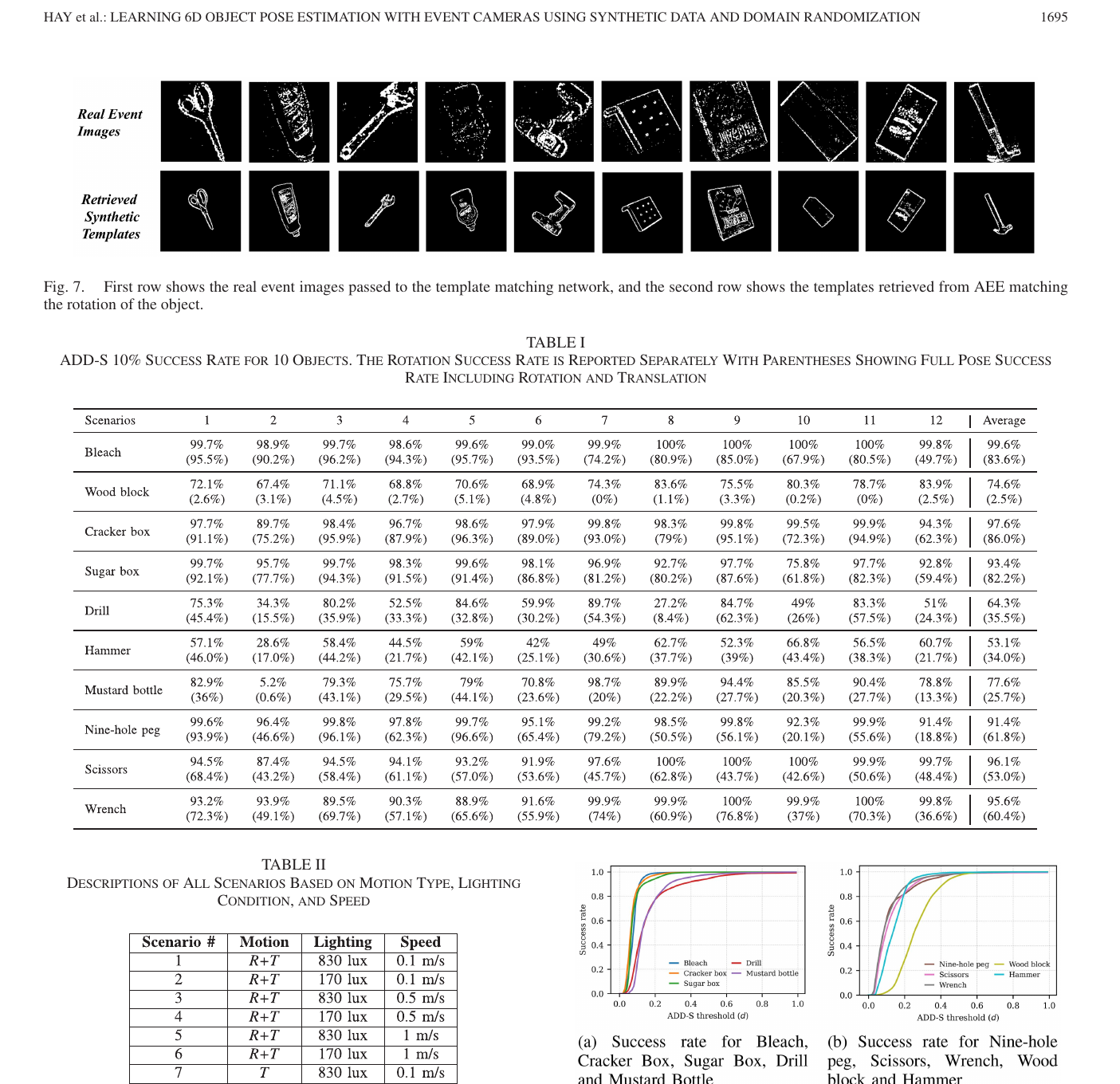
Rotation-only ADD-S at 10% is generally high, but estimated translation substantially lowers full-pose results:
AEE encoding + retrieval takes approximately 5 ms; overall inference in Table IV should also distinguish YOLO detection and translation computation.
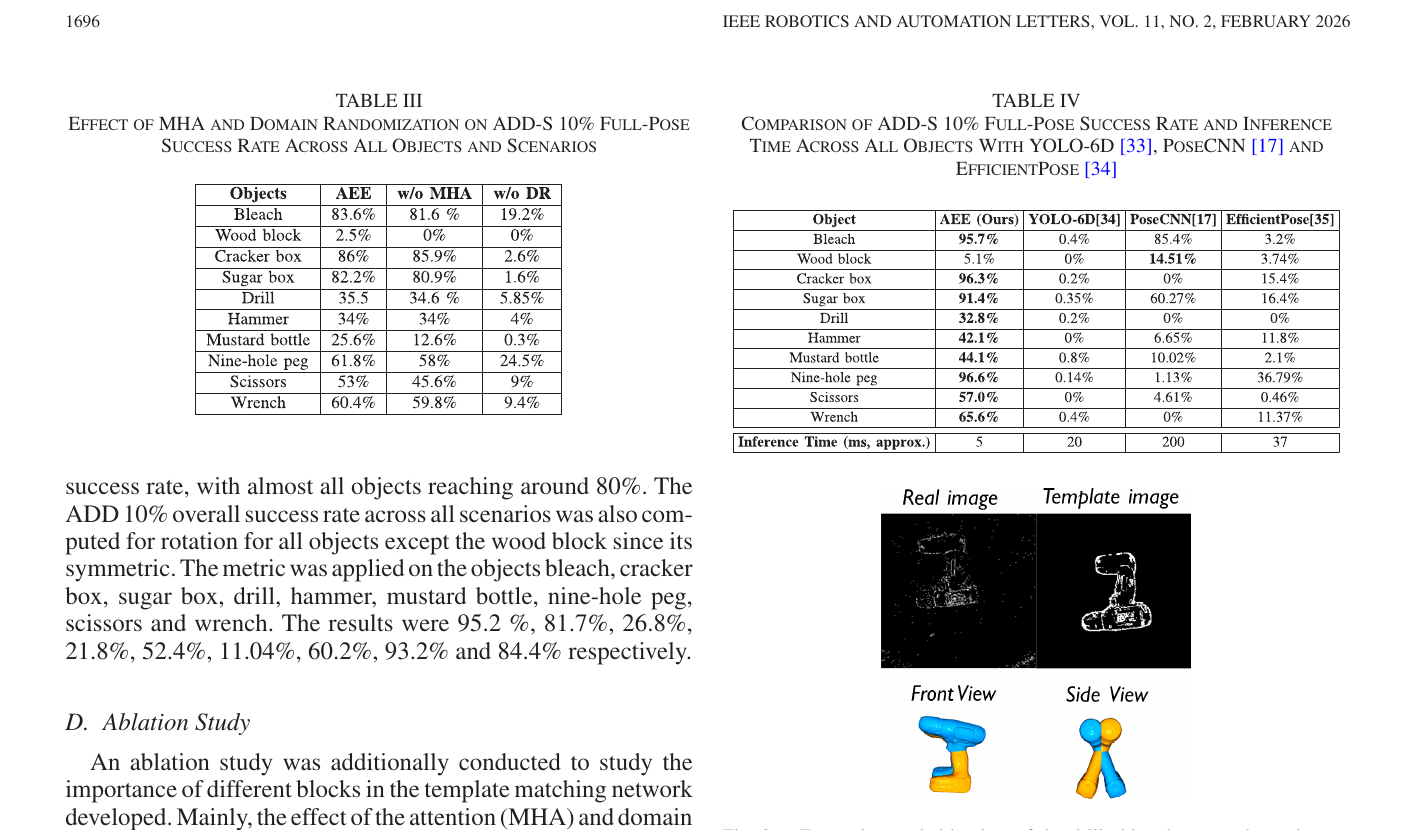
Removing domain randomization sharply reduces full-pose success. MHA gains are smaller, mainly helping objects such as scissors and mustard bottle.
Original Figure 7 and Tables I–II: main cell values are rotation-only, parentheses full pose. The gap directly highlights translation / detection as the main bottleneck. Source: original paper. The paper uses CC BY 4.0; image copyright belongs to the authors. Shown here for academic analysis.
5. Quick assessment
Strength: the pose encoder needs no real event training data, focusing event-sensor advantages on orientation retrieval under fast motion / illumination changes.
Important limits: separate training and a 40k codebook per known object / CAD, rather than arbitrary unseen objects; translation depends on detector boxes, intrinsics, and scale approximations.
Full 6D pose combines rotation retrieval with box geometry, but rotation has the strongest evidence. Approximately 200 Hz should not distract from full-pose accuracy.
Available src/paper-notes/event-pose-synthetic-icra2026/deep.md
In-depth paper notes
Support reproduction, comparison, related-work writing, and identifying opportunities for further research.
Deep Reading Notes: Learning 6D Object Pose Estimation With Event Cameras Using Synthetic Data and Domain Randomization
Core question: real event-pose data are scarce, and conventional trackers require initial poses, clear model edges, and hand tuning. Can ordinary CAD / synthetic RGB renders train a method that initializes pose from one event representation?
Core answer: randomize synthetic RGB templates into event-like sparse edges and learn a rotation-discriminative latent with an augmented autoencoder. Retrieve the closest template for a real event image, then estimate translation from template / query bounding-box scale.
My assessment: AEE demonstrates synthetic-to-event orientation retrieval, especially under fast motion. Full 6D pose combines unequal components: strong rotation latents and an analytical translation approximation sensitive to box center and scale. It is closer to a strong event-orientation initializer than a mature millimeter-accuracy 6D estimator.
2. Positioning in one sentence
Domain-randomized edge reconstruction compresses 40k synthetic rotations into a 512D codebook, enabling real event frames to retrieve orientation in approximately 5 ms. Bounding-box apparent scale and camera intrinsics provide translation.
2.1 Guide to figures and tables
Figure / table
What to look for
Figures 2–4
How RGB templates become event-like edges, and whether codebook / query processing is shared.
Table I
Main percentages are rotation-only, parentheses full pose; do not mix them.
Table II
12 scenarios vary motion, illumination, and speed.
Table III
Domain randomization provides the main gains; MHA is secondary.
Figures 9–10
Roll ambiguity and missing motion-parallel edges are structural representation failures.
Original Figures 2–4: 40,000 pose-labeled synthetic templates undergo edge extraction and corruption; encoder outputs form the codebook. Real event frames use the same encoder to retrieve the nearest rotation. Source: original paper. The paper uses CC BY 4.0; image copyright belongs to the authors. Shown here for academic analysis.
3. Task setting
Test-object CAD, identity, and intrinsics are known. Each object has independently trained networks / codebooks. Online input is a frame-like binary image accumulated from a specified event count, with YOLOv11 detection first. Outputs are rotation R and translation T.
The method addresses:
No initial pose: unlike trackers requiring manual first-frame alignment;
Synthetic-only pose training: no real event-pose labels for AEE;
Known-instance adaptation: not one model for arbitrary new CAD; each object requires 40k templates and 200 training epochs.
4. Synthetic templates and domain randomization
4.1 rotation coverage
Fibonacci sampling provides 4,000 near-uniform upper-hemisphere viewpoints with 10 in-plane rotations each, totaling 40,000 poses. The tabletop hemisphere assumption reduces codebook size but excludes arbitrary full-sphere views.
4.2 Simulating event appearance from RGB renders
Real events respond to log-intensity changes, while static renders lack time. Instead of full physical event simulation, the authors randomize appearance:
Extract Sobel edges from RGB renders;
Randomize thresholds to remove weak edges;
Use random masks / patches to break edge continuity;
Add background noise for low signal-to-noise conditions;
Randomize scale / translation to reduce sensitivity to detection boxes;
Reconstruct the unaugmented canonical binary edge template.
This trains recovery of clean pose-specific structure from potentially missing / corrupted edges, rather than precise event generation. It is inexpensive and scalable but explicitly models neither polarity nor microsecond timing.
5. Augmented Event Encoder
A 256×256 binary input passes through 5 encoder convolutions, multi-head attention (MHA), and two linear layers to produce a 512D embedding. A 5-layer deconvolution decoder reconstructs clean templates using MSE.
Quaternion / Euler angles are not directly supervised. Pose-dependent clean edge patterns force orientation information into the latent; random corruptions of one pose must reconstruct the same template. Each object trains for 200 epochs, batch 32, on RTX 3070, with learning rate 2×10⁻⁴.
After training, encode clean templates with MHA and store embeddings plus rotations in the codebook. A YOLO-cropped / resized event query is encoded and compared by cosine similarity against 40k vectors; the nearest template supplies Re.
Approximately 5 ms / 200 Hz refers to encoding and retrieval, not automatically the end-to-end event-stream update rate. Event frames first accumulate 5,000 events with a 500-event sliding window, and YOLO also costs time.
6. Recovering translation
The matched template has known depth ttemplate,z, focal length ftemplate, and box diagonal ∥bbtemplate∥, with corresponding query quantities. Assume apparent rigid-object size is proportional to f/z:
Then back-project box centers through intrinsics to obtain x,y translation from their difference. This assumes:
Tight object boxes whose rotation-dependent size is explained by the matched template;
Approximately consistent projection relationships between object center and box center;
Known metric CAD scale;
Accurate intrinsics;
No severe cropping / occlusion.
At 346×260 and 1 m, a 1-pixel detector error can correspond to approximately 3 mm; several pixels cause centimeter-scale translation errors. Reporting rotation-only separately from full pose exposes this weakness.
7. Data and evaluation
Choose 10 E-POSE objects under 12 scenarios:
Rotation + translation or translation-only motion;
Illumination of 830 lux and 170 lux;
Speeds of 0.1 / 0.5 / 1 m/s.
Each representation accumulates 5,000 events with a 500-event sliding step. Evaluation uses ADD-S at 10% object diameter:
Rotation-only: predicted R + ground-truth T;
Full pose: predicted R,T.
Wood-block symmetry receives a separate rotation-metric explanation; curves over different d thresholds are also reported.
8. Main results
Original Figure 7 and Tables I–II: main Table I values use rotation only; parentheses include estimated translation for full pose. Their gap is central to interpreting the results. Source: original paper. The paper uses CC BY 4.0; image copyright belongs to the authors. Shown here for academic analysis.
Averages over 12 scenarios:
Object
Rotation-only
Full pose
bleach
99.6
83.6
wood block
74.6
2.5
cracker box
97.6
86.0
sugar box
93.4
82.2
drill
64.3
35.5
hammer
53.1
34.0
mustard bottle
77.6
25.7
nine-hole peg
91.4
61.8
scissors
61.5
53.0
wrench
95.6
60.4
Strong bleach / cracker / sugar / wrench retrieval suggests distinctive edge shapes survive the domain gap. Full-pose results fall sharply for wood block, drill, and mustard, mainly from uniform texture / shape, box-center bias, and translation.
Low light slightly degrades results, attributed to SNR; higher motion speeds do not systematically hurt performance, supporting event sensing for fast motion. However, event-count windows reach 5,000 events sooner at high speed, also changing the effective temporal window.
9. Ablations and baselines
Original Tables III–IV: removing domain randomization hurts much more than removing MHA. Baselines are RGB-pose networks fine-tuned to events; object and training protocols need individual checking. Source: original paper. The paper uses CC BY 4.0; image copyright belongs to the authors. Shown here for academic analysis.
Table III full-pose ablations include:
Bleach: AEE 83.6, without MHA 81.6, without DR 19.2;
cracker box: 86.0, 85.9, 2.6;
sugar box: 82.2, 80.9, 1.6;
scissors: 53.0, 45.6, 9.0;
wrench: 60.4, 59.8, 9.4.
Domain randomization is decisive for RGB-render → real-event transfer; MHA usually adds smaller gains. In Table III, wood block scores 2.5% with AEE and 0% without either MHA or DR. Table IV reports 5.1% for AEE under a different evaluation setting; these should be distinguished. Architecture cannot recover absent discriminative edges.
Table IV fine-tunes YOLO-6D, PoseCNN, and EfficientPose on event data. AEE has higher full-pose success on most objects and approximately 5 ms inference versus approximately 20 / 200 / 37 ms. However, these networks were designed for direct RGB regression, and adaptation, detection, and codebook protocols are not identical. This supports suitability for the E-POSE protocol, rather than SOTA over all event methods.
10. Failure mechanisms
Out-of-plane / roll: front / side drill templates can be similar in yaw / pitch, with events too sparse to distinguish small roll changes.
Motion-parallel edges: motion along an edge creates little brightness change and few events, leaving an incomplete orientation description.
Detector-box bias: persistent offset between drill center and box center creates systematic translation errors.
Fixed event count: low light yields fewer events and more noise proportionally; frame duration varies with speed.
Hemisphere templates: views outside the tabletop viewing hemisphere are uncovered.
11. Authors’ claims and my assessment
Authors’ claims
My assessment
First learning-based event 6D object pose method
Reasonable within the authors’ single-event-image, no-initialization definition; note object-specific template learning.
Synthetic-only transfer to real events
Strongly supported by main results and DR ablations.
Approximately 200 Hz
Applies to AEE inference + retrieval, excluding complete event accumulation and detection.
Robust full 6D pose
Strong rotation, but box-based translation makes full pose vulnerable; rotation results cannot represent 6D accuracy.
12. Reproduction checklist and research implications
Specify hemisphere orientation, in-plane ordering, and object coordinates for the 40k templates.
Save random DR parameters and separately ablate Sobel thresholds, edge dropout, noise, scale / translation.
Match real event-frame polarity merging and time / event-count windows.
Time encoding, 40k nearest-neighbor lookup, YOLO, and event accumulation separately.
Report translation with GT versus predicted boxes, distinguishing upper bounds from actual performance.
Replace box-scale translation with learned keypoints / depth uncertainty or event–RGB stereo; product quantization / ANN could scale multi-object codebooks.
The paper provides no verifiable official code; exact DR recipes and training details require reproduction from the full text.
AEE’s central contribution is learning invariance to how edges can disappear when large-scale event annotations are unavailable, rather than simulating every event physically. Orientation is already strong; reliable metric translation and unified end-to-end latency are the next requirements for manipulation.