Implicit Coarse-to-Fine 3D Perception for Category-Level Object Pose Estimation from Monocular RGB Image
FAP-Net learns coarse 3D awareness through geometry supervision, then refines features with pose and size constraints. Its public abstract reports gains of 14.7 and 11.4 percentage points on REAL275 10°10cm and IoU50, respectively, at 42 FPS.
Availability recorded in the source notes: IEEE full text was not open access; the author abstract was publicly searchable, with no author manuscript or code found.
2. One-sentence summary
FAP-Net addresses translation / size ambiguity when small nearby and large distant objects have similar RGB projections. Geometry supervision first shapes coarse 3D features; pose and size constraints then refine them for end-to-end regression. The author abstract reports REAL275 gains of 14.7 percentage points at 10°10cm and 11.4 points at IoU50, with 42 FPS inference.
3. Method outline
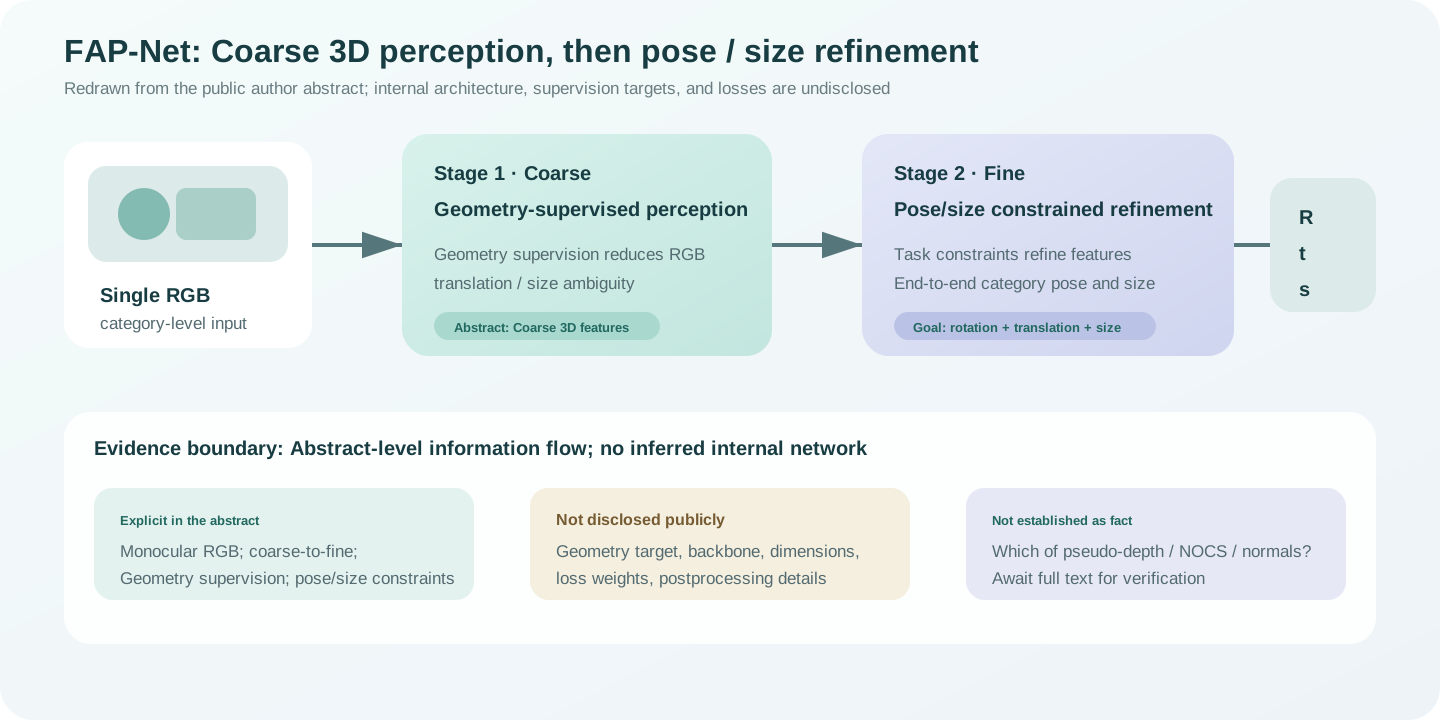
The public abstract establishes only four steps:
Input one RGB image, without test-time depth;
Feature Auxiliary Perception Network learns coarse 3D features with geometry supervision;
Refine the representation using pose and size constraints;
Predict category-level pose / size end to end.
Redrawn by this site from the public author abstract, not an original paper figure. The abstract does not identify geometry supervision as pseudo-depth, NOCS, normals, or another target; only verified information flow is shown. Copyright in the paper belongs to the authors; this redraw is for academic analysis. Source: FAP-Net, ICRA 2024.
Pure 2D appearance can exploit texture and background correlations. Geometrically supervised intermediate features, subsequently refined for pose / size, are more likely to retain cues explaining 3D projection.
4. Interpreting quantitative results
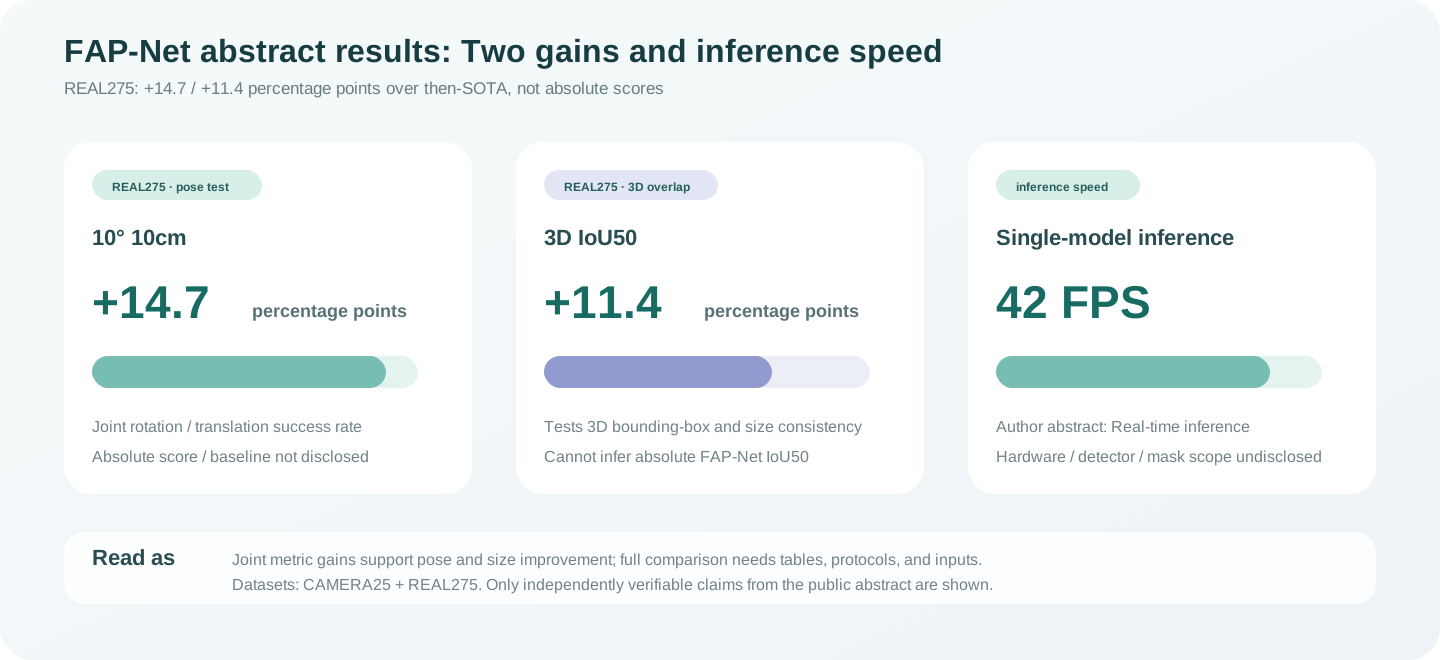
The author abstract provides three figures:
Dataset / metric
Abstract report
REAL275, 10°10cm
+14.7 percentage points over the then-SOTA
REAL275, 3D IoU50
+11.4 percentage points over the then-SOTA
Inference speed
42 FPS
Redrawn by this site from the public author abstract. +14.7 and +11.4 are gains over a baseline, not absolute FAP-Net scores. Hardware and inclusion of detection / segmentation in 42 FPS are unspecified. Source: FAP-Net, ICRA 2024.
The metrics measure different aspects:
10°10cm jointly thresholds rotation and translation errors;
IoU50 checks whether predicted / GT 3D-box intersection over union exceeds 50%, testing size and overall localization.
Improving both matches the pose-and-size refinement rationale. Without absolute scores, named baselines, and input protocols, the gains cannot reconstruct a leaderboard or establish whether GT crops / masks are used.
5. Assessment
FAP-Net trades training-time geometry supervision for RGB-only inference, retaining simple deployment sensors and reported real-time speed. The abstract emphasizes feature perception plus task-constrained refinement, rather than directly predicting NOCS, explicitly reconstructing pseudo-depth, or recovering a cloud for alignment.
Evidence availability is the main caution. The available material does not establish:
The geometry-supervision target;
The backbone, feature hierarchy, or stage connections;
Whether pose / size constraints are losses, feature modulation, or explicit geometry;
Inclusion of detection, segmentation, cropping, or postprocessing in 42 FPS;
Per-category behavior for symmetry, occlusion, transparency / reflection.
It is a useful example of adding 3D inductive bias to monocular category-level pose, but the available evidence does not make it a directly reproducible engineering recipe.
Available src/paper-notes/fap-net-icra2024/deep.md
In-depth paper notes
Support reproduction, comparison, related-work writing, and identifying opportunities for further research.
Deep Reading Notes: Implicit Coarse-to-Fine 3D Perception for Category-Level Object Pose Estimation from Monocular RGB Image
1. Assessment and evidence level
FAP-Net performs monocular RGB, category-level, end-to-end pose + size estimation. Training-time geometry supervision promotes coarse 3D perception, followed by pose / size refinement, without inference-time depth. Reported REAL275 gains and 42 FPS reflect aims of metric reasoning and real-time deployment.
Evidence boundary: when these source notes were compiled, IEEE full text was not openly accessible without login, and no author manuscript or usable code was found. Paper facts here come only from DOI metadata and the public author abstract. Projection, metric, and reproduction-risk discussions are this site’s analysis, not undisclosed paper equations, layers, or ablations.
Content
Evidence status
Single RGB, category-level, end-to-end
Explicit in author abstract
Coarse-to-fine, geometry supervision
Explicit in author abstract
Pose / size constraints for refinement
Explicit in author abstract
CAMERA25, REAL275, two gains, 42 FPS
Explicit in author abstract
Backbone / geometry target / loss
Not disclosed in public abstract
Absolute scores / complete baselines / hardware
Not disclosed in public abstract
GT masks / detector crops
Not disclosed in public abstract
2. Why monocular category-level pose is difficult
Category-level estimation handles unseen instances of known categories: for example, test bottles differ in shape, proportions, and texture from training bottles. Metric size is often required alongside 6DoF rotation and translation.
Perspective projection is written as:
u~∼K(RX+t).
Scaling object size and depth by approximately the same factor can preserve projected size. A single RGB image therefore has scale–depth ambiguity:
z1s1≈z2s2⇒similar image extent.
RGB indicates category, contour, and visible surfaces but not inherently absolute metric scale. Within-category shape variation also defeats memorizing a mean CAD. Directly regressing (R,t,s) from global appearance can exploit background, texture, or box-size shortcuts.
The title and abstract attribute translation / size ambiguity to missing 3D information. Geometry is injected into representation learning rather than through an extra test-time depth sensor.
The abstract describes geometry supervision promoting coarse 3D feature perception. This implies some auxiliary structural signal beyond final pose error.
Public material does not identify that signal. Pseudo-depth, NOCS coordinates, surface normals, shape priors, and combinations are common possibilities, but none can be attributed to FAP-Net from this evidence. The verified claim is only that intermediate features carry geometric information.
3.2 Stage 2: pose / size constrained refinement
The second stage refines coarse features with pose / size constraints, separating two levels:
Geometry supervision asks whether features encode 3D structure;
Pose / size constraints ask whether those cues serve the final metric task.
This is a coarse-to-fine division: the first stage supplies a structural foundation, and the second adjusts it toward pose and size, rather than placing all objectives into one regression head.
Redrawn by this site from the public author abstract, not an original paper figure. Explicit abstract claims are distinguished from undisclosed details, avoiding attribution of common field modules to FAP-Net. Copyright in the paper belongs to its authors; this redraw is for academic analysis. Source: FAP-Net, ICRA 2024.
3.3 Meaning of end-to-end
The abstract describes end-to-end category-level pose from one RGB image, supporting unified-network final prediction. It does not establish:
Whether the network explicitly solves Umeyama / PnP;
Whether size uses independent axes, uniform scale, or a 3D box;
Whether nondifferentiable postprocessing exists.
These distinctions affect end-to-end and 42 FPS interpretation and require full-text verification.
4. Experiments and numbers
CAMERA25 and REAL275 belong to the NOCS benchmark:
CAMERA25 is mainly synthetic;
REAL275 better reflects sim-to-real differences and real occlusion / appearance.
The abstract emphasizes REAL275:
Metric
Gain over the then-SOTA
10°10cm
+14.7 percentage points
IoU50
+11.4 percentage points
Inference speed
42 FPS
4.1 Why consider both gains?
10°10cm counts success below 10° rotation and 10 cm translation error, without directly requiring accurate size. 3D IoU50 tests sized-box overlap and is sensitive to center, orientation, and scale.
Improving only 10°10cm could reflect stronger pose regression; improving only IoU50 could reflect a better size prior. Gains in both fit coarse geometry plus pose / size refinement.
4.2 Gains are not absolute scores
“+14.7” and “+11.4” are percentage-point differences from a then-SOTA baseline, not FAP-Net scores of 14.7% / 11.4%. Without full tables, the following cannot be inferred:
FAP score=unknown baseline score+reported gain.
Nor can the same baseline, inputs, or training data be assumed for both gains. This site plots reported gains rather than inventing a complete ranking.
Redrawn by this site from the public author abstract. +14.7 / +11.4 are percentage-point gains; 42 FPS hardware, batch size, and inclusion of detection / segmentation are undisclosed. Source: FAP-Net, ICRA 2024.
5. Relation to nearby approaches
5.1 Explicit canonical correspondences
NOCS-style methods predict canonical coordinates per pixel / point and align observation geometry with canonical shape. This gives explicit geometry but propagates correspondence, depth, and instance-deformation errors.
5.2 RGB → pseudo-depth / shape reconstruction
Other methods reconstruct depth, clouds, or shape from RGB before alignment. This exposes monocular ambiguity for visualization, but reconstruction errors can bottleneck pose.
5.3 Implicit geometric features in FAP-Net
The public description instead shapes features with auxiliary geometry supervision and refines them with task constraints. This may avoid full reconstruction cost while maintaining 42 FPS, but implicit geometry makes domain failures harder to attribute to perception, pose, or size heads.
This possibility is a methodological interpretation, not a substitute for undisclosed ablations.
6. Reasonable interpretation and unsupported extrapolations
Reasonably supported
Training-time geometric supervision is valuable for RGB-only category-level pose;
Both pose thresholds and 3D overlap improve, rather than one output alone;
Reported 42 FPS indicates real-time-level single-model inference in the tested implementation.
Not established by available evidence
Absolute REAL275 scores;
Superiority over all later methods, since comparisons concern contemporary baselines;
End-to-end system throughput of 42 FPS;
Advantages under symmetry, severe occlusion, transparency / reflection;
The exact depth / NOCS / normal target behind geometry supervision.
7. Potential failure modes
These are task-derived reproduction risks, not paper-reported failures:
Scale-prior bias: objects outside training size statistics can distort monocular metric scale.
Occlusion: fewer visible contours / surfaces weaken coarse 3D constraints.
Symmetry: point rotation regression can penalize equivalent poses when appearance and geometry are symmetric.
Domain shift: shortcuts from CAMERA25 textures, backgrounds, or lighting can hurt REAL275 / new-camera performance.
Crop / mask dependence: clean training / evaluation crops versus jittery deployment boxes can jointly shift translation and size.
Intrinsics / framing changes: focal lengths or resizing particularly affect depth inferred implicitly from image scale.
8. Reproduction and fair comparison checklist
Once full text or code is available, establish:
Geometry-supervision targets, sources, and units;
Coarse / fine tensors, connections, and losses;
Rotation representation, symmetry handling, and size parameters;
CAMERA25 / REAL275 training splits and synthetic-to-real strategy;
GT / predicted masks, GT boxes, or detector boxes;
Absolute scores, per-category results, and ablations;
GPU, batch size, resolution, and timing scope for 42 FPS;
Parameters, memory, and separate detection / segmentation timing;
Whether inference requires intrinsics.
Only then can DMSR, OLD-Net, and NOCS variants be compared under matching protocols.
9. Research implications
The useful high-level idea is make features account for 3D structure before adapting them to the final task. Extensions could:
Replace point coarse geometry with uncertain depth / coordinate distributions;
Propagate geometry uncertainty into pose / size refinement to avoid amplifying coarse errors;
Use symmetry-equivalent pose sets or distributional rotation losses;
Normalize image scale with intrinsics to avoid confusing focal-length changes with depth;
Separately report detector, geometry, pose, and size errors for diagnosis.
Available evidence makes FAP-Net a signal of the 2024 monocular category-level trend: training-time geometry with RGB-only, real-time inference rather than pure appearance regression. Detailed network novelty, full SOTA status, and technical reproduction remain contingent on full text / code availability.