Fast-WAM: Do World Action Models Need Test-time Future Imagination?
Fast-WAM retains future-video prediction during training but uses attention masks so actions read only current observations. At deployment, Wan2.2 acts as a single-pass encoder followed by 10-step action-expert denoising, without generating future video. Mean success is 91.8% / 97.6% on RoboTwin 2.0 / LIBERO. Latency on RTX 5090D V2 is 190 ms versus IDM's 810 ms, around 4.26× faster. This world-action model requires robot demonstrations and does not output object 6D pose; real tasks still trade speed against success.
Wan2.2-5B video backbonePretrained video VAE / T51B action expertRobot video and action demonstrationsJoint flow-matching training
Reading Notes
Overview / Deep Dive
Available src/paper-notes/fast-wam/coarse.md
Paper overview notes
Quickly assess the paper's scope, problem setting, core method, experimental findings, and whether to read it in depth.
Overview Notes: Fast-WAM
1. Basic information
Title: Fast-WAM: Do World Action Models Need Test-time Future Imagination?
Authors: Tianyuan Yuan, Zibin Dong, Yicheng Liu, Hang Zhao
Affiliations: Institute for Interdisciplinary Information Sciences (IIIS), Tsinghua University; Galaxea AI
Year / version: 2026; these notes analyze arXiv v2 (2026-03-23), first submitted 2026-03-17. Verified sources in the original notes classify it as a preprint.
Research area: World Action Models (WAM), language-conditioned robot manipulation
Reading mode: coarse; resources checked on 2026-09-12 in the source notes
2. Positioning in one sentence
Fast-WAM separates future-video prediction during training from future-video generation before acting. It retains the former as representation supervision; inference encodes current observations once with the video backbone, then generates an action chunk. Most policy gains remain on the tested tasks with substantially lower latency.
It is not an object 6D pose estimator and outputs neither object rotation nor translation. This site includes it as world-model / embodied-control research downstream of pose perception, rather than instance- or category-level pose estimation.
Method inputs and outputs
Item
Content (compiled for this site)
Inference input
Current multi-camera RGB and task language; concatenated, encoded images provide action-expert context.
Final output
Continuous robot action chunks, with 32 steps by default; no object 6D pose or future video in default inference.
Requirements
Robot demonstrations with actions and corresponding future video remain necessary for training. Future frames supervise training rather than test input. CAD, depth, masks, and intrinsics are not listed as required model inputs.
2.1 Guide to the paper’s figures and tables
Tables below are compiled by this site; figures are corresponding originals from the official project page.
Figure / table
Question
Reading focus
Figure 1
Must WAMs generate futures before acting?
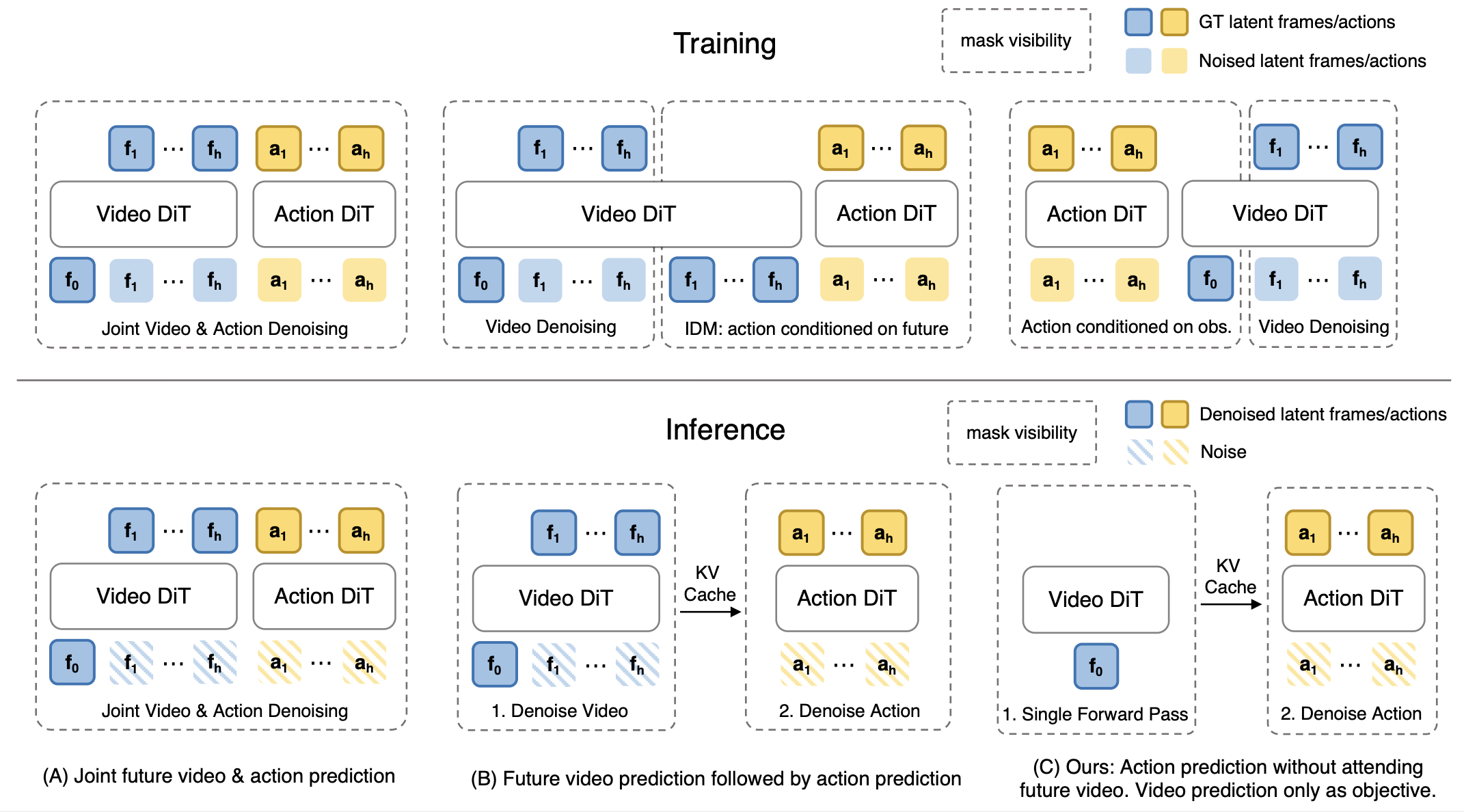
Different Joint, IDM, and Fast-WAM training / inference paths
Figure 2(a)
How do vision, language, and actions connect?
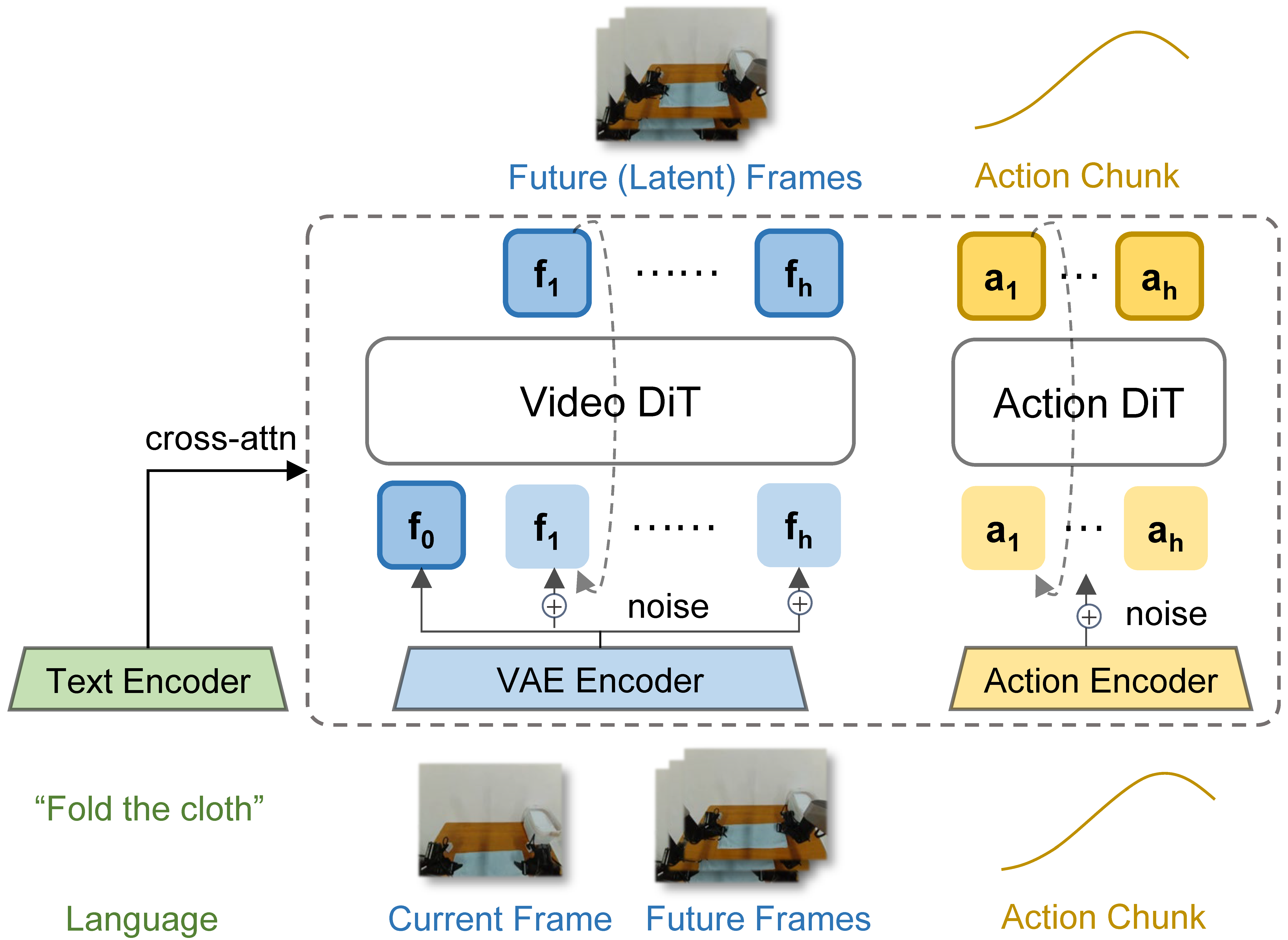
Wan video DiT and action experts interact through shared attention
Figure 2(b), in deep notes
Does training with futures leak information?
Actions can read only current-frame and action tokens
Tables 1–2, site compilation
Where do gains mainly come from?
Removing video co-training hurts more than skipping test-time future generation
Figures 3–4
Can real robots combine success and efficiency?
Separate folding success, completion time, and inference latency
3. Problem setting
Dimension
Setting compiled by this site
Input
Current multi-camera RGB and task language
Output
Continuous action chunk, 32 steps in the paper
Training supervision
Demonstration actions and corresponding future video
Inference conditions
Current visual context and language, without real or generated future frames
Foundation models
Pretrained Wan2.2-5B video DiT, video VAE, and T5 encoder, plus a 1B action expert
Geometry requirements
No required CAD, depth, masks, or explicit intrinsics listed as model inputs
Avoid conflating
Not training-free or zero-shot execution; no demonstrated unseen-object 6D pose generalization
“No embodied pretraining” means no additional large-scale robot-pretraining stage. Generic video pretraining remains, and downstream robot demonstrations are still needed.
4. Core motivation
WAMs often imagine futures before predicting actions, or jointly denoise future video and actions. Both spend inference budget on generation, but gains may arise from two sources:
Predicting futures during training encourages motion, interaction, and temporal representations.
Generating futures during inference supplies extra action conditions.
The question is whether using video-trained representations requires paying full future-video denoising cost every time the robot acts.
Original Figure 1: training paths above and inference paths below. Fast-WAM still trains video prediction, but deployment first encodes current frames, caches visual conditions, and denoises actions. Source: official author project page. Image copyright belongs to the paper’s authors and publisher; shown here for paper analysis.
5. Method overview
5.1 Training: one visual context, two prediction objectives
Concatenated multi-camera images pass through a video VAE into latent tokens. Current frames stay clean; future video and actions receive noise. Video DiT and an action expert form a Mixture-of-Transformer (MoT), with all branches reading T5 language through cross-attention.
The mask is crucial: future video and actions read current frames, but actions cannot read future video, and current frames cannot read future video or actions. Training therefore avoids action conditions unavailable at deployment.
Both branches use jointly optimized flow matching:
L=Lact+λLvid.Original Figure 2(a): language conditions both branches; video and action prediction share current visual anchors. Future frames are training targets rather than default action-branch conditions. Source: official author project page. Image copyright belongs to the paper’s authors and publisher; shown here for paper analysis.
5.2 Inference: one visual pass, multiple action-denoising steps
Deployment creates no future-video tokens. Video DiT encodes current observations once and caches features; the action expert generates a chunk from those conditions.
Single-pass refers to the video backbone, not one-step generation by the whole policy. Inference still uses 10 denoising steps and CFG scale 1.0. Savings mainly come from omitting future video and reusing current-frame conditions across action-denoising steps.
6. Experimental overview
6.1 Controlled variants matter more than rankings
The following is compiled by this site from Tables 1–2. Values are success rates (%), higher is better; RoboTwin reports Clean / Rand. averages, LIBERO four-suite averages.
Method
Video prediction in training
Future generation at test
RoboTwin 2.0
LIBERO
Fast-WAM
Yes
No
91.8
97.6
Fast-WAM-Joint
Yes
Joint with actions
90.6
98.5
Fast-WAM-IDM
Yes
Video before actions
91.3
98.0
Without video co-training
No
No
83.8
93.5
Removing video co-training reduces the two benchmarks by 8.0 and 4.1 percentage points. Differences from explicitly future-generating Joint / IDM are smaller. Fast-WAM is slightly lower on LIBERO, so skipping future generation does not always improve accuracy.
Externally pretrained LingBot-VA averages 92.2 / 98.5 on RoboTwin / LIBERO. Fast-WAM is competitive without leading every result. Different pretraining and protocols make internal ablations more informative for the central question than cross-method rankings.
6.2 Real towel folding: efficiency has multiple dimensions
The real Galaxea R1 Lite experiment uses 60 hours of teleoperation demonstrations. The figure reports success, mean completion time, and per-inference latency separately.
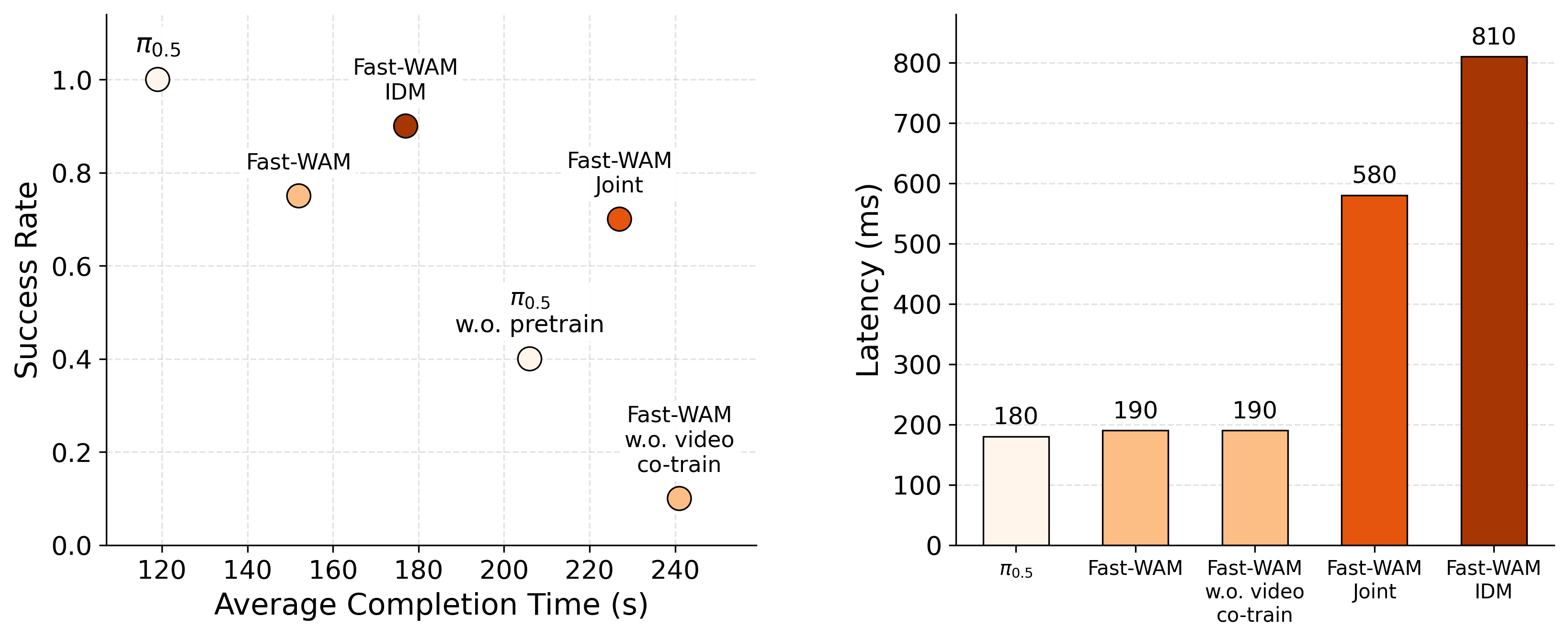
Original Figure 4: upper left is better in the scatter plot; right, latency on one RTX 5090D V2 32GB. Fast-WAM / Joint / IDM take 190 / 580 / 810 ms. Source: official author project page. Image copyright belongs to the paper’s authors and publisher; shown here for paper analysis.
Speed: IDM’s 810 ms versus Fast-WAM’s 190 ms gives approximately 4.26× speedup; versus Joint it is approximately 3.05×, not above 4× for every baseline.
Quality: approximate scatter-plot readings are 75% Fast-WAM success, 90% IDM, and 100% pretrained π0.5, which also finishes fastest.
Ablation: without video co-training, success is only 10% and completion time is longest.
Boundary: 190 ms is action-chunk inference latency, not robot control frequency; approximately 5.3 chunk inferences per second do not directly equal closed-loop Hz.
Author claim: video co-training supplies the main gains; test-time future imagination contributes less.
My analysis: two simulations and one real task support this direction, but IDM’s real-task success advantage matters. The paper does not establish that every long-horizon reasoning task can omit future generation.
7. Strengths and limitations
Strengths
Separating training objectives from deployment computation enables direct hypothesis testing through ablations.
Attention keeps action conditions consistent across training / inference, reducing future-information mismatch.
Strong video priors remain while inference uses current observations and action denoising, offering clear engineering value.
Limitations / risks
Approximately 6B core parameters remain; skipping video generation does not imply a lightweight model. Timing on a 32GB GPU does not establish minimum memory needs.
Only one real task, without systematic cross-scene, occlusion, or out-of-distribution long-horizon analysis.
Physical reasoning in representations is not directly measured; success gains alone do not prove a learned causal world model.
No embodied pretraining still involves substantial downstream demonstrations, so comparisons with zero-shot WAMs or robot-data-free methods need care.
8. Research takeaways
Useful idea: use future state, geometry, or contact prediction as auxiliary training while keeping a low-latency action path independent of those outputs.
As a baseline: relevant to video-backbone robot policies, not direct ADD(-S) / BOP AR comparison with SAM-6D or FoundationPose.
Deep-reading priorities: Figure 2(b), four variants, and real success / speed tradeoffs.
Future question: which states need explicit future generation, and can uncertainty trigger slow imagination from a default fast path? This is proposed research, not a validated result here.
Released-version note
At the resource check recorded in these notes, the official repository provided training / simulation evaluation, weight and dataset links; README updates added inference acceleration and Optional IDM. These later engineering updates do not replace the v2 results above. Original-checkpoint reproduction requires checking noise schedules, normalization statistics, and simulator versions; see the deep notes and official README.
Available src/paper-notes/fast-wam/deep.md
In-depth paper notes
Support reproduction, comparison, related-work writing, and identifying opportunities for further research.
Deep Reading Notes: Fast-WAM
1. Basic information
Full title: Fast-WAM: Do World Action Models Need Test-time Future Imagination?
Authors / affiliations: Tianyuan Yuan, Zibin Dong, Yicheng Liu, Hang Zhao; Institute for Interdisciplinary Information Sciences (IIIS), Tsinghua University; Galaxea AI
Publication: arXiv 2026 preprint; these notes analyze v2 (2026-03-23), without adding unverified acceptance information to metadata.
Reading mode: deep; paper experiments are recorded separately from repository updates checked on 2026-09-12.
2. Positioning in one sentence
Fast-WAM separates two potential WAM benefits: future-video prediction can train current-observation representations without being an inference step before every action generation.
The paper offers a more economical policy parameterization and supporting experiments, not a theorem that future imagination is always useless.
Method inputs and outputs
Item
Content (compiled for this site)
Inference input
Current multi-camera RGB and language; cache current-observation conditions, then initialize the action expert with random action noise. Default inference neither receives real futures nor samples future-video latents.
Final output
A continuous action chunk of length 32 for robot execution / replanning, not object pose, segmentation, or future RGB.
Training input
Current images, language, future video, and corresponding demonstration actions. Current tokens stay clean; future video / actions receive noise. Attention prevents actions from reading future video.
Training objective
Video / action flow-matching fields optimized jointly as Lact+λLvid. Futures improve representations through supervision, not as deployment prerequisites.
Output details
Intermediate action fields become 32-step actions through 10 default denoising steps. Dimensions, joint / end-effector frames, units, and normalization depend on the benchmark; no universal specification makes them fixed 6D object transforms.
Requirements
Video-pretrained weights and robot demonstrations, without explicit CAD / depth / masks / intrinsics. Proprioceptive inputs require implementation checks; multiple cameras do not establish geometric triangulation.
2.1 Guide to the paper’s figures and tables
Figure / table
Evidence role, compiled by this site
Misreading to avoid
Figure 1
Defines Joint, IDM, and Fast-WAM dependencies
Skipping RGB decoding does not skip future-latent denoising
Figure 2(a)
Video / action expert architecture
Shared context does not make all tokens mutually visible
Figure 2(b)
Training / deployment visibility masks
Current frames must not read futures and leak them indirectly to actions
Future video is an intermediate variable; this does not claim exact evaluation of the integral. Actual methods use generated samples or joint denoising. Controlled comparisons focus on one action chunk, omitting some previous methods’ outer autoregressive rollouts.
Fast-WAM instead uses:
pθ(a1:H∣o,l)=pθ(a1:H∣z(o,l)),
Here z(o,l) encodes current context once, rather than a sampled future video. This policy-modeling form does not imply exact equivalence of a finite-capacity model to the true action distribution.
3.2 Training versus inference resources
Item
Training
Inference
Current cameras and language
Input conditions
Input conditions
Future video
Noised demonstration supervision
Default Fast-WAM generates none
Action chunk
Targets and noised targets
Recover continuous actions from noise
Generic video priors
Wan2.2-5B, video VAE, T5
Encoding and conditioning remain
Additional large-scale embodied pretraining
Not used by this model
Does not imply zero-shot policy
CAD / depth / object masks / intrinsics
Not listed as required model inputs
No explicit geometry-solving pipeline needed
Multi-camera images are concatenated before VAE encoding. No object canonical frame, output R,t, size recovery, symmetry classes, PnP, or ICP is defined. Multiple cameras should not imply calibrated triangulation. Action frames, dimensions, normalization, and proprioception are not specified uniformly enough in the text; use benchmark configurations for reproduction.
4. Research context
The following summarizes the paper’s Related Work, rather than asserting priority across all WAM literature.
Approach
Representatives discussed
Relationship
Direct VLA policies
OpenVLA, π0, π0.5
Similar deployment interfaces, different representations / objectives
Joint video–action generation
Motus, Unified World Models, etc.
Fast-WAM-Joint models tightly coupled generation
Future video before actions
LingBot-VA, Vidar, etc.
Fast-WAM-IDM conditions actions on generated futures
Reduced test-time video computation
VPP, UVA
Fast-WAM is not the first to bypass full video synthesis
VPP uses predictive visual representations from video diffusion; UVA jointly models video / actions and skips test-time video decoding. Fast-WAM emphasizes comparing training-video supervision with test-time future generation within one framework. Distinguish visible-video VAE decoding from multistep future-latent generation cost.
5. Research motivation
Seeing a future might help action selection, but leaves two engineering questions:
Has video-prediction training already encoded useful temporal information into current-observation features?
Does generating futures before every action provide enough control benefit for its cost?
The authors retain video supervision but prevent actions from reading future tokens from the start; inference removes that branch to compare quality and latency. This removes a deployment dependency, not video pretraining, demonstrations, or action denoising.
Original Figure 1: Joint denoises video and actions together; IDM generates video before actions; Fast-WAM encodes current vision once before action denoising. Source: official author project page. Image copyright belongs to the paper’s authors and publisher; shown here for paper analysis.
6. Method details
6.1 Architecture
A Mixture-of-Transformer (MoT) retains separate video DiT and action-expert branches interacting through shared attention. This is not sparse MoE routing that selects a few experts per token.
Module
Input
Output / role
T5 text encoder
Task instructions
Language conditions for cross-attention in all token groups
Pretrained video VAE
Concatenated multi-camera images / video
Current / future latent tokens
Wan2.2-5B video DiT
Clean current frames, noised future frames in training
Video training; current-context encoding at deployment
1B action-expert DiT
Action noise, current features, language
Action-field prediction and continuous chunks
Structured attention mask
Three token groups
Restricts dependencies to exclude futures from action conditions
The action expert follows video DiT structure with hidden size reduced to 1024. Core scale is 5B video + 1B actions, approximately 6B total; this does not account for all auxiliary encoders, caches, and optimizer memory.
Original Figure 2(a): future video exists during training; action and video branches receive separate flow-matching supervision. The mask below determines actual information flow. Source: official author project page. Image copyright belongs to the paper’s authors and publisher; shown here for paper analysis.
6.2 Attention masks and prevention of future leakage
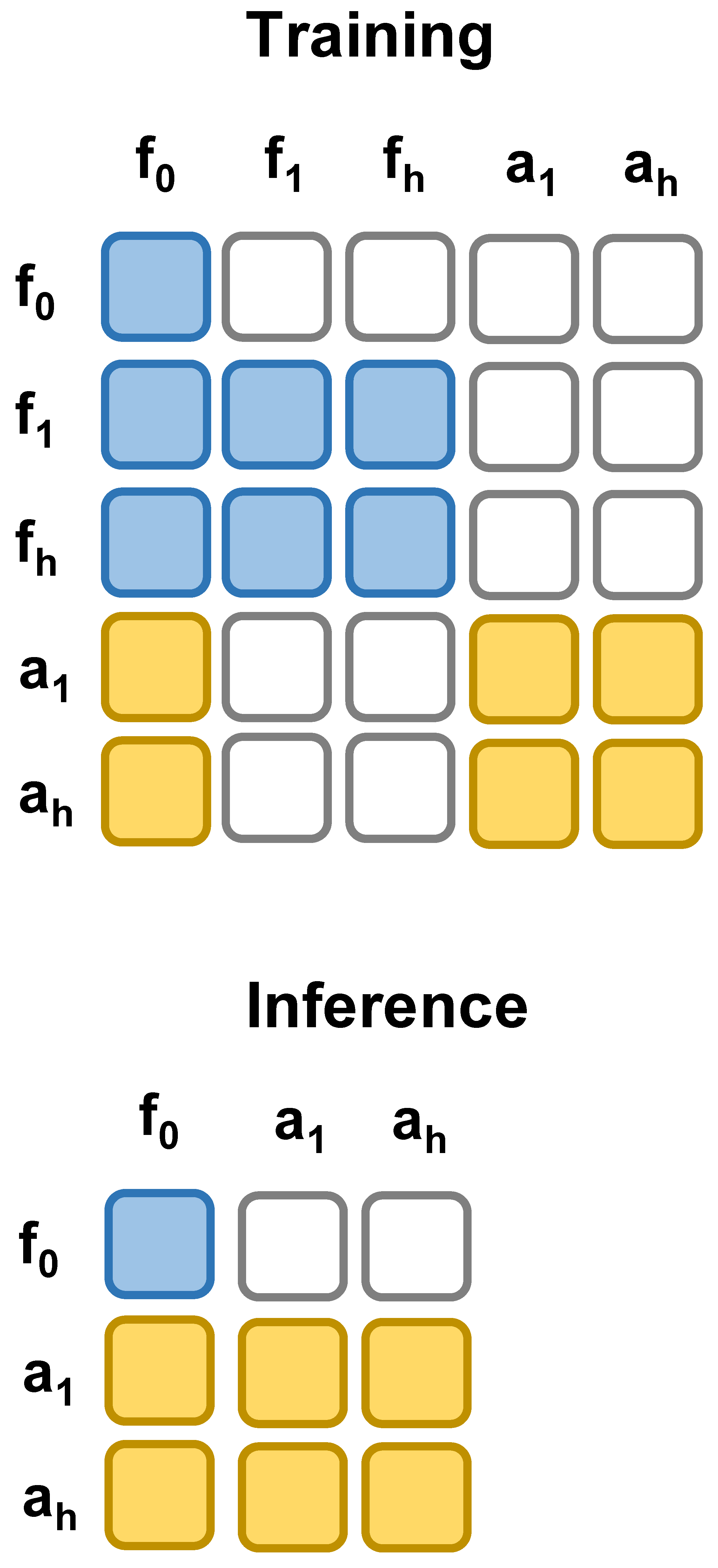
Let clean current-frame tokens be C, future-video tokens F, and action tokens A. Compiled from Figure 2(b), rows are queries and columns readable keys/values; visibility refers to the corresponding attention block.
Query / Key-Value
Current C
Future video F
Actions A
Current C
Visible
Hidden
Hidden
Future video F
Visible
Bidirectional within group
Hidden
Actions A
Visible
Hidden
Bidirectional within group
All groups additionally read language. Two safeguards matter:
A cannot directly read F.
C cannot read F either, preventing indirect leakage through F→C→A.
Remove F rows / columns for inference, preserving C/A dependencies. Since C does not depend on action noise, layer features / KVs can be cached after one pass rather than rerunning video DiT per action-denoising step.
Original Figure 2(b): blue / yellow indicate video / action visibility, while blank blocks are masked. Current frames attend only to themselves, enabling caching without future leakage. Source: official author project page. Image copyright belongs to the paper’s authors and publisher; shown here for paper analysis.
Why can video supervision help without reading futures? My analysis: future prediction and current encoding share video-backbone parameters. Future losses alter those parameters and context representations. Learning through gradients differs from reading a future sample during a test forward pass; the mask blocks the latter, not parameter learning.
6.3 Joint flow matching
For action or future-latent target y, sample Gaussian noise ϵ∼N(0,I) and time t∈(0,1), following original Eqs. (5)–(9):
Here z1:T denotes future-video target latents, unlike current-context z(o,l) above. Under this interpolation, t=0 is data and t=1 noise, with target velocity ϵ−y. Generation solves from noise toward data; reversing time conventions requires changing signs consistently.
The joint objective minimizes demonstrated action / video field errors, not task success directly; evaluation measures closed-loop behavior. The paper introduces λ without listing its value in the implementation settings. Check weights and normalization in a fixed code version.
6.4 Controlled variants
Variant
Video objective
Training / inference dependence
Question
Fast-WAM
Retained
Actions read current context only; no generated test futures
Default design
Fast-WAM-Joint
Retained
Video / action attention enabled; joint test denoising
Is joint future imagination necessary?
Fast-WAM-IDM
Retained
Actions depend on futures; generate test video first
Is imagine-then-act more effective?
w.o. video co-train
Removed
Default architecture and inference retained
Does video-prediction training matter?
IDM adds noise to real training-video tokens with probability p=0.5 to reduce real-versus-generated future mismatch. Variants alter attention and some training processing, so this is not a strict factorial experiment changing only one switch. It is nevertheless more informative than comparisons across differently sized / trained external WAMs.
The no-video-co-training variant still starts from pretrained Wan. It tests additional downstream video supervision, not whether video pretraining itself helps.
Deployment encodes language and current images, runs video DiT once to cache context, initializes action noise, performs 10 action-expert denoising steps, outputs a chunk, and delegates execution / replanning to the robot interface.
A single-pass world encoder is not a single-step policy. No generated future does not mean no video model. Reported latency is hardware-specific model inference, without a full sensor, communication, safety-control, and execution-scheduling breakdown.
7. Experimental analysis
7.1 Data and protocols
Environment
Training data / steps
Evaluation protocol
LIBERO
Four suites, 10 tasks and 500 demonstrations each; 20k training steps
2000 evaluations across 40 tasks; per-suite success
100 trials per task in Clean / Rand.; appendix lists 50 tasks
Real towel folding
60 hours of R1 Lite teleoperation; 30k steps
Success and mean completion time; inference latency separately
The RoboTwin text says over 50 tasks while the appendix lists 50; these notes invent no extra tasks. Training steps refer to this paper’s setup, not every external baseline’s historical training.
7.2 RoboTwin: averages and missing entries
Compiled by this site from Table 1, in %. Embodied PT means additional robot pretraining, excluding generic Wan video pretraining. Averages retain displayed paper precision.
Method
Embodied PT
Clean
Rand.
Average
π0
Yes
65.92
58.40
62.2
π0.5
Yes
82.74
76.76
79.8
Motus
Yes
88.66
87.02
87.8
Motus from Wan2.2
No
77.56
77.00
77.3
LingBot-VA
Yes
92.90
91.50
92.2
LingBot-VA from Wan2.2
No
80.60
Not reported
80.6
Fast-WAM
No
91.88
91.78
91.8
Fast-WAM-Joint
No
90.84
90.32
90.6
Fast-WAM-IDM
No
91.16
91.34
91.3
Fast-WAM w.o. video co-train
No
82.76
84.80
83.8
LingBot-VA from Wan2.2 has no Rand. value; its Average of 80.6 reflects only reported Clean performance. It cannot be compared as an equivalent two-setting mean. Clean values 91.88 and 80.60 can be compared, as can averages for methods with complete Rand. data.
Fast-WAM’s mean exceeds Joint / IDM by 1.2 / 0.5 percentage points, while removing video co-training loses 8.0 points. This scale comparison better addresses the central question than external-model rankings.
7.3 LIBERO: explicit futures can still help slightly
Compiled by this site from Table 2, in %, retaining paper average precision.
Method
Embodied PT
Spatial
Object
Goal
Long
Average
OpenVLA
Yes
84.7
88.4
79.2
53.7
76.5
π0
Yes
96.8
98.8
95.8
85.2
94.1
π0.5
Yes
98.8
98.2
98.0
92.4
96.9
LingBot-VA
Yes
98.5
99.6
97.2
98.5
98.5
Motus
Yes
96.8
99.8
96.6
97.6
97.7
Fast-WAM
No
98.2
100.0
97.0
95.2
97.6
Fast-WAM-Joint
No
99.6
99.4
98.2
96.8
98.5
Fast-WAM-IDM
No
98.8
97.8
97.8
97.6
98.0
Fast-WAM w.o. video co-train
No
89.2
99.2
95.4
90.0
93.5
Fast-WAM is 0.9 / 0.4 percentage points below Joint / IDM, so omitting test-time futures is not strictly lossless. Removing video training loses 4.1 mean points, with Spatial 98.2→89.2 and Long 95.2→90.0, consistent with RoboTwin’s broader direction.
My analysis: this supports the relative importance of training-video supervision. No independent-training variance or significance tests accompany these differences; sub-point gaps should not be treated as stable rankings, and a perfect Object-suite score does not establish open-object generalization.
7.4 Real experiment: lower latency with quality tradeoffs
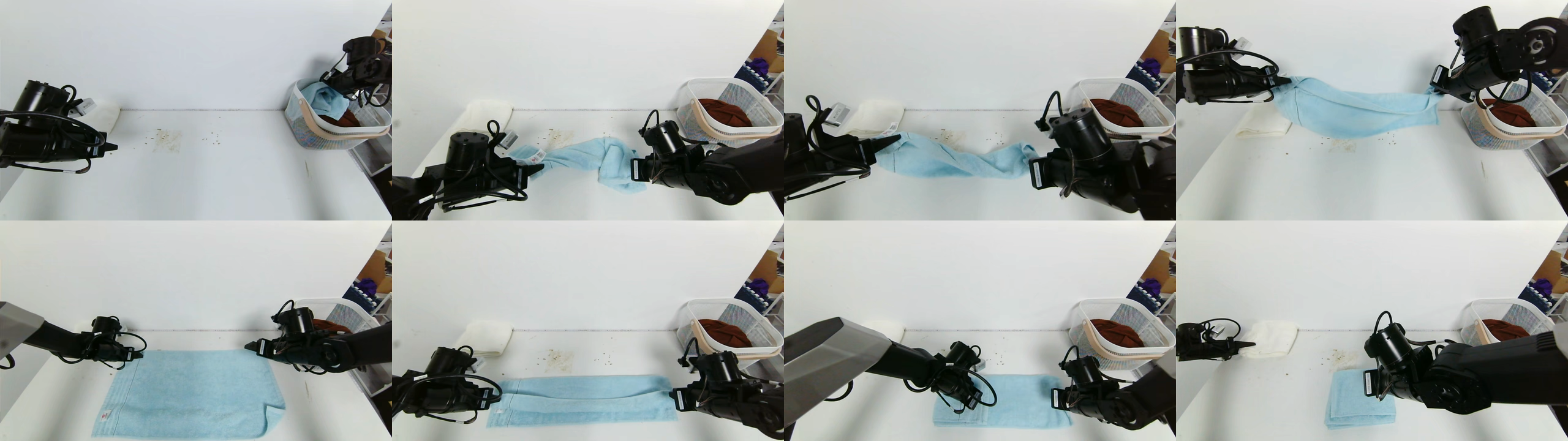
Original Figure 3: real towel folding with deformable objects and long-horizon dual-arm interaction, trained on 60 hours of teleoperation. Source: official author project page. Image copyright belongs to the paper’s authors and publisher; shown here for paper analysis.Original Figure 4: policy quality versus task time on the left; model latency on identical hardware on the right. Source: official author project page. Image copyright belongs to the paper’s authors and publisher; shown here for paper analysis.
The following is compiled by this site from Figure 4. Success / completion time are approximate scatter-coordinate readings; latencies are explicit bar labels. The text also explicitly reports 10% success without video training.
Method
Approx. success
Approx. mean completion time, s
Inference latency, ms
Pretrained π0.5
100%
120
180
π0.5 w.o. pretrain
40%
206
Not separately reported
Fast-WAM
75%
152
190
Fast-WAM-Joint
70%
227
580
Fast-WAM-IDM
90%
177
810
Fast-WAM w.o. video co-train
10%
241
190
The figure conveys more than a fourfold speedup:
810 / 190 is approximately 4.26 for IDM; 580 / 190 is approximately 3.05 for Joint.
Fast-WAM and no-video-co-training have identical latency but sharply different quality, supporting retention of the training target.
IDM still has higher real success, while Fast-WAM has shorter completion time and model latency.
Pretrained π0.5 leads this task’s success, completion time, and inference latency; Fast-WAM cannot be advertised as uniformly better than VLA.
Success measures eventual completion within sufficient time, while completion time measures efficiency. The text does not fully specify how failures enter average time, trial counts, or confidence intervals, limiting interpretation of the gaps.
7.5 Claims and evidence
Author claim
Evidence
My assessment
Strong policies without test-time futures
Fast-WAM / Joint / IDM on two simulations and one real task
Broadly supported, not lossless per task
Video co-training matters more than test-time generation
Removing video objectives hurts all three experiments
Strong within this recipe, not automatically every model scale
More suitable inference for real time
190 ms, faster than Joint / IDM
Supports lower model latency, not a complete real-time control system
Better world representations
Downstream success and ablations
Plausible, without direct representation / physical-prediction diagnosis
Competitive without embodied pretraining
Shared tables with pretrained baselines
Does not establish equal data, compute, or pretrained knowledge
7.6 Robustness and failure boundaries
RoboTwin Rand. tests scene randomization and real folding tests deformable manipulation. There is no complete breakdown by occlusion, lighting, textureless objects, camera movement, or novel-object difficulty, nor systematic failure-trajectory analysis.
Symmetry-equivalent object poses, depth noise, and mask errors are not directly evaluated. Not using these inputs does not prove robustness to their errors. Sufficiency of current frames in partial observability also remains underexplored.
8. Critical analysis
8.1 Design strengths
Separating training needs from deployment needs is reflected in actual caching through structured masks, linking the conceptual test to engineering savings. Two benchmarks plus a real task broaden evidence beyond one simulated suite.
8.2 Conclusions requiring restraint
First, explicit planning is not shown to be useless. Branch search, counterfactual action comparison, and multi-hypothesis assessment in risky scenes are not systematically studied. Generating one future video is not synonymous with world-model planning.
Second, video-prior sources are not fully separated. Removing downstream video training still retains pretrained Wan; no full comparison crosses video-pretraining presence with downstream-video-objective presence.
Third, data efficiency lacks full scaling curves. Without extra embodied pretraining, RoboTwin still uses 27500 demonstrations and real folding 60 hours. The recipe works but is not shown optimal for arbitrary few-shot budgets.
Fourth, benchmark scores do not establish reliable deployment. LIBERO approaches saturation and real tasks are narrow, without long-term failures, safe contact, or cross-robot transfer. A 32GB card’s 190 ms does not establish edge-hardware feasibility.
9. Reproduction and repository versions
9.1 Released resources
The source notes’ 2026-09-12 check found training, LIBERO / RoboTwin evaluation, and configuration in the official repository, with weights, LIBERO data, and RoboTwin data. This site verified resource entry points but did not train the model or reproduce benchmarks.
Preparation should follow this order rather than loading only a policy checkpoint:
Fix commits, model / simulator versions, and task configurations; record precision, denoising steps, and timing scope.
Prepare Wan components and the action DiT backbone per README, then task checkpoints and matching dataset statistics.
Match LIBERO data with MuJoCo versions; RoboTwin also requires simulator environments, scene assets, and policy interfaces.
Check camera ordering, action normalization, and success termination on a few tasks before full evaluation.
Keep data, training budgets, and rollouts consistent in controlled comparisons and report repeated-training variance.
9.2 Repository updates versus original paper
The README checked in the source notes added compiled inference, LeRobot 3.0, and Optional IDM. The latter lets a newer model choose imagination or direct current-frame execution; it is not the same checkpoint set as the paper’s four-row ablation.
The repository notes specify EVALUATION.sigma_shift=5.0 for original release weights, while newer default action-scheduler shift is 1.0. Latest defaults need not reproduce original checkpoint numbers.
The repository also notes unseen RoboTwin instructions differing from the compared LingBot-VA protocol. Unseen language and unseen objects are distinct splits; the former does not establish novel-object pose generalization. Strict comparison requires matched protocols. These are official README engineering supplements, separate from v2 main results.
9.3 Remaining checks
Exact commits, hyperparameters, and loss weights for original results;
Benchmark action representations, normalization, proprioception, and replanning execution steps;
Real trial counts, initialization distributions, failure timeouts, and completion-time rules;
Inclusion of text / VAE encoding, preprocessing, transfer, first compilation, and warmup in latency;
Peak memory, training GPU hours, and seed variance, which cannot be inferred from parameter counts or one timing value.
10. Implications for 6D perception and embodied research
The following is my analysis and research advice, not paper findings.
Geometry as supervision: test whether future pose, contact, or affordance prediction similarly shapes low-latency policies without requiring those outputs at deployment.
Adaptive computation: default to current-frame execution and generate futures only under occlusion, ambiguity, or increased failure risk; evaluate trigger quality and total task cost.
Representation diagnosis: probe pose / depth / motion on the same backbone to separate geometric dynamics from general multitask regularization.
Fair controls: comparisons with Pose-VLA should match demonstrations, action heads, budgets, and splits. Video-temporal and explicit spatial supervision differ; existing cross-paper averages cannot isolate causes.
11. Summary
Fast-WAM’s useful conclusion is that within the tested tasks and recipe, retaining future-video training matters more than actually generating futures at test time. Structured attention turns this into one-pass visual encoding, while actions still require multistep generation and real success has tradeoffs. Complex planning and open environments need further evidence.