
Reading Notes
Overview / Deep Dive
Paper overview notes
Quickly assess the paper's scope, problem setting, core method, experimental findings, and whether to read it in depth.
Overview Notes: Multi-Layer Feature Exchange Transformer for Multi-View 6D Object Pose Estimation in Robot Bin Picking
1. Basic information
- Authors: Momen Khalil, Vincent Dietrich, Slobodan Ilic
- Venue / year: IEEE ICRA 2025
- Affiliations: Technical University of Munich, Siemens AG
- Paper: DOI
- Task / data: multi-view RGB-D industrial bin-picking 6D pose; ROBI benchmark
- Base method: EpiSurfEmb
- Availability in the source notes: no open-access full text, author manuscript, or code found; facts are limited to the author abstract.
2. One-sentence summary
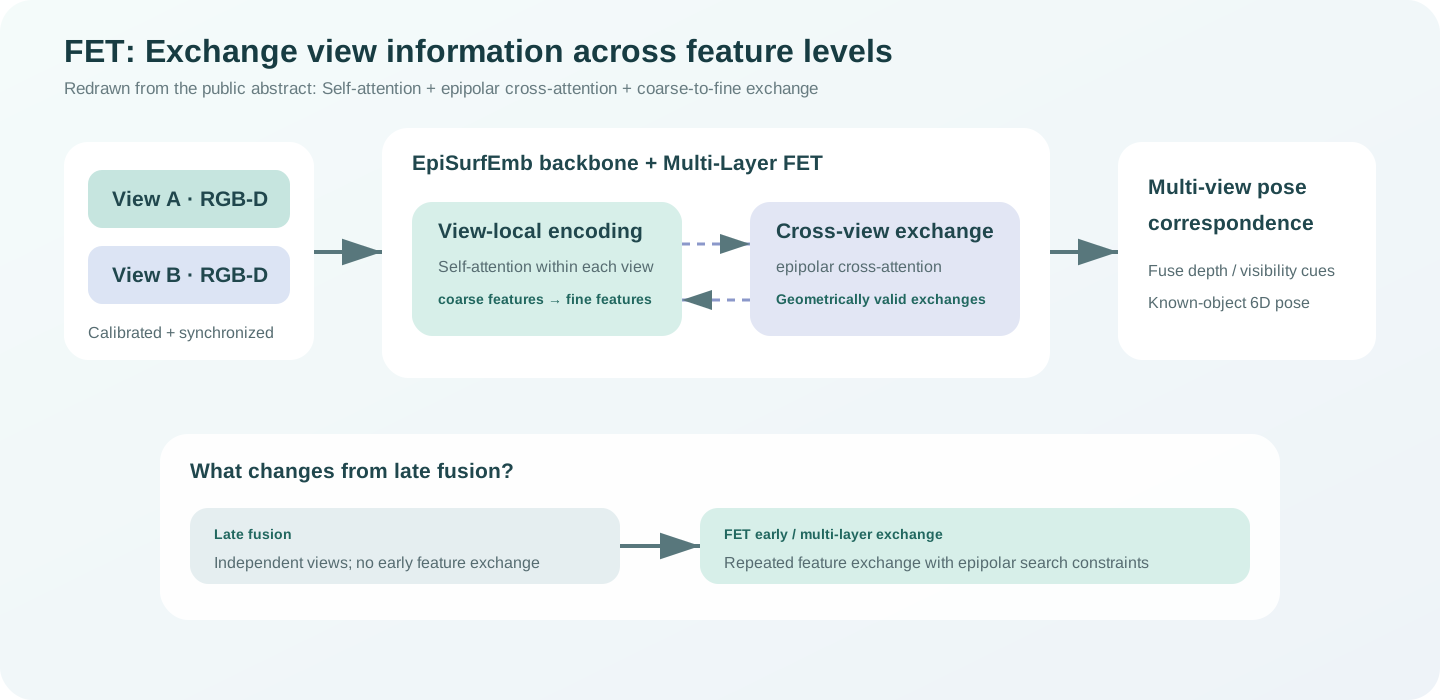
FET exchanges information during feature extraction rather than waiting for independently completed views. Multiple Feature Exchange Transformers inside EpiSurfEmb use self-attention within views, epipolar cross-attention across geometrically feasible locations, and coarse-to-fine scheduling to control cost.
3. Method outline
Reflection, occlusion, and missing depth leave individual bin-picking views with partial evidence. Another camera may see hidden regions, but late hypothesis fusion cannot recover correspondence features already lost earlier.
The public description includes:
- Several calibrated RGB-D views;
- EpiSurfEmb-style correspondence backbone;
- Self-attention at each level;
- Epipolar cross-attention over corresponding geometric loci;
- coarse-to-fine multi-layer exchange;
- Multi-view 6D pose output.
4. Public results and evidence boundaries
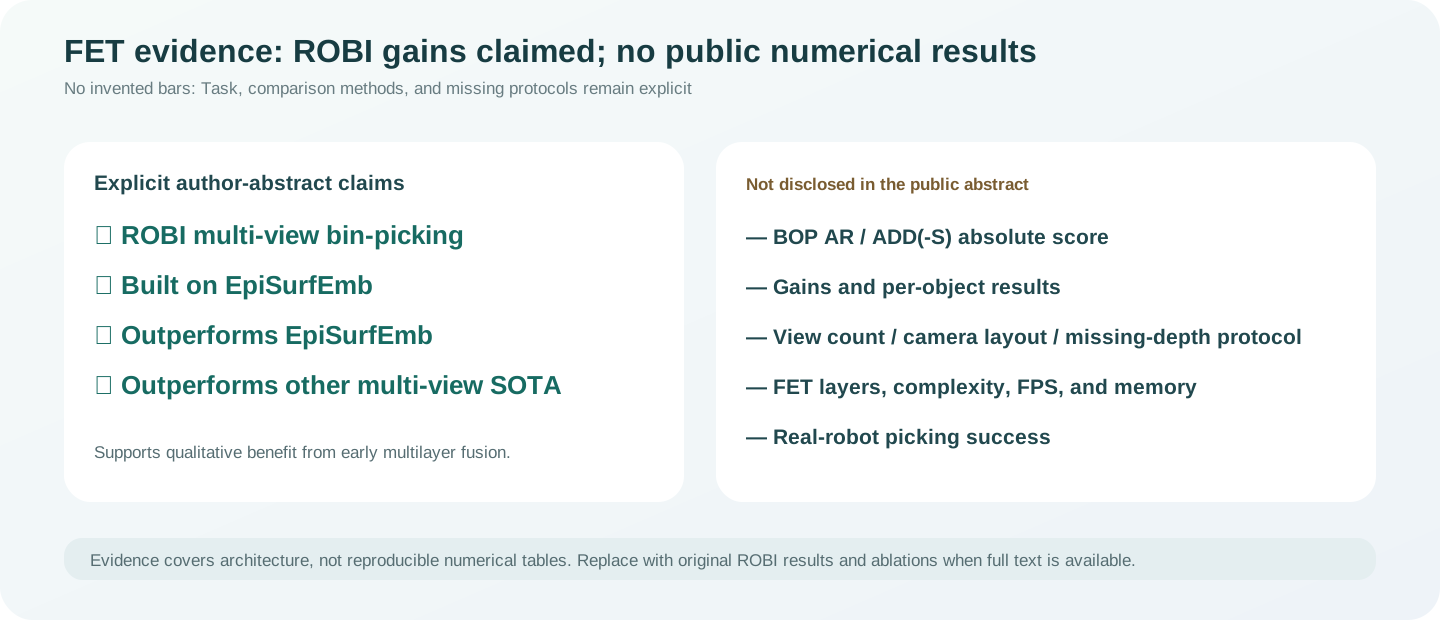
The abstract claims on ROBI:
- Better performance than EpiSurfEmb;
- Better performance than other state-of-the-art multi-view methods;
- Improved accuracy and robustness in challenging bin picking.
No BOP AR, ADD(-S), gains, per-object tables, or runtime are publicly specified in the available material.
5. Assessment
Epipolar geometry constrains attention searches, reducing implausible matches and computation relative to global cross-attention. Coarse-to-fine exchange links broad low-resolution context before precise local correspondences.
Deployment requires calibration, synchronization, overlap, and more feature memory. Correlated reflection-induced depth errors may limit additional cameras’ independent evidence. Without numerical results, method direction is established but gains versus hardware / computation costs remain unresolved.