Reading Notes
Overview / Deep Dive
Available src/paper-notes/follow-my-hold-3dv2026/coarse.md
Paper overview notes
Quickly assess the paper's scope, problem setting, core method, experimental findings, and whether to read it in depth.
Paper Reading Notes (Coarse): Follow My Hold: Hand-Object Interaction Reconstruction through Geometric Guidance
1. Basic information
- Authors / affiliations: Ayce Idil Aytekin, Helge Rhodin, Rishabh Dabral, Christian Theobalt; MPI-INF, Saarland University, Bielefeld University.
- Year / venue: 2026 / 3DV.
- Paper links: OpenReview; arXiv PDF; Project.
- Reading mode: Overview.
2. Positioning in one sentence
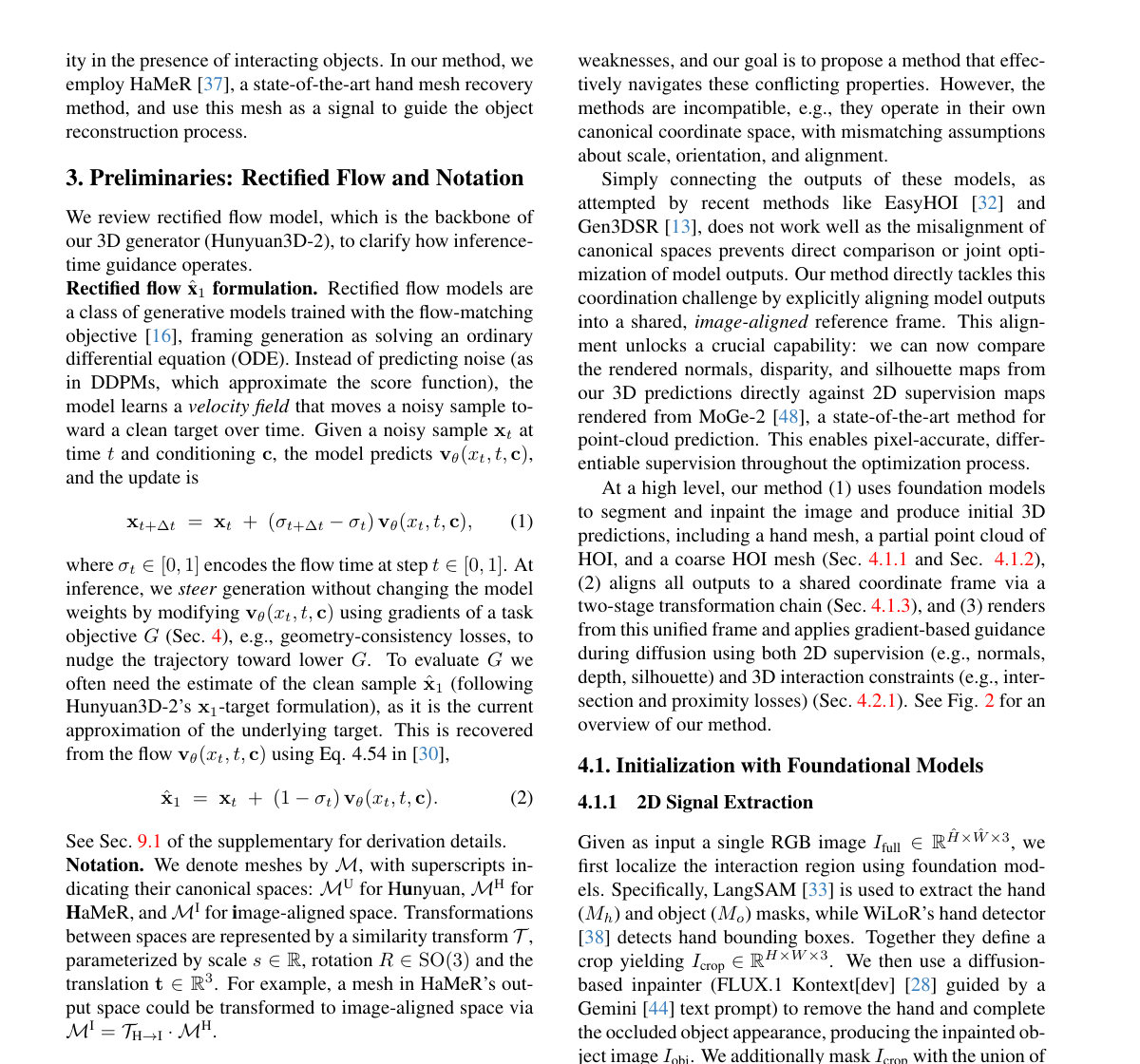
FollowMyHold adds optimization-in-the-loop guidance during sampling in a rectified-flow generator such as Hunyuan3D-2. Joint optimization of hand / object transforms, geometry, and contact directly generates more plausible single-image HOI reconstructions.
3. Problem setting
- Input: a single RGB hand–object image, with geometric cues such as masks, inpainting, and hand pose supplied upstream.
- Outputs: an object mesh, hand mesh / transform, and physically plausible hand–object interaction.
- This is not a real-time 6D pose head: each sample takes approximately 6.03 minutes. Its main value is high-quality reconstruction under occlusion.
4. Method overview
- Isolate the interaction region in the input; pretrained modules provide cues such as normals, depth / disparity, and keypoints.
- Perform hand-only, object-only, and joint refinement in stages while steering the diffusion velocity field.
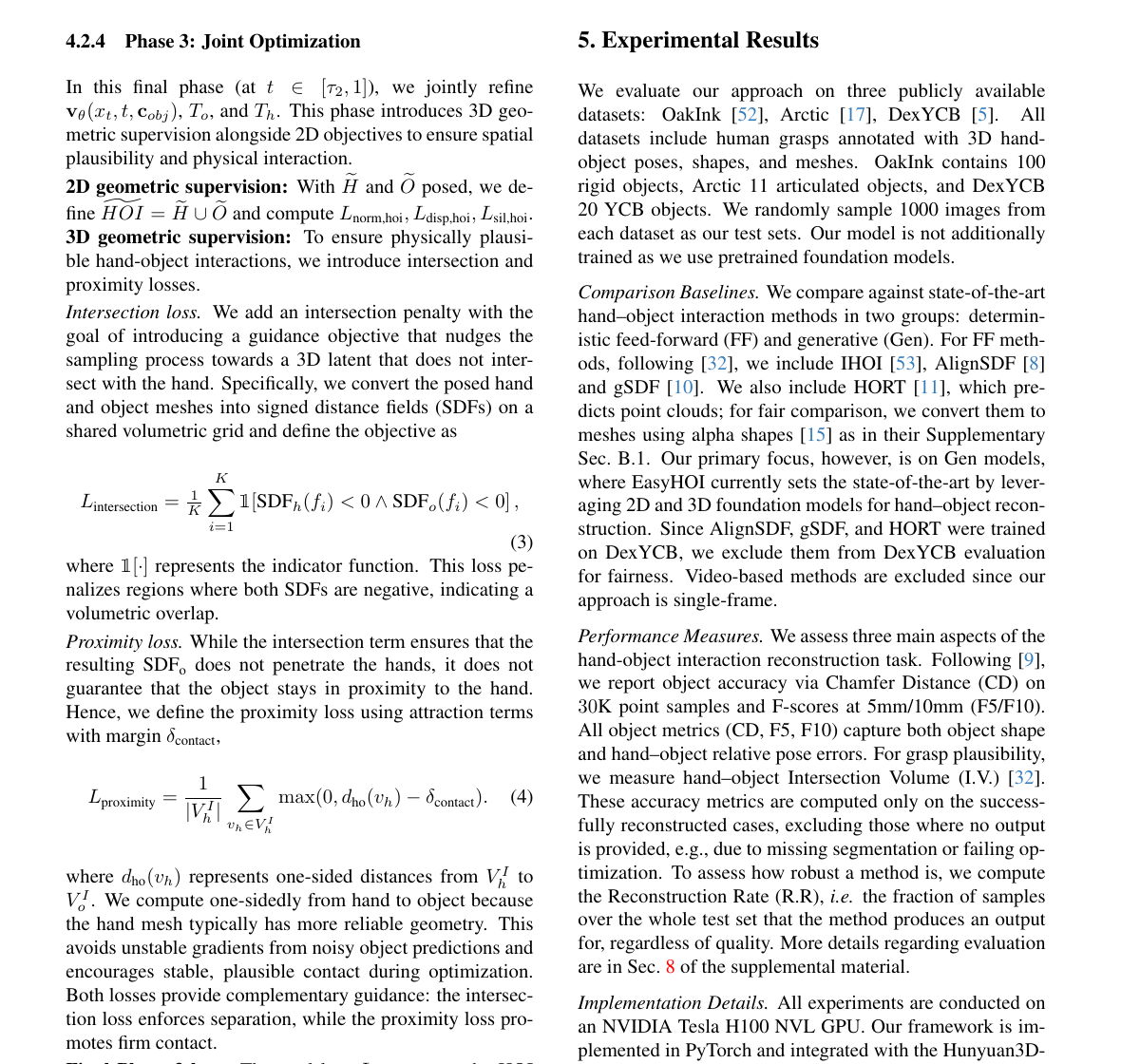
- Constrain object geometry and relative pose with silhouette, normal / depth, 2D keypoint, SDF intersection, and proximity losses.
5. Experimental overview
- OakInk / ARCTIC / DexYCB: the paper reports CD of 1.80 / 2.57 / 2.04 cm², the lowest in the table on all three datasets.
- OakInk reconstruction rate is 0.87, compared with 0.39 for EasyHOI, indicating both higher accuracy and fewer outright reconstruction failures.
- Phase ablation on 100 OakInk samples: full-method CD is 1.70; removing guidance, Phase 1, or Phase 2 gives 3.70, 5.67, or 3.53, respectively.
6. Strengths, Limitations, and Insights
Strengths
- Image-to-3D generation obeys geometry and contact during sampling, rather than relying on corrections afterward.
Limitations / risks
- Runtime is on the order of minutes per sample and depends on masks / inpainting; thin objects and upstream errors remain failure cases.
- Accurate geometry does not automatically yield metric-scale 6D pose suitable for immediate robotic grasping.
7. Points Worth Reading Closely
The explicit separation into hand-first, object-first, and joint optimization stages is valuable: it reflects the hand’s role as a more stable spatial anchor than the object in single-image interaction.