FoundationPose: Unified 6D Pose Estimation and Tracking of Novel Objects
Unifies RGB-D 6D pose estimation and tracking of rigid instances unseen in training. With CAD, the model is rendered directly; without CAD, a few posed reference images fit an object-centric neural field for RGB-D rendering. Globally sampled hypotheses are refined by a Transformer RefineNet and ranked by a cross-hypothesis self-attention ScoreNet. LLMs and diffusion models only augment synthetic training data; testing uses no text input or main-network fine-tuning.
FoundationPose is a render-and-compare foundation model for RGB-D pose estimation and tracking of unseen rigid instances. With CAD, it renders the model directly; without CAD, it fits an object-centric neural field from a few reference images with known camera–object poses to render RGB-D. Both settings share global hypothesis generation, Transformer refinement, and cross-hypothesis ranking for single-frame estimation and video tracking. The LLM supports offline synthetic training data generation; it does not supply language prompts at test time.
Method inputs and outputs
Item
Content (compiled for this site)
Inference inputs
Current RGB-D, camera intrinsics, and a renderable object representation. Initial estimation also requires a target detection box / mask; tracking initializes from the previous frame’s pose.
Final outputs
Rotation R and translation t from the target object frame to the current camera frame. Processing successive frames yields a 6D pose trajectory, without producing robot actions.
Requirements
Model-based operation requires the target CAD model. Model-free operation requires a few posed RGB-D references, followed by object neural-field fitting / mesh extraction. Both modes require depth and omit a complete object-discovery frontend.
2.1 Guide to the paper’s figures and tables
Figure / table
Purpose
Overview reading tips
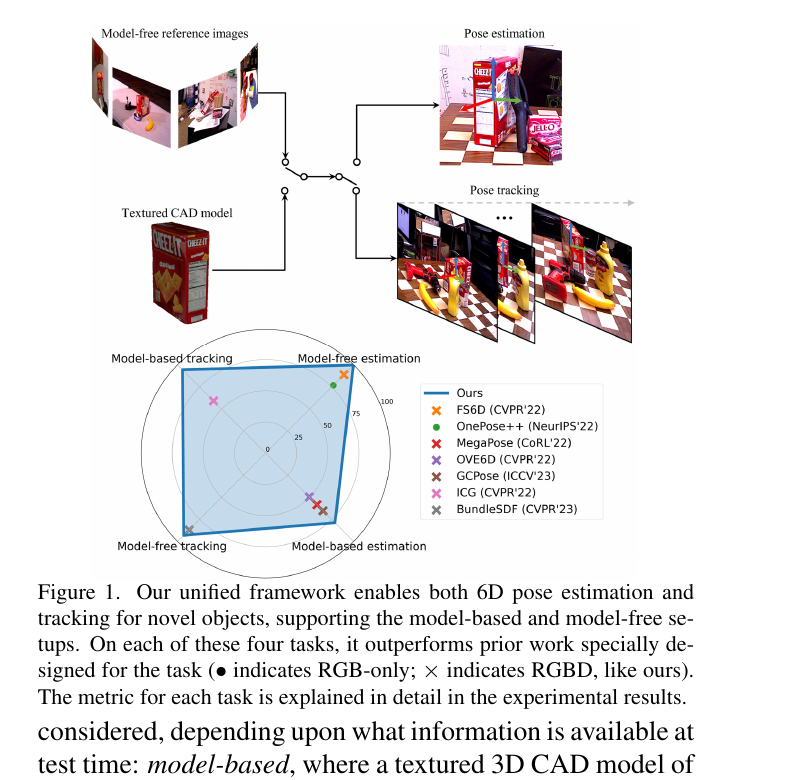
Figure 1
Four unified tasks and an overall comparison
Distinguish the model-based / model-free and estimation / tracking axes first
Figure 2
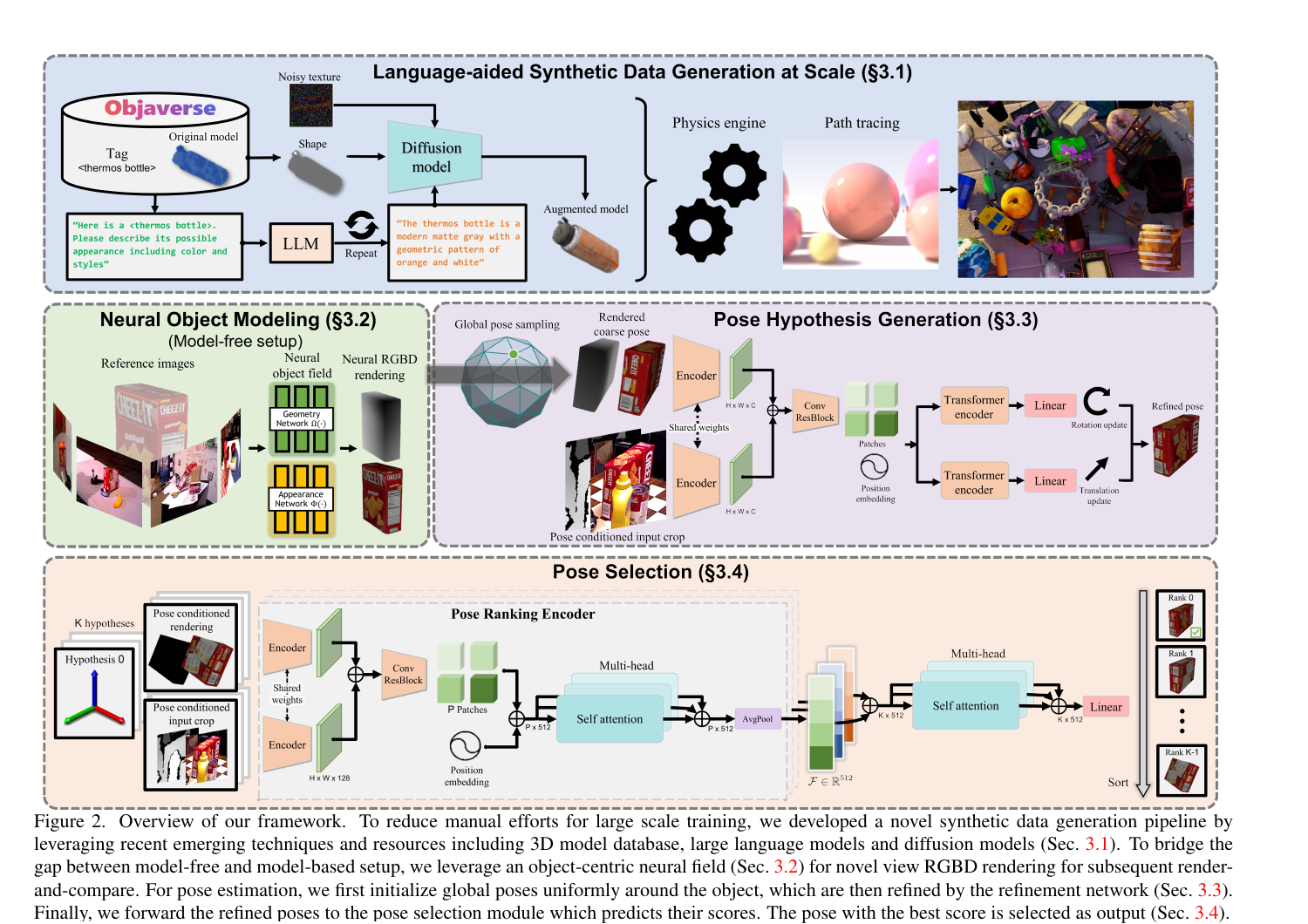
Full framework: training data, neural field, refinement, and ranking
Read its four sections from top to bottom; the LLM is not an online module
Figure 4
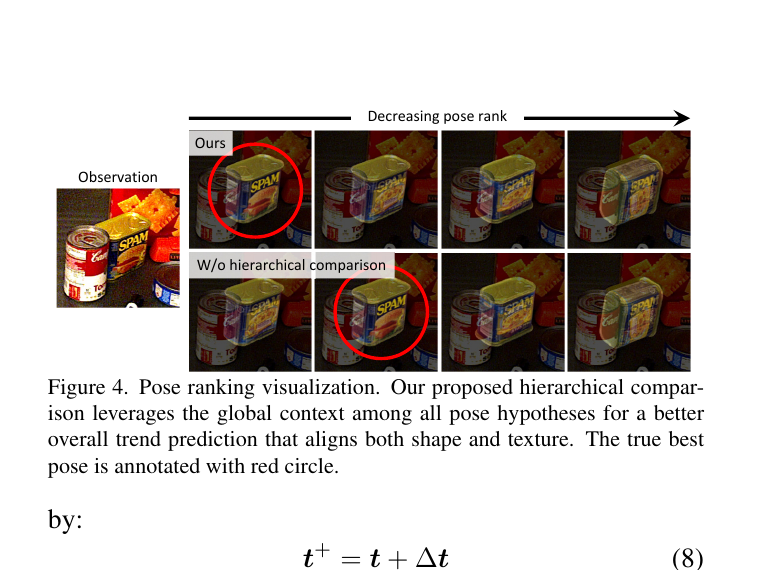
Hierarchical hypothesis ranking
Examine why independently scoring each pose hypothesis is insufficient: the correct candidate needs comparison with the full set
Tables 1—3
Model-free and model-based single-frame estimation
YCB-Video AUC, LINEMOD ADD-0.1d, and BOP AR use different protocols and cannot be compared directly
Tables 5—6
YCB-Video tracking and ablations
Examine the tradeoffs for real-time tracking and the components with the largest effect on accuracy
Original paper, Figure 1: one framework supports four task combinations. The two object priors shown at the top are posed reference images and textured CAD; the radar charts below compare prior methods by task. Source: arXiv. Image copyright belongs to the paper's authors and publisher; reproduced here for paper commentary.
3. Task setting: instance-level pose estimation
Task level: instance-level, unseen objects. The shared networks are trained on synthetic objects, without object-specific fine-tuning of the main network for test instances. This is not category-level 6D pose estimation based on NOCS or category shape priors.
Model-based: a textured CAD model of the new object is supplied at test time. The system can render object RGB-D at any candidate R,t and compare it with the observed RGB-D.
Model-free: CAD is unavailable, but a few reference RGB-D images of the same object, with known object poses, are required. The paper typically uses around 16 images. The system first optimizes a neural object field for that object, then renders novel views.
Single-frame estimation: initialize translation from the detection box and depth, uniformly sample multiple rotation hypotheses around the object, refine each hypothesis, and choose the most plausible one.
Tracking: when the previous frame’s pose is already a sufficiently close initialization, skip multi-hypothesis initialization and global ranking, and run only the refinement branch. The paper reports around 32 Hz.
Input boundaries: camera intrinsics, RGB-D, and object detection / masks are required. Model-based operation additionally requires CAD; model-free operation additionally requires posed reference images and per-object neural-field fitting. The framework omits complete frontends for automatically discovering arbitrary objects or acquiring reference poses.
4. Why unify two object priors?
Rendering CAD is straightforward, but reliable meshes may be unavailable for new objects. Reference images avoid requiring CAD, yet make fast RGB-D rendering for many pose hypotheses difficult. FoundationPose uses a shared interface: render object RGB-D at a specified pose.
With CAD, use conventional graphics rendering.
Without CAD, fit an object-centric SDF / appearance field to posed references, extract a mesh, and render it through rasterization.
Downstream RefineNet and ScoreNet always compare candidate-pose renderings with pose-conditioned observation crops, regardless of whether the renderer uses CAD or a neural field.
The rendering interface is unified; the input quality and preparation costs can still differ. Model-free operation avoids CAD and main pose-network fine-tuning, but retains per-object field construction costs and dependence on reference-pose quality.
5. Method overview
Original paper, Figure 2: the top section shows offline synthetic training using Objaverse / GSO, LLMs, and diffusion-based texture augmentation. The middle left shows the model-free neural object field, and the middle right shows multi-hypothesis RefineNet. At the bottom, ScoreNet performs local comparisons followed by cross-hypothesis self-attention. Source: Paper PDF. Image copyright belongs to the paper's authors and publisher; reproduced here for paper commentary.
Synthetic training data: more than 40,000 Objaverse-LVIS objects spanning 1156 categories, together with GSO, provide shapes. ChatGPT generates appearance descriptions for object categories, TexFusion produces more natural textures, and Isaac Sim supplies physical placement and path tracing. This stage augments data before training.
Renderable object representation: in model-free operation, geometry SDF and appearance networks are supervised by RGB-D references. They subsequently support parallel GPU rendering of RGB-D for candidate poses.
Pose hypothesis generation: initialize translation using a 3D point near the median depth inside the detection box. Uniformly sample viewpoints on an object-centered icosphere and combine them with discrete in-plane rotations to form a global initial pose set.
RefineNet: for each hypothesis, encode the rendered image and the observation crop projected using the candidate pose, fuse them into patch tokens, and use a Transformer to regress translation and rotation updates separately. Updated poses can be refined iteratively.
ScoreNet: compute a render–observation alignment embedding for each hypothesis, apply self-attention across all K embeddings, and select the hypothesis with the highest relative ranking score.
6. Why hierarchical ranking matters
Original paper, Figure 4: hierarchical comparison in the top row ranks the candidate matching both shape and texture first. Independent per-candidate scoring in the bottom row selects another nearby candidate. Red circles mark the actual best pose. Source: Paper PDF. Image copyright belongs to the paper's authors and publisher; reproduced here for paper commentary.
The first level compares each candidate’s rendering with its pose-conditioned observation crop to obtain local matching features.
The second level applies multi-head self-attention to the sequence of candidate features, using the global context of which hypothesis is best relative to this set. No positional encoding is used, allowing variable candidate counts without depending on their input order.
Training uses a pose-conditioned triplet loss to separate positive candidates closer to ground truth from poorer negative candidates. Conventional InfoNCE performs worse in this setting.
Local visual similarity in render-and-compare does not always uniquely determine the correct pose, especially with weak texture, approximate symmetry, or occlusion. Comparing hypotheses against one another is more reliable than predicting an absolute score for each.
Metrics: YCB-Video uses ADD / ADD-S AUC; LINEMOD uses ADD-0.1d; BOP uses average recall (AR) over VSD, MSSD, and MSPD.
Fairness considerations: model-free reference images come from the dataset’s training split and include ground-truth object poses. Model-based BOP comparisons all use Mask R-CNN detections. Results must be interpreted with these frontend conditions in mind.
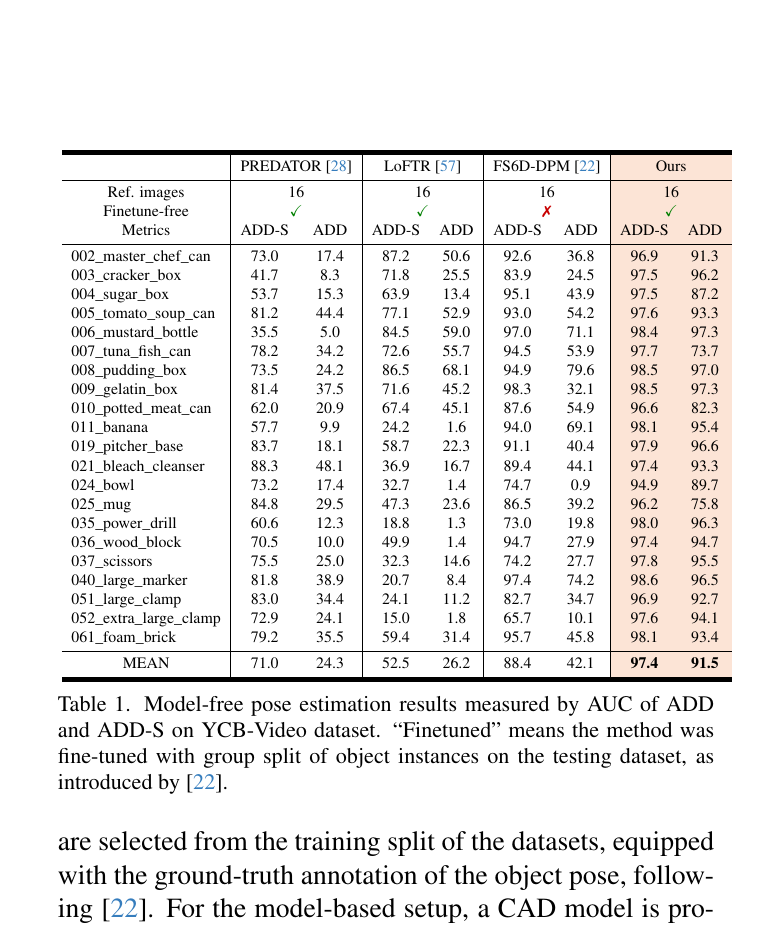
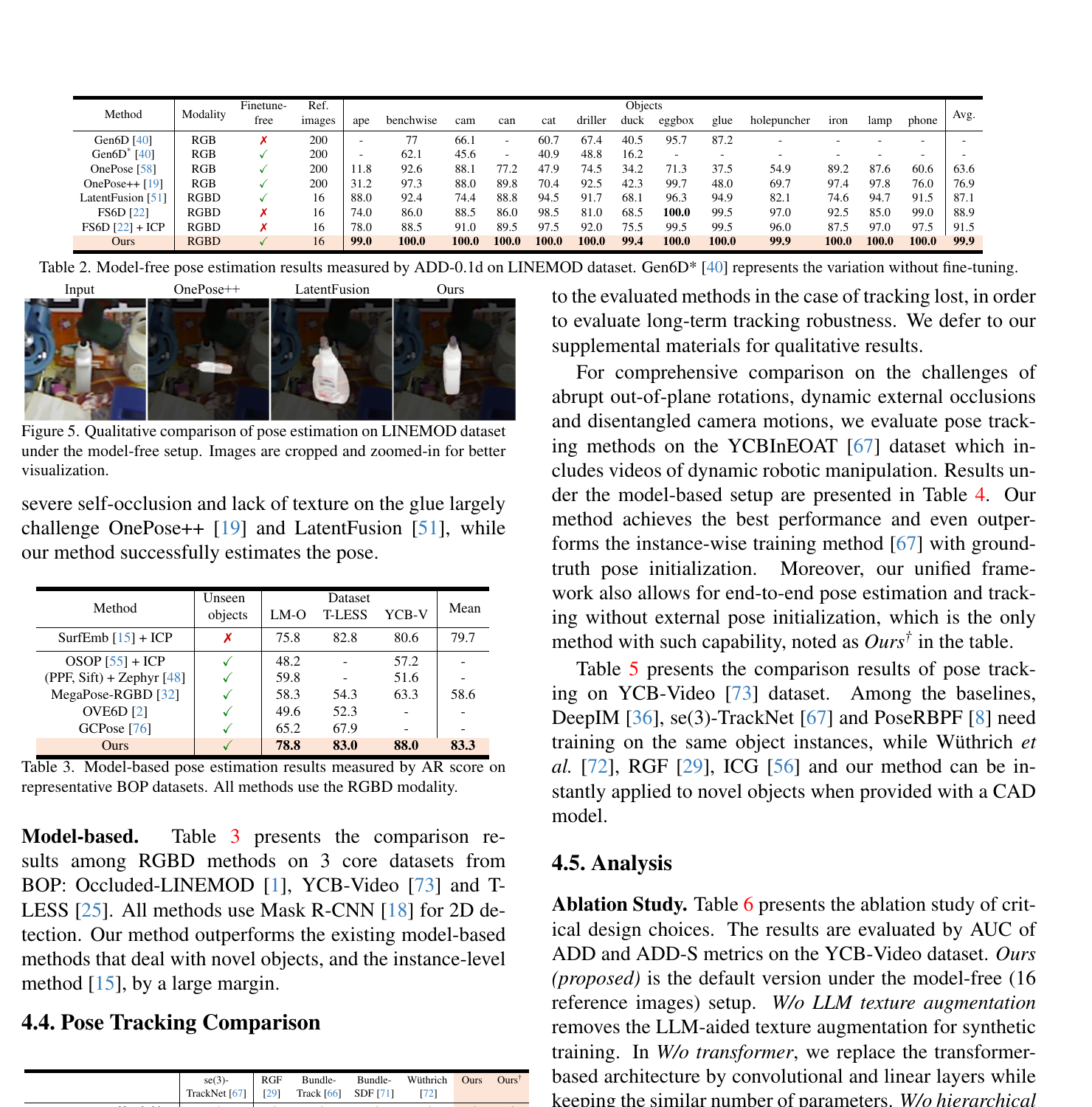
Original paper, Table 1: model-free single-frame estimation on YCB-Video. With 16 reference images, FoundationPose achieves mean ADD-S / ADD AUC of 97.4 / 91.5, compared with 88.4 / 42.1 for FS6D-DPM, which the table marks as requiring target-object fine-tuning. Source: Paper PDF. Image copyright belongs to the paper's authors and publisher; reproduced here for paper commentary.Original paper, Tables 2--3: in Table 2, model-free FoundationPose with 16 references achieves mean LINEMOD ADD-0.1d of 99.9. In Table 3, model-based BOP AR on LM-O / T-LESS / YCB-V is 78.8 / 83.0 / 88.0, averaging 83.3. Source: Paper PDF. Image copyright belongs to the paper's authors and publisher; reproduced here for paper commentary.
Model-free YCB-Video: Table 1 reports ADD-S / ADD AUC of 97.4 / 91.5 using 16 references and no target-object fine-tuning. ADD and ADD-S are separate columns and should not be collapsed into a single ADD(S) value.
Model-free LINEMOD: Table 2 reports ADD-0.1d of 99.9 with 16 references. RGB-only methods in this table often use 200 references, while RGB-D methods have different input conditions. These numbers establish performance under the paper’s protocols rather than an unconditional ranking of all methods.
Model-based BOP: Table 3 reports AR of 78.8 / 83.0 / 88.0 on LM-O / T-LESS / YCB-V, averaging 83.3. All use RGB-D and external Mask R-CNN 2D detections.
8. Tracking, ablations, and speed
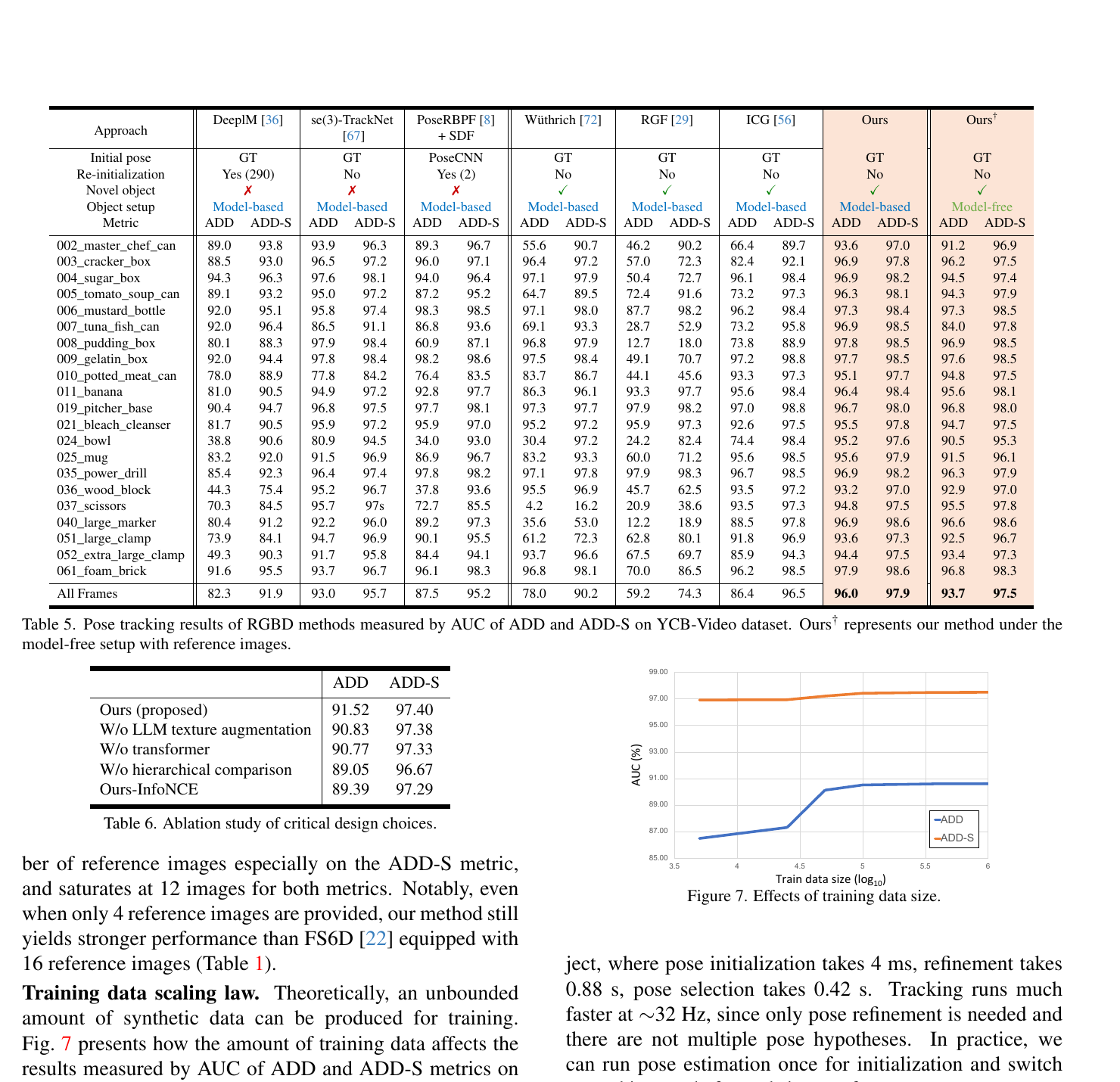
Original paper, Tables 5--6: on YCB-Video tracking, model-based FoundationPose achieves all-frame ADD / ADD-S AUC of 96.0 / 97.9; the model-free version achieves 93.7 / 97.5. Ablations default to model-free operation with 16 references. Removing hierarchical comparison produces the largest ADD decrease, from 91.52 to 89.05. Source: Paper PDF. Image copyright belongs to the paper's authors and publisher; reproduced here for paper commentary.
Model-based YCBInEOAT tracking: Table 4 reports overall ADD-S / ADD of 96.42 / 93.22; the model-free version of the unified pipeline achieves 96.40 / 93.09. This dataset includes dynamic robotic manipulation, external occlusion, and camera motion.
YCB-Video tracking: Table 5 reports model-based ADD / ADD-S of 96.0 / 97.9 and model-free results of 93.7 / 97.5. Neural-field rendering is therefore viable for tracking, although model-free operation is not universally equivalent to using CAD.
Ablations: the default model-free setting with 16 references achieves ADD / ADD-S AUC of 91.52 / 97.40. Removing LLM texture augmentation gives 90.83 / 97.38; removing the Transformer gives 90.77 / 97.33; removing hierarchical comparison gives 89.05 / 96.67; replacing the loss with InfoNCE gives 89.39 / 97.29. Hierarchical comparison has the largest effect on ADD in this experiment.
Reference count: performance saturates at around 12 references. The paper reports that 4 references already outperform FS6D with 16 references. Gains from synthetic training scale largely saturate after about 1M samples.
Latency: on an Intel i9-10980XE + RTX 3090, single-object pose estimation takes about 1.3 s: 4 ms for initialization, 0.88 s for refinement, and 0.42 s for selection. Tracking runs at about 32 Hz. Estimation suits first-time initialization; tracking is the real-time stage.
9. Strengths and limitations
Strengths
CAD and posed references share a renderable RGB-D interface, with consistent downstream networks and task-switching behavior.
No target-instance pose-network fine-tuning is needed: one synthetically trained model handles everyday objects unseen during training.
RefineNet retains iterative geometric alignment, and ScoreNet explicitly selects among multiple hypotheses. Ablations support the value of both modules.
Results cover model-free / model-based operation and single-frame estimation / tracking, including protocols of varying difficulty such as BOP and YCBInEOAT.
Limitations / risks
Model-free operation still requires preparation: each new object needs posed RGB-D references and object-specific neural-field optimization. Reference-pose errors propagate into the representation and rendering.
Depth, intrinsics, and detections / masks are required. Many benchmarks in the paper use ground truth or fixed detection protocols, which do not establish end-to-end success rates in open-world scenes.
Global single-frame search takes about 1.3 seconds, and complex multi-object scenes require separate initialization for each object. The 32 Hz figure applies only to tracking with an already good initialization.
The paper targets individual rigid objects. Articulated objects, transparent / highly reflective materials, strong symmetries, and redetection after prolonged loss remain engineering challenges.
LLM / diffusion augmentation belongs to the training data pipeline, rather than deployment-time language understanding. The open-source implementation also notes that upstream licensing restrictions prevent some diffusion-augmented assets from being distributed with the code.
10. Research takeaways
A reusable idea: abstract object priors into a shared differentiable / batch-renderable interface, connecting CAD, neural fields, and reconstructed meshes to the same refinement and scoring backend.
As a baseline: suitable for RGB-D pose estimation / tracking of rigid instances unseen in training, with CAD or posed references available. Also record reference count, reference-pose source, neural-field fitting time, detector quality, and initial-estimation success rate.
Worth reading in depth: yes. Focus on how pose-conditioned crops support iterative translation correction, triplet supervision for hierarchical ranking, and the offline / online cost boundaries of model-free neural fields.
Available src/paper-notes/foundationpose/deep.md
In-depth paper notes
Support reproduction, comparison, related-work writing, and identifying opportunities for further research.
In-depth paper notes: FoundationPose: Unified 6D Pose Estimation and Tracking of Novel Objects
1. Basic information
Title: FoundationPose: Unified 6D Pose Estimation and Tracking of Novel Objects
Authors / affiliation: Bowen Wen, Wei Yang, Jan Kautz, Stan Birchfield; NVIDIA
FoundationPose uses a shared interface that renders object RGB-D for any candidate T=(R,t). Known CAD is rasterized directly; without CAD, a few posed RGB-D references fit an object-centric SDF / appearance field and produce a renderable mesh. The same Transformer RefineNet corrects globally generated pose hypotheses, and a shared ScoreNet with cross-hypothesis self-attention selects the best pose. Video tracking retains only refinement, running at around 32 Hz.
Method inputs and outputs
Item
Content (compiled for this site)
Inference inputs
Current RGB-D, K, and a renderable object representation. Global estimation initializes candidates from external detections; tracking initializes refinement with the previous TCO, without requiring a new ground-truth mask each frame.
Final outputs
The best object-to-camera transform TCO∈SE(3); tracking yields per-frame TCO,t. RefineNet updates and ScoreNet candidate scores are internal outputs.
Training inputs
Synthetic RGB-D, training CAD, ground-truth object poses / masks, and renderings of perturbed candidate poses. LLM / diffusion models generate training textures rather than online inputs.
Training objectives
Shared RefineNet learns pose updates, and ScoreNet learns candidate ranking. Model-free operation also optimizes a per-object SDF / appearance field from posed RGB-D references to produce a renderable mesh; this differs from fine-tuning the pose networks.
Output details
TCO comprises rotation R∈SO(3) and translation t∈R3. CAD or the reconstructed object defines coordinates, and depth / mesh length units must agree. Category size is not independently predicted, and segmentation or actions are not direct outputs.
Requirements
Model-based operation requires target CAD; model-free operation requires RGB-D references with reliable poses, calibration, target regions, and offline field fitting. Both branches require a renderer, online RGB-D, and camera intrinsics.
2.1 Guide to the paper’s figures and tables
Figure / table
Location in the paper
What it demonstrates / explains
Reading cautions
Figure 1
Motivation and overview
One system supports model-free / model-based estimation and tracking
The radar-chart axes represent different tasks and protocols; area is not a unified metric
Figure 2
End-to-end framework
Dependencies between training data, the object field, RefineNet, and ScoreNet
LLMs and diffusion appear at the top only for synthetic training data construction
Figure 3
Texture augmentation
TexFusion textures from LLM-generated prompts look more natural than random texture maps
This increases appearance diversity without replacing object geometry modeling
Figure 4
Pose ranking
The first level compares individual alignments; the second compares all candidates
Correct pose selection uses relative ranking rather than independent absolute classification
Tables 1—3
Single-frame estimation
Model-free YCB-V / LINEMOD and model-based BOP results
The tables use different input priors and metrics
Tables 4—6
Tracking and ablations
Unified capabilities, key structures, and speed–accuracy tradeoffs
Ablations default to model-free operation with 16 references, rather than averaging all tasks
Original paper, Figure 2: the full pipeline from offline synthetic data generation to model-free neural object fields, hypothesis refinement, and hierarchical pose selection. CAD-based operation skips the neural field at the lower left and directly supplies renderings for render-and-compare. Source: Paper PDF. Image copyright belongs to the paper's authors and publisher; reproduced here for paper commentary.
3. Problem definition and assumptions
For an object-frame point xobj, the goal is to predict the rigid transform into the camera frame:
xcam=Rxobj+t,R∈SO(3),t∈R3.
FoundationPose claims that one shared pose model supports two object priors, rather than eliminating object priors:
Setting
Available object prior
Additional preparation
Downstream input
model-based
Textured CAD mesh
Prepare / validate mesh coordinates and scale
CAD-rendered RGB-D at candidate T
model-free
A few RGB-D references with per-image object poses
Fit a neural object field once per object, then extract a renderable mesh
RGB-D rendered from the field-derived mesh at candidate T
Shared training without target fine-tuning: RefineNet and ScoreNet train on large synthetic datasets. Their weights remain fixed for new test objects.
Model-free boundaries: the paper reports one-time, per-object field optimization in seconds. This still models the test object, and references require reliable object-to-camera poses. An uncalibrated image alone does not provide preparation-free deployment.
Detection and depth assumptions: inputs are RGB-D. Single-frame initialization uses an existing detector such as Mask R-CNN or CNOS; the method itself is not a detector. All methods in model-based BOP comparisons use Mask R-CNN 2D detections.
Four tasks: model-based estimation, model-free estimation, model-based tracking, and model-free tracking. Tracking uses temporal continuity, without constituting category-level learning or a joint multi-object pose solver.
4. Research context and central design choice
4.1 Historical input requirements
Instance-level CAD pose: training and testing concern the same instances. Renderable CAD supports 2D–3D or 3D–3D correspondences, but new objects often require object-specific training or explicitly supplied assets.
Model-based novel-object pose: objects may be unseen during training if CAD is provided. The bottleneck is render-and-compare generalization to unfamiliar shapes / textures.
Few-shot model-free pose: methods such as Gen6D, OnePose, and FS6D use posed reference images rather than CAD. They avoid explicit meshes but often depend on SfM, 2D–3D correspondences, or object-specific test-time adaptation.
Object tracking: previous-frame initialization reduces search, although conventional approaches often retain CAD, object-specific training, or category-prior requirements.
4.2 The FoundationPose design
Rather than training separate pose networks for the two priors, the method confines their differences to the renderer:
R(O,T)→(Irender,Drender).
Here O can be CAD or a textured mesh extracted from a neural field. Subsequent networks determine whether rendered and observed images agree at candidate T and how to update it. This makes the backend reusable, while rendering quality remains a bottleneck for model-free operation.
5. Offline synthetic data: LLMs are used before training
5.1 Assets and scenes
Training objects come from Objaverse and Google Scanned Objects (GSO). The Objaverse-LVIS subset contains over 40,000 objects in 1156 LVIS categories.
NVIDIA Isaac Sim provides gravity / physics simulation with randomized objects, materials, sizes, cameras, and lighting. Path tracing produces photorealistic RGB-D scenes with pose / mask labels.
Each sample supplies RGB, depth, object pose, camera pose, instance segmentation, and 2D bounding boxes for refinement and ranking training.
5.2 LLM-aided texture augmentation
Randomly mapping ImageNet / COCO images onto UVs can create seams and place entire backgrounds on object surfaces. The authors use two prompt stages:
Insert Objaverse-LVIS category tags into a template asking ChatGPT for plausible object colors and styles.
Use the responses as TexFusion text prompts to generate augmented materials with the original shape and random noise textures.
The language model broadens the training appearance distribution but does not enter test inputs or generate target poses, masks, or CAD. Table 6 supports a modest benefit: removing it lowers ADD AUC from 91.52 to 90.83 and ADD-S from 97.40 to 97.38, without producing the largest ablation decrease.
6. Model-free neural object modeling
6.1 Representation
Without CAD, posed references must support RGB-D rendering at arbitrary candidate poses. The authors represent the object as an object-centric field:
Geometry function Ω:R3→R outputs signed distances; the zero level set defines the surface.
Appearance function Φ takes intermediate geometry-network features, surface normals, and viewing direction to predict color c∈R3.
3D points use two-resolution hash encoding, while normals and directions use second-order spherical harmonics.
Unlike a density-only NeRF, the SDF directly describes depth surfaces and supports mesh extraction through marching cubes. Each object is optimized independently, without a cross-object shape prior.
6.2 Supervision from RGB-D references
Ray r undergoes volumetric rendering in a truncated surface region near the observed depth. Reference RGB supplies L2 color supervision; hybrid SDF geometry uses empty-space, near-surface, and eikonal regularization. The total loss can be summarized as:
Lfield=wcLc+weLe+wsLs+weikLeik.
This optimization prepares per-object assets for model-free operation rather than training pose networks. The paper emphasizes completion within seconds and one-time training of each object field.
6.3 Why not render the neural field online each time?
After field optimization, marching cubes extracts a textured mesh from the SDF zero level set. Inference rasterizes RGB-D for multiple pose hypotheses in parallel. Direct online depth rendering through sphere tracing is more expensive when handling many hypotheses.
Engineering implications: model-free operation avoids CAD and pose-network fine-tuning for unseen objects, but shifts costs to reference capture, pose calibration, and field fitting. Real systems must measure these costs alongside refinement-network runtime.
7. Pose hypothesis generation and RefineNet
7.1 Global initialization
Given the current RGB-D observation:
A detector supplies a 2D box / mask; a 3D point corresponding to median depth within the box initializes translation.
Build an object-centered icosphere and uniformly sample Ns viewpoints whose cameras face the center.
Add Ni discrete in-plane rotations per viewpoint to obtain K=NsNi initial poses.
Sampling turns large rotation errors into a hypothesis-coverage problem, while translation still uses a local initialization. Tracking can skip this expensive stage when a previous-frame estimate is available.
7.2 Pose-conditioned crops and refinement
For each coarse pose T:
Render RGB-D with R(O,T);
Project the object origin into the image as the crop center, and use a slightly enlarged projected object diameter to determine crop size;
Extract the corresponding candidate-pose-conditioned crop from the real observation, rather than using a fixed detector box;
Encode both RGB-D inputs with a shared CNN, concatenate their features, and apply a residual block, patch tokenization, and positional embeddings;
Use two Transformer encoders to predict translation update Δt and rotation update ΔR separately.
The updates are:
t+=t+Δt,R+=ΔR⊗R.
Δt and ΔR are defined in the camera frame, with axis–angle rotation. Pose-conditioned cropping is crucial: when a coarse pose projects to the wrong center, the crop itself provides feedback about translation error, which a fixed detection crop cannot easily supply. RefineNet can iterate by passing each updated pose into the next round.
7.3 Refinement supervision
RefineNet uses L2 regression for the ground-truth translation and rotation updates:
Lrefine=w1∥Δt−Δtˉ∥2+w2∥ΔR−ΔRˉ∥2.
Both weights are set to 1. The network learns small updates rather than directly regressing a global pose from images, naturally supporting multi-hypothesis initialization and tracking warm starts.
8. ScoreNet: from local alignment to relative ranking
8.1 Two-level comparison
After RefineNet, K refined poses remain. At the first level, each candidate’s rendering and observation crop pass through a pose-ranking encoder, producing Fi∈R512 to represent local alignment.
Direct linear projection of each Fi would require independent absolute scores, making similar silhouettes, repetitive textures, and occlusion misleading. Instead, the second level treats
F=[F0,…,FK−1]T∈RK×512
as a sequence for multi-head self-attention, then linearly projects it into K scores. Without positional encodings, the sequence is insensitive to hypothesis order and supports varying K.
Original paper, Figure 4: hierarchical comparison selects the correct pose from the full hypothesis set. Without the second level, a visually similar candidate with an incorrect pose may rank first. Red circles identify the best ground-truth-aligned candidate. Source: Paper PDF. Image copyright belongs to the paper's authors and publisher; reproduced here for paper commentary.
8.2 Pose-conditioned triplet loss
For pose pairs, geodesic rotation distance to ground truth defines positive and negative candidates, with the loss:
L(i+,i−)=max(S(i−)−S(i+)+α,0).
Unlike a conventional triplet loss, positive and negative pairs do not share an anchor: each pose hypothesis produces a different crop, and translation also changes the input. To avoid uninformative comparisons between two candidates far from ground truth, only pairs with a sufficiently close positive rotation are retained. The paper also tests InfoNCE, whose implicit perfect-translation assumption is unsuitable here.
9. Experimental design and results
9.1 Datasets, task combinations, and protocols
Dataset
Use
Main challenges / metrics
YCB-Video
Model-free single-frame estimation, tracking, and ablations
ADD / ADD-S AUC; many object instances and symmetric objects
Textureless, symmetric / industrial objects; BOP AR
YCBInEOAT
Model-based tracking
Dynamic robotic manipulation, external occlusion, and camera motion
In the model-free setup, references come from each dataset’s training split with ground-truth object poses, following FS6D. These clean research initialization conditions require external reference-pose acquisition in deployment, through fiducials, robot calibration, SLAM / SfM, or similar systems.
9.2 Model-free single-frame estimation: YCB-Video
Original paper, Table 1: ADD-S / ADD AUC for model-free RGB-D pose estimation on YCB-Video. FoundationPose uses 16 references without object-specific fine-tuning and averages 97.4 / 91.5. Source: Paper PDF. Image copyright belongs to the paper's authors and publisher; reproduced here for paper commentary.
Method
Modality
References
Target fine-tuning
ADD-S AUC
ADD AUC
PREDATOR
RGB-D
16
No
71.0
24.3
LoFTR
RGB-D
16
No
52.5
26.2
FS6D-DPM
RGB-D
16
Yes
88.4
42.1
FoundationPose
RGB-D
16
No
97.4
91.5
Correspondence-based baselines are more vulnerable to weak texture and occlusion. Rendering alignment and global ranking reduce FoundationPose’s reliance on identifiable local matches. However, the AUC limit, ground-truth reference poses, and detection / cropping protocol remain part of the comparison; the table does not measure complete-system success in open environments.
9.3 Model-free LINEMOD and model-based BOP
Original paper, Tables 2--3: Table 2 uses RGB-D and 16 references for model-free FoundationPose, with mean LINEMOD ADD-0.1d of 99.9. In Table 3, model-based BOP AR on LM-O / T-LESS / YCB-V is 78.8 / 83.0 / 88.0, averaging 83.3. Source: Paper PDF. Image copyright belongs to the paper's authors and publisher; reproduced here for paper commentary.
Table 2: FoundationPose’s 99.9 is mean ADD-0.1d success across 13 LINEMOD categories. OnePose / OnePose++ achieve 63.6 / 76.0 with RGB and 200 references; LatentFusion / FS6D use RGB-D and 16 references, scoring 87.1 / 88.9. These different inputs demonstrate model-free RGB-D capability under the paper’s protocols, rather than establishing an unconditional shared ranking.
Table 3: with RGB-D and Mask R-CNN 2D detections, FoundationPose’s mean BOP AR of 83.3 exceeds the listed model-based novel-object methods, including MegaPose-RGBD at 58.6. AR aggregates recall over VSD, MSSD, and MSPD and cannot be numerically compared directly with ADD AUC.
9.4 Tracking: initial global estimation and subsequent refinement
Table 4 evaluates model-based tracking on YCBInEOAT. FoundationPose achieves all-frame ADD-S / ADD AUC of 96.42 / 93.22, while its unified model-free pipeline reaches 96.40 / 93.09. The latter obtains its initial pose from the pose estimation module.
Original paper, Tables 5--6: model-based FoundationPose achieves YCB-Video tracking ADD / ADD-S of 96.0 / 97.9; the model-free version achieves 93.7 / 97.5. Below are key ablations under the default model-free, 16-reference setting. Source: Paper PDF. Image copyright belongs to the paper's authors and publisher; reproduced here for paper commentary.
Table 5 reports the following all-frame YCB-Video tracking results:
Method setting
ADD AUC
ADD-S AUC
Interpretation
Ours, model-based
96.0
97.9
CAD rendering; tracking runs only refinement
Ours, model-free
93.7
97.5
Neural-field rendering also supports stable tracking
BundleSDF
86.4
96.5
An established model-free RGB-D tracking reference
se(3)-TrackNet
93.0
95.7
Model-based, with training on the same objects
These results support an architecture with expensive initial global estimation followed by lightweight refinement. They do not establish automatic recovery after prolonged loss or occlusion, since tracking reinitialization carries additional assumptions in each protocol.
9.5 Ablations and scaling
The default is model-free operation with 16 references. YCB-Video ADD / ADD-S AUC results are:
Variant
ADD
ADD-S
Interpretation relative to the default
Ours
91.52
97.40
Complete design
Without LLM texture augmentation
90.83
97.38
Appearance diversity makes a modest contribution to ADD
Largest ADD decrease; hypothesis-set context is most important
InfoNCE replaces ranking loss
89.39
97.29
The perfect-translation assumption does not fit this problem
Reference count: performance improves with more references and saturates at around 12. The paper reports that 4 references already outperform FS6D with 16. Field modeling and ranking remain sensitive to reference coverage, and the few-shot setting is not one-shot.
Training data size: larger synthetic datasets improve YCB-Video AUC, with gains saturating around 1M samples. Generalization reflects data scale, asset diversity, and texture augmentation together, rather than network structure alone.
Latency: on Intel i9-10980XE + RTX 3090, global estimation takes around 1.3 s per object: 4 ms initialization, 0.88 s refinement, and 0.42 s selection. Tracking runs at around 32 Hz. Report initialization latency separately from steady-state tracking speed.
10. Do the contributions match the evidence?
Authors’ claim
Supporting evidence
Assessment
One model supports model-based / model-free pose estimation and tracking
Figure 1, Tables 1—5
Broadly supported across all four tasks, although frontends and protocols differ
Neural fields unify rendering with and without CAD
Section 3.2, model-free tables
A sound mechanism; deployment still requires measurements of reference-pose noise and field-fitting wall-clock time
Synthetic training generalizes strongly to novel objects
LINEMOD, BOP, YCB-V
Substantial support, but training assets, LLM textures, and diffusion all contribute; architecture alone cannot receive all credit
Hierarchical ranking is a key design
Table 6, Figure 4
Supported: removing it lowers ADD by 2.47 points, the largest decrease in the table
Real-time tracking is possible
Reported 32 Hz, Tables 4—5
Conditional: only subsequent refinement is real time; initial global estimation remains around 1.3 s / object
11. Critical analysis
Strengths
A well-chosen shared interface: object representation is decoupled from how the pose backend compares renderings and observations. CAD, reconstructed meshes, and SDF fields can reuse the same Transformer modules.
Geometric structure beyond direct regression: hypothesis coverage, render-and-compare, and iterative updates make errors easier to diagnose under distribution shifts to new objects.
Ranking matches the decision structure: the goal is the relatively best pose in a candidate set. Self-attention fits this decision better than independent binary scores.
Broad task coverage: results cover single-frame model-free estimation, CAD-based estimation, and tracking, giving a reasonably complete account of the system’s operating scope.
Limitations and implicit assumptions
Reference poses are strong priors: model-free references require object poses, supplied as ground truth in benchmarks. Scale or coordinate-frame drift in real pose recovery affects both fields and downstream renderings; the paper does not systematically quantify this propagation.
Detection / segmentation remains consequential: initial translation comes from the target box and depth. Occlusion or incorrect boxes can shift the center of subsequent global sampling. A shared Mask R-CNN BOP protocol does not solve open-vocabulary or unknown-object detection.
Initial latency and multi-object throughput: 1.3 s covers global initialization for one object. The paper gives no end-to-end frame budget for scheduling sampling, rendering, and ranking across multiple candidate instances in cluttered scenes.
A single-rigid-object assumption: the conclusion identifies state estimation beyond a single rigid body as future work. Neural-field modeling and pose ambiguity for articulated, soft, transparent, or highly specular objects are not systematically evaluated.
Training-asset reproducibility: the complete LLM / diffusion augmentation pipeline depends on model and licensing restrictions. Reproductions should identify the public weights and data used, rather than assuming every reported benefit is directly reproducible from the repository.
Conclusions that should not be overinterpreted
LLMs provide training-material prompts, rather than improving pose through test-time language input.
Model-free operation replaces CAD preparation with per-object field fitting; object modeling remains necessary.
The 32 Hz figure concerns refinement with an existing initialization. Initial single-frame global estimation takes around 1.3 s.
Comparisons with instance-level methods must respect each task’s references, depth, detector, initial poses, and metric protocol. Results do not establish superiority over every method in every environment.
12. Practical deployment recommendations
Choose the asset path: prefer model-based operation when reliable CAD is available. Use model-free operation when multiview RGB-D and poses can be acquired during object onboarding / calibration.
Separate initialization from tracking: use the 1.3 s global estimator for new targets or recovery after tracking loss, with lightweight refinement in normal operation. Design reinitialization triggers using detector confidence, crop inliers, and ranking margins.
Record system-level metrics: reference count and coverage, reference-pose source / error, neural-field fitting time, mesh-extraction success, detector mask IoU, initial-estimation success, recovery after tracking loss, and total wall-clock time.
Reusable ideas: decouple model sources and pose backends through an object representation that renders RGB-D at arbitrary poses; use pose-conditioned crops and relative ranking through cross-hypothesis self-attention; separate initial global estimation from steady-state tracking.
Possible improvements: expose field / rendering uncertainty to ScoreNet; calibrate ranking confidence to trigger reinitialization; replace a single R with symmetry-aware multiple hypotheses; augment reference-pose / depth noise more robustly to bridge ground-truth references and real capture.
Baseline configuration: report model-based and model-free FoundationPose separately. Fix RGB-D inputs, reference count, reference-pose acquisition, the detector, ground-truth initialization policy, and permission for per-object field fitting. Separate single-frame latency from tracking FPS.
Open questions: how do field quality and pose AUC degrade when reference poses come from SfM / robot hand–eye calibration rather than ground truth? Without restricted diffusion augmentation, are LLM-texture gains still consistent? Can global ranking meet robot cycle-time requirements when multiple objects share GPU rendering?