FoundPose: Unseen Object Pose Estimation with Foundation Features
FoundPose registers DINOv2 layer-18 patch features from 800 CAD templates into 3D in under 5 minutes of onboarding per object. Online BoW retrieval selects 5 views, followed by 2D–3D matching and PnP-RANSAC. Training-free coarse / featuremetric AR is 37.2 / 42.6. The strongest 59.6-AR configuration additionally uses a MegaPose refiner trained on over 2 million synthetic images.
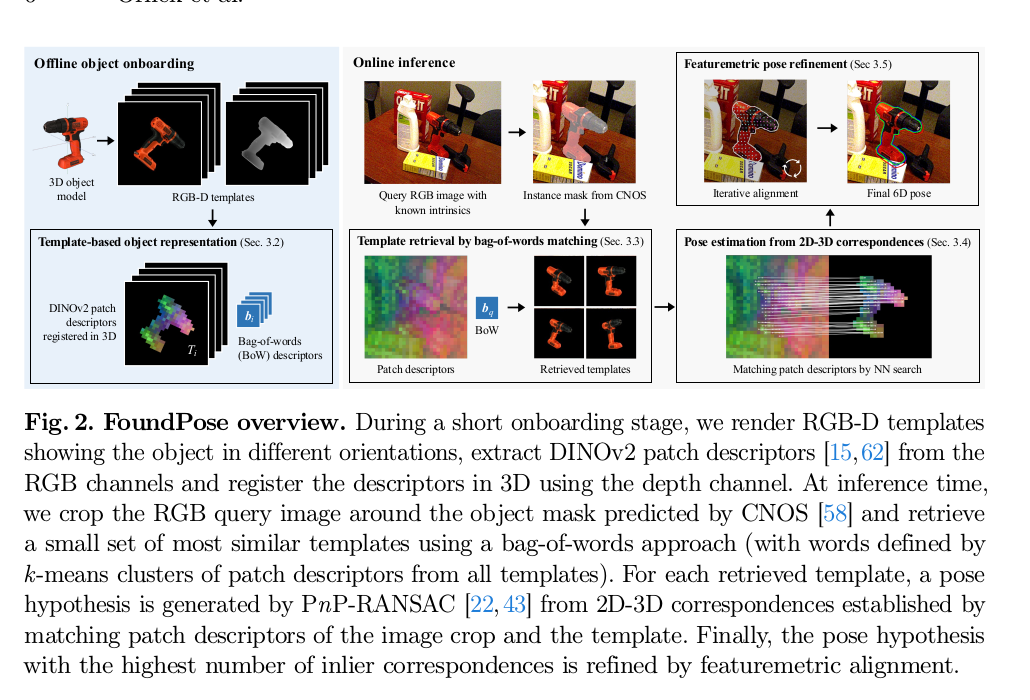
During offline onboarding of less than 5 minutes per new object, FoundPose renders 800 CAD RGB-D templates and registers DINOv2 ViT-L layer-18 patch descriptors to model 3D points. Online, it retrieves 5 views using bag-of-words, builds 2D–3D correspondences through patch nearest neighbors, solves pose with PnP-RANSAC, and applies training-free featuremetric refinement. Coarse AR reaches 37.2 across seven BOP datasets, substantially above contemporary coarse RGB methods requiring task-specific training.
3. Guide to figures and tables
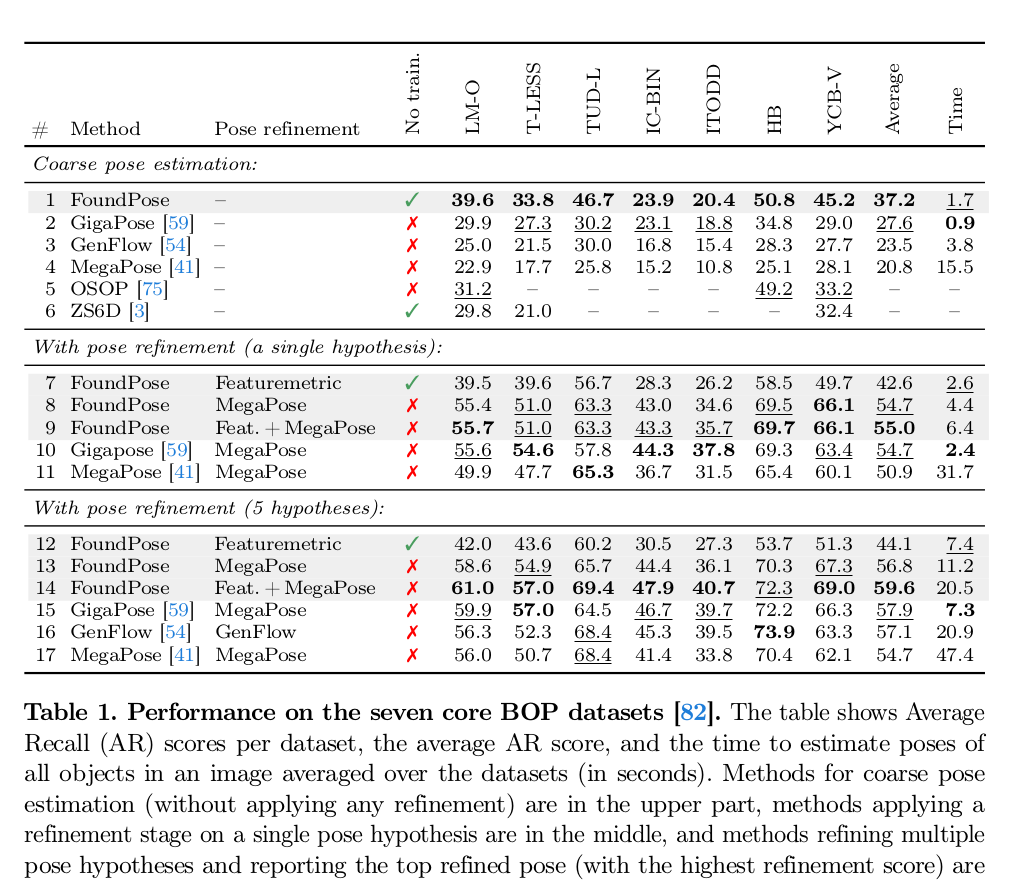
Original Figure 2: offline, template patch descriptors are associated with CAD 3D points and a visual bag-of-words is built. Online, a CNOS mask crops the query image; similar templates are retrieved, PnP-RANSAC estimates coarse poses, and L-M alignment operates directly on DINOv2 feature maps. Source: official ECVA paper. Image copyright belongs to the paper's authors and Springer Nature; reproduced here for paper analysis.Original Table 1: FoundPose coarse / single-hypothesis featuremetric refinement achieves mean AR 37.2 / 42.6 at 1.7 / 2.6 s. Adding the task-trained MegaPose refiner can reach 59.6 AR, but the complete system is then no longer training-free. Source: official ECVA paper. Table copyright belongs to the paper's authors and Springer Nature; reproduced here for paper analysis.
4. Problem setting
Inputs: a single RGB image, camera intrinsics, an instance mask with object identity, and a texture-mapped 3D mesh of the target object.
Output: 6D pose from the object model to the camera.
Object setting: test objects were never used for pose / task-specific training; each object permits only 5 minutes of onboarding on a single GPU.
Training boundary: FoundPose itself uses frozen DINOv2 without object-level or pose-task training. Default masks come from CNOS, which also requires CAD onboarding.
Modality boundary: the online pose estimator is RGB-only. CAD depth comes solely from the offline renderer to register template descriptors to 3D.
5. Method overview
Render 800 RGB-D templates at 420×420 per object, with approximately 25° viewpoint spacing.
Extract layer-18 patch tokens from layers 18 / 23 of DINOv2 ViT-L/14 with registers: 30×30 patches, reduced to 256D by PCA.
Back-project each valid patch center to a CAD 3D point using template depth.
Build a TF-IDF-style bag-of-words per object with 2,048 k-means visual words, soft-assigning each patch to 3 words.
Apply a mask-based virtual-camera perspective crop to the query image and retrieve 5 templates.
Match query patches to nearest-neighbor patches in one template to form 2D–3D correspondences; run EPnP-RANSAC for up to 400 iterations with a 10 px inlier threshold.
Directly minimize DINOv2 featuremetric error with up to 30 Levenberg–Marquardt iterations, compensating for discretization at 14×14 patch centers.
6. Experiments at a glance
Seven core BOP datasets, 108 objects; only test RGB, CAD, and CNOS masks are used, without dataset training images.
Coarse FoundPose: 37.2 AR / 1.7 s, compared with GigaPose 27.6 / 0.9, GenFlow 23.5 / 3.8, and MegaPose 20.8 / 15.5.
Single-hypothesis featuremetric refinement: 42.6 AR / 2.6 s, a gain of 5.4 points.
5 hypotheses + both refinement methods: 59.6 AR / 20.5 s, the most accurate configuration, but reliant on MegaPose trained on more than 2 million synthetic images.
Runtime includes approximately 0.3 s for CNOS; object onboarding takes <5 min.
Replacing CNOS with GT masks can add 6–19 AR; segmentation is a major performance bottleneck.
7. Quick assessment
Strengths: foundation features feed an interpretable sequence of template retrieval, 2D–3D matching, and PnP; clear gains for training-free coarse pose; comprehensive speed–accuracy configurations.
Limitations: requires high-quality CAD textures, masks, and intrinsics; default representation is approximately 234 MB per object; 1.7 s / image is still not real-time; featuremetric refinement is local optimization.
Available src/paper-notes/foundpose-eccv2024/deep.md
In-depth paper notes
Support reproduction, comparison, related-work writing, and identifying opportunities for further research.
Paper Reading Notes (Deep): FoundPose
1. Key assessment
FoundPose’s contribution can be stated concisely: intermediate-layer DINOv2 patch descriptors already support strong enough real-to-rendered correspondences to make the classical “template retrieval → 2D–3D correspondence → PnP” pipeline competitive again for unseen-object pose, without training a network for the pose task.
The intermediate layer is essential. Final-layer features favor semantics and may look similar across different sides of textureless or symmetric objects; shallow layers retain position but have weaker cross-domain semantics. The authors find that layer 18 of ViT-L/14 with registers best balances positional and semantic information. It makes the same object side matchable between rendered templates and real images, extending foundation models beyond global similarity to local 2D–3D correspondences usable by PnP.
FoundPose itself and its featuremetric refinement require no pose-specific training. However, the highest-scoring 59.6 AR configuration also uses the MegaPose refiner, trained on more than 2 million synthetic images. Results must distinguish the training-free method from this hybrid system.
2. Task, Inputs, and Object Onboarding
Given:
A query RGB image;
camera intrinsics;
A segmentation mask with object identity;
texture-mapped 3D model.
The objective is to estimate model-to-camera R,t. Default masks come from CNOS; mask identification and pose estimation share the same CAD inventory, so this is not detection with entirely unknown identities in an open world.
The BOP 2023 unseen-object protocol allows at most 5 minutes of onboarding per object on a single GPU. Within this budget, FoundPose performs the following for each object:
Uniformly sample SO(3) and render 800 RGB-D templates;
Extract patch descriptors;
Associate each descriptor with a CAD surface point using rendered depth;
Build a per-object bag-of-words index.
This is not training, but still incurs object-specific precomputation, storage, and rendering costs.
3. From Templates to 2D–3D Correspondences
Original Figure 2. Retrieval does not produce the final pose: it reduces exhaustive all-template matching to 5 candidates. Each candidate then independently establishes correspondences, and PnP-RANSAC verifies spatial consistency. Source: official ECVA paper. Image copyright belongs to the paper's authors and Springer Nature; reproduced here for paper analysis.
3.1 Template representation
Templates and query crops are both 420×420, with the object’s longer side occupying δ=0.6. DINOv2 uses patch size 14, yielding a 30×30 grid per image.
For template patch j:
Project the raw layer-18 descriptor to 256D with PCA fitted across all templates;
Keep only patches whose centers fall inside the mask;
Rendered depth + intrinsics provide the corresponding CAD point xj;
Represent the template as Tt={(pj,xj)}.
This turns purely 2D foundation features into a bank of 3D descriptors in model space.
3.2 Bag-of-words retrieval
For each object, cluster all template patch descriptors into 2,048 visual words. Template word frequencies use TF-IDF-like weighting:
bi=ntni,tlogniN,
Each patch is soft-assigned to its 3 nearest words with σ=10. Cosine similarity ranks query and template BoW representations, retaining the top 5.
BoW is robust to occlusion because visible parts still contribute some words; subsequent PnP-RANSAC implicitly performs spatial verification. Direct patch kNN for every query–template pair takes 0.64 s / query, whereas BoW retrieval takes only approximately 0.0008 s.
3.3 Perspective crop
An ordinary rectangular crop can introduce perspective distortion relative to templates when the object lies away from the principal point. The authors construct a virtual pinhole camera whose optical axis points at the mask-box center, then warp the image to match template size and object occupancy. This easily overlooked geometric preprocessing is useful for PnP correspondences.
4. PnP and Training-Free Featuremetric Refinement
For each retrieved template, match query patch descriptors to template nearest neighbors to obtain:
Ct={(ui,xi)},
Here, ui is a query patch center and xi is the CAD point associated with a template patch. EPnP uses a minimal set of 4 correspondences per trial; RANSAC runs for up to 400 iterations with a 10 px threshold. The 5 templates each produce a pose, and the one with the most inliers becomes the coarse estimate.
The 14×14 patch centers form a coarse sampling grid; the actual projection of a matched point may not lie at the patch center. Featuremetric refinement uses up to 30 L-M optimization iterations:
R,tmini∑ρ(pi−Fq(π(Rxi+t))),
Bilinear sampling on the query DINO feature map and a Barron robust loss (α=−5,c=0.5) reduce the influence of incorrect correspondences. No specially trained refinement network is needed, but this remains local optimization and cannot guarantee recovery from an incorrect coarse-pose basin.
5. Qualitative Evidence
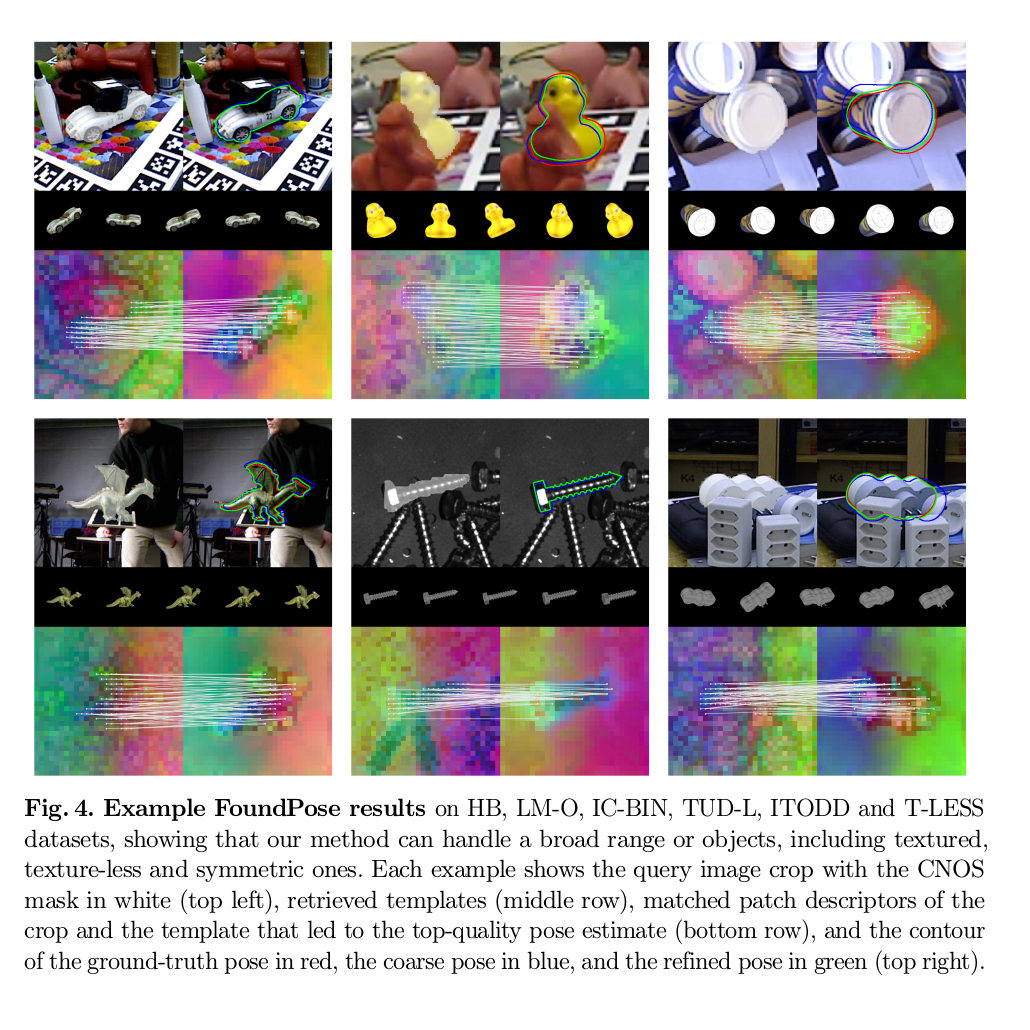
Original Figure 4: each example shows the query + CNOS mask, retrieved templates, patch correspondences, and GT / coarse / refined contours. Source: official ECVA paper. Image copyright belongs to the paper's authors and Springer Nature; reproduced here for paper analysis.
The figure covers HB, LM-O, IC-BIN, TUD-L, ITODD, and T-LESS, including clutter, occlusion, textureless objects, and symmetry. It shows usable patch matches between real and rendered images, but these are author-selected examples. The qualitative figure does not systematically show failure rates; BOP AR remains necessary for assessment.
6. Main BOP Results and the Training-Free Boundary
Original Table 1. A green check means that the entire row uses no task-specific training. Rows with MegaPose refinement have no check because that refiner uses large-scale synthetic training. Source: official ECVA paper. Table copyright belongs to the paper's authors and Springer Nature; reproduced here for paper analysis.
The seven BOP datasets contain 108 objects in total. The metric is:
AR=(ARVSD+ARMSSD+ARMSPD)/3.
Configuration
Task-specific training
Hypotheses
Mean AR
s / image
FoundPose coarse
No
1
37.2
1.7
+ featuremetric
No
1
42.6
2.6
+ MegaPose refiner
Yes
1
54.7
4.4
+ featuremetric + MegaPose
Yes
1
55.0
6.4
featuremetric, 5 hypotheses
No
5
44.1
7.4
featuremetric + MegaPose, 5 hypotheses
Yes
5
59.6
20.5
Coarse FoundPose exceeds coarse GigaPose / GenFlow / MegaPose by 9.6 / 13.7 / 16.4 AR. Single-hypothesis featuremetric refinement adds 5.4, but refining 5 hypotheses alone reaches only 44.1, indicating limited marginal gains from repeated local optimization.
The strongest 59.6 AR result combines FoundPose proposals, FoundPose featuremetric refinement, and trained MegaPose render-and-compare refinement. It cannot be attributed to frozen DINOv2 alone.
Runtime includes approximately 0.3 s for CNOS; hardware also differs: GigaPose’s 0.9 s uses a V100 48 GB, whereas FoundPose uses a P100 16 GB. FoundPose coarse is more accurate but not real-time.
7. Ablations: Why Intermediate DINO Features and BoW?
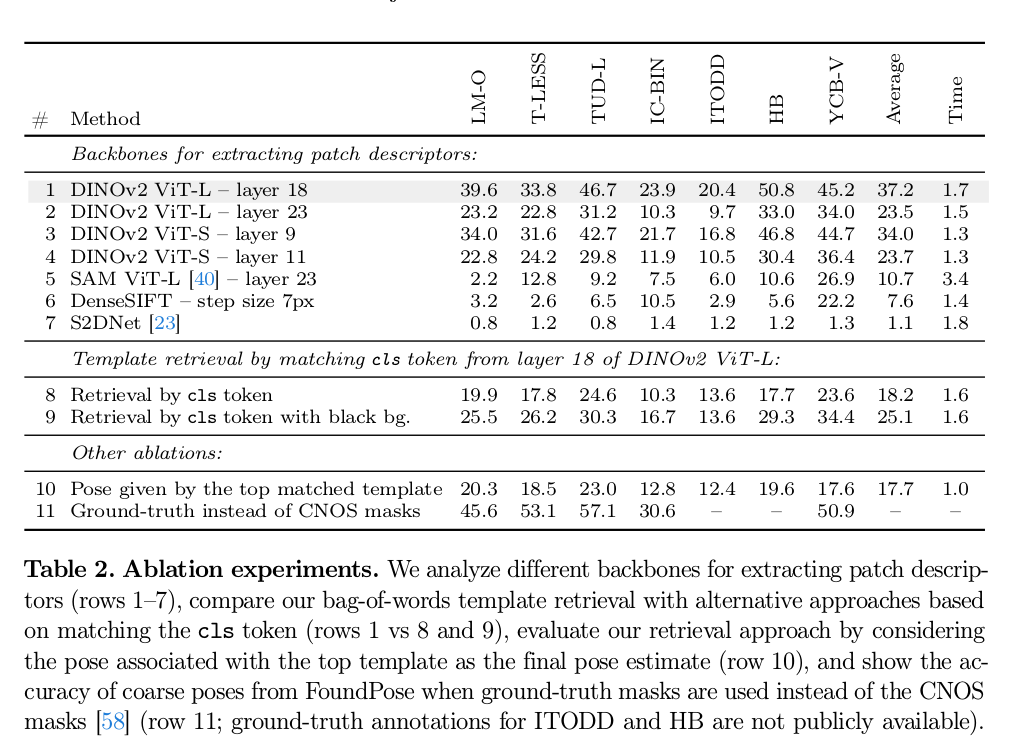
Original Table 2. The large gap between layer 18 and the final layer supports the importance of positional information; GT-mask rows quantify the segmentation upper bound. Source: official ECVA paper. Table copyright belongs to the paper's authors and Springer Nature; reproduced here for paper analysis.
DINOv2 ViT-L layer 18: 37.2 AR;
Layer 23 of the same model: 23.5, a drop of 13.7;
ViT-S intermediate layer 9: 34.0 / 1.3 s;
SAM ViT-L: 10.7;
DenseSIFT: 7.6;
S2DNet: 1.1.
BoW yields 37.2 versus 18.2 for cls-token retrieval. Blacking out the background raises the cls-token result to 25.1, still substantially lower. Directly outputting the top template’s pose gives only 17.7, showing that retrieval cannot replace PnP.
GT masks improve over CNOS by 6–19 AR on datasets where this can be verified. The default object representation requires approximately:
800×(300 patches×256×4 B+8 kB BoW)≈234 MB.
Using 400 templates, 128D PCA, and 1,024 words reduces this to 59 MB with less than 1 AR lost.
8. Limitations and Reproduction Risks
Requires a texture-mapped 3D model; incorrect CAD textures affect template features;
Depends on CNOS masks and correct object identity;
Intrinsics and the virtual-camera warp must be consistent;
At 1.7–2.6 s / image, it is unsuitable for high-frame-rate closed-loop control;
234 MB per object becomes substantial for large inventories;
The featuremetric objective has local optima;
Intermediate-layer positional encoding may depend on cropping, padding, and background conventions;
BOP evaluates localization with a supplied instance count; open-scene detector errors are not fully included;
The most accurate configuration relies on trained MegaPose, so the entire pipeline cannot be called training-free.
The official code repository currently provides the coarse-pose pipeline without the paper’s featuremetric refinement. Reproducing the 42.6 / 59.6 AR configurations therefore requires more than the repository’s default implementation.
9. Reproduction Checklist
800 views per object, approximately 25° spacing, 420×420, δ=0.6;
Report coarse, featuremetric, and MegaPose refinement separately;
Record onboarding time, per-object memory, CNOS time, and pose time.
10. Overall assessment
FoundPose’s most valuable finding is that intermediate foundation-model layers can directly support geometrically consistent real-to-rendered correspondences, beyond semantic retrieval. It makes classical BoW, nearest-neighbor matching, PnP-RANSAC, and L-M strongly competitive for unseen-object pose again, while keeping every step diagnosable.
Training-free coarse estimation at 37.2 AR and training-free refinement at 42.6 AR are the paper’s clearest contributions; 59.6 AR comes from a system combined with a trained MegaPose refiner. With these results distinguished, FoundPose remains a particularly valuable foundation-feature approach to study among 2024 RGB-only unseen-object pose methods.