FreeZe: Training-free Zero-shot 6D Pose Estimation with Geometric and Vision Foundation Models
FreeZe separately normalizes and concatenates multiscale GeDi geometry and 3D-lifted DINOv2 features from CAD and RGB-D targets. Feature nearest neighbors, RANSAC, ICP, and visual symmetry selection recover pose. With CNOS masks, coarse / refined BOP AR is 64.0 / 69.3. SAR adds only 0.5 on average over ICP, and end-to-end runtime is unreported.
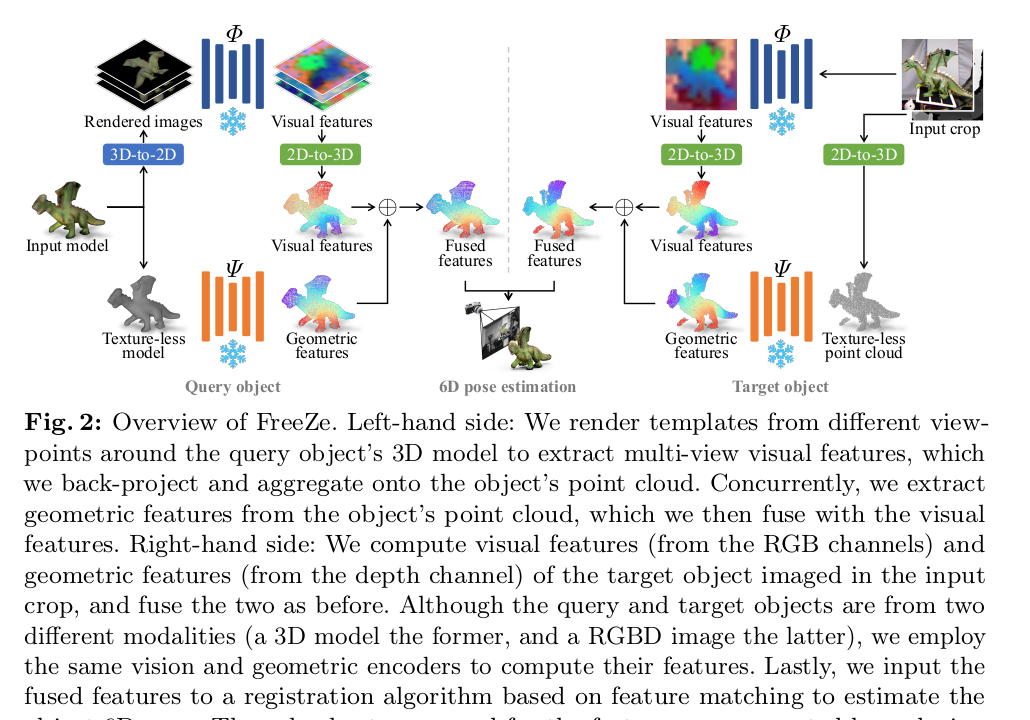
FreeZe trains no pose network. The CAD / query point cloud and RGB-D target use the same frozen GeDi and DINOv2 ViT-G; multiscale local geometry and visual features lifted to 3D are concatenated into point descriptors. Pose is then solved by 3D–3D feature matching, RANSAC, ICP, and symmetry-aware visual selection. With CNOS masks, coarse / refined BOP AR is 64.0 / 69.3.
3. Guide to figures and tables
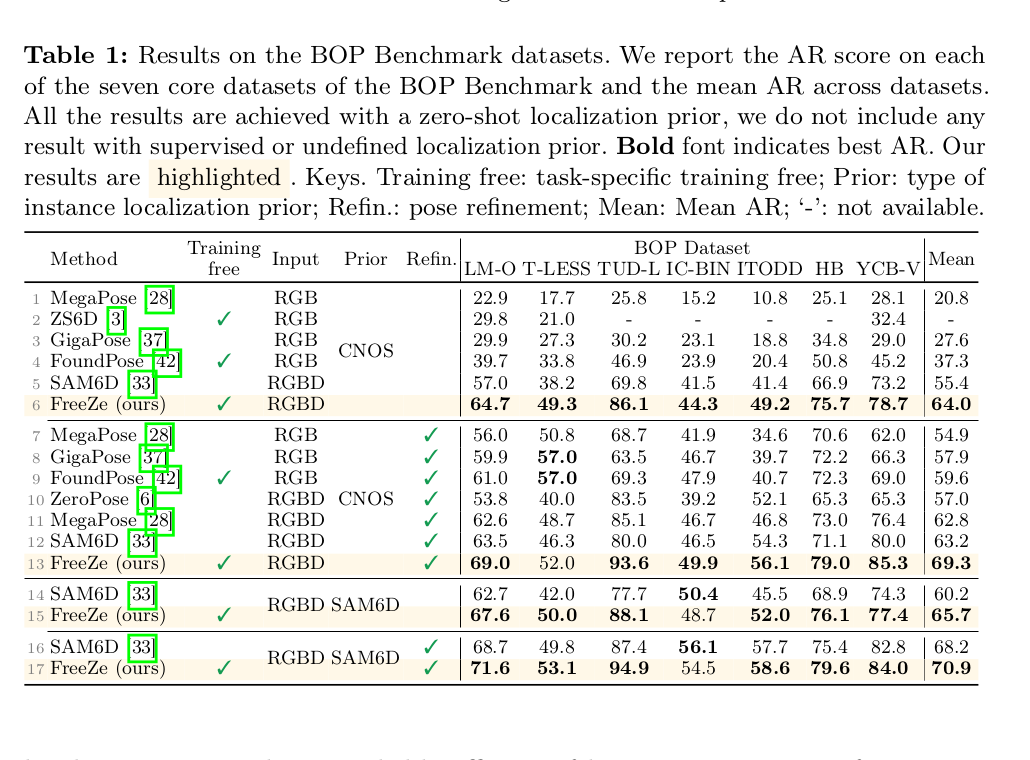
Original Figure 2: the query branch extracts GeDi from CAD points and back-projects multiview DINOv2 features onto CAD. The target branch obtains a point cloud and visual features from masked RGB-D. Geometry and vision are separately normalized and concatenated on each side, then 3D registration solves pose. Source: official ECVA paper. Image copyright belongs to the paper's authors and Springer Nature; reproduced here for paper analysis.Original Table 1: with the same CNOS localization prior, FreeZe coarse reaches 64.0 AR and ICP + SAR reaches 69.3; with SAM6D masks, the values are 65.7 / 70.9. Source: official ECVA paper. Table copyright belongs to the paper's authors and Springer Nature; reproduced here for paper analysis.
4. Problem setting
Inputs: RGB-D, camera intrinsics, an object mask / box, and a 3D model with geometry and preferably texture.
Output: 6D pose from model to camera coordinates.
Generalization: target objects and categories are absent from pose-specific training; FreeZe itself uses no task-specific training.
The “training-free” boundary: GeDi, DINOv2, and CNOS / SAM6D are pretrained components. The claim means FreeZe is not additionally trained on synthetic 6D pose data, rather than a system initialized randomly or built without external models.
Online inference requires depth. RGB-only methods such as FoundPose are supplementary comparisons and do not form a fair ranking under identical inputs.
5. Method overview
Sample 5k query points from the CAD surface and 1k target points inside the RGB-D mask.
GeDi extracts 32D features at neighborhood radii of 30% / 40% of object diameter, concatenated into 64D multiscale geometry.
DINOv2 ViT-G extracts 1,536D patch features, reduced to 64D with PCA.
On the query side, render multiview RGB-D, back-project visual features, and average them onto CAD points. On the target side, RGB–depth pixel correspondences directly associate them with 3D points.
L2-normalize geometry / vision separately, then concatenate them into a 128D fused descriptor.
Feature nearest neighbors + RANSAC triplets estimate coarse SE(3); among multiple mask candidates, retain the one with the most inliers.
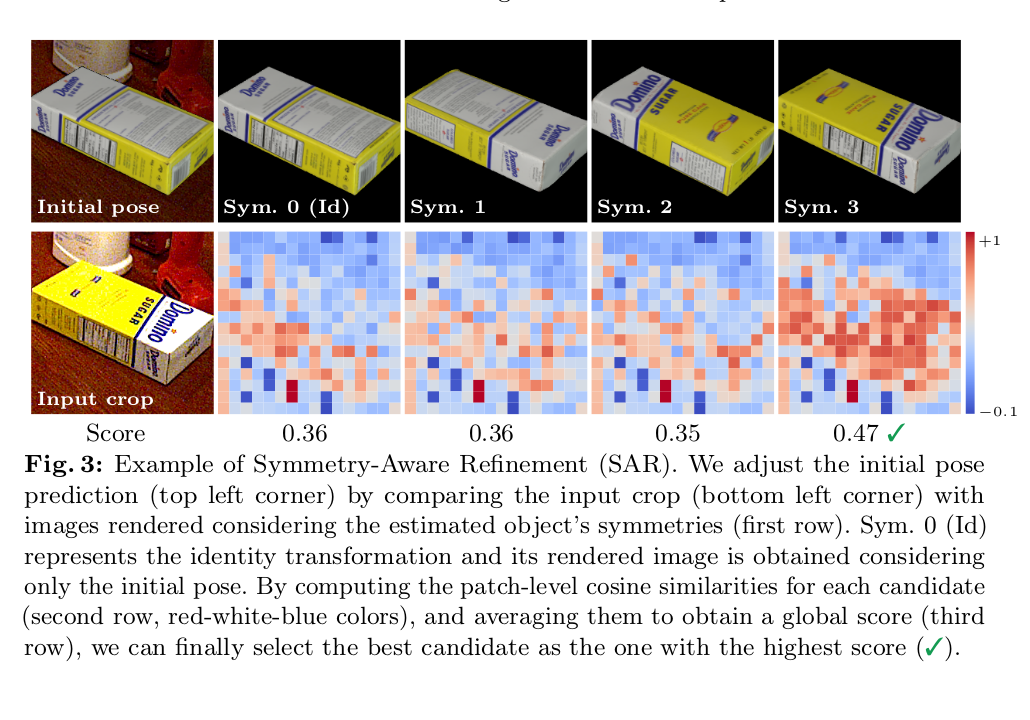
ICP refines geometry. SAR enumerates CAD geometric-symmetry rotations, renders candidates, and uses DINOv2 patch cosine similarity to select the texture-consistent pose.
Same CNOS, no refinement: SAM6D 55.4, FreeZe 64.0, a gain of +8.6.
Same CNOS, with refinement: SAM6D 63.2, FreeZe 69.3, a gain of +6.1.
SAR adds only +0.5 AR on average beyond ICP, with the largest gain of +2.6 on IC-BIN. It targets geometrically symmetric but texturally distinguishable objects rather than providing a large general refinement gain.
The paper reports no end-to-end runtime on standardized hardware, parameter count, or peak GPU memory.
7. Quick assessment
Strengths: complementary geometric and visual evidence; explicit 3D correspondences and registration throughout; seven datasets, two mask priors, and substantial ablations.
Limitations: requires RGB-D, CAD, and a localization prior; ViT-G and pointwise GeDi are heavy; RANSAC / ICP engineering runtime is unquantified; matching the main body may still dominate small occluded structures.
Relevant readers: zero-shot 6D pose, RGB-D, 3D local descriptors, foundation-feature lifting, RANSAC / ICP, and symmetry handling.
Available src/paper-notes/freeze-eccv2024/deep.md
In-depth paper notes
Support reproduction, comparison, related-work writing, and identifying opportunities for further research.
Paper Reading Notes (Deep): FreeZe
1. Key assessment
FreeZe’s central idea is a 3D point descriptor that jointly encodes geometry and appearance, beyond simply using DINOv2 for pose:
GeDi handles textureless surfaces, occlusion, and local shape;
DINOv2 distinguishes geometrically similar surfaces with different textures;
Both are lifted to / defined on 3D points, and the final solution still uses 3D–3D correspondences and rigid registration.
This is more interpretable than directly regressing SE(3) from foundation features and requires no pose-specific training. Ablations show 56.5 AR for geometry alone and at best 39.6 for vision alone, compared with 64.7 after fusion. Vision thus supplies discriminative evidence on top of the geometric backbone rather than replacing it.
“Training-free” also needs precision: FreeZe is not trained on BOP / MegaPose synthetic data, but GeDi and DINOv2 are frozen pretrained models, and front-end CNOS / SAM6D have their own training and object onboarding. It is free of task-specific pose training, rather than free of learned components.
2. Inputs and System Boundaries
Input:
RGB-D image I and intrinsics;
A query object 3D model Q;
Instance-mask candidates from CNOS or SAM6D.
The output is model-to-camera T=(R,t). Sample N=5K points from the query surface and M=1K points from the target masked cloud.
GeDi can still operate when CAD provides only geometry, while the visual query branch needs renderable texture. Ordinary BOP objects are mostly textured meshes reconstructed from RGB-D; industrial CAD in T-LESS / ITODD relies mainly on geometry.
3. Symmetric Query / Target Feature Construction
Original Figure 2. Although the two sides originate from a 3D model and an RGB-D observation, both use the same GeDi and DINOv2, ultimately producing fused descriptors on 3D points. Source: official ECVA paper. Image copyright belongs to the paper's authors and Springer Nature; reproduced here for paper analysis.
3.1 Query object
Sample PQ from the CAD surface;
Frozen GeDi extracts 32D local descriptors at radii 0.3 / 0.4 of object diameter, concatenated into 64D;
Render RGB-D from multiple views;
DINOv2 ViT-G outputs patch features from RGB crops, converted to pixel features by bilinear interpolation;
Rendered depth back-projects pixel features to 3D;
Average features from multiple views for the same query point.
3.2 Target observation
Mask + depth + intrinsics directly back-project into PT. GeDi processes the point cloud; DINOv2 processes the RGB crop. One-to-one RGB and depth pixel correspondences directly bind foreground pixel features to target points.
3.3 Fusion
L2-normalize geometry and vision separately, then concatenate:
f=[∥g∥2g∥v∥2v].
Each feature is 64D, yielding a 128D fused descriptor. Independent normalization prevents the raw scale of 1,536D DINOv2 features, or one modality’s norm, from dominating. PCA reduces vision to 64D and balances its dimensionality with geometry.
4. 3D Correspondences, RANSAC, and Refinement
RANSAC samples query-point triplets, finds target nearest neighbors in fused feature space, rejects inconsistent matches, and estimates PQR+t≈PT. Estimate separately for multiple mask candidates and select the registration with the most inliers.
ICP then refines point-level geometry. Every stage allows inspection of correspondences / inliers / residuals, but speed and robustness depend on RANSAC iterations, overlap, mask outliers, and the ICP convergence basin.
The conclusion also identifies simple RANSAC as a direction for improvement. However, runtime, RANSAC iterations, and standardized hardware profiling are absent, leaving the engineering cost unclear.
5. Symmetry-Aware Refinement
Original Figure 3: the initial geometric pose is compatible with multiple symmetry rotations. SAR renders candidates and compares them with the input crop using DINOv2 patch-level cosine similarity, selecting the texture-consistent candidate scored at 0.47. Source: official ECVA paper. Image copyright belongs to the paper's authors and Springer Nature; reproduced here for paper analysis.
SAR has two steps:
Uniformly sample rotations in SO(3), identifying geometry-only symmetries through transforms with small CD(RsPQ,PQ);
Compose each Rs with the ICP pose and render it. Extract DINOv2 patch features, average cosine similarity against the input crop’s patch features, and select the highest-scoring candidate.
This specifically addresses objects whose geometry is equivalent under a transform but whose texture is not. If both physical shape and texture are symmetric, candidates remain indistinguishable. If the coarse-pose error is unrelated to symmetry, SAR also cannot replace general refinement.
6. Main BOP Results
Original Table 1. The upper half consistently uses a CNOS prior, and the lower half uses a SAM6D prior. RGB-only rows have different inputs from RGB-D FreeZe and serve only as background references. Source: official ECVA paper. Table copyright belongs to the paper's authors and Springer Nature; reproduced here for paper analysis.
The metric is BOP AR=(ARVSD+ARMSSD+ARMSPD)/3.
Prior
Method
Refinement
Mean AR
CNOS
FoundPose RGB
None
37.3
CNOS
SAM6D RGB-D
None
55.4
CNOS
FreeZe RGB-D
None
64.0
CNOS
SAM6D RGB-D
Yes
63.2
CNOS
FreeZe RGB-D
ICP + SAR
69.3
SAM6D
SAM6D RGB-D
None
60.2
SAM6D
FreeZe RGB-D
None
65.7
SAM6D
SAM6D RGB-D
Yes
68.2
SAM6D
FreeZe RGB-D
Yes
70.9
FreeZe coarse at 64.0 already exceeds CNOS + refined SAM6D at 63.2, although their pipelines are not identical. TUD-L is especially strong: CNOS + FreeZe coarse reaches 86.1 and refined reaches 93.6. The authors attribute this to strong geometric features under difficult lighting.
The mask prior itself has a clear effect: FreeZe coarse changes from 64.0→65.7 and refined from 69.3→70.9. Comparing only pose backends while ignoring localization quality is insufficient.
7. Ablations: Geometry as the Backbone, Vision as Added Evidence
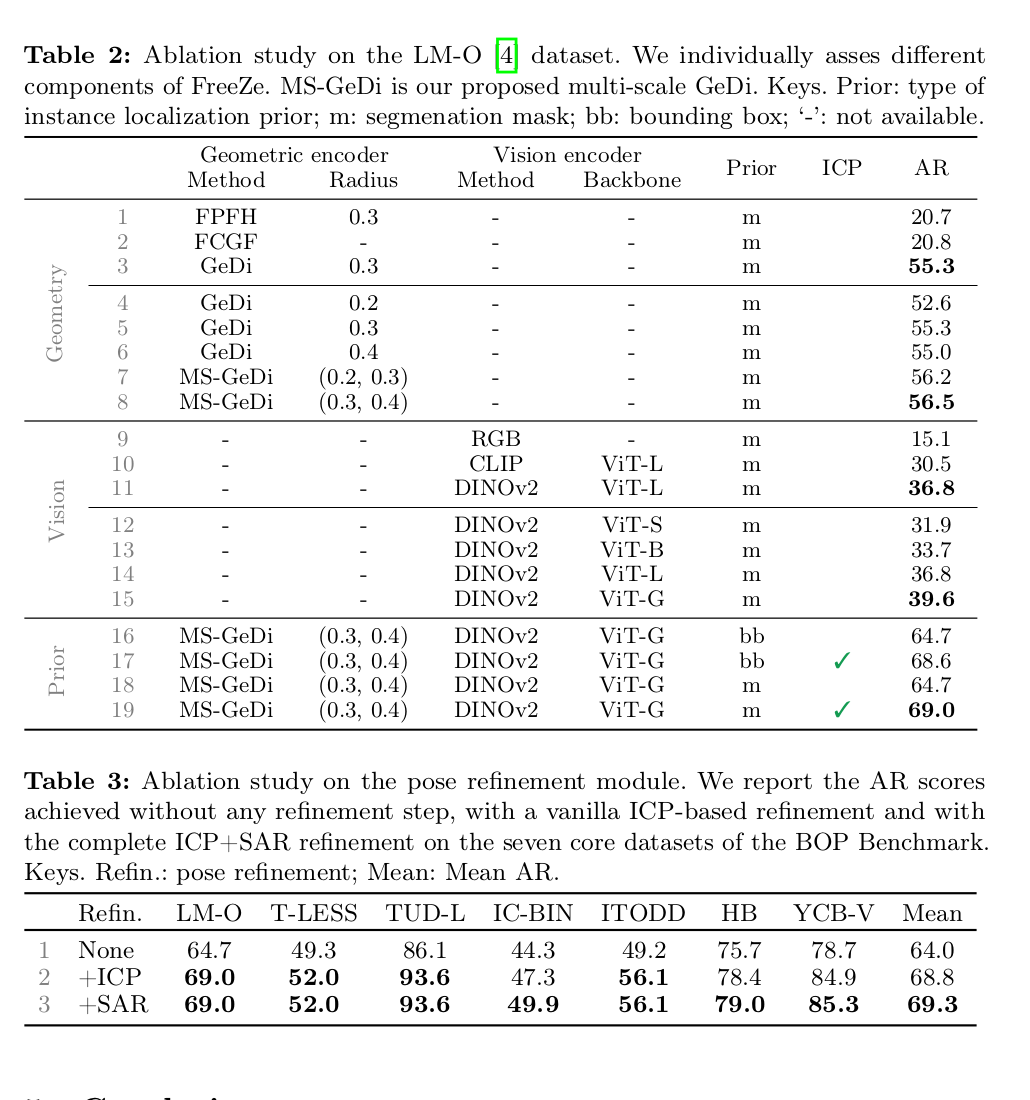
Original Tables 2–3. On LM-O, multiscale GeDi + DINOv2 ViT-G gives 64.7 AR. Across seven datasets, ICP raises 64.0 to 68.8 and SAR then reaches 69.3. Source: official ECVA paper. Table copyright belongs to the paper's authors and Springer Nature; reproduced here for paper analysis.
LM-O geometry-only:
FPFH 20.7;
FCGF 20.8;
GeDi radius 0.3: 55.3;
MS-GeDi (0.3, 0.4): 56.5.
vision-only:
raw RGB 15.1;
CLIP ViT-L 30.5;
DINOv2 ViT-L 36.8;
DINOv2 ViT-G 39.6.
Fused MS-GeDi + ViT-G reaches 64.7. Geometry exceeds vision alone by 16.9 points, and fusion adds 8.2 beyond geometry, supporting the interpretation of a geometric backbone with visual disambiguation.
Box / mask priors both yield 64.7 at the coarse stage; after ICP, box reaches 68.6 and mask 69.0. Masks are cleaner, but missing object parts can also harm correspondences; ICP is more sensitive to background outliers in boxes.
refinement:
none: 64.0;
+ICP: 68.8;
+SAR: 69.3.
SAR adds only 0.5 on average, with gains of +2.6 on IC-BIN, +0.6 on HB, and +0.4 on YCB-V, concentrated in data with geometric symmetry and discriminative textures.
8. Failure Modes and Limitations
Figure 5 shows four types of failure:
Under occlusion, only the nearest corner aligns, leaving the overall rotation roughly perpendicular to the correct orientation;
Simple box geometry and weak texture cause confusion between lying on the side and standing upright;
The mug body aligns but the small handle does not;
The drill handle is completely occluded, leaving only the visible body to align.
System limitations:
Depth is required; sensor noise / transparent or reflective objects directly contaminate 3D;
GeDi pointwise local features and ViT-G are heavy; the authors also identify difficulties with edge deployment;
Runtime, GPU memory, and parameter count are not reported;
RANSAC / ICP remain bottlenecks and depend on overlap;
RGB-only operation is unavailable; predicting geometric features from RGB is proposed as future work;
Differences in query texture / rendered lighting from real images affect visual features;
CNOS / SAM6D candidate calibration is unstable, requiring multiple masks and additional computation;
SAR estimates symmetries by discrete sampling and a Chamfer threshold, without sufficient analysis of accuracy or candidate count.
9. Reproduction Checklist
query 5K points, target 1K points;
GeDi radii = 0.3d / 0.4d, each 32D;
DINOv2 ViT-G, 224×224, 1,536D→PCA 64D;
Aggregate query multiview visual features by 3D point;
L2-normalize the two modalities separately before concatenation;
Preserve both box / mask priors and multiple candidates;
Compare baselines using the same CNOS / SAM6D masks;
Add stage-wise runtime and memory for feature extraction, matching, RANSAC, ICP, and SAR;
Stratify by missing depth, visible ratio, small-part area, and symmetry type.
10. Overall assessment
FreeZe is a clearly structured RGB-D zero-shot pose method: it trains no new pose network, instead placing established pretrained geometric / visual features on 3D points and solving SE(3) through classical registration. Across seven BOP datasets, its 64.0 coarse, 69.3 CNOS-refined, and 70.9 SAM6D-refined scores show that strong features plus explicit geometry could outperform large-scale pose-specific training in 2024.
It is no lightweight universal solution: depth, CAD, masks, GeDi, ViT-G, RANSAC, and ICP are all required, with no reported runtime. With these dependencies understood, FreeZe remains a representative example of how foundation models and 3D geometry complement each other; subsequent dGeDi work specifically improves its slow geometric encoder.