GCE-Pose: Global Context Enhancement for Category-level Object Pose Estimation
GCE-Pose first reconstructs global semantic geometry from partially visible instances, then fuses reconstruction context with observed features to predict NOCS and category-level pose.
Authors / affiliations: Weihang Li et al.; TUM, MCML, XYZ Robotics.
Task: estimate the pose of unseen instances within known categories from partial RGB-D observations, completing global semantic geometry before predicting NOCS.
Reading mode: Overview.
2. Positioning in one sentence
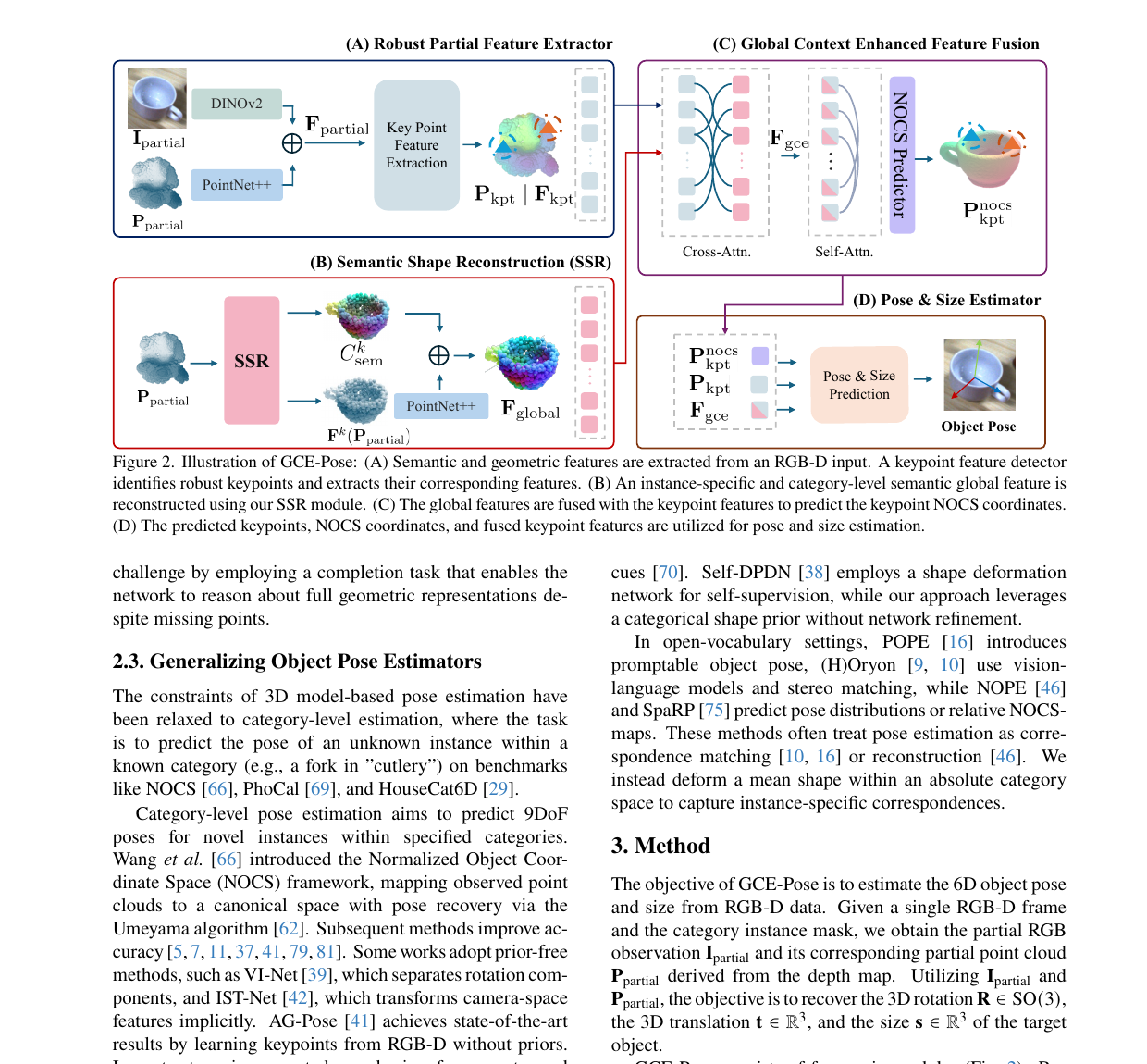
GCE-Pose follows a first-complete-then-aggregate strategy: SSR completes the object using a category semantic prototype and a deep linear shape model; GCE fusion then incorporates global context into local pose features.
3. Problem and motivation
Local features of partially visible objects are incomplete, making direct NOCS regression vulnerable to occlusion and instance variation.
Category shape priors alone can over-average shape, so instance-specific observations must also be retained.
4. Method overview
Extract semantic / geometric features from RGB-D.
SSR deforms a category-specific semantic prototype to reconstruct global instance geometry / semantic context.
GCE fusion combines partial and global features, predicting NOCS before pose fitting.
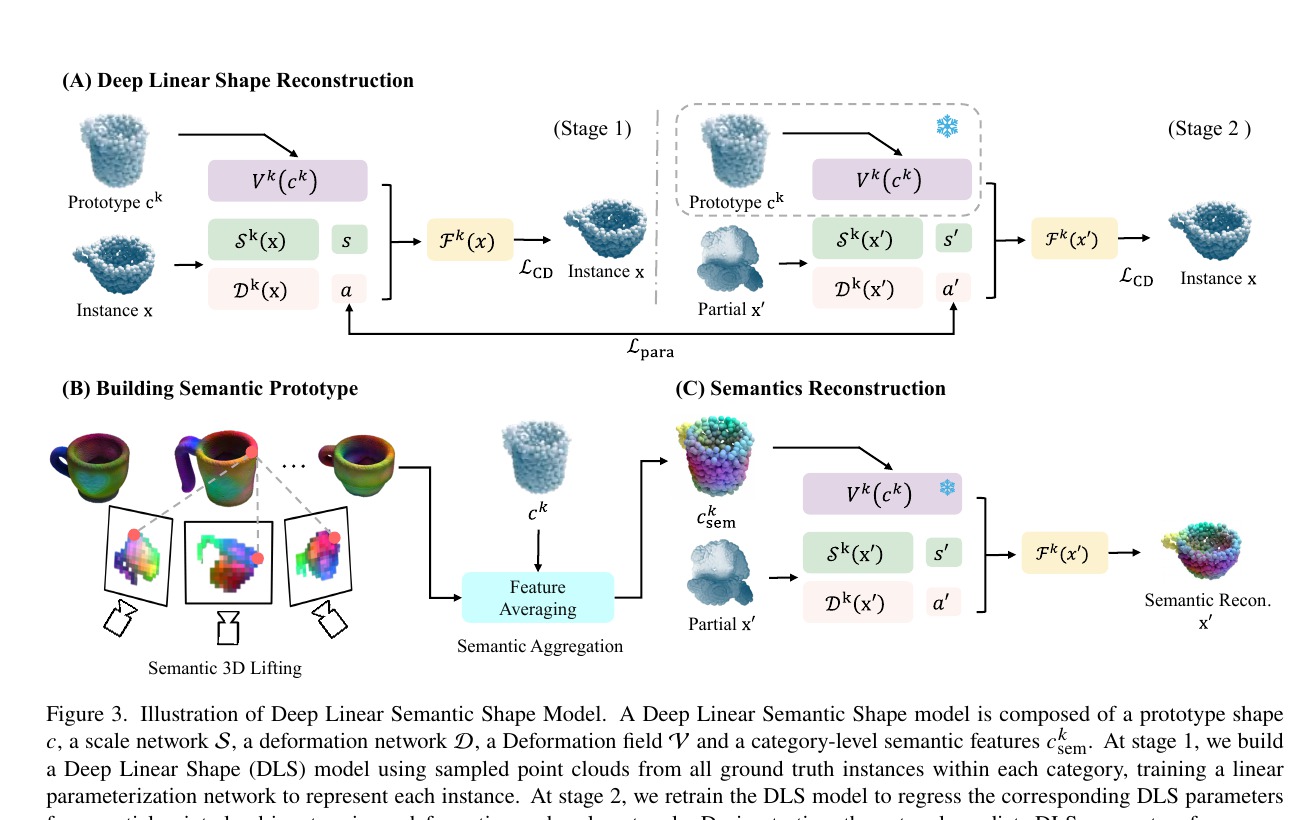
Original Figure 3: the first stage learns a category prototype, scale, and deformation field; the second regresses instance parameters from partial observations. Multiview DINOv2 features are lifted to 3D and aggregated into a semantic prototype. Source: CVPR 2025 paper PDF. Image copyright belongs to the paper's authors and publisher; reproduced here for paper analysis.
5. Experiments at a glance
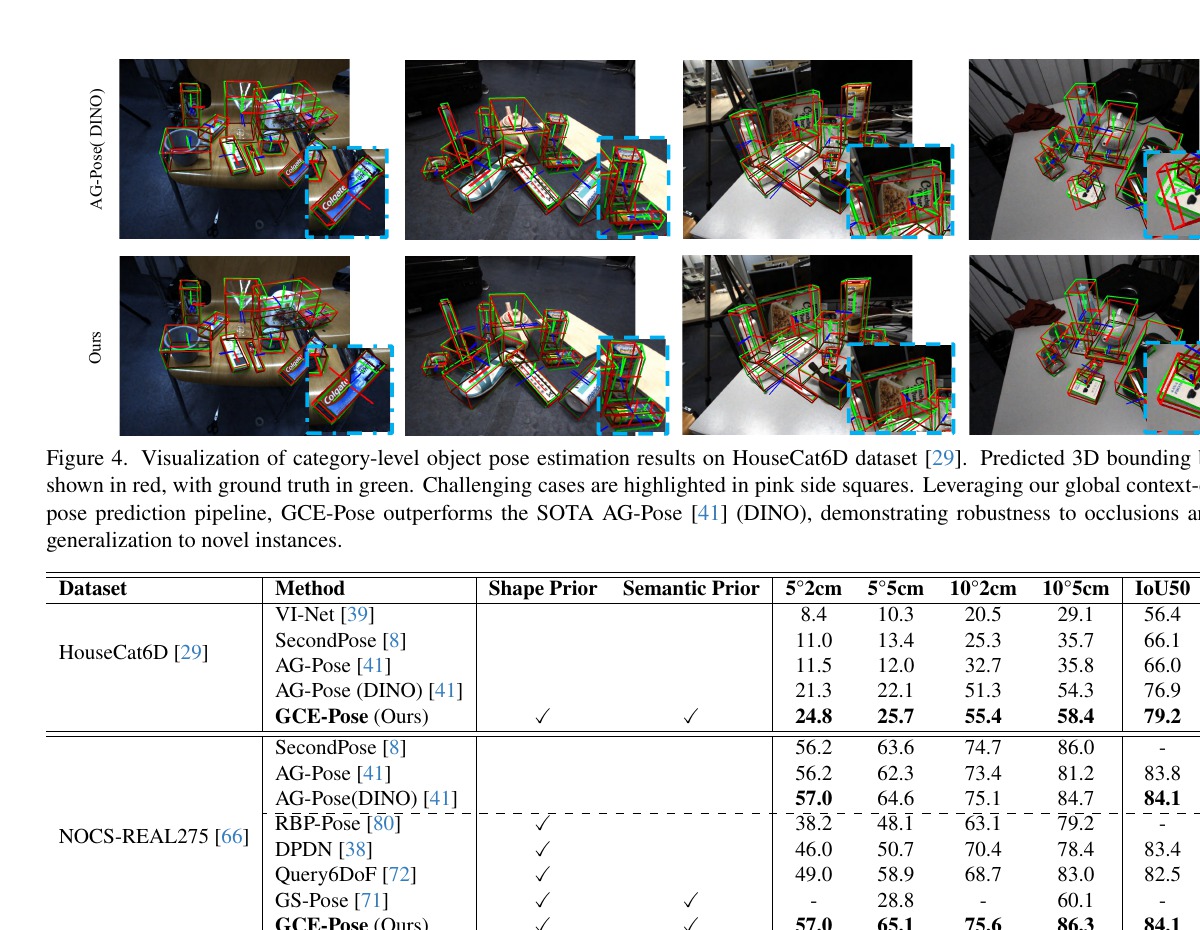
On HouseCat6D, GCE-Pose achieves 24.8 / 25.7 / 58.4 / 60.6 for 5°2cm / 5°5cm / 10°5cm / IoU75, compared with AG-Pose (DINO) at 21.3 / 22.1 / 54.3 / 53.0, a gain of 7.6 on strict IoU75.
On NOCS-REAL275, it reaches 57.0 / 65.1 / 75.6 / 86.3 at four rotation–translation thresholds, with IoU50 84.1 and IoU75 79.8. Comparisons against methods using shape / semantic priors must identify its category-level prototype dependency; scores alone do not fairly rank it against prior-free methods.
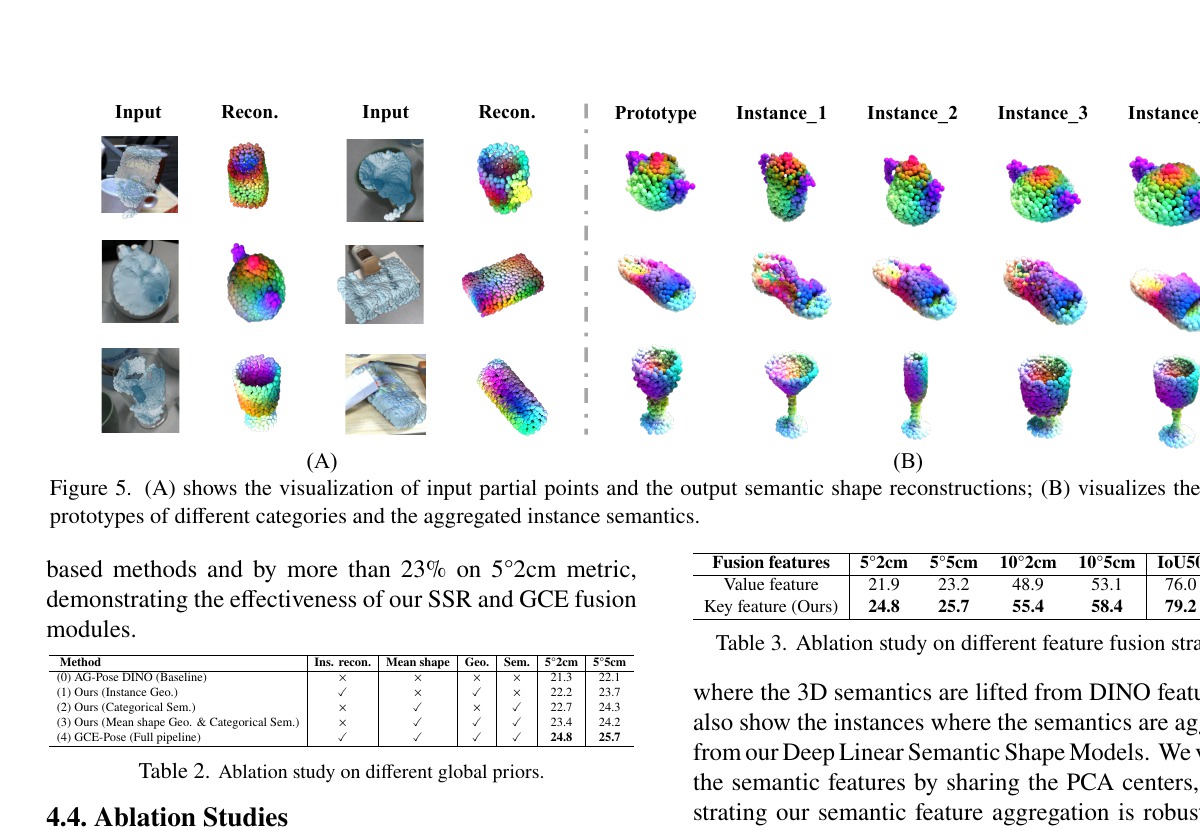
In ablations, baseline AG-Pose DINO has 5°2cm of 21.3 and the full model 24.8. Key-token fusion at 24.8 exceeds value-token fusion at 21.9, showing that both the reconstructed prior’s content and how it is injected matter.
6. Quick assessment
Value: explicitly separates completing global semantics from incorporating them into local pose features.
Boundary: shape reconstruction depends on coverage by category prototypes; it does not handle entirely unknown new categories.
Available src/paper-notes/gce-pose/deep.md
In-depth paper notes
Support reproduction, comparison, related-work writing, and identifying opportunities for further research.
Paper Reading Notes (Deep): GCE-Pose: Global Context Enhancement for Category-level Object Pose Estimation
Key problem: partially visible RGB-D provides only local features, while category-level pose requires the overall semantic shape, including occluded regions. Predicting NOCS directly from partial observations lacks global context.
Core answer: Semantic Shape Reconstruction (SSR) first completes global semantic geometry, then GCE fusion aggregates global and local features.
2. Positioning in one sentence
GCE-Pose’s first-complete-then-aggregate strategy separates category-prior completion from instance-observation pose estimation, giving global context a role beyond an extra feature.
2.1 Guide to the paper’s figures and tables
Figure / table
What to look for
Figures 1–2
Differences between conventional partial-feature pipelines and SSR + GCE fusion, especially where reconstructed global features enter.
Figure 3
How the deep linear semantic shape model combines a prototype with instance deformation.
Table 1
Pose / 3D IoU metrics and prior conditions on HouseCat6D and NOCS-REAL275.
Tables 2–3 / Figure 5
Contributions of the global prior and key/value fusion, and whether the completed shapes are plausible.
Original method diagram: GCE-Pose reconstructs category semantic shape from partial RGB-D and fuses global context with local observation features before predicting pose. Source: CVF Open Access. Image copyright belongs to the paper's authors and publisher; reproduced here for paper analysis.
3. Problem setting and boundaries
Input: a partially visible RGB-D object instance. Output: NOCS / pose for unseen instances within a known category.
CAD for each test instance is unnecessary, but the pretrained category semantic prototype and deformation prior are strong priors.
“Global” means object-level whole-shape context, rather than scene-level multi-object context.
4. Method details
SSR: extract semantic / geometric features from the partial observation and use a Deep Linear Semantic Shape Model to deform a category-specific prototype, reconstructing global instance shape.
GCE fusion: combine reconstructed global semantic context with partial local features; the paper compares key and value tokens as fusion carriers.
Pose: enhanced features predict NOCS, after which a pose solver recovers category-level pose.
5. Experimental analysis
HouseCat6D
5°2cm
5°5cm
10°5cm
IoU75
AG-Pose
11.5
12.0
35.8
45.0
AG-Pose (DINO)
21.3
22.1
54.3
53.0
GCE-Pose
24.8
25.7
58.4
60.6
Changing to a DINOv2 backbone already produces large gains, so the careful comparison uses AG-Pose (DINO) with the same backbone: GCE-Pose adds 3.5 on 5°2cm and 7.6 on IoU75. The larger latter gain suggests that complete-shape priors improve instance scale and 3D box alignment alongside rotation–translation accuracy.
Original Figure 4 and Table 1: red boxes are predictions, green boxes ground truth, and pink details highlight challenging occlusion and deformation examples. The table lists prior conditions and multiple metrics separately for HouseCat6D and NOCS-REAL275. Source: CVPR 2025 paper PDF. Image copyright belongs to the paper's authors and publisher; reproduced here for paper analysis.
On NOCS-REAL275, GCE-Pose achieves 57.0 / 65.1 / 75.6 / 86.3 for 5°2cm / 5°5cm / 10°2cm / 10°5cm. Against prior-free AG-Pose (DINO), strict 5°2cm is unchanged, while 5°5cm rises from 64.6 to 65.1. Gains are clearer against other shape-prior methods, DPDN (46.0 / 50.7) and Query6DoF (49.0 / 58.9). This does not establish that category priors are necessary on every dataset, since backbones and training setups remain confounders.
Table 2 decomposes the global prior starting from the same-backbone baseline: instance geometry gives 22.2, categorical semantics 22.7, mean-shape geometry + semantics 23.4, and full instance-specific geometry + semantics 24.8. Geometry and semantic priors complement each other, and instance-level reconstruction outperforms a simple mean shape.
Original Figure 5 and Tables 2–3: semantic reconstruction of partial point clouds and category prototypes, with comparisons of global priors and key / value feature-fusion strategies. Source: CVPR 2025 paper PDF. Image copyright belongs to the paper's authors and publisher; reproduced here for paper analysis.
Value-feature fusion yields 21.9 / 23.2 / 48.9 / 53.1, versus 24.8 / 25.7 / 55.4 / 58.4 for the authors’ key-feature fusion. The difference goes beyond parameter count and concerns the cross-attention matching relationship: partial local features act as queries and the global semantic prior as keys. This direct comparison supports the GCE fusion design, beyond SSR simply supplying extra features.
6. Authors’ claims and my assessment
Authors’ claims
My assessment
Global context improves pose under partial visibility
The same-backbone baseline rises from 21.3 to 24.8 for the full model, with instance geometry / semantics at 22.2 / 22.7; progressive ablations support this, though grouping by visibility ratio is also needed.
Key tokens better fuse semantic priors
Key versus value gives 24.8 versus 21.9 on 5°2cm and 55.4 versus 48.9 on 10°2cm, a substantial gap; identical training budgets still need confirmation.
7. Reproduction considerations and limitations
Specify each category prototype’s coordinates and scale, SSR latent dimensionality, partial-point sampling, and the NOCS solver.
When prototypes fail to cover long-tail shapes, completion can introduce more bias than using partial observations alone.
Analyze the correlation between invisible-surface reconstruction error and final pose error to verify that better completion actually improves pose.