Reading Notes
Overview / Deep Dive
Available src/paper-notes/gen6d/coarse.md
Paper overview notes
Quickly assess the paper's scope, problem setting, core method, experimental findings, and whether to read it in depth.
Paper Reading Notes (Coarse): Gen6D: Generalizable Model-Free 6-DoF Object Pose Estimation from RGB Images
1. Basic information
- Title: Gen6D: Generalizable Model-Free 6-DoF Object Pose Estimation from RGB Images
- Authors / affiliations: Yuan Liu, Yilin Wen, Sida Peng, Cheng Lin, Xiaoxiao Long, Taku Komura, Wenping Wang; The University of Hong Kong, Zhejiang University, Tencent, Texas A&M University
- Year / venue or journal: 2022 / ECCV
- Paper: arXiv:2204.10776
- Code / project: Project / Code
- Reading mode: Overview
2. Positioning in one sentence
Gen6D is an early representative of generalizable, CAD-free, RGB-only 6D pose estimation. Given reference images of an unseen object with known camera poses, its detector, viewpoint selector, and feature-volume refiner estimate query pose without CAD, depth, or test-time masks.
Method inputs and outputs
| Item | Content (compiled for this site) |
|---|---|
| Inference inputs | One query RGB image; multiview reference RGB images of the same target with known poses; query / reference camera intrinsics. Database construction also requires the approximate object center and normalization scale. |
| Final outputs | Object-to-camera rotation and translation in the query; detection boxes, reference-view selection, and pose residuals are internal steps. |
| Prerequisites | No target CAD, depth, or query GT mask; a posed reference database is required. Physical translation scale depends on reference-frame and normalization-scale calibration, rather than being determined automatically from one RGB image. |
2.1 Guide to the paper’s figures and tables
| Figure / table | Purpose | Overview reading tips |
|---|---|---|
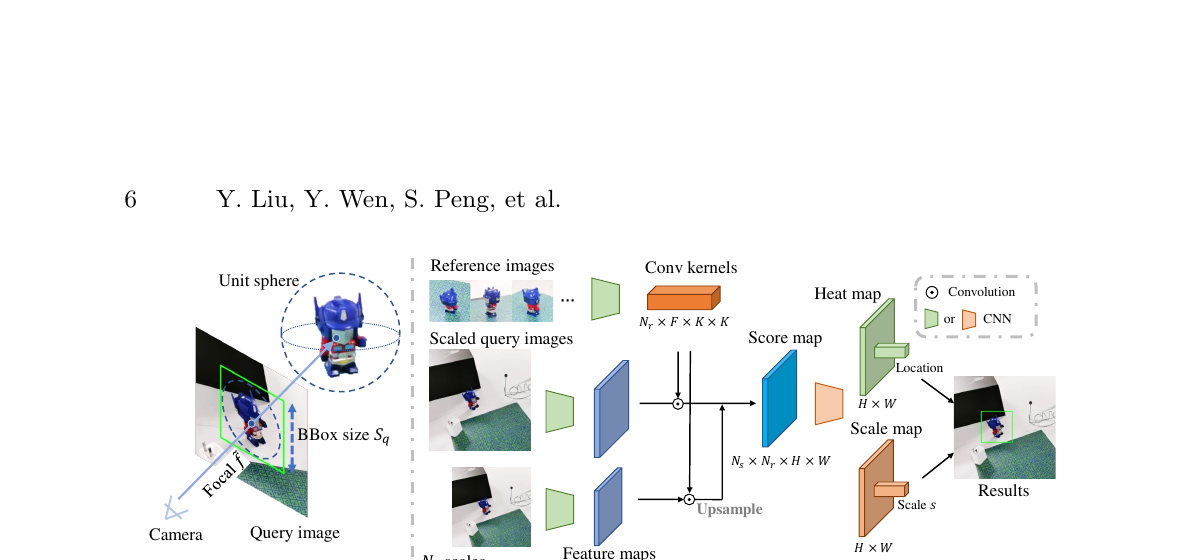
| Figure 2 | Three-stage overview: detection, view selection, refinement | Establish the full pipeline first |
| Figure 4 | How correlation detection derives depth from box scale | Understand the source and vulnerability of translation |
| Figure 6 | Constructing a 3D feature volume from multiple references for refinement | The key difference from render-and-compare |
| Table 1 | Main GenMOP results | Inspect gains on unseen objects for generalizable methods |
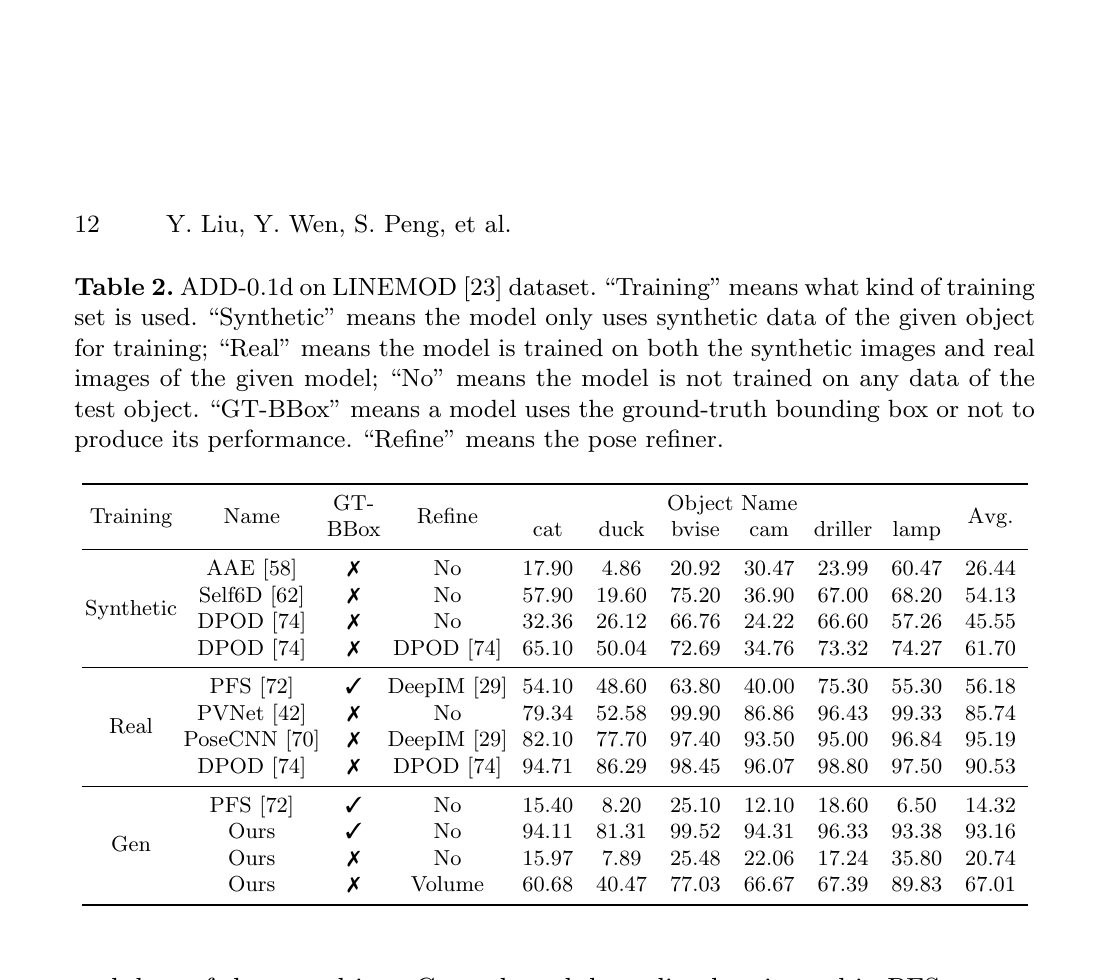
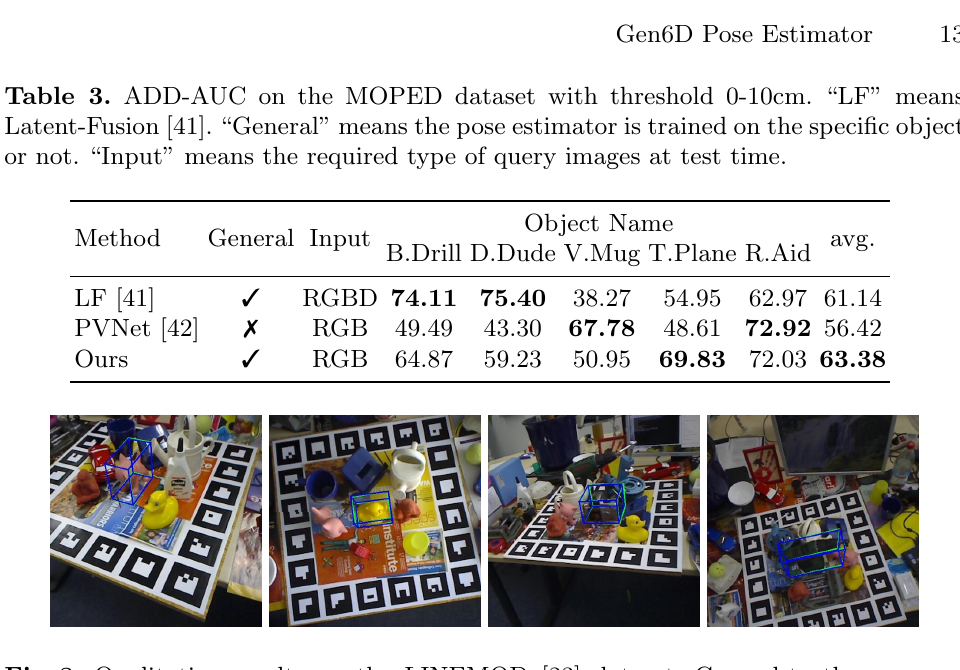
| Tables 2 / 3 | LINEMOD and MOPED | Note GT-box and RGBD-baseline setting differences |
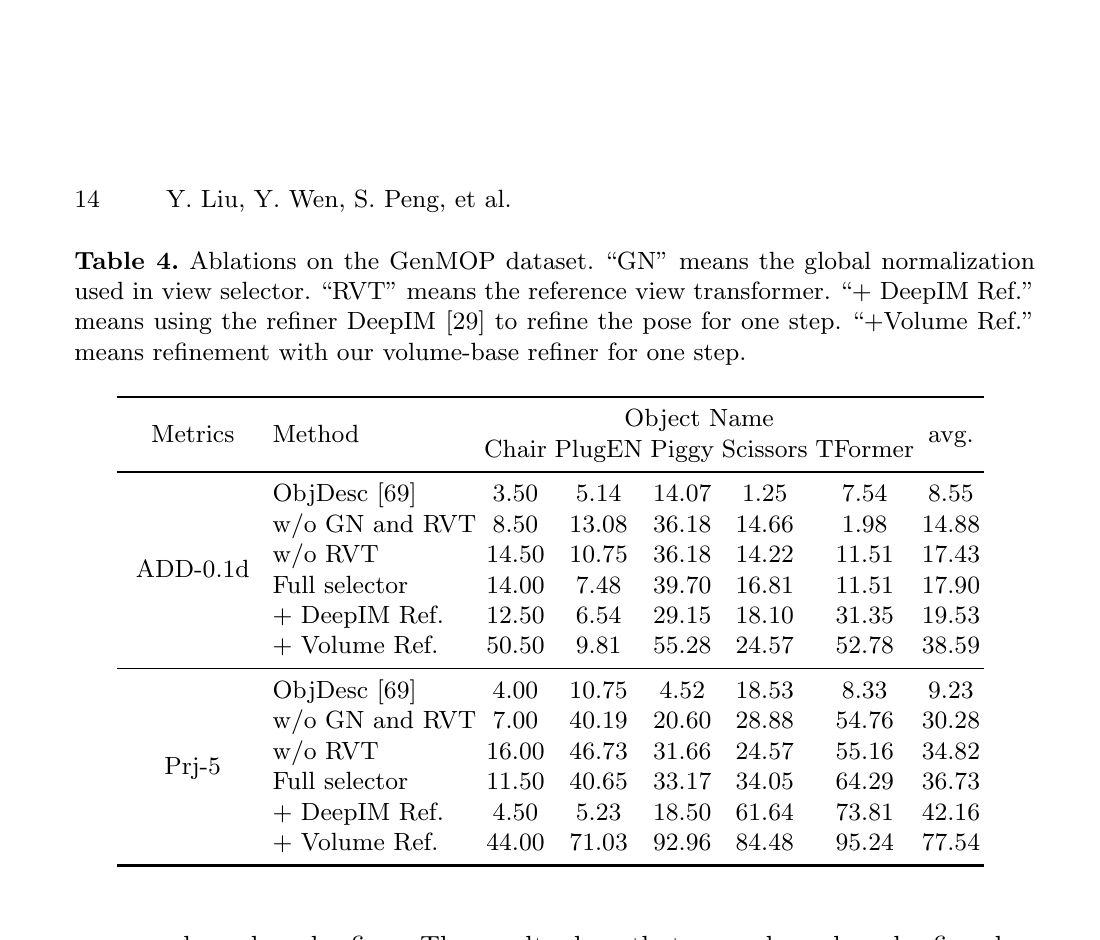
| Table 4 | Selector / refiner ablations | Verify global normalization, Transformer, and volume refinement |
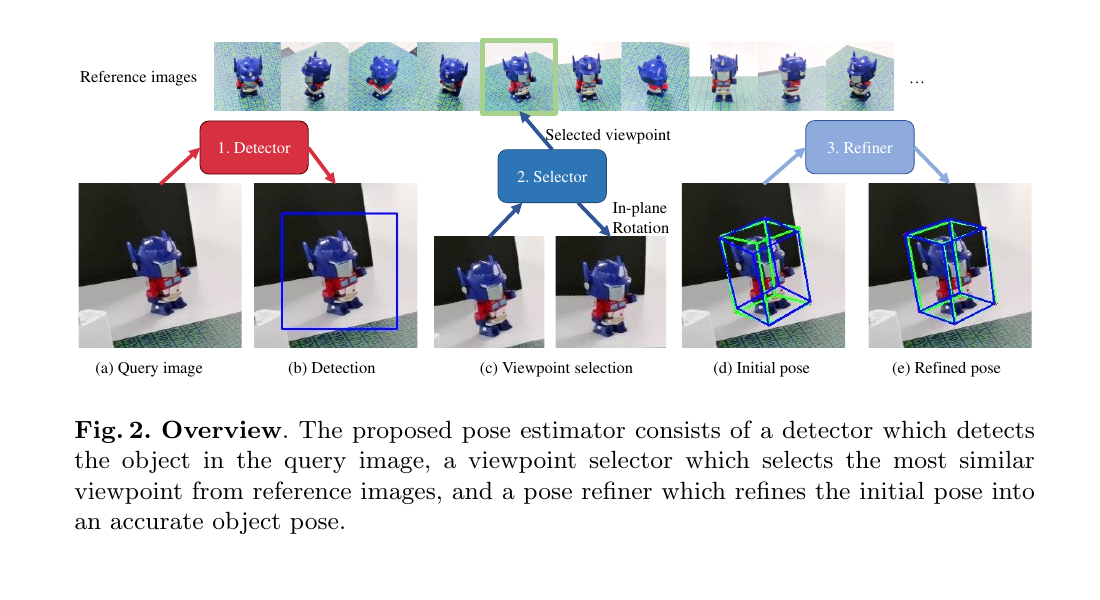
3. Problem setting
- Task: generalizable instance-level object pose estimation, recovering 6D pose for objects unseen during training without instance-specific retraining.
- Inputs:
- query RGB image;
- reference RGB images of the same object;
- Known camera / object pose and intrinsics for each reference image.
- Outputs: object-to-camera rotation and translation in the query.
- Not required: CAD models, query depth, or query object masks.
- Practical prerequisites: reference poses must be available in advance. Triangulation or unprojection roughly estimates object center and scale, and reference views must cover the object sufficiently.
- Applications: AR, robot perception, or rapid database construction where multiple calibrated reference images can be acquired for a new object.
4. Core motivation
- Conventional instance-specific 6D pose often requires per-object CAD, synthetic rendering, or dedicated training and cannot directly transfer to new objects.
- Existing model-free approaches often still require depth or object masks; Gen6D reduces inference inputs to RGB + posed references.
- With sparse references, global image embeddings suffer from background clutter and struggle to separate nearby views. Without CAD, conventional refinement also cannot render updated viewpoints.
5. Method overview
- Overall pipeline:
- Detector: treat all reference features as convolution kernels, correlate against multiscale query features, and predict projected object center and box scale to initialize translation.
- Viewpoint selector: compare query and reference crops pixelwise; global normalization and a reference-view Transformer select the nearest viewpoint and regress in-plane rotation to initialize rotation.
- Pose refiner: select nearby references around the initial pose and unproject their 2D features into a 3D volume. Project query features into the same volume, then use a 3D CNN to predict pose residuals, iterating 3 times by default.
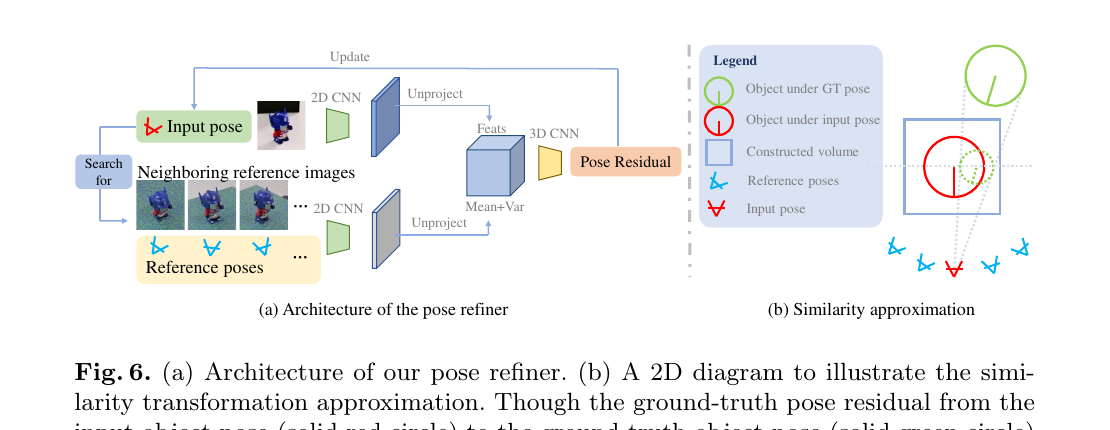
- Models / techniques: VGG-11 feature extraction, correlation matching, global normalization, Transformer self-attention, 2D/3D CNNs, and feature unprojection.
- Training-free? No. A shared detector, selector, and refiner are trained, but new test objects require no fine-tuning.
6. Experimental overview
- Datasets: newly introduced GenMOP, MOPED, and LINEMOD.
- Metrics: ADD-0.1d, ADD-AUC, and Prj-5 measure 3D point-distance threshold success, AUC over 0—10 cm, and 5-pixel projection success, respectively.
- Main baselines: ObjDesc, PVNet, RLLG, Pose-From-Shape, Latent-Fusion, and DeepIM.
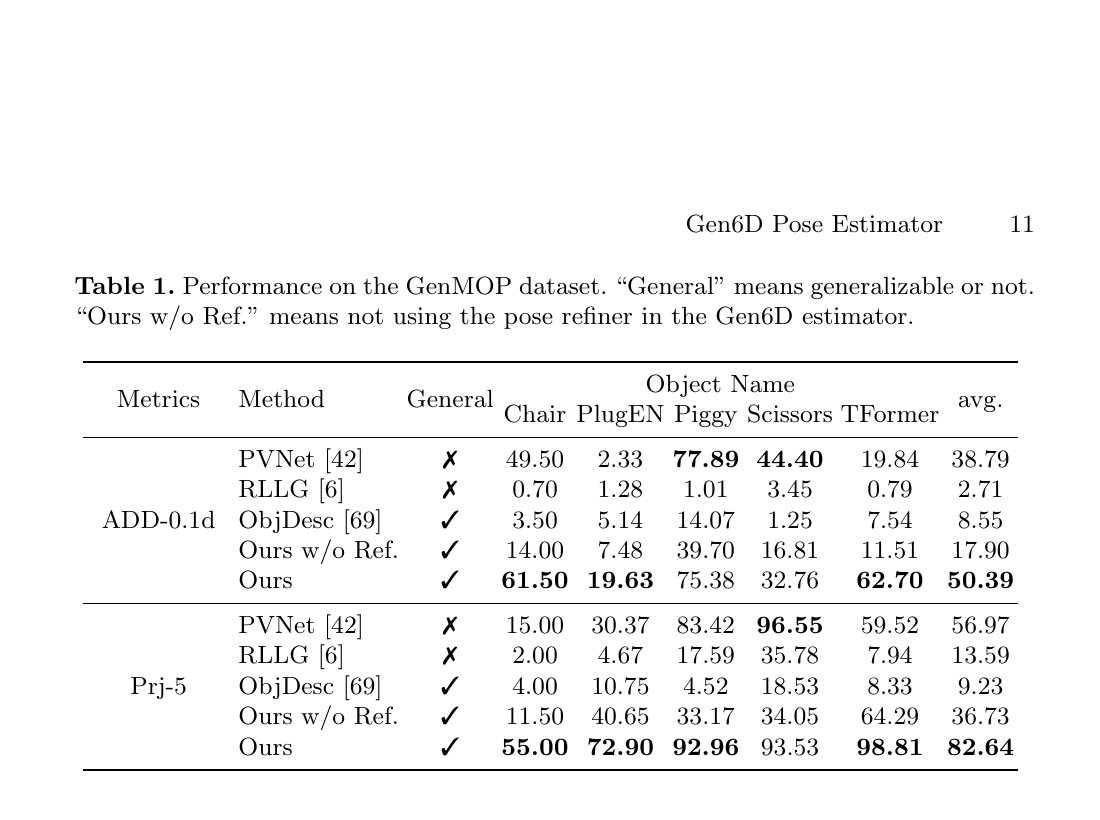
- Main results:
- GenMOP: mean ADD-0.1d / Prj-5 of 50.39 / 82.64, above ObjDesc at 8.55 / 9.23 and PVNet at 38.79 / 56.97, despite PVNet’s per-object training on approximately 200 references.
- MOPED: RGB-only Gen6D has ADD-AUC 63.38, above Latent-Fusion at 61.14 with RGBD / masks and instance-specific PVNet at 56.42.
- LINEMOD: GT boxes yield 93.16 ADD-0.1d. Its own detector without refinement gives only 20.74; volume refinement raises this to 67.01, identifying depth / detection as major system bottlenecks.
- Ablation: one volume-refinement step after the full selector raises GenMOP ADD-0.1d from 17.90 to 38.59, far more than DeepIM refinement using a selected reference in place of rendering, at 19.53.
7. Strengths and limitations
Strengths
- Clearly combines generalization, CAD-free operation, and RGB-only inputs in 2022, becoming an important baseline for reference-based unseen-object pose.
- 3D feature volumes require no CAD rendering and provide more geometric structure than refiners using only two 2D images.
- Few extra depth / mask dependencies, with no retraining for new objects.
Limitations / risks
- Model-free still entails database construction: new objects need multiple posed reference images, typically requiring COLMAP / SfM or another calibration process.
- Sparse or uneven reference coverage substantially degrades accuracy. On GenMOP, reducing 128 views to 8 lowers ADD-0.1d from 51.30 to 27.55; covering only half-space reduces 50.39 to 28.79.
- Box scale determines depth, amplifying LINEMOD detection errors into depth errors; severe occlusion is also not specifically addressed.
- The paper reports approximately 0.64 s for 540 x 960 input on RTX 2080Ti, including approximately 0.5 s for three refinement rounds, short of high-frame-rate deployment.
8. Research takeaways
- Reusable ideas: reference-conditioned feature volumes instead of CAD rendering; global normalization / view Transformers sharing similarity context across candidate references; separate translation initialization and rotation selection.
- Baseline suitability: a classic baseline for CAD-free, reference-based, unseen-instance RGB pose; BOP seen-object CAD settings are not directly equivalent.
- Worth deep reading: yes, especially detector scale-to-depth conversion, cross-reference selector context, volume unprojection, and similarity approximation.
- Further questions: replacing VGG / early Transformers with modern representations, reducing reference-pose acquisition costs, and integrating open-vocabulary detection and occlusion recovery.