Generalizable Zero-Shot Object Pose Estimation for Bin-Picking
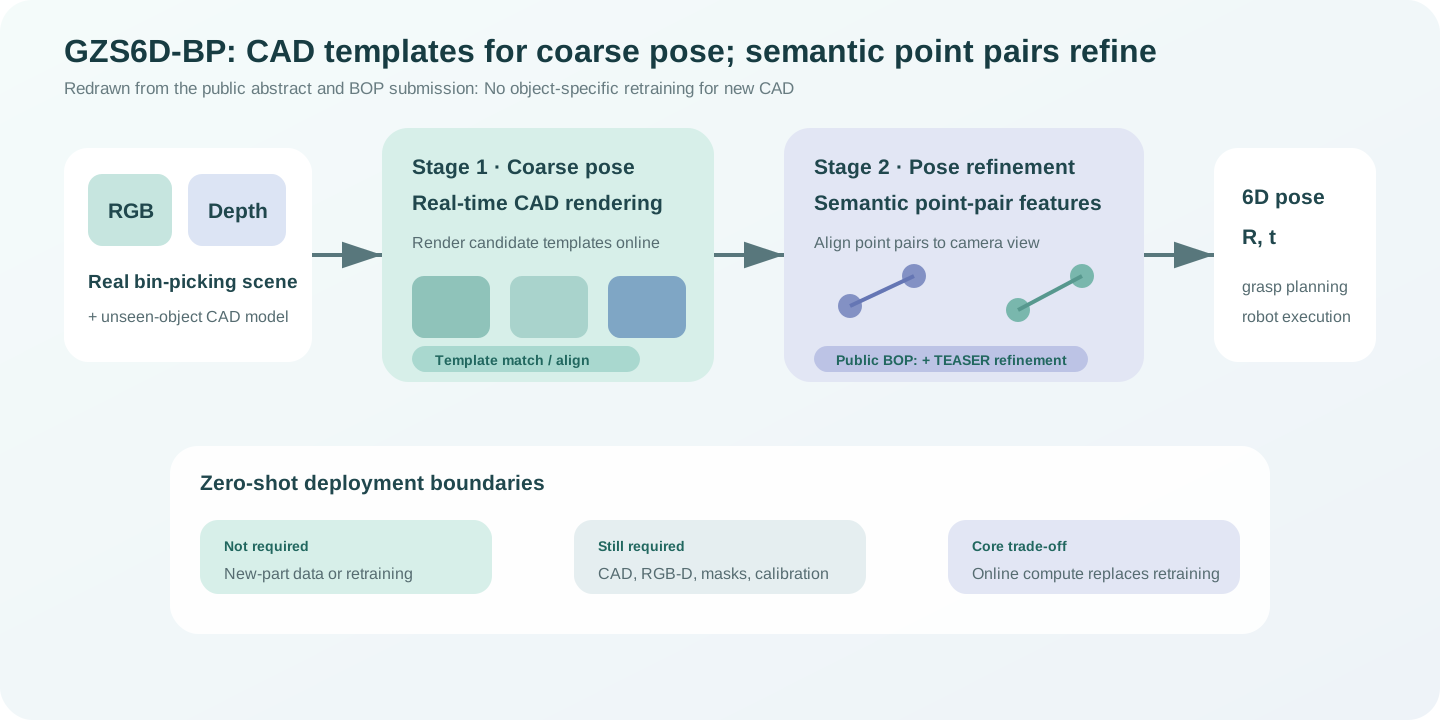
GZS6D-BP renders CAD templates in real time for coarse poses, then refines them with camera-view-aligned semantic point-pair features, without retraining for new parts. Its public BOP coarse+refine+teaser submission achieves AR 0.717 across seven Classic-Core datasets, averaging 6.516 s/image.
Task: RGB-D 6D localization for industrial bin picking, given new-part CAD without object-specific retraining
Availability: the full paper is not open access; the author abstract and seven official BOP submissions are public, with no public code
2. One-sentence summary
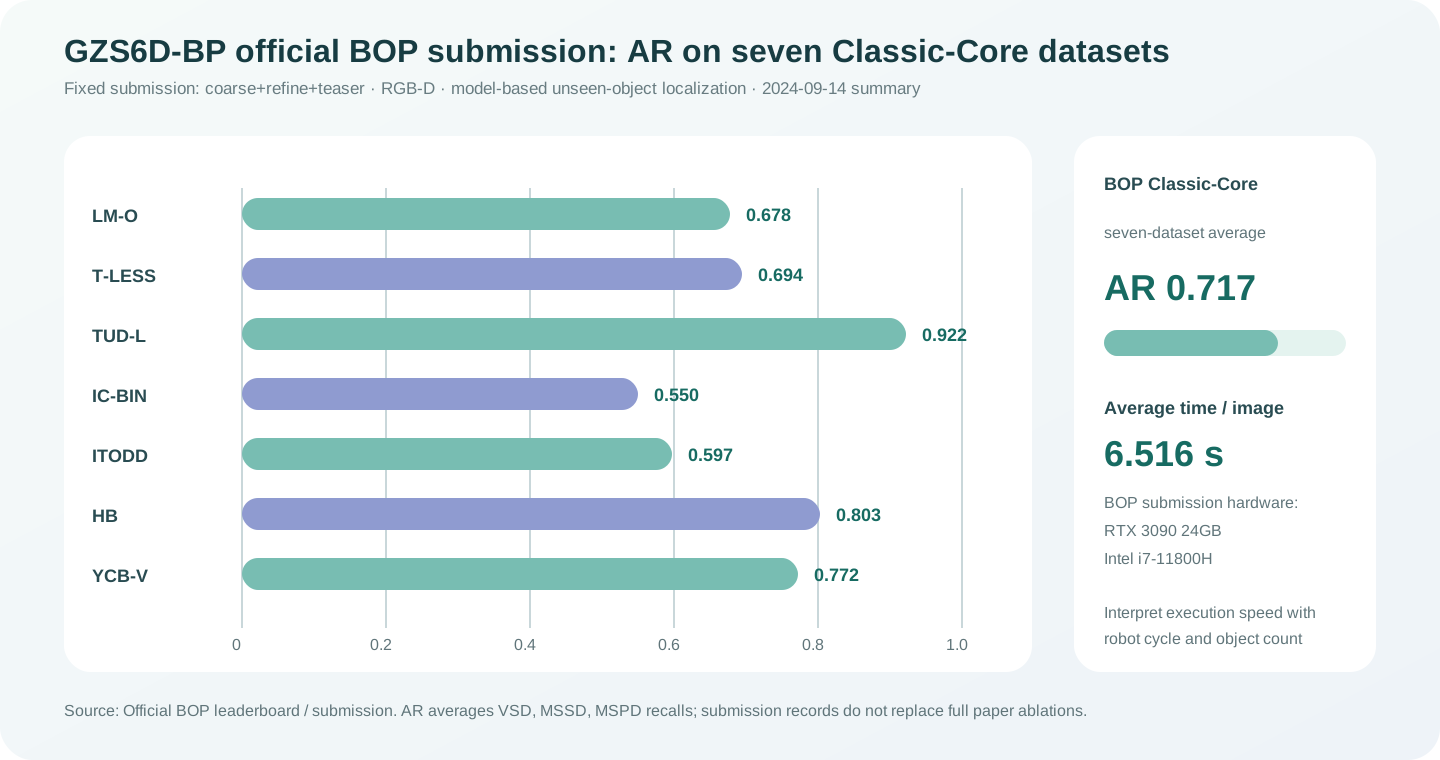
GZS6D-BP renders CAD templates in real time for coarse pose, then refines with camera-viewpoint-aligned semantic point-pair features. Its public coarse+refine+teaser BOP submission achieves AR 0.717 across seven Classic-Core datasets, including TUD-L 0.922, HB 0.803, and YCB-V 0.772, at mean 6.516 s/image.
3. Main Method
The authors divide zero-shot bin-picking pose into two stages:
CAD template coarse pose: render templates online at candidate viewpoints for a new object, then match scene and templates to estimate coarse pose;
Semantic point-pair refinement: construct camera-viewpoint-aligned semantic point-pair features, using local geometry and semantics to correct coarse pose.
The public BOP name GZS6D-BP(coarse+refine+teaser) indicates TEASER-type robust registration after coarse + refine. This verifiable leaderboard configuration does not reconstruct every equation in the unavailable full paper.
Redrawn by this site from the public author abstract and BOP submission; not an original paper figure. TEASER is labeled only as a public submission configuration, without inventing unpublished core equations. Paper content copyright belongs to the original authors; the redraw supports academic analysis. Sources: paper DOI, BOP method page.
4. What Does Zero-Shot Mean Here?
It means no object-specific training after a new CAD model arrives, rather than no priors:
Target CAD is still required;
RGB-D is still used;
Intrinsics, detection / segmentation, and renderable inputs remain necessary;
Computation shifts from offline retraining to online template rendering and matching.
This is useful on industrial lines: CAD is often available when parts change, whereas collecting real data, annotating 6D poses, retraining, and validation can take hours to days.
5. Official BOP Results
Seven-dataset AR for the public coarse+refine+teaser submission:
Dataset
AR
LM-O
0.678
T-LESS
0.694
TUD-L
0.922
IC-BIN
0.550
ITODD
0.597
HB
0.803
YCB-V
0.772
BOP Classic-Core average
0.717
BOP reports mean 6.516 s/image; the method page records RGB-D with RTX 3090 24GB + Intel i7-11800H hardware.
Redrawn by this site from a fixed official BOP submission. AR averages recalls for VSD, MSSD, and MSPD; 6.516 s/image is aggregated across seven datasets. Sources: BOP Classic-Core leaderboard, method submission.
Performance is strong on clean / easier-localization datasets, with substantial difficulties remaining in industrial, low-texture, and occluded conditions such as IC-BIN and ITODD. The abstract’s fast-execution claim needs context: 6.516 seconds per image is not real-time video, but bin-picking cycles often take seconds. Usability depends on grasp-cycle duration, object count, and parallelism.
6. Coarse Assessment
GZS6D-BP offers clear deployment benefits and officially verifiable results. It avoids retraining per object while extending classical geometric point-pair features with semantics and viewpoint alignment to address generalization and industrial local ambiguity.
Limitations include:
RGB-D and CAD dependencies;
Seconds of template rendering / matching;
No public implementation;
The abstract omits real-robot precision, trial counts, and complete failure categories;
Large AR variation across seven datasets: generalizable does not mean consistently robust on every industrial object.
Available src/paper-notes/generalizable-zero-shot-bin-picking-icra2025/deep.md
In-depth paper notes
Support reproduction, comparison, related-work writing, and identifying opportunities for further research.
Paper Reading Notes (Deep): Generalizable Zero-Shot Object Pose Estimation for Bin-Picking
1. Positioning
GZS6D-BP targets model-based unseen-object 6D localization for industrial unordered grasping. Given a real RGB-D scene and new-part CAD, it avoids collecting training images or retraining for that object, instead rendering templates online for coarse pose and refining with semantic point-pair features.
It sits between two approaches:
More learned semantics and viewpoint alignment than conventional point-pair features;
More emphasis on training-free new-object deployment than object-specific deep pose networks.
The full paper is currently not open access, but seven core-dataset submissions are public on the official BOP leaderboard. The page therefore offers abstract-level method evidence plus official quantitative results, stronger than abstract-only qualitative claims.
2. Why Bin Picking Needs Zero-Shot Methods
Industrial parts often involve:
Low texture and reflective metal;
Tightly packed instances of the same type;
Repeated local holes, edges, and planes;
Frequent SKU / CAD changes;
Expensive 6D annotations and real-grasp validation.
Object-specific models require synthetic generation or real-data collection and retraining for each new object. Even fast inference can leave total deployment costs high. Zero-shot CAD-based methods shift costs to:
new CAD→render / match / align→Tco,
Rather than:
new CAD→data generation→training→validation→Tco.
3. Stage 1: Real-Time CAD Template Rendering
The author abstract explicitly describes real-time rendering of CAD templates as the first coarse-pose stage.
Template approaches typically discretize SO(3) or a viewing sphere into candidate viewpoints:
{Rk}k=1KR(M,Rk){Tk}k=1K,
Then select the template Tk∗ most similar to the scene crop. This is a high-level mathematical explanation, not the unpublished implementation. Without full-text disclosure, the following remain unclear:
Whether templates contain RGB, depth, normals, or features;
Candidate viewpoint count;
matching backbone / similarity;
Detection / segmentation source;
Translation initialization.
Real-time rendering avoids per-CAD pretraining; denser candidates can improve retrieval while increasing runtime and memory.
They require no training and are geometrically interpretable, but repeated descriptors on textureless symmetric parts create correspondence ambiguity.
The authors propose semantic point-pair features aligned with the camera viewpoint. At a high level:
Point pairs provide local 3D geometry;
Semantic features add object / region discrimination beyond local geometry;
Camera-view alignment unifies scene and template representations by viewing direction, reducing viewpoint variation.
The abstract omits the semantic backbone, pair construction, alignment transform, and refinement optimizer; these cannot be written as paper-specific equations.
The public BOP submission name contains +teaser. TEASER++ is a point-cloud registration solver robust to many outliers. Its leaderboard configuration is verifiable, but the abstract does not identify it as a core contribution; method concepts and evaluation configuration must remain distinct.
Redrawn by this site from the public author abstract and BOP method submission; not an original paper figure. The abstract's two-stage method and the public TEASER configuration are labeled separately. Paper content copyright belongs to the original authors; the redraw supports academic analysis. Sources: paper DOI, BOP method page.
5. BOP Task and Metrics
The official submission task is Model-based 6D localization of unseen objects:
Object models are supplied at test time;
Objects are unseen by the learning system;
Localization typically evaluates pose under supplied target / detection conditions;
Input is RGB-D.
BOP AR aggregates recalls for three error types:
VSD: visibility-aware surface discrepancy;
MSSD: maximum symmetry-aware surface distance;
MSPD: maximum symmetry-aware projection distance.
Therefore:
ARD=3ARVSD+ARMSSD+ARMSPD,
Average over seven Classic-Core datasets to obtain ARCore.
6. Official Seven-Dataset Results
BOP records for GZS6D-BP coarse+refine+teaser:
Dataset
AR
Interpretation
LM-O
0.678
Heavily occluded household objects
T-LESS
0.694
Textureless, symmetric industrial parts
TUD-L
0.922
Relatively clean household / tabletop scenes
IC-BIN
0.550
Few objects but heavy bin-picking occlusion
ITODD
0.597
Industrial, textureless, challenging depth
HB
0.803
HomebrewedDB
YCB-V
0.772
Multi-object RGB-D video
Core average
0.717
Seven-dataset mean
Redrawn by this site from a fixed official BOP submission. Values: LM-O 0.678, T-LESS 0.694, TUD-L 0.922, IC-BIN 0.550, ITODD 0.597, HB 0.803, YCB-V 0.772; Core AR 0.717; 6.516 s/image. Sources: BOP leaderboard, method page.
7. Interpreting the Result Distribution
7.1 High TUD-L, Lower IC-BIN / ITODD
AR ranges widely from 0.550 to 0.922. Training-free onboarding does not imply equal strength across visual regimes. Clean scenes with large visible object regions favor template retrieval and pair alignment; heavy occlusion, repeated industrial geometry, and depth dropout can hurt both stages.
7.2 T-LESS 0.694
T-LESS directly tests industrial texturelessness / symmetry. Its 0.694 shows success on many symmetric parts without solving the problem universally. Symmetry-aware MSSD / MSPD avoid penalizing equivalent poses, so the score does not directly translate into ordinary rotation error.
7.3 Clues about +TEASER
BOP also records some coarse+refine and coarse+refine+teaser results:
LM-O: 0.671 → 0.678;
IC-BIN: 0.544 → 0.550;
HB: 0.795 → 0.803;
YCB-V: 0.758 → 0.772;
TUD-L: 0.907 → 0.922.
These suggest small, consistent gains from robust geometry at extra runtime. Different submission dates and possibly different full configurations make this a leaderboard clue rather than a paper ablation.
8. Understanding Speed
BOP reports mean 6.516 s/image on RTX 3090 24GB + Intel i7-11800H. Dataset times also vary with object count, for example:
HB submission: 8.180 s/image;
YCB-V: 5.884 s/image;
IC-BIN: 9.079 s/image.
Fast execution in the abstract does not mean video-rate real time. Plausible contexts include:
A few online seconds versus hours / days of new-object retraining;
Industrial grasp cycles already measured in seconds;
Localization rendering / matching multiple scene objects sequentially.
Deployment should report together:
Tcycle=Tdetect+Tpose+Tplan+Tmotion+Tgrasp.
If arm motion takes more than ten seconds, 6.5 seconds may be usable; dynamic conveyor tracking clearly requires more speed.
9. Related Approaches
Approach
New-object training?
CAD
Main computation
Typical issue
object-specific network
Yes
Often
Offline training + fast inference
Slow SKU changes
classical PPF
No
Yes
Geometric voting
Repeated local geometry / noise
learned template method
No
Yes
render + feature match
Template density
GZS6D-BP
No
Yes
coarse render + semantic pair refine
Seconds of compute, RGB-D dependency
model-free reference method
No
Not always
Reference reconstruction / matching
Reference-view quality
The trade-off is clear: online geometry and matching replace object-specific data acquisition and training.
10. Evidence Limits of Real-Robot Validation
The abstract reports integration into a robotic grasping system with high precision and fast execution for bin picking, but does not disclose:
robot / gripper / camera;
Part counts, materials, and symmetries;
Trial counts and picking success rate;
Whether grasp planning uses GT masks;
failure cases;
End-to-end comparisons with object-specific systems.
Real-system integration can be reported, but undisclosed success rates or millimeter errors cannot.
11. Reproduction Checklist
When full text or code becomes available, verify:
Template modalities, viewpoint count, and caching;
Detection / segmentation frontend;
Coarse similarity and translation initialization;
Semantic point-pair feature definition;
Camera-viewpoint alignment coordinate transforms;
Input correspondences for refinement and TEASER;
BOP detection / localization protocols and default detections;
Stage-wise runtime and scaling with object count;
Real-robot setup and success criteria;
Total preparation time from new CAD import to execution.
12. Research Insights
Industrial zero-shot need not mean entirely model-free:
CAD is a strong prior already available on industrial sites;
The goal is removing object-specific training, not all geometry;
Foundation features could improve coarse-stage appearance generalization;
Refinement should retain interpretable point pairs / robust registration;
Speed work should prioritize fewer templates, reused CAD features, and scene-prior restrictions on pose distributions.
A future system could use robot-workspace upright / approach constraints for template proposals, then apply limited semantic-pair refinement to high-confidence coarse poses. This could preserve new-object deployment benefits while bringing 6.5 seconds closer to industrial cycle requirements.
Overall, GZS6D-BP has a comparatively complete evidence chain among non-open-full-text papers in the ICRA 2025 collection: an abstract describing two stages, seven-dataset official BOP numbers, and real-robot integration as an application direction. Full method structure, code, and robot success rates remain unavailable.