GenFlow: Generalizable Recurrent Flow for 6D Pose Refinement of Novel Objects
GenFlow recurrently estimates flow, certainty, pose sensitivity, and 6D pose between observations and the current CAD rendering. 3D shape-constrained correlation lookup and differentiable PnP preserve projection geometry. Under the CNOS unseen-object protocol, RGB / RGB-D mean AR is 57.8 / 67.2. The complete-design ablation reaches 70.7, 4.4 above the version without shape constraints.
observed RGB or RGB-D cropCAD renderinginitial pose hypotheses
Requirements
metric CAD model and renderercamera intrinsicsobject crop or detectioninitial pose hypothesisoptional depth for RANSAC-KabschMegaPose-scale synthetic training
Full paper metadataAuthors, affiliations, research area, datasets, metrics, method tags, and reading statusExpandCollapse
Authors
Sungphill Moon, Hyeontae Son, Dongcheol Hur, Sangwook Kim
metric CAD model and renderercamera intrinsicsobject crop or detectioninitial pose hypothesisoptional depth for RANSAC-KabschMegaPose-scale synthetic training
Reading Notes
Overview / Deep Dive
Available src/paper-notes/genflow-cvpr2024/coarse.md
Paper overview notes
Quickly assess the paper's scope, problem setting, core method, experimental findings, and whether to read it in depth.
Paper Reading Notes (Coarse): GenFlow
1. Basic information
Title: GenFlow: Generalizable Recurrent Flow for 6D Pose Refinement of Novel Objects
Authors: Sungphill Moon, Hyeontae Son, Dongcheol Hur, Sangwook Kim
GenFlow reformulates novel-object render-and-compare as recurrent optical flow. Dense flow between observations and current CAD renders, 3D shape constraints, confidence factorization, and differentiable PnP iteratively update pose; RGB-D can add 3D–3D Kabsch alignment.
3. Guide to figures and tables
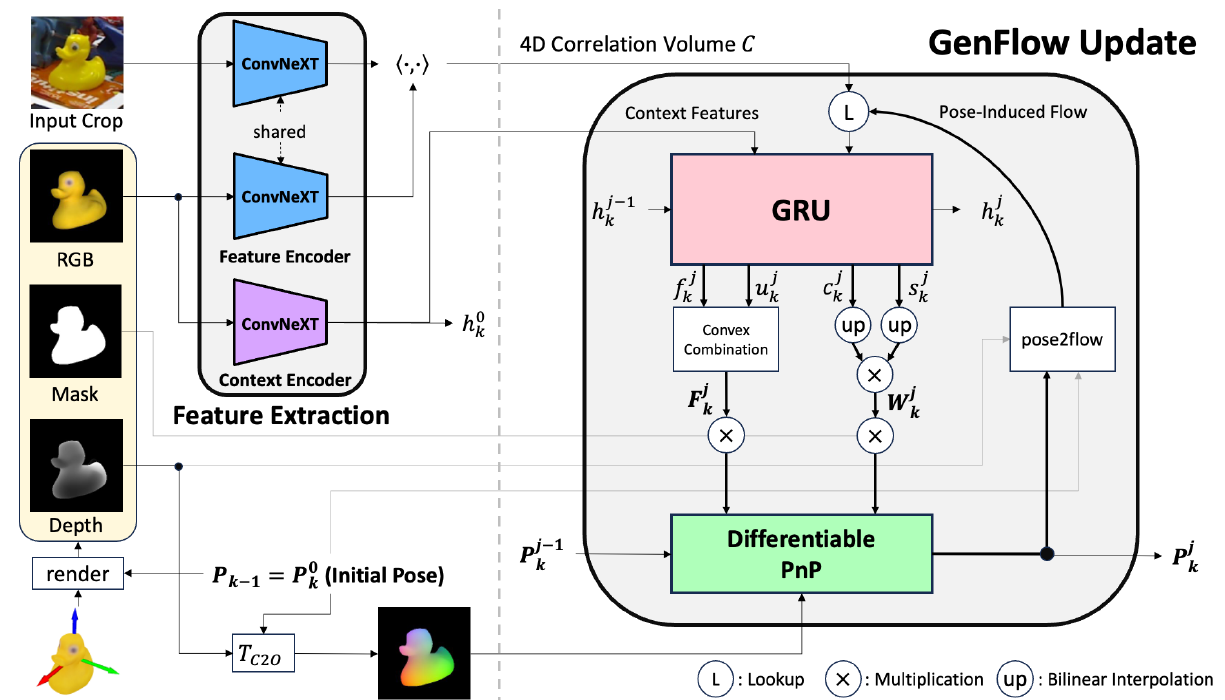
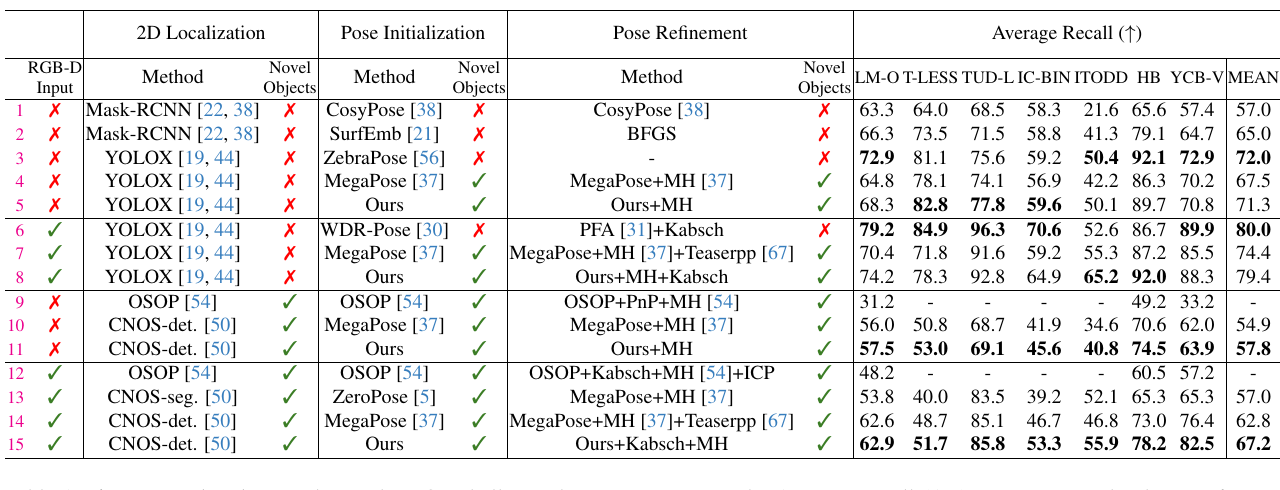
Original Figure 3: shared ConvNeXt builds a 4D correlation volume; ConvGRU recurrently outputs flow, an upsampling mask, certainty, and pose sensitivity. Differentiable PnP converts weighted 2D–3D correspondences into the next pose. Source: official CVPR 2024 paper. Image copyright belongs to the paper's authors and IEEE/CVF; reproduced here for paper analysis.Original Table 1: distinguishes RGB-D, whether localization has seen test objects, and novel-object capabilities of initialization / refinement. Under unseen-object CNOS localization, GenFlow mean AR is 57.8 / 67.2 for RGB / RGB-D. Source: official CVPR 2024 paper. Table copyright belongs to the paper's authors and IEEE/CVF; reproduced here for paper analysis.
4. Problem setting
Inputs: observed RGB or RGB-D crops, target CAD, intrinsics, and one or more initial pose hypotheses.
Output: refined absolute 6D pose; the paper also trains a coarse scorer / sampler for initialization.
Test objects: unseen during training, but metric CAD must be provided and renderable.
Training: approximately 2M synthetic RGB-D images from MegaPose, with ShapeNet and GSO shapes.
Evaluation: seven BOP datasets using BOP AR.
5. Method overview
Render CAD RGB, masks, and depth at the current pose; share a ConvNeXt encoder with the observation crop.
A two-level feature pyramid forms 4D correlation volumes; coarse results initialize fine processing.
Each GRU update outputs flow, certainty c, and pose sensitivity s; their product gives correspondence weights.
Render depth lifts pixels to object-space 3D; flow supplies observed-image locations, and differentiable PnP updates pose.
Pose-induced flow from the new pose queries the correlation volume again, closing a recurrent geometric loop.
With observed depth, certainty filters correspondences before RANSAC-Kabsch; multiple hypotheses are refined and the best selected.
6. Experiments at a glance
Unseen-object CNOS localization: RGB mean AR 57.8, versus 54.9 for the corresponding MegaPose pipeline.
Same protocol, RGB-D: mean AR 67.2, versus 62.8 for MegaPose+Teaser++.
GMM sampling uses 208 renders for coarse mean AR 35.8; naive sampling with 576 renders gives only 22.5.
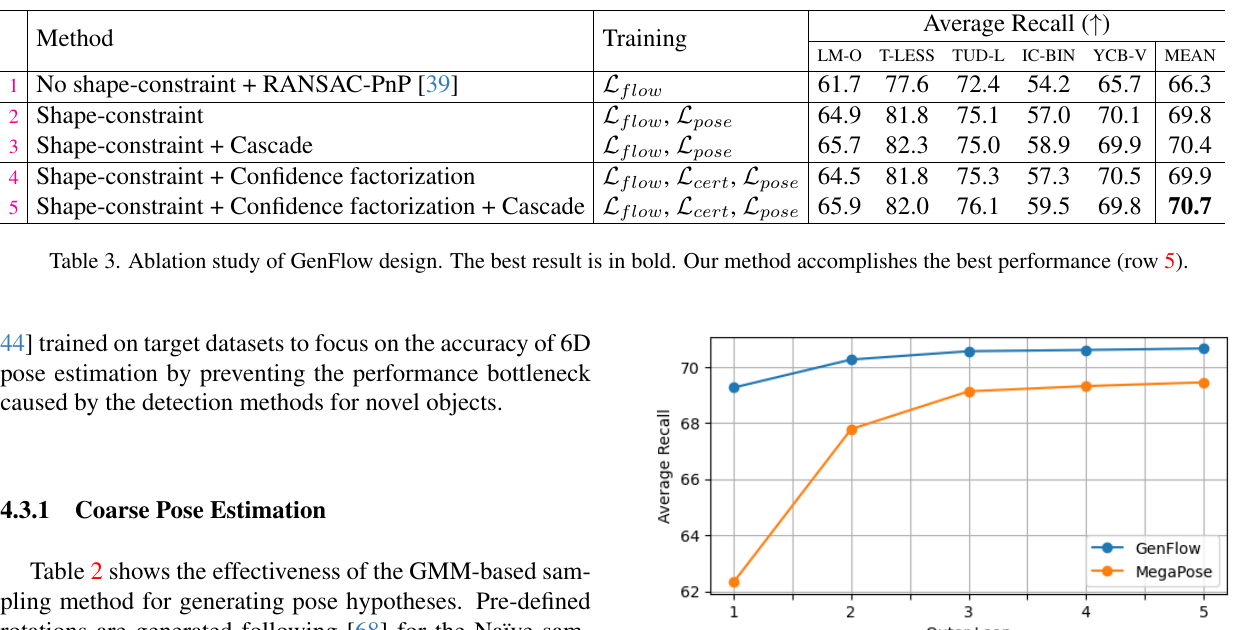
Full-refiner mean AR is 70.7; removing shape constraints and using RANSAC-PnP gives 66.3.
One outer update takes 98.2 ms versus MegaPose’s 66.5 ms. GenFlow is slower per step but exceeds MegaPose’s five-step AR after two steps.
7. Quick assessment
Strength: flow, 3D shape, PnP, and recurrent correlation lookup constrain each other instead of directly regressing a pose delta; transfer to new CAD has a clear geometric basis.
Main limitations: requires CAD, rendering, initial poses, and object localization; full multihypothesis / multi-outer-loop latency greatly exceeds 98.2 ms.
Table-reading caution: 71.3 / 79.4 in Table 1 uses YOLOX trained on test-dataset objects; open-scene assessment should use CNOS at 57.8 / 67.2.
Available src/paper-notes/genflow-cvpr2024/deep.md
In-depth paper notes
Support reproduction, comparison, related-work writing, and identifying opportunities for further research.
Paper Reading Notes (Deep): GenFlow
1. Key assessment
GenFlow starts from a dilemma: direct pose-delta regression can train across objects but underuses test-CAD shape and camera projection; generic optical flow followed by external PnP disconnects flow and pose objectives.
It combines them into one recurrent loop:
Render CAD at the current pose;
Predict dense flow between render and observation;
Convert flow into 2D–3D correspondences with render depth;
Update pose through differentiable PnP;
Requery the correlation volume using flow induced by the new pose.
Shape constraints, certainty / pose-sensitivity factorization, and a multiscale cascade improve generalization. Under unified coarse initialization, the full design raises mean AR from 66.3 to 70.7; unseen-object CNOS gives RGB / RGB-D mean AR 57.8 / 67.2.
2. Task Boundaries and System Components
Core refiner inputs:
Observed RGB crop It, optionally observed depth;
Target CAD M;
Intrinsics K;
Initial pose Pinit;
RGB, mask, and depth rendered at the current pose.
The output is absolute 6D pose in camera coordinates. New objects require no fine-tuning, but metric CAD, a renderer, object localization, and initial hypotheses remain necessary.
The paper also trains a coarse model:
Input observed RGB and a candidate-pose render;
Predict whether the candidate lies in the refiner’s convergence basin;
GMM sampling generates good hypotheses with fewer renders;
After refining multiple hypotheses, the coarse scorer reranks them.
Training data come from MegaPose:
Approximately 2M synthetic RGB-D images;
Shapes from ShapeNet and Google Scanned Objects;
Both coarse and refinement networks learn category-agnostic comparisons across many training objects.
3. How Recurrent Flow Updates Pose
Original Figure 3. Observations and CAD renders share an encoder. A GRU receives the 4D correlation volume, context features, and pose-induced flow, outputting dense flow and weights; differentiable PnP produces the next pose. Source: official CVPR 2024 paper. Image copyright belongs to the paper's authors and IEEE/CVF; reproduced here for paper analysis.
3.1 4D correlation volume
Pretrained ConvNeXt encodes observation and render; two feature scales form all-pairs correlations:
Ci∈RHi×Wi×Hi×Wi.
This resembles RAFT, but lookup coordinates come from flow induced by the current 6D pose on CAD shape, not merely the preceding flow estimate. Object geometry thus constrains correlation search.
3.2 Render Pixels to Object-Space 3D
At current pose Pk0=[Rk0∣tk0], render pixel (u,v) and depth Dr(u,v) lift to object-space points:
After each update, recompute pose-induced flow from Pkj and query local evidence in the fixed correlation volume. Errors can be corrected without re-encoding every image at every iteration.
One outer refinement step contains 8 inner GenFlow updates; the paper commonly uses 5 outer steps.
4. Confidence Factorization and Cascade
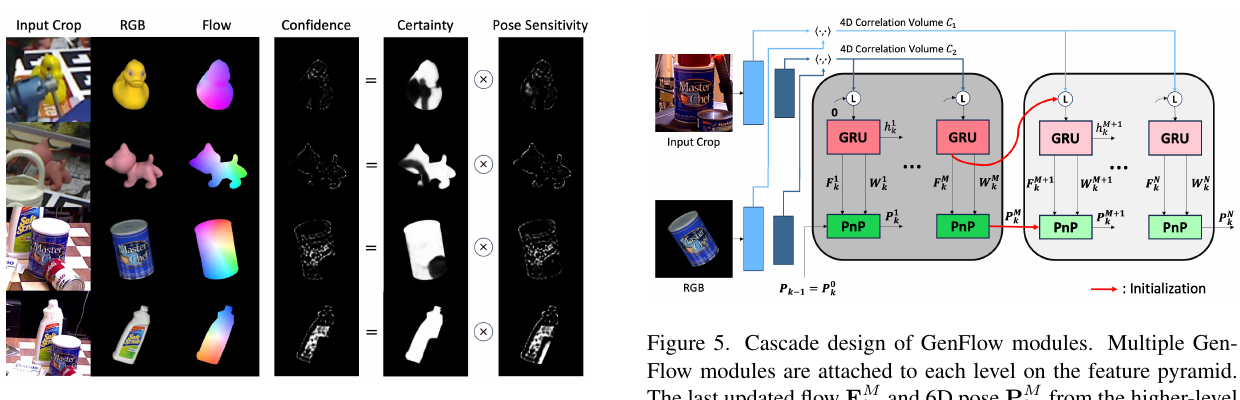
Original Figures 4–5. Correspondence confidence factorizes into certainty and pose sensitivity. Two cascaded GenFlow levels pass final coarse flow / pose to initialize fine processing. Source: official CVPR 2024 paper. Image copyright belongs to the paper's authors and IEEE/CVF; reproduced here for paper analysis.
Final weighting is not a single confidence head:
Wj=cj⊙sj.
Certainty c: synthetic depth-consistency supervision identifies pixels unreliable because of occlusion, background, or mismatch;
Pose sensitivity s: pose-loss supervision emphasizes rich texture, object edges, and regions that constrain R,t.
Separating them distinguishes accurate-looking matches from pose-informative matches. Certainty uses depth during training, but RGB inference requires no observed depth.
The cascade assigns a GenFlow module to each correlation scale. High-level semantics / large receptive fields perform coarse updates; their final flow and pose initialize the lower-level detail module. Pose state transfers between levels rather than simply concatenating a feature pyramid.
5. Losses and Stable Training
Pose loss separates rotation, 2D center, and depth translation to prevent one component dominating an SE(3) distance. Flow uses L1 endpoint error; certainty uses depth-consistency BCE.
The total loss weights later recurrent steps exponentially more heavily:
L=j=1∑Nγj−N(Lflowj+αLcertj+βLposej),
Here γ=0.8 and N=8. To reduce numerical instability, gradients do not pass through all LM iterations: obtain a detached pose, then backpropagate only through the final Gauss–Newton update.
6. BOP Results: Distinguish Localization Protocols First
Original Table 1. Red / green markers distinguish RGB-D use and novel-object capabilities in localization, initialization, and refinement. Each row's final AR belongs to the complete pipeline. Source: official CVPR 2024 paper. Table copyright belongs to the paper's authors and IEEE/CVF; reproduced here for paper analysis.
CNOS rows provide the genuinely unseen end-to-end localization protocol:
Input
Pipeline
LM-O
T-LESS
TUD-L
IC-BIN
ITODD
HB
YCB-V
Mean
RGB
CNOS-det + MegaPose + MH
56.0
50.8
68.7
41.9
34.6
70.6
62.0
54.9
RGB
CNOS-det + GenFlow + MH
57.5
53.0
69.1
45.6
40.8
74.5
63.9
57.8
RGB-D
CNOS-det + MegaPose + Teaser++
62.6
48.7
85.1
46.7
46.8
73.0
76.4
62.8
RGB-D
CNOS-det + GenFlow + Kabsch + MH
62.9
51.7
85.8
53.3
55.9
78.2
82.5
67.2
Against MegaPose with the same localizer:
RGB +2.9 mean AR;
RGB-D +4.4;
RGB-D gains +9.1 on ITODD and +6.1 on YCB-V, suggesting particular value from certainty-filtered depth correspondences on some datasets.
Target-trained YOLOX raises RGB / RGB-D means to 71.3 / 79.4, demonstrating refiner strength without establishing complete open-scene performance.
7. Coarse Sampling, Design Ablations, and Runtime
GMM-based coarse sampling:
Method
renders
Mean AR
naive uniform
576
22.5
GMM
144
31.3
GMM
208
35.8
Fewer renders produce higher accuracy, indicating that the coarse proposal distribution matters more than template count.
Original Table 3 and Figure 6. Shape constraints give the largest base gain, with cascade and confidence factorization adding benefits. GenFlow is slower per outer step but exceeds multiple MegaPose steps after two updates. Source: official CVPR 2024 paper. Figure and table copyright belongs to the paper's authors and IEEE/CVF; reproduced here for paper analysis.
With identical coarse poses:
Design
Mean AR
No shape constraint + RANSAC-PnP
66.3
+ shape constraint
69.8
+ cascade
70.4
+ confidence factorization
69.9
+ factorization + cascade
70.7
Shape constraints contribute +3.5, the largest single gain. Cascade / factorization each add modestly, with their combination performing best.
RTX 3090 + i9-10920X:
GenFlow outer update: 98.2 ms;
MegaPose refiner: 66.5 ms.
GenFlow is not faster per step. It is more accurate for the same step count and exceeds approximately five MegaPose steps after about two. Actual latency must include outer steps, hypothesis count, rendering, coarse scoring, and detection.
8. What the RGB-D Extension Actually Adds
The RGB backbone already uses render depth for 2D–3D correspondences, without observed depth. When observed RGB-D is available, final flow pairs observed depth with render points as 3D–3D correspondences:
Remove outliers with a certainty threshold;
Solve a depth correction with RANSAC-Kabsch;
Run after every outer step.
This branch explains clear RGB-D gains on IC-BIN / ITODD / YCB-V and means RGB-D pose updates are no longer solely differentiable PnP.
9. Limitations and Reproduction Checks
Not CAD-free: metric meshes and a reliable renderer are required;
Not direct full-image pose: external detection / segmentation remains a bottleneck;
The refiner has a convergence basin and can fail from poor initial poses;
98.2 ms is neither complete-pipeline latency nor the total for five steps and multiple hypotheses;
Noisy observed depth harms Kabsch; the paper mitigates this only through certainty filtering;
MegaPose-scale 2M synthetic training brings substantial data costs;
Reproduction must fix outer=5, inner=8, hypotheses=10, GMM render count, and localizer;
Seven-dataset BOP means and five-dataset ablation means must not be conflated;
Report RGB versus RGB-D and seen-object YOLOX versus unseen-object CNOS separately.
10. Overall assessment
GenFlow closes its flow-like architecture around 6D geometry: flow provides correspondences, PnP updates pose, and pose determines the next correlation lookup. Shape constraints at +3.5 AR, consistent CNOS gains over MegaPose, and further RGB-D improvements support the design.
It retains render-and-compare dependencies rather than providing a real-time end-to-end system: CAD, initialization, multiple hypotheses, and large-scale synthetic training remain. GenFlow is a generalizable, more geometrically constrained pose refiner for CAD unseen during training, suitable behind coarse estimators such as MegaPose / GigaPose, rather than a standalone open-world detection-and-pose model.