GenHOI: Generalized Hand-Object Pose Estimation with Occlusion Awareness
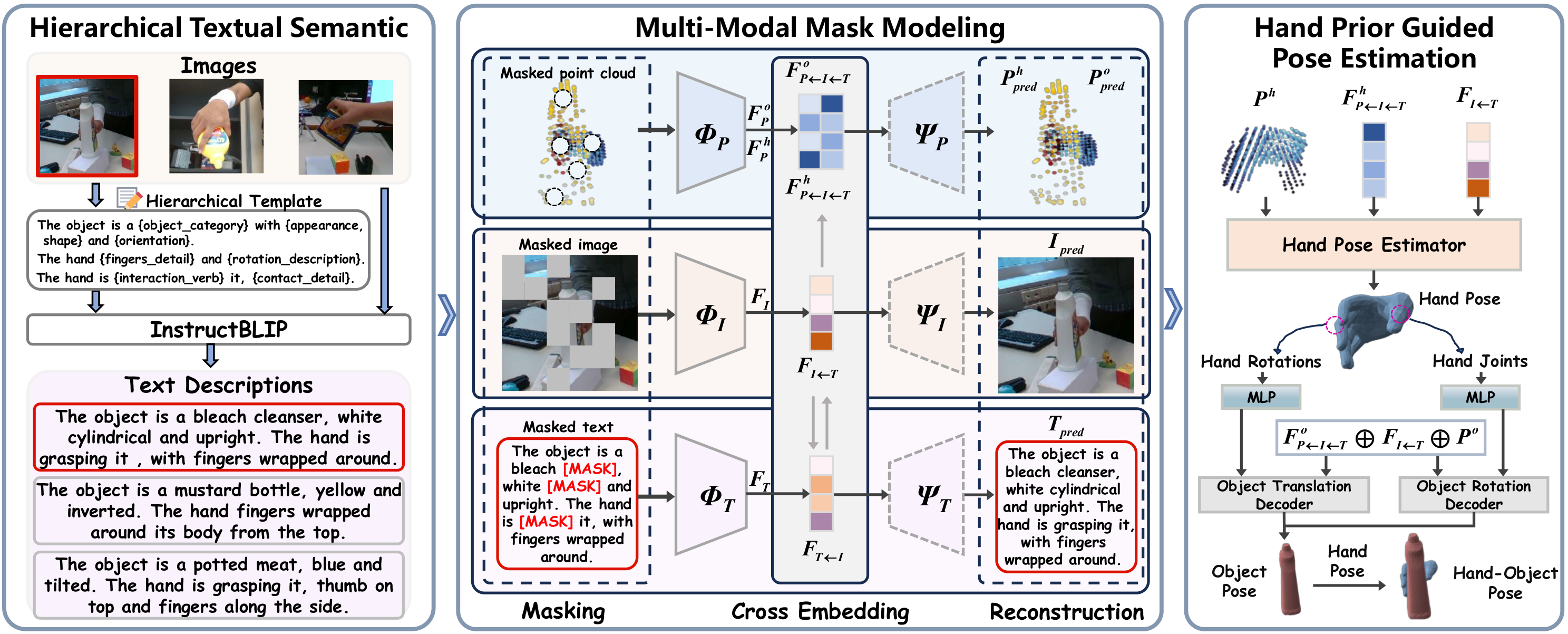
GenHOI jointly recovers MANO hands and object rotation / translation from object-centered monocular RGB. InstructBLIP generates object, hand, and interaction descriptions; multimodal masked reconstruction over images, text, and training ground-truth mesh point clouds learns occlusion-aware representations. Predicted hand rotation and 3D joints constrain object rotation and translation heads. On three unseen DexYCB S3 objects, reported mean ADD-0.5D is 89.34 and ADD-S is 21.76 mm, well above the listed comparisons. All four hand metrics slightly trail UniHOPE, and HO3Dv2 PA-MJE is not best. Inference needs neither CAD nor a depth sensor, but requires object crops and image-guided voxel sampling; 18 FPS excludes offline InstructBLIP text generation.
object-centered monocular RGB cropInstructBLIP-generated hierarchical text descriptionsground-truth-mesh point samples during trainingimage-guided voxel point samples during inferencepredicted MANO hand rotations and 3D joints
Requirements
object-centered crop or equivalent bounding-box preprocessingMANO hand and object-pose supervisionground-truth hand and object meshes for training-time point samplingoffline hierarchical text generation for the reported 18 FPS settingDexYCB / HO3Dv2 object-coordinate and evaluation conventions
Full paper metadataAuthors, affiliations, research area, datasets, metrics, method tags, and reading statusExpandCollapse
Authors
Hui Yang, Wei Sun, Jian Liu, Jian Xiao, Tao Xie, Hossein Rahmani, Ajmal Mian, Nicu Sebe, Gim Hee Lee
Affiliations
NERC-RVC, Hunan University / National University of Singapore / Lancaster University / The University of Western Australia / University of Trento
object-centered crop or equivalent bounding-box preprocessingMANO hand and object-pose supervisionground-truth hand and object meshes for training-time point samplingoffline hierarchical text generation for the reported 18 FPS settingDexYCB / HO3Dv2 object-coordinate and evaluation conventions
Reading Notes
Overview / Deep Dive
Available src/paper-notes/genhoi-eccv2026/coarse.md
Paper overview notes
Quickly assess the paper's scope, problem setting, core method, experimental findings, and whether to read it in depth.
Paper Reading Notes (Coarse): GenHOI: Generalized Hand-Object Pose Estimation with Occlusion Awareness
1. Basic information
Title: GenHOI: Generalized Hand-Object Pose Estimation with Occlusion Awareness
Authors: Hui Yang, Wei Sun, Jian Liu, Jian Xiao, Tao Xie, Hossein Rahmani, Ajmal Mian, Nicu Sebe, Gim Hee Lee
Affiliations: NERC-RVC, Hunan University; National University of Singapore; Lancaster University; The University of Western Australia; University of Trento
Code / project: at this site’s verification, no public code or project page was linked from the paper, arXiv, or ECCV page
Reading mode: Overview
2. Positioning in one sentence
GenHOI jointly recovers MANO hand pose / mesh and object rotation / translation from one object-centric RGB crop. InstructBLIP generates object, hand, and interaction descriptions. Multimodal masked reconstruction combines images, text, and point clouds sampled from GT meshes during training or image-guided voxels at inference. Predicted hand-joint rotations and 3D joints then provide structural priors for object 6D pose.
Key assessment
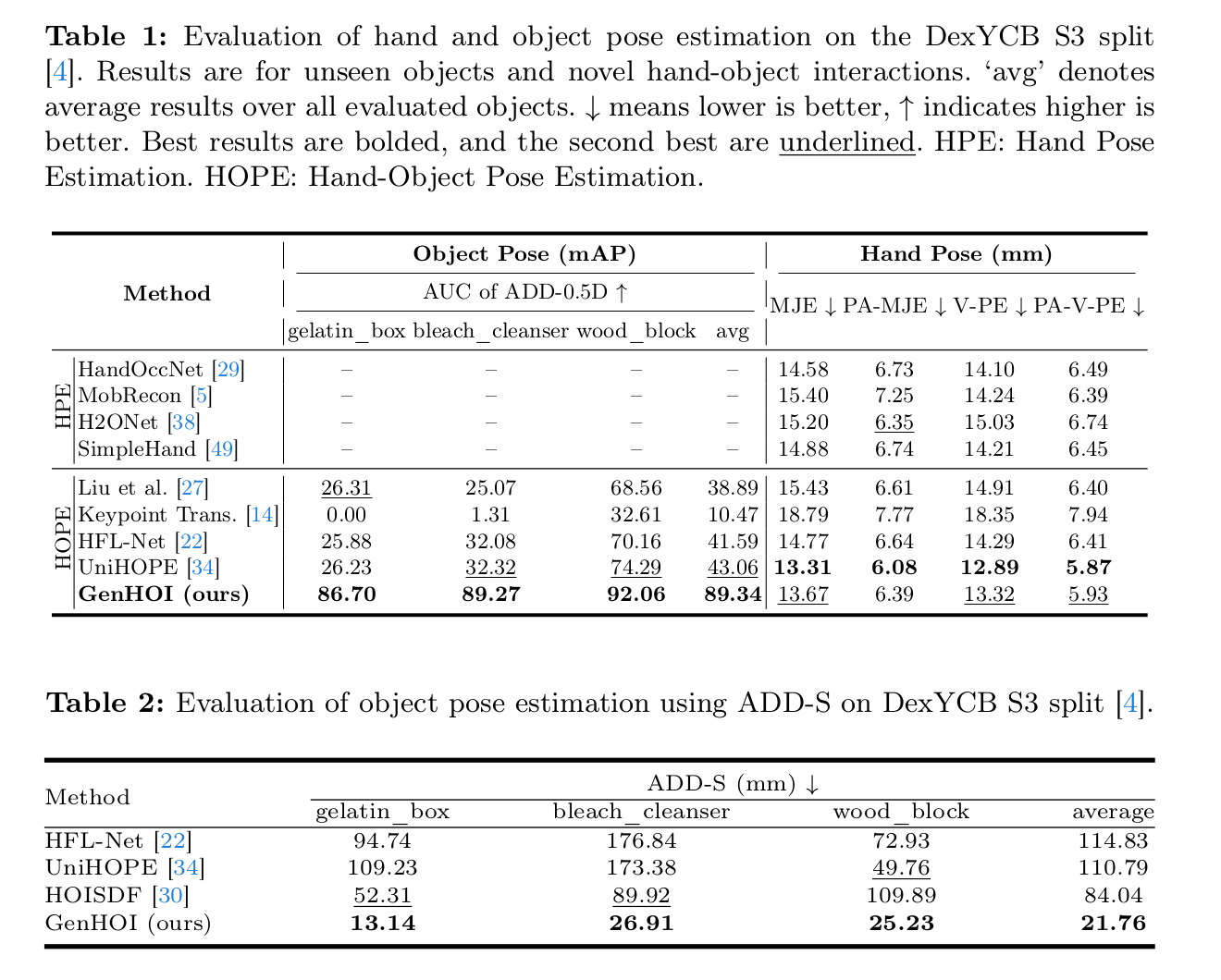
The contribution connects three cues within one hand–object pipeline rather than introducing a geometric solver: hierarchical language supplements object state and interaction intent, multimodal masking simulates occlusion, and stable hand topology constrains the occluded object. DexYCB S3 object results are striking: mean reported ADD-0.5D is 89.34 over three unseen YCB objects, versus UniHOPE 43.06; shared millimeter ADD-S falls from HOISDF 84.04 mm to 21.76 mm.
Claims of across-the-board SOTA need qualification:
UniHOPE is slightly better on all four DexYCB S3 hand metrics; the paper itself describes hand results as competitive;
On HO3Dv2, GenHOI leads MJE, ST-MJE, OME, and ADD-S, but PA-MJE 9.9 mm trails HFL-Net / LCP at 8.9 mm, contradicting the text’s across-all-metrics claim;
GenHOI and UniHOPE trade wins across occlusion bins rather than one method leading everywhere;
Inference requires neither depth sensors nor GT meshes, but needs pre-cropped object images. Runtime uses offline-generated text, so 18 FPS is not complete online VLM + pose throughput.
2.1 Guide to figures and tables
Figure / table
Focus
Supported conclusion
Not directly established
Figure 2
Hierarchical semantics, image / text / point-cloud masked reconstruction, and hand-prior object head
How the three contributions connect in the pipeline
RGB-D, real point clouds, or object CAD required at inference
Tables 1–2
DexYCB S3 unseen-object hand and object results
Large reported object-pose gains and hand accuracy close to UniHOPE
Hand SOTA everywhere or identical preprocessing across studies
Table 6
Text, three masking types, hand-rotation / joint-prior ablations
Removing each group hurts, especially hand priors for object metrics
All VLM, training-point-cloud, and baseline-implementation variables isolated
Supplement Figure C
Extreme-occlusion failures
Objects fully covered by hands can still have large pose errors
Masked modeling solves complete occlusion
Original Figure 2: object, hand, and interaction templates generate text on the left. Images, point clouds, and text are masked / reconstructed only during training in the middle. MANO hand estimates supply rotations and 3D joints to object rotation / translation heads on the right. Source: arXiv. Image copyright belongs to the paper's authors and publisher; reproduced here for paper analysis.
3. Problem setting
3.1 Inputs and Outputs
Input: one RGB image; supplementary material specifies object-centered cropping and resizing to 224×224.
Text branch: RGB plus hierarchical templates enter InstructBLIP, yielding a unified description of object category / appearance / orientation, finger state / rotation, interaction verbs, and contact details.
Geometry branch: training samples point clouds from GT hand / object meshes; inference dynamically samples image-feature-guided voxel grids, following HOISDF-style methods, without GT meshes.
Hand outputs: 16 MANO joint rotations θ∈R^(16×3), 10D shape coefficients α, and reconstructed 21 3D hand joints / hand mesh.
Object outputs: R_obj∈R^(3×3) and T_obj∈R^3, the object’s rotation and translation relative to the camera.
3.2 Task Boundaries
Beyond standard object-only 6D pose: hand, object, and interaction are jointly modeled, with object pose only one output; this site places it in ECCV 2026 extended coverage.
Not RGB-D: point clouds are internal geometric representations, not back-projected sensor depth at inference.
Not BOP-style model-based pose: no target CAD at inference and no MSSD / MSPD / VSD evaluation.
Not open-world detection: input is an object-centered crop; full-scene discovery, bounding boxes, and pose are not demonstrated.
Geometric supervision remains: training uses GT hand / object meshes, SDFs, MANO, and object-pose labels.
Temporal occlusion recovery is not established: the method is single-frame, and complete-occlusion failures are a stated limitation.
Interaction: grasping / interaction verbs and contact details.
InstructBLIP fills templates from the image into one description. Token perturbations during training reduce dependence on perfect captions. In the supplementary category-leakage ablation, removing YCB category tokens changes MJE 13.42→13.45 mm and ADD-0.5D 90.44→90.22, almost unchanged. Explicit GT category tokens therefore are not the main gain, but implicit appearance-based VLM category recognition is not ruled out.
4.2 Multimodal Masked Modeling
Training corrupts three inputs separately:
Images: 12 patches, 50% in the hand–object region and the rest in background, replaced with Gaussian noise;
Point clouds: 600 hand points and 200 object points, each divided into 64 local groups with 30% randomly masked;
Text: replace 50% of tokens with [MASK].
Image and text first interact through bidirectional cross-attention; semantically enhanced image features then fuse with hand / object point features, in Text → Image → Point order. Reconstruction heads recover images, text, and both clouds. Masking / reconstruction are training-only; inference uses learned cross-modal representations directly.
A key train–test asymmetry remains: training points come from GT meshes, inference points from image-guided voxels. Point-cloud noise mitigates this gap, but sampling errors are not evaluated in separate bins. Deployment can depend jointly on cropping, image features, and sampling quality.
4.3 SDF, Hand Estimation, and Object Pose
Fourier-encoded point coordinates, semantically enhanced image features, and raw coordinates predict hand / object SDFs. SDF weights aggregate surface-aware features, and hand Transformer / MLP heads output MANO parameters.
The object head uses more than object features:
Rotation concatenates projections and global pooling of 16 hand-joint rotations;
Translation concatenates positional descriptions of 21 reconstructed 3D hand joints.
The structural assumption is explicit: grasp pose and contact topology constrain object orientation and position. It better suits stable hand grasps; performance should not be extrapolated directly to hand-free objects, loose contact, or complex multihand manipulation.
4.4 Training Objectives
The total loss weights image, text, and point-cloud reconstruction, MANO, object pose, SDF, and other HOISDF-style constraints. The first six weights are 1 in supplementary material, with λ7 inherited from HOISDF. Images / points / SDF / hand / object pose use L1; text uses cross-entropy.
5. Datasets and Evaluation
Dataset / split
Scale and objects
Role
Generalization boundary
DexYCB S0
582K images, 10 people, 20 YCB objects; 8 training people and 2 test people
Standard seen-object / unseen-subject evaluation
Objects are seen during training
DexYCB S3
15 training objects, 3 held out
Main generalized HOPE evaluation, interaction frames only
Three specific unseen YCB objects, not arbitrary open categories
Main seen-object evaluation + one unseen 019 pitcher base
Unseen-object evidence covers only one category
Hand metrics include MJE, PA-MJE, ST-MJE, V-PE / MME, AUC, and F-score; object metrics include OCE, MCE, OME, ADD-S, and ADD-0.5D.
The text defines ADD-0.5D as the fraction with ADD below 50% of object diameter, but Table 1 labels it Object Pose (mAP) / AUC of ADD-0.5D. These terms are not equivalent; preserve the table’s label rather than interpreting 89.34 automatically as standard ADD AUC or BOP AP.
6. Main results
Original Tables 1–2: on three held-out DexYCB S3 objects, GenHOI reports mean ADD-0.5D 89.34 and ADD-S 21.76 mm, but slightly trails UniHOPE in hand MJE / PA-MJE / V-PE / PA-V-PE. Source: arXiv. Image copyright belongs to the paper's authors and publisher; reproduced here for paper analysis.
6.1 DexYCB S3: Large Object Gains, Competitive Hands
Metric
GenHOI
Strongest comparison
Correct interpretation
ADD-0.5D average
89.34
UniHOPE 43.06
A large gain in the original table’s reported object metric
ADD-S average
21.76 mm
HOISDF 84.04 mm
Shared millimeter error also falls substantially
MJE
13.67 mm
UniHOPE 13.31 mm
GenHOI is not best
PA-MJE
6.39 mm
UniHOPE 6.08 mm
GenHOI is not best
V-PE
13.32 mm
UniHOPE 12.89 mm
GenHOI is not best
PA-V-PE
5.93 mm
UniHOPE 5.87 mm
GenHOI is not best
Held-out-object ADD-0.5D values are gelatin_box 86.70, bleach_cleanser 89.27, and wood_block 92.06. These large gaps merit attention and independent checks with code, a unified evaluator, and identical preprocessing. Without public implementation, tables alone cannot attribute the entire gap to three added modules.
6.2 Occlusion Bins: Close to UniHOPE, with Mixed Wins
UniHOPE wins all four hand metrics at 25–50% occlusion; each method leads on approximately two metrics at 50–75% and 75–100%. Under heavy occlusion, GenHOI J-PE / PA-J-PE is 26.28 / 7.55 mm versus UniHOPE 26.42 / 7.64 mm, but V-PE / PA-V is 25.64 / 7.57 mm versus UniHOPE 25.51 / 7.40 mm. Comparable performance under heavy occlusion is appropriate; universal superiority is not.
6.3 HO3Dv2: Leading Object Errors, but Not Best PA-MJE
Single unseen 019 pitcher base: ADD-0.5D 92.7, versus HOISDF 88.4 and HFL-Net 24.1.
Main seen-object table: MJE 21.3, ST-MJE 21.1, OME 35.9, ADD-S 13.4 mm, all best in that table.
PA-MJE is 9.9 mm, versus HFL-Net and LCP at 8.9 mm. The text’s claim of surpassing all metrics therefore conflicts with Table 5.
6.4 DexYCB S0: Supplementary Seen-Object Results
Supplementary results give MJE 9.83, PA-MJE 5.12, OCE 17.2, MCE 25.1, and ADD-S 12.3 mm, best on all comparable metrics there. Hand-mesh results give PA-V-PE 4.9 mm and V-PE 9.5 mm; J-AUC 80.7 ties HOISDF rather than winning outright.
7. Ablations and Evidence Strength
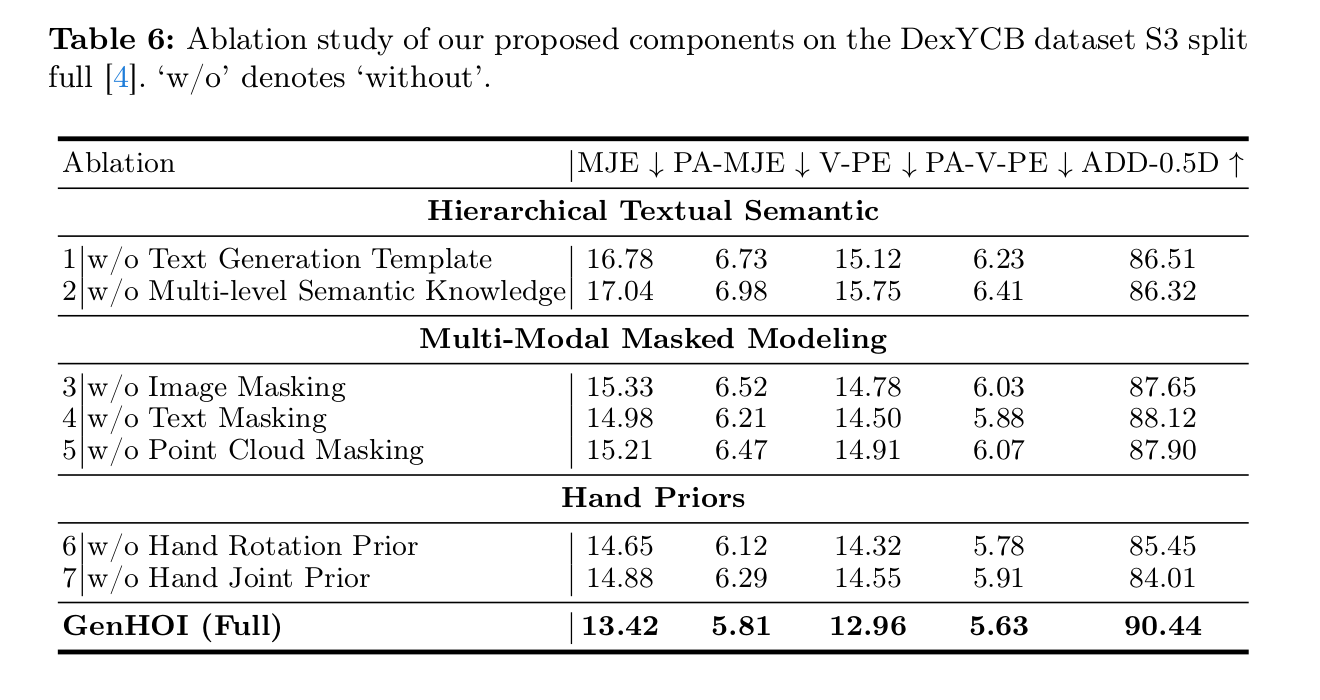
Original Table 6: the full model on DexYCB S3 full gives MJE 13.42 mm and ADD-0.5D 90.44. Removing hand-rotation / 3D-joint priors drops the object metric to 85.45 / 84.01 while changing hand error little. Source: arXiv. Image copyright belongs to the paper's authors and publisher; reproduced here for paper analysis.
Remove the full text-generation template: MJE 13.42→16.78, ADD-0.5D 90.44→86.51.
Remove multilevel semantic knowledge: MJE 17.04, ADD-0.5D 86.32, the largest degradation in the text group.
Remove image / text / point masking separately: ADD-0.5D 87.65 / 88.12 / 87.90, supporting all three masking types.
Remove hand-rotation / joint priors: ADD-0.5D drops to 85.45 / 84.01, more than hand MJE changes, supporting hand priors mainly helping object reasoning.
More masking is not always better: image 50% + 12 patches, text 50%, and points 30% are best. Masking the whole object box worsens MJE to 24.86 mm and ADD-0.5D to 73.21.
Table 6 uses all frames in DexYCB S3 split full, while Table 1 follows UniHOPE’s interaction-only frames. Thus 90.44 and 89.34 come from different evaluation sets and should not be treated as random variation of one setting.
Supplementary occlusion Table C contains only component-removal rows numbered 1–7, without a full-model row. It compares degradation among removed-component variants but cannot alone quantify each component’s occlusion gain against the full model. Consistent-drop claims need other tables as well.
8. Failure Cases and Limitations
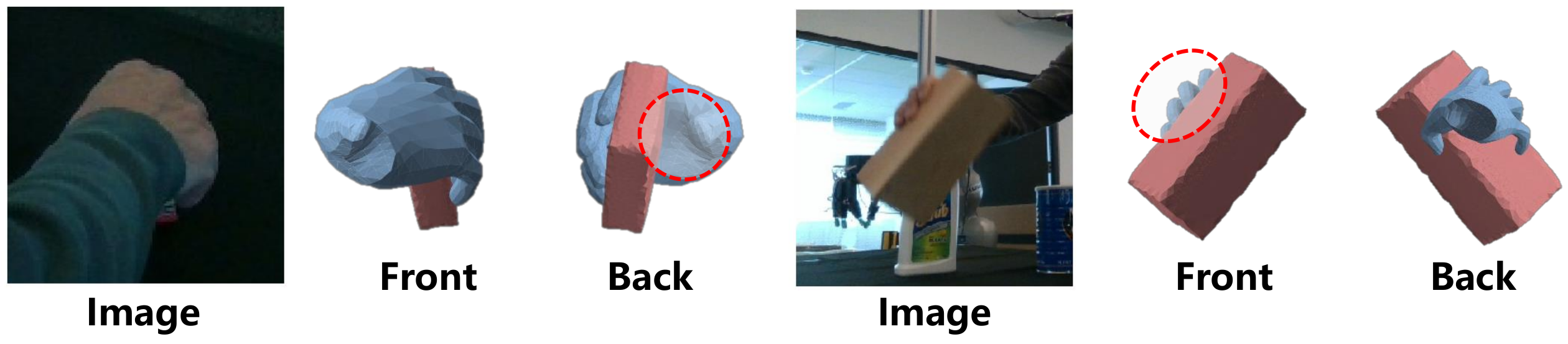
Original supplementary Figure C: when both hand and object are heavily occluded, especially with the object fully covered, single-frame vision and generated semantics cannot uniquely determine orientation and position; red circles mark incorrect geometry. Source: arXiv. Image copyright belongs to the paper's authors and publisher; reproduced here for paper analysis.
Single frames cannot supply observable evidence from truly invisible regions; language and hand priors narrow solutions without guaranteeing uniqueness.
Hand priors assume a stable grasp; hand-estimation errors propagate through rotation / joint branches into object pose.
GT-mesh training points differ from image-guided inference samples, addressed indirectly through noise augmentation.
InstructBLIP text can carry category bias, unstable orientation words, or hallucinated contact. Noise ablations do not provide pose-error curves grouped by actual caption-error rates.
Three held-out S3 YCB objects and one unseen HO3Dv2 object do not establish open-category, cross-dataset, or in-the-wild generalization.
Crop provenance and perturbation protocols are insufficiently detailed; full-scene detection errors may substantially affect deployment.
No public code makes large object-pose gains, voxel sampling, HOISDF auxiliary losses, and evaluator details difficult to reproduce independently.
9. Efficiency and Reproduction Notes
Training: PyTorch, one NVIDIA RTX 4090, Adam, batch size 24, initial learning rate 1e-4; every 5 epochs, multiply by 0.7. DexYCB and HO3Dv2 each train for 60 epochs.
Feature dimensions: image 768, point cloud 768, text 512.
Supplementary material calls 292 MB a parameter count. MB measures model storage, so report approximately 292 MB model size rather than 292M parameters.
Reported memory footprint is approximately 5109 MB, without separating crops, point sampling, offline InstructBLIP, and the pose backbone.
10. Worth a Deep Reading?
Yes, especially for readers investigating:
Integrating VLM semantics into 3D hand–object pose beyond category prompting;
Simulating occlusion through masked modeling and testing gains from each modality’s masking;
Using stable hand topology to constrain occluded objects;
Checking broad generalized / occlusion-aware / SOTA claims against specific tables.
For standard BOP object-only 6D pose, CAD-based unseen-object pose, or complete scene detection, it is extended reading on interaction priors and multimodal occlusion reasoning rather than a direct baseline replacement.
Available src/paper-notes/genhoi-eccv2026/deep.md
In-depth paper notes
Support reproduction, comparison, related-work writing, and identifying opportunities for further research.
Paper Reading Notes (Deep): GenHOI: Generalized Hand-Object Pose Estimation with Occlusion Awareness
1. Basic information
Title: GenHOI: Generalized Hand-Object Pose Estimation with Occlusion Awareness
Authors: Hui Yang, Wei Sun, Jian Liu, Jian Xiao, Tao Xie, Hossein Rahmani, Ajmal Mian, Nicu Sebe, Gim Hee Lee
Affiliations: NERC-RVC, Hunan University; National University of Singapore; Lancaster University; The University of Western Australia; University of Trento
Year / venue: ECCV 2026 Poster
Paper version: arXiv:2603.19013 v4 (the version verified by this site was revised on 2026-07-02)
Code / project: at this site’s verification, the paper, arXiv, and ECCV pages linked no public implementation or project page
Reading mode: Deep Dive
Reading focus: the actual generalized hand–object pose task; image, text, and predicted-point-cloud sources at training / inference; how hand priors enter object rotation / translation; tables supporting occlusion / unseen-object claims; and whether SOTA holds metric by metric.
2. Core Assessment
GenHOI jointly estimates 3D hand–object pose from a single RGB frame. InstructBLIP fills hierarchical object, hand, and interaction descriptions; training reconstructs masked images, text, and hand / object clouds, with Text→Image→Point fusion. SDF aggregation predicts MANO hand parameters, then 16 hand-joint rotations inform the object rotation head and 21 3D joints inform translation, producing R_obj and T_obj.
2.1 Overall Judgment
Its strongest aspect is correspondence between modules, assumptions, and ablations:
Removing hierarchical text worsens hand and object metrics;
Removing each masking type degrades results, while moderate masking outperforms 0 or excessive occlusion;
Removing rotation / joint priors harms object ADD-0.5D more than hand error, consistent with hands constraining objects;
Supplementary complete-occlusion failures show that language and hand priors cannot replace observations.
The strongest result is object pose on three unseen DexYCB S3 objects: reported mean ADD-0.5D 89.34 versus UniHOPE 43.06, and ADD-S 21.76 mm versus HOISDF 84.04 mm. This is large enough to warrant reproduction beyond treating it as an ordinary 1–3 point improvement.
Evidence boundaries remain clear:
Generalization rests mainly on 3 held-out DexYCB S3 YCB objects and 1 unseen HO3Dv2 object, rather than open-world cross-category generalization;
Occlusion awareness mainly rests on augmentation, ablations, and hand-occlusion bins, without a complete full-versus-ablation analysis of object pose by occlusion ratio;
RGB-only describes external sensor input. Internal clouds come from GT meshes during training and image-guided voxel sampling at inference;
18 FPS excludes offline text generation and does not measure end-to-end online InstructBLIP throughput;
Despite the HO3Dv2 text claiming all-metric superiority, PA-MJE 9.9 mm trails HFL-Net / LCP at 8.9 mm; all four DexYCB S3 hand metrics slightly trail UniHOPE.
GenHOI therefore offers very strong reported object-pose generalization and a focused design, but task scale, preprocessing, text costs, and reproduction transparency do not justify unrestricted claims of a hand–object foundation model.
2.2 Evidence Map
Paper claim
Main evidence
Strength
Site assessment
Unseen-object generalization
DexYCB S3 Tables 1–2; HO3Dv2 Table 4
Moderate
Strong numbers, but only 3+1 unseen YCB objects
Occlusion robustness
DexYCB Table 3; main Table 6; supplementary Tables C–G
Moderate
Supports proximity to strong baselines and useful masking, not solved complete occlusion
Hierarchical semantics help
Table 6 text ablations; supplementary Tables H / I
Fairly strong
Component, template, and noise evidence; actual caption-error analysis is missing
Hand priors help objects
Table 6 rows 6–7
Fairly strong
Object metrics drop 4.99 / 6.43 points, with only small hand changes, consistent with the hypothesis
SOTA on every metric
DexYCB / HO3Dv2 main tables
Unsupported
Several hand metrics are not best; the text overstates results
Real-time deployment
18 FPS, 292 MB, 5109 MB
Weak
Text is offline, and parameter count in 292 MB uses incorrect units
Original Figure 2: RGB and hierarchical templates generate text on the left; training-only masked reconstruction learns complementary image, text, and geometric representations in the middle. Hand rotations / joint positions then inform object rotation / translation separately. Dashed boxes mark masking / reconstruction omitted at inference. Source: arXiv. Image copyright belongs to the paper's authors and publisher; reproduced here for paper analysis.
3. Task Definition: Clarifying Pose
3.1 Inputs
The abstract specifies one RGB image I∈R^(3×H×W); supplementary material specifies object-centered cropping and resizing to 224×224, assuming an approximate target region is already known. No detector, box provenance, or box-noise experiment is specified, so this is not arbitrary full-scene RGB object discovery and pose estimation.
Two additional inputs are derived internally:
Text T: InstructBLIP generation from the image and fixed hierarchical templates;
Hand / object clouds P^h, P^o: GT-mesh samples during training, dynamically selected image-guided voxel samples at inference.
RGB-only refers to the external sensor interface, not exclusively 2D processing or absence of 3D training ground truth.
3.2 Outputs
Hand outputs are MANO parameters:
θ∈R^(16×3): rotations for 16 joints;
α∈R^10: hand-shape coefficients;
MANO reconstructs 21 3D joints J∈R^(21×3) and a hand mesh.
Object outputs are:
Robj∈R3×3,Tobj∈R3,
A full rotation matrix and 3D translation. No object scale is predicted, so this is not NOCS-style 9DoF pose + size. Nor is object-mesh reconstruction a final task; point-cloud reconstruction is auxiliary training supervision.
3.3 Coordinates and Object Protocol
The paper follows DexYCB / HO3Dv2 YCB coordinates and evaluators, without BOP-style detail on object-frame conventions, symmetry sets, visible masks, or detection. Errors use hand–object metrics such as ADD-S, OME, and OCE / MCE.
Two reproduction risks follow:
ADD-0.5D is defined as the fraction below 50% object diameter, but Table 1 calls it mAP / AUC of ADD-0.5D, using inconsistent terminology;
Per-metric closest-point / symmetry-equivalent treatment is not fully specified; verify against official benchmark evaluators.
3.4 Relation to This Site’s Object-Pose Focus
Its object 6D output warrants inclusion, but hand state is essential context and the task, data, and metrics are not object-only. It is ECCV 2026 extended reading, excluded from the 14 core object-pose papers, avoiding these comparisons:
Direct ranking against arbitrary-object BOP methods with CAD + RGB-D;
Direct ranking against category-level NOCS 9DoF pose + size;
Combining hand MJE with object-only ADD / BOP AR in one leaderboard;
Extrapolating interaction-crop results to full-scene multi-object detection.
4. Research Context and Actual Novelty
Joint hand–object methods typically regress parameters directly or recover pose from hand / object keypoints. Regression can overdepend on appearance; occlusion removes keypoint correspondences. HOISDF already models implicit geometry / SDFs, while UniHOPE specifically addresses hand occlusion.
GenHOI retains MANO, SDF, and direct regression, adding three priors:
Semantics: language supplies category, appearance, orientation, fingers, and contact relationships;
Missing-information training: cross-modal masking / reconstruction discourages memorizing visible local regions alone;
Structure: hand topology and motion ranges are more stable than arbitrary object shapes, constraining object pose.
The transferable idea is assigning priors to different levels, rather than expecting a VLM to solve occlusion: language aligns with vision before guiding internal geometry; hand pose is estimated before explicitly entering object heads. This is more structured than concatenating CLIP tokens at the final layer, but lengthens error propagation.
5. Complete Pipeline
5.1 Step 0: Object Crops and Two Geometry Sources
Supplementary material says crop around the object without specifying GT versus detected boxes, detector identity, or margins. Reproduction must fix at least:
Box source and expansion ratio;
Whether resizing preserves aspect ratio;
Handling hands outside the object box;
Updating intrinsics / coordinates after cropping and resizing;
Whether comparison methods receive the same boxes.
Training samples GT hand / object meshes with ideal surface support. Inference follows HOISDF / earlier occlusion-aware methods, selecting voxel-grid 3D points using image features. GT meshes are explicitly unnecessary at inference, but voxel bounds, sampling thresholds, initial point coordinates, and separate sampling-error statistics are missing, making this difficult to reproduce.
5.2 Step 1: Hierarchical Prompts
The template has three sections:
T=[so,sh,si].
s_o: the object is a {object_category} with a {shape, appearance}, and {orientation_description};
s_h: the hand {fingers_detail} and {rotation_description};
s_i: the hand is {interaction_verb} it, {contact_detail}.
Pass I and T_template to generator G:
T=G(I,T).
The hierarchy separately encodes object identity / direction, finger articulation / rotation, and contact rather than one YCB category name. Supplementary Table H supports this:
Template
MJE ↓
ADD-0.5D ↑
object only
14.52
88.56
hand only
13.98
87.15
interaction only
13.82
89.27
Without YCB category tokens
13.45
90.22
full template
13.42
90.44
Interaction-only beats object-only / hand-only on the object metric, supporting relationship descriptions. Removing explicit category tokens barely changes results, arguing against simple GT-class leakage. However, the full template is not best on every PA-MJE / PA-V-PE value: no-category gives 5.78 / 5.61 versus full 5.81 / 5.63. These small differences preserve the overall finding but preclude claiming every submetric favors the full model.
5.3 Step 2: Object-Centered Image Masking
Image masking combines hand–object and background regions:
The final setting is N_I=12, α=50%. Background masking supplements foreground holes, discouraging learning one fixed foreground-only occlusion pattern.
Supplementary Table D shows a clear inverted-U pattern:
0%: MJE 15.33, ADD-0.5D 87.65;
25%: 14.15 / 88.17;
50%: 13.42 / 90.44;
75%: 15.48 / 87.95;
100%: 16.75 / 85.68;
Mask the complete bounding box: 24.86 / 73.21.
Moderately simulating missing information helps, while stronger masking does not teach recovery from complete occlusion indefinitely. Training still requires enough visible conditioning structure.
5.4 Step 3: Local Point-Cloud Masking
Divide hand points into K patches and zero random indices K^h; do the same for object points. Final settings are:
N_H=600 hand points;
N_O=200 object points;
K=64 groups;
β=30% masked groups.
Supplementary Table F gives ADD-0.5D 87.90 / 90.44 / 82.23 / 71.19 / 54.93 at 0 / 30 / 50 / 70 / 100% point masking. Rapid collapse at high ratios indicates geometric completion from partial evidence, not arbitrary 3D reconstruction independently from text / images.
5.5 Step 4: Text-Token Masking
Randomly replace positions in a length-L description with [MASK], with final γ=50%. Supplementary Table E gives object scores 88.12 / 88.75 / 90.44 / 84.05 / 79.21 at 0 / 25 / 50 / 75 / 100%. The best 50% balances robustness and retained context.
5.6 Step 5: Encoding, Fusion Order, and Reconstruction
The three encoders output:
image feature F_I∈R^(H_I×W_I×768);
point feature F_P∈R^(N_P×768);
text feature F_T∈R^(L_T×512).
Image queries first attend to text keys / values:
FI←T=Softmax(dQIKT⊤)VT,
Symmetrically obtain F_(T←I). Then:
ψ_I(F_(I←T)) reconstructs images;
ψ_T(F_(T←I)) reconstructs text;
Semantically enhanced vision attends to hand / object point features;
ψ_P reconstructs both clouds.
Why not text-to-point first? The authors argue that abstract text and local point geometry lack visual grounding between them. Supplementary Table G supports this order:
Fusion order
MJE ↓
ADD-0.5D ↑
Text→Point→Image
14.27
87.18
Parallel Text→Image and Text→Point
13.76
88.76
Text→Image→Point
13.42
90.44
Some equations alternate F_(P←I←S) and F_(P←I←T), with S undefined there, apparently a notation / typesetting error. Reproduction should follow Figure 2 and the described Text→Image→Point order rather than every subscript literally.
5.7 Step 6: SDF-Guided Hand Estimation
Fourier-encode hand-point coordinates and concatenate with semantic vision and raw coordinates:
SDFh=MLPSDF(γ(Ph)⊕FI←T⊕Ph).
Object SDF_o follows the same construction. SDF weights emphasize near-surface points; aggregated features enter a hand Transformer / MLP to regress:
({θi}i=116,α)=MLPh(Transformerh(Faggh)).
Hand priors are predicted from current image / geometry rather than supplied as GT hand poses. This avoids inference-time GT-hand dependence but introduces explicit propagation: incorrect rotations / 3D joints can corrupt object rotation / translation.
5.8 Step 7: Hand-Prior Object Pose
Object features F^o_agg fuse separately with two types of hand information:
Joint rotations encode grasp articulation, direction, and local contact topology, making them useful for orientation;
3D joints supply spatial position and scale relationships, more directly constraining translation.
This remains learned regression, without explicit contact equations, collision constraints, or differentiable-rendering solving. Hand priors are learned conditioning features rather than hard physical constraints.
The first six weights are 1; λ7 follows HOISDF. Image / point reconstruction, SDF, MANO, and object pose use L1; text uses token cross-entropy. L_others refers directly to HOISDF task constraints without full expansion in the main paper, requiring its implementation for independent reproduction.
6. Training and Inference Breakdown
6.1 Training
Crop object-centered RGB to 224×224;
Sample 600 / 200 points from GT hand / object meshes;
Fill hierarchical templates with InstructBLIP and add text perturbations;
Mask images with 50% target allocation, 30% of point groups, and 50% of text tokens;
Fuse Text→Image→Point and reconstruct all three modalities;
Predict hand / object SDFs and aggregate surface features;
Regress MANO and hand joints;
Inject hand rotations / joints into object heads;
Optimize seven loss groups jointly.
Training uses PyTorch, one RTX 4090, Adam, batch size 24, initial learning rate 1e-4, decay by 0.7 every 5 epochs, and 60 epochs on both datasets.
6.2 Inference
Masking and reconstruction losses are omitted. The described path is:
Read object-centered RGB;
Obtain pregenerated hierarchical text;
Form hand / object geometric points through image-guided voxel sampling;
Run fusion, SDF, hand-pose, and object-pose heads;
Output MANO and [R_obj,T_obj].
Runtime reporting must state offline text: 18 FPS excludes InstructBLIP generation. Per-frame long descriptions would change throughput / latency substantially; generating text once for video instead requires update rules for changing interactions. Single-frame evaluation does not answer this deployment choice.
6.3 Model-Size Terminology
Supplementary material gives parameter count as 292 MB, mixing units: counts use M / B parameters, while MB suggests weight storage. This site records approximately 292 MB model size, not 292M parameters. GPU memory is about 5109 MB, without detailed batch, precision, or offline-VLM inclusion conditions.
7. Data, Splits, and Generalization
7.1 DexYCB
DexYCB has 582K images, 1000+ sequences, 10 subjects, and 20 YCB objects.
S0: 8 training subjects, 2 test subjects; subjects and interaction patterns are unseen, but objects are seen.
S3: 15 training objects and 3 held out: gelatin_box, bleach_cleanser, wood_block.
Main S3 results follow UniHOPE and evaluate interaction frames only.
Table 6 ablations explicitly use every frame of S3 split full.
This explains full-ablation ADD-0.5D 90.44 versus main-result mean 89.34: evaluation subsets differ, rather than repeated runs of one protocol.
7.2 HO3Dv2
HO3Dv2 has 77K images, 68 sequences, 10 subjects, and 10 YCB objects. Official testing has one unseen object, 019 pitcher base; results are submitted to its evaluation server.
This demonstrates some independence from training-object identity, but one object cannot establish stable cross-category statistics. The text generator likely recognizes everyday pitchers; genuinely rare categories, industrial parts, and non-YCB shapes remain untested.
7.3 Metrics
Hand / mesh: MJE, PA-MJE, ST-MJE, V-PE / MME, J / V-AUC, F@5, F@15, and Procrustes-aligned variants.
Objects:
OCE: object center error;
MCE: mean corner error;
OME: object mesh error;
ADD-S: mean nearest-point distance, accommodating surface symmetry ambiguity;
ADD-0.5D: textually defined as the prediction fraction below 50% object diameter.
0.5D is permissive, and Table 1 also calls it AUC / mAP. Strong object-gain evidence should therefore combine 89.34 with Table 2 ADD-S 21.76 mm; different measurement conventions both indicate improvement.
8. Main Results, Table by Table
Original Tables 1–2: ADD-0.5D and ADD-S show large GenHOI object gains, while UniHOPE slightly leads all four hand metrics. The accurate interpretation is substantially better objects and hands close to the strongest comparison. Source: arXiv. Image copyright belongs to the paper's authors and publisher; reproduced here for paper analysis.
8.1 DexYCB S3 Object Pose
ADD-0.5D:
Method
gelatin_box
bleach_cleanser
wood_block
avg
Liu et al.
26.31
25.07
68.56
38.89
HFL-Net
25.88
32.08
70.16
41.59
UniHOPE
26.23
32.32
74.29
43.06
GenHOI
86.70
89.27
92.06
89.34
ADD-S:
Method
gelatin_box
bleach_cleanser
wood_block
avg ↓
HFL-Net
94.74
176.84
72.93
114.83 mm
UniHOPE
109.23
173.38
49.76
110.79 mm
HOISDF
52.31
89.92
109.89
84.04 mm
GenHOI
13.14
26.91
25.23
21.76 mm
Both tables agree, especially bleach_cleanser dropping from 89.92 / 173.38 mm to 26.91 mm. This supports substantial object-pose benefits, but the unusually large incremental gap makes these fairness checks a priority:
Are all baselines retrained / evaluated on the same S3 interaction-frame subset?
Are unseen-object meshes, category tokens, and crops equally available?
Is ADD-0.5D AUC / mAP implemented identically?
Does the predicted-cloud pipeline inherit HOISDF pretraining or extra supervision?
Does offline text use the test image with an external pretrained prior unavailable to baselines?
Without code, the tables establish large reported improvements, while independent attribution and reproduction remain unresolved.
8.2 DexYCB S3 Hand Pose
Method
MJE ↓
PA-MJE ↓
V-PE ↓
PA-V-PE ↓
UniHOPE
13.31
6.08
12.89
5.87
GenHOI
13.67
6.39
13.32
5.93
GenHOI ranks second or near second on all four. The main text’s competitive-hand-accuracy description is accurate; the abstract’s broad hand–object SOTA wording must separate object and hand results.
This shows no major collapse under heavy occlusion and close performance to UniHOPE’s dedicated hand-occlusion removal, without universal dominance. Main Table 3 only has hand metrics, not object ADD-S / OME by occlusion, despite occluded-object reasoning being a central goal.
8.4 HO3Dv2
Unseen 019 pitcher base ADD-0.5D: HFL-Net 24.1, HOISDF 88.4, GenHOI 92.7. The HOISDF gain is 4.3 points rather than the near-doubling on DexYCB S3, showing dataset / object dependence.
seen-object Table 5:
Metric
GenHOI
Best tabulated comparison
Best?
MJE
21.3
HOISDF 23.6
Yes
ST-MJE
21.1
HOISDF 22.8
Yes
PA-MJE
9.9
HFL-Net / LCP 8.9
No
OME
35.9
HOISDF 48.5
Yes
ADD-S
13.4
HOISDF 17.8
Yes
Lowest errors across all metrics is unsupported. Unaligned hand error and both object errors lead, while rigid / Procrustes-aligned hand pose still trails by 1.0 mm.
8.5 Supplementary DexYCB S0 Results
Table A gives MJE 9.83, PA-MJE 5.12, OCE 17.2, MCE 25.1, ADD-S 12.3 mm, better than comparable entries. Table B mostly leads on aligned / unaligned meshes, with J-AUC 80.7 tied with HOISDF 80.7.
S0 shows benefits on seen objects beyond S3 specialization. But object sets, frame selection, and training differ, so S0 cannot replace S3 generalization evidence.
9. Ablations: What Matters Most?
Original Table 6: full model and seven removal variants on DexYCB S3 full. Hand-prior removal most affects object ADD-0.5D; hierarchical-semantic removal harms both hands and objects, and all three masking types help consistently. Source: arXiv. Image copyright belongs to the paper's authors and publisher; reproduced here for paper analysis.
MJE degrades by 3.36–3.62 mm, more than removing any individual mask or hand prior. Structured semantics therefore strongly support hands too, beyond category recognition.
The variants still need code-level clarification: the retained free text, encoders, and attention in w/o Text Generation Template versus w/o Multi-level Semantic Knowledge are not precisely specified in pseudocode. Removing all text generation and removing hierarchy alone would not be orthogonal factors.
9.2 Three Mask Types
Relative to full:
No image masking: MJE +1.91 mm, ADD -2.79;
No text masking: MJE +1.56 mm, ADD -2.32;
No point masking: MJE +1.79 mm, ADD -2.54.
Effects are similar, largest for images. Ratio tables clarify that 0-mask retains encoders / fusion and removes masking training only. They evaluate corruption–reconstruction training, not presence versus absence of each modality.
9.3 Hand Priors
No hand-rotation prior: MJE +1.23 mm, ADD -4.99;
No hand-joint prior: MJE +1.46 mm, ADD -6.43.
Objects degrade much more than hands, consistent with the head design. Joint priors matter more for ADD-0.5D, perhaps because ADD is sensitive to translation. Without separate rotation / translation errors, one cannot infer that each branch improves only its intended component.
9.4 Component Ablations under Occlusion
Supplementary Table C follows Table 6 rows 1–7 and reports hand + ADD across three occlusion bins. At 75–100% occlusion, for example:
No text template / multilevel semantics: ADD 78.70 / 78.10;
No image / text / point masks: 80.65 / 81.45 / 80.95;
No hand-rotation / joint priors: 77.40 / 75.85.
Hand priors again appear most important for objects, but Table C lacks a GenHOI Full row. Full-model object ADD in the same bins and exact drops are unavailable there. Consistent-drop wording depends on Table 6’s all-frame baseline rather than a self-contained Table C comparison.
9.5 Text and Point-Cloud Noise
Supplement Table I:
w/o text noise: MJE 14.55, ADD 89.12;
w/o point-cloud noise: 14.41, 88.53;
full noise: 13.42, 90.44.
Training perturbations mitigate unstable InstructBLIP descriptions and the GT-mesh-to-voxel sampling gap. However, no actual VLM-error bins or end-to-end cost–benefit comparisons with another VLM, corrected text, or no text are reported.
Original supplementary Figure C: substantial hand / object appearance is missing on the left; the hand covers much of the object on the right. Red circles mark implausible mesh contact or relative orientation. The authors identify extreme occlusion as a key limitation and propose temporal, physical / motion, and multiview constraints. Source: arXiv. Image copyright belongs to the paper's authors and publisher; reproduced here for paper analysis.
Masked training learns completion from remaining context, but a completely invisible object may admit multiple poses consistent with the hand and language. Then:
VLM text may describe visible gestures but cannot provide precise metric pose for the hidden object;
Hand joints define feasible contacts without uniquely determining rotation around a symmetry axis;
Predicted points derive from the same RGB and add no independent measurements;
Errors across modalities may be correlated rather than independently complementary.
The authors’ future directions are reasonable: prior interaction frames, physical / motion constraints, third- plus first-person views, and feature fusion. Explicit multimodal pose distributions could additionally avoid forcing one rotation under unobservability.
11. Assumptions and Deployment Risks
11.1 A Known Object Region
Object-centered crops are assumed. A detector box missing fingers or an object extremity can simultaneously corrupt text, voxel samples, and pose heads. Without box-noise / detector-AP-conditioned experiments, end-to-end performance remains unknown.
11.2 Hands Always Provide Useful Constraints
Training mainly covers one hand grasping YCB objects. Cases outside this include:
A hand near the object without contact;
Two-handed manipulation;
Flexible / articulated objects;
Tools contacting through intermediate parts;
Incorrect hand pose from gloves, blur, or skin-appearance domain gaps;
Hand priors can then become incorrect conditioning. No confidence gate or fallback to an object-only head is provided.
11.3 Language Is Not an Independent Sensor
Text from the same RGB mainly compresses its semantics through a VLM rather than adding observations. Pretrained knowledge and structure help, but can inject category, orientation, and contact bias. Category-token removal reduces explicit leakage concerns without excluding appearance-based YCB recognition by InstructBLIP.
11.4 Different Training and Inference Point Sources
GT mesh points have complete, clean surfaces; voxels are inferred from image features. Noise augmentation only approximates the gap. Stronger evidence would include:
GT points, predicted points, and no points in one table;
Pose-error curves against sampling recall / precision;
Point quality by occlusion and material;
Consistent training using predicted points too.
11.5 Few Generalization Objects
Three DexYCB held-out objects and one HO3Dv2 unseen object are all everyday YCB items. They do not establish long-tail industrial, transparent, textureless symmetric, or arbitrary open-vocabulary generalization.
11.6 Large Gains Lack Independent Reproduction
No code, configurations, caption cache, voxel details, or complete evaluator are provided. The S3 ADD-S drop from 84.04 to 21.76 mm particularly warrants checking frames, scale, meshes, symmetry, and subsets.
12. Reproduction Checklist
12.1 Data and Preprocessing
Obtain official DexYCB S0 / S3 and HO3Dv2 splits;
Fix interaction-only versus S3-full evaluation and distinguish them in filenames / table captions;
Verify the three S3 held-out objects and 019 pitcher base;
Record crop boxes, margins, resizing, and coordinate transforms;
Prepare hand / object meshes, MANO labels, object poses, and camera parameters;
Specify object symmetry and the ADD-S evaluator.
12.2 Text Generation
Fix InstructBLIP checkpoint, templates, and decoding parameters;
Cache text per frame so experiments share captions;
Separate offline caption cost from online pose FPS;
Measure errors in category, orientation, finger, and contact slots;
Compare no text, GT template fields, automatic text, and perturbed text.
12.3 Geometry Branch
Sample 600 hand / 200 object points during training;
Implement image-guided voxel sampling at inference;
Fix voxel volume, resolution, threshold, and coordinates;
Verify scale agreement of predicted and GT mesh points;
Report sampling error and runtime separately.
12.4 Model and Optimization
Image / point / text dimensions: 768 / 768 / 512;
12 image masks with 50% target-region allocation;
text mask 50%; point groups 64, mask 30%;
Implement Text→Image→Point cross-attention order;
Implement SDF aggregation, MANO, rotation-hand priors, and translation-joint priors;
First six loss weights are 1; check HOISDF L_others and λ7;
Adam, batch 24, 60 epochs, LR 1e-4, ×0.7 every 5 epochs.
Whether removing the joint prior reduces ADD-0.5D to approximately 84.01;
Whether category-token removal remains close to full;
Pose gaps between predicted and GT point clouds;
Actual end-to-end latency including InstructBLIP;
HOISDF / UniHOPE reruns with identical crops, meshes, and evaluators;
HO3Dv2 PA-MJE ranking, avoiding the all-metrics error.
13. Improvement Directions
13.1 Verifiable Language Structure Instead of Offline Prose
Free text is costly and potentially ambiguous. Convert hierarchical templates to confidence-scored slots: category, principal-axis orientation, visible fingers, contact surfaces, and grasp type. Confidence gating can avoid forcing unreliable text into pose heads.
13.2 Hand-Prior Uncertainty
Object heads directly use predicted rotations / joints. Hand covariance or multiple hypotheses could propagate uncertainty into object pose, increasing object-visual weighting when hand estimates are unreliable.
13.3 Temporal and Physical Consistency
Earlier visible frames can turn unobservable single-frame occlusion into tracking:
Preserve object identity and the previous pose posterior;
Add an SE(3) motion prior;
Filter hypotheses through hand–object contact and penetration losses;
Correct with rendering / geometry consistency when the object reappears.
13.4 Multiple Object-Pose Hypotheses
Symmetry or complete occlusion can make single R_obj regression average feasible solutions. SO(3) distributions, diffusion / flow matching, or discrete rotation hypotheses could report calibration and recall alongside point estimates.
13.5 Reduce the Train–Test Geometry Gap
Begin with GT mesh points and gradually mix predicted voxels, or align them through teacher–student consistency. Explicit point-confidence supervision could reject unreliable samples.
13.6 Stronger Generalization Evaluation
Add:
Cross-dataset training / testing;
Non-YCB, industrial, transparent / reflective, and strongly symmetric objects;
Different detectors / crop noise;
Two hands, nongrasping contact, and tool-mediated contact;
VLM checkpoints and text-error bins;
Object-pose occlusion bins beyond hand metrics alone;
Complete latency / energy comparisons with and without captions.
14. Author Claims versus Site Assessment
Topic
Author wording
More cautious assessment
generalized
unseen objects and novel interactions
Verified on 3+1 unseen YCB objects across two datasets; limited scope
occlusion-aware
masked modeling + hand priors support severe occlusion
Heavy-occlusion hands are close to UniHOPE; complete occlusion still fails
SOTA
Broad SOTA claims in abstract / conclusion
Most object metrics lead; all four S3 hand metrics and HO3Dv2 PA-MJE do not
RGB input
single RGB image
RGB externally, GT-mesh training points and dynamically sampled inference clouds internally
practical runtime
18 FPS
Pose pipeline with offline text; complete VLM latency unknown
moderate parameter count
292 MB
Storage units, not parameter counts; do not rewrite as 292M parameters
15. Overall assessment
Strengths
Clear integration points for language, vision, geometry, and hand structure beyond simple concatenation.
Rotation and translation separately use hand rotations / positions, matching geometric intuition.
S3 includes relative thresholds and millimeter ADD-S, so large object gains rest on more than one metric.
Main and supplementary experiments span components, mask ratios, fusion order, templates, noise, occlusion bins, and failures.
Explicit training-only masking / reconstruction prevents auxiliary objectives being mistaken for inference costs.
Weaknesses
Insufficient crop, voxel, L_others, and evaluator detail; no public code.
Generalization on few held-out YCB objects without open-category cross-dataset evidence.
GT training geometry differs from image-derived inference points, without direct controlled comparisons.
Incomplete object-pose occlusion bins; supplementary Table C lacks a full-model row.
Terminology issues include all metrics versus Table 5, parameter count in 292 MB, and mixed ADD-0.5D mAP / AUC / threshold language.
Insights for 6D Pose Researchers
With interaction structure, hands are more than occluders: they are stable, predictable geometric references in contact with objects. This can extend to grippers, containers, support surfaces, or fixtures. Robust systems should estimate prior confidence, preserve multimodal object pose, and fall back to independent object-visual evidence when priors are wrong.
Recommendation
Hand–object pose / HOI reconstruction: worth deep reading, especially Table 6 and the training / inference point-cloud gap.
Standard object-only 6D pose: extended reading on interaction priors, occlusion training, and language fusion rather than directly comparable SOTA.
Robotics: insightful, but no closed-loop grasping, temporal, physical-consistency, or real-robot system validation.
Reproduction: prioritize obtaining code; independent implementations should first verify crops, voxel sampling, caption caches, and ADD evaluation before interpreting the large reported gaps.