GeniWorld: A Generalizable Interactive World Model for Robotic Manipulation via Visual Actions
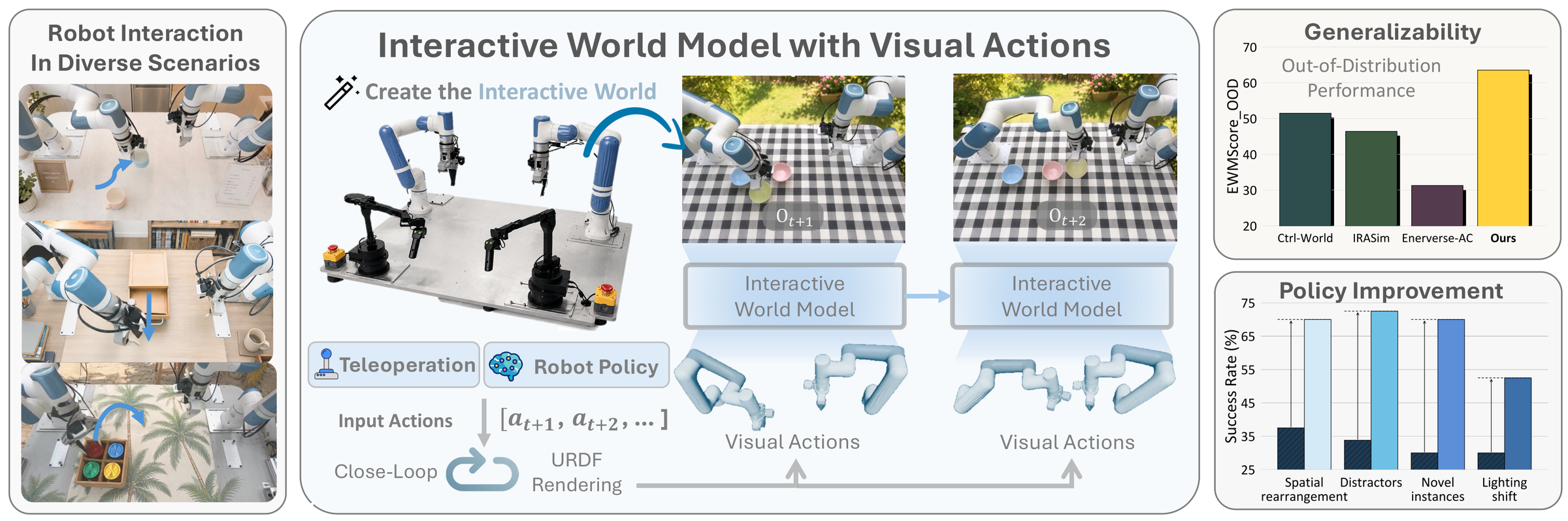
GeniWorld renders URDF-based numerical actions as camera-aligned visual motion conditions, driving a Wan2.2 causal video model to predict environmental responses for closed-loop policy evaluation and data synthesis. On RoboTwin Clean-to-Random it reports FVD 20.15 and EWMScore 63.54. Synthetic data raise aggregate policy success across four real tasks and five settings from 40.8% to 69.0%. It generates future observations rather than actions or object poses, requires robot models and camera calibration, and the official code is still marked Coming soon.
Initial RGB scene image and observation historyTask language instructionsRobot action sequences
Requirements
Robot URDF and forward kinematicsCamera calibration and view alignmentRobot-motion rendererWan2.2-TI2V-5B / causal 3D VAEPaired video and action training data
Full paper metadataAuthors, affiliations, research area, datasets, metrics, method tags, and reading statusExpandCollapse
Shenzhen International Graduate School, Tsinghua University / Tencent Robotics X / The Hong Kong University of Science and Technology / Shenzhen Technology University
Robot URDF and forward kinematicsCamera calibration and view alignmentRobot-motion rendererWan2.2-TI2V-5B / causal 3D VAEPaired video and action training data
Reading Notes
Overview / Deep Dive
Available src/paper-notes/geniworld/coarse.md
Paper overview notes
Quickly assess the paper's scope, problem setting, core method, experimental findings, and whether to read it in depth.
Paper Reading Notes (Coarse): GeniWorld
1. Basic information
Title: GeniWorld: A Generalizable Interactive World Model for Robotic Manipulation via Visual Actions
Affiliations: Tsinghua Shenzhen International Graduate School, Tencent Robotics X, The Hong Kong University of Science and Technology, Shenzhen Technology University
Year / version: 2026; arXiv v1, submitted 2026-08-06; verified sources identify it as a preprint
Code status: as of 2026-09-12, the official page said Coming soon; public implementation and weights had not been confirmed
Reading mode: Overview
2. Positioning in one sentence
GeniWorld uses robot URDF and forward kinematics to render numerical actions as camera-aligned visual actions. A video world model then predicts object / environment responses, supporting interaction, policy evaluation, and synthetic training data in unseen scenes.
It is an action-conditioned world model: actions enter, future observations leave. It is neither an action-output VLA nor an object-R,t 6D pose estimator; this site classifies it under world models.
Method inputs and outputs
Item
Content (compiled for this site)
Inference inputs
Initial / historical RGB, language, and robot-action sequences from an external policy or operator. URDF / kinematics render camera-aligned visual actions to condition video generation.
Final output
Future RGB observations after the supplied actions. This forward model does not generate numerical robot actions, object R,t, or contact forces.
Prerequisites
Robot geometry / kinematics, rendering, and camera alignment; no target CAD, full-scene reconstruction, depth, or instance masks. In closed loop, an external policy reads generated frames and supplies further actions.
2.1 Guide to the paper’s figures and tables
Tables below are compiled by this site; illustrations are originals from the authors’ project page.
Figure / table
What it explains
Reading focus
Figure 1
Connecting humans, policies, and synthetic environments
External policies / operators supply actions
Figure 2
Visual-action and causal-video training / inference
Render robot motion, not full-scene physics
Figure 3
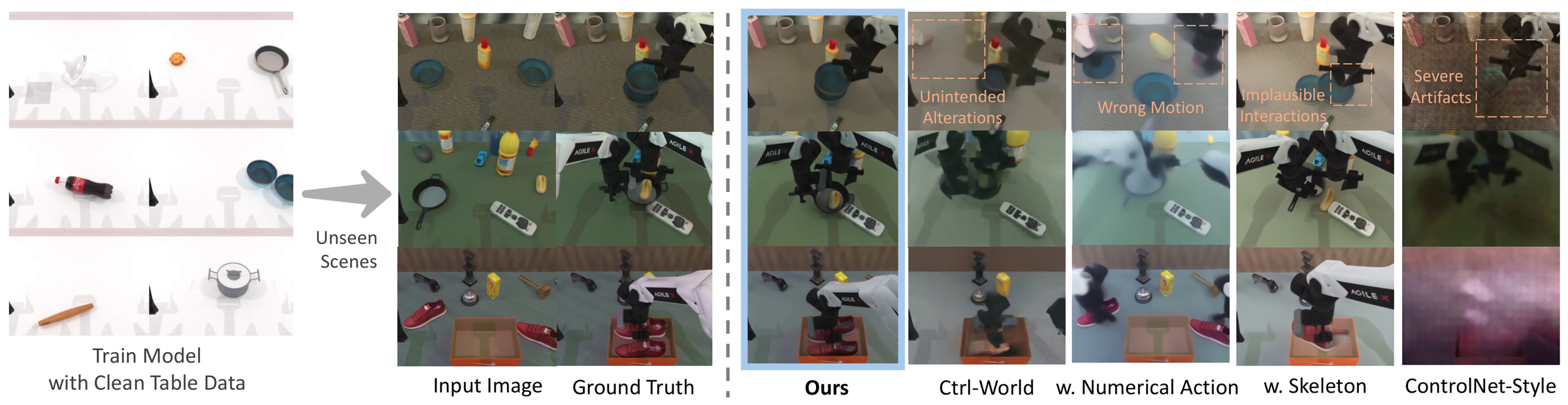
Clean-scene training to randomized-scene testing
Action following and interaction beyond appearance
Table I, compiled here
World-model quality and action-representation ablations
Image / video quality is not robot success rate
Figure 9 / Table III
Synthetic-data benefits for real policies
69.0% averages five settings, including standard scenes
Original Figure 1: external actions drive synthetic-scene responses for policy evaluation and data generation. Upper-right OOD world-model scores and lower-right real-policy gains from synthetic data are different metrics. Source: official author project page. Image copyright belongs to the paper's authors and publisher; reproduced here for paper analysis.
3. Problem setting
Dimension
Setting compiled by this site
Task
Generate subsequent manipulation observations from current / historical observations and supplied actions
Input
Initial RGB scene, language, robot-action sequence; new actions continue in closed loop
Output
Future RGB observations, not object pose, joint actions, or contact-force states
Key assets
Robot URDF, kinematics, and a rendering viewpoint matched to the real camera
Training
Paired robot videos and actions; training is required, using pretrained Wan video models
CAD / depth
Robot geometry and articulation are required; target CAD, full-scene geometry reconstruction, and depth images are not necessary inputs
Generalization
Predict world responses under new appearances, instances, and layouts after fixed-scene training; not zero-shot transfer across every robot
Limited fixed-scene data does not imply no priors: URDF, calibration, and generic video pretraining help. Downstream data synthesis also uses image editing and human teleoperation.
4. Core motivation
Feeding joint angles or end-effector poses directly to a video generator requires learning kinematics, number-to-pixel mappings, and contact-driven changes together. With few scenes, actions can become tied to backgrounds, degrading action following after a scene change.
GeniWorld assigns known kinematics to URDF rendering: first specify where and how the robot moves, then learn the scene response. This reduces what must be inferred implicitly from limited data.
5. Method overview
5.1 Numerical Actions Become Spatially Aligned Visual Conditions
Forward kinematics drives a robot model, rendered from the target camera. The condition isolates robot structure without target-object or background appearance.
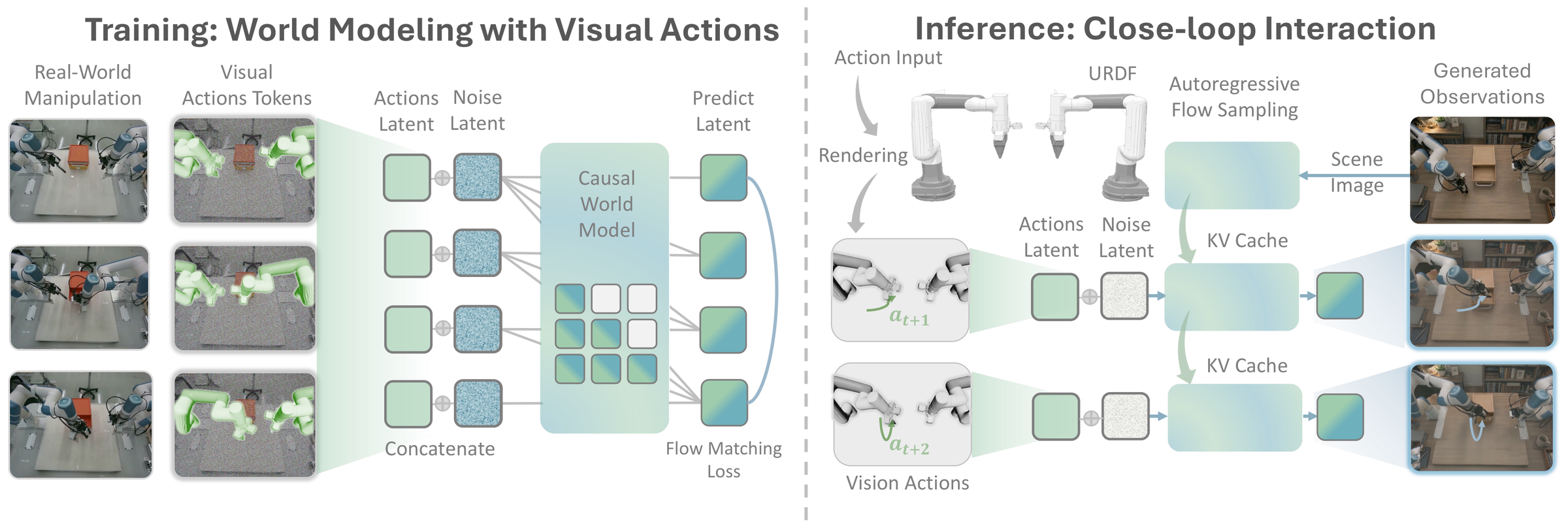
Visual actions and real videos share a causal 3D VAE, with 48 latent channels each. Concatenating clean action and noisy video latents yields 96 input channels. The backbone is Wan2.2-TI2V-5B, adapted by expanding input patch embedding.
Original Figure 2: flow-matching training on the left; action rendering and autoregressive closed-loop generation on the right. Actions remain clean conditions; only observation latents receive noise and prediction. Source: official author project page. Image copyright belongs to the paper's authors and publisher; reproduced here for paper analysis.
5.2 Autoregression and Closed-Loop Feedback
Causal generation predicts future blocks with a history KV cache. Policies / operators read generated observations to provide subsequent actions. Training starts with real history and later incorporates generated history, reducing the gap to closed-loop rollout.
The paper reports approximately 8 Hz interactive inference with 5 sampling steps on NVIDIA H20. This is neither low-level arm servo frequency nor the data’s 24 fps.
5.3 Generating Training Data
GPT-Image, Qwen-Image, and similar editors alter initial object positions, instances, or backgrounds. Action replay or human closed-loop teleoperation then generates trajectories. Humans can create new behaviors beyond changing backgrounds on fixed-action video, but production is not entirely automated.
6. Experimental overview
6.1 World Model: Clean-to-Random
RoboTwin 2.0 has 50 tasks, with 45 Clean training and 5 test trajectories each: 2250 training and 250 in-domain tests. OOD testing uses 250 Random trajectories without target adaptation.
The following is compiled by this site from Table I, showing Clean-to-Random only. Lower LPIPS, FID, and FVD are better; higher EWMScore is better.
Method
LPIPS
FID
FVD
EWMScore
Ctrl-World
0.285
21.66
35.85
51.47
IRASim
0.766
174.52
191.26
46.41
EnerVerse-AC
0.751
74.55
99.14
31.28
GeniWorld
0.144
13.08
20.15
63.54
Same-backbone OOD FVD is 53.69 for numerical actions, 45.89 for end-effector trajectories, and 39.88 for skeletons, all above full visual actions at 20.15. This supports dense, spatially aligned conditioning over these alternatives.
Metric caution: appendix B specifies FVD feature extraction and temporal aggregation, with public code not yet confirmed. Values support within-paper comparisons rather than direct cross-paper rankings.
6.2 Policy Evaluation: Correlation, Not Proven Replacement for Reality
The same π0 policy checkpoints run in GeniWorld and real Xtrainer with matched initial images across four tasks. Success rates correlate positively and are relatively stable under visual distractors. Humans judge binary success; a VLM assists interaction-plausibility assessment.
This supports potential offline evaluation, without guaranteeing accurate predictions for arbitrary new policies or failure modes. Plausible video is not equated with successful physical execution.
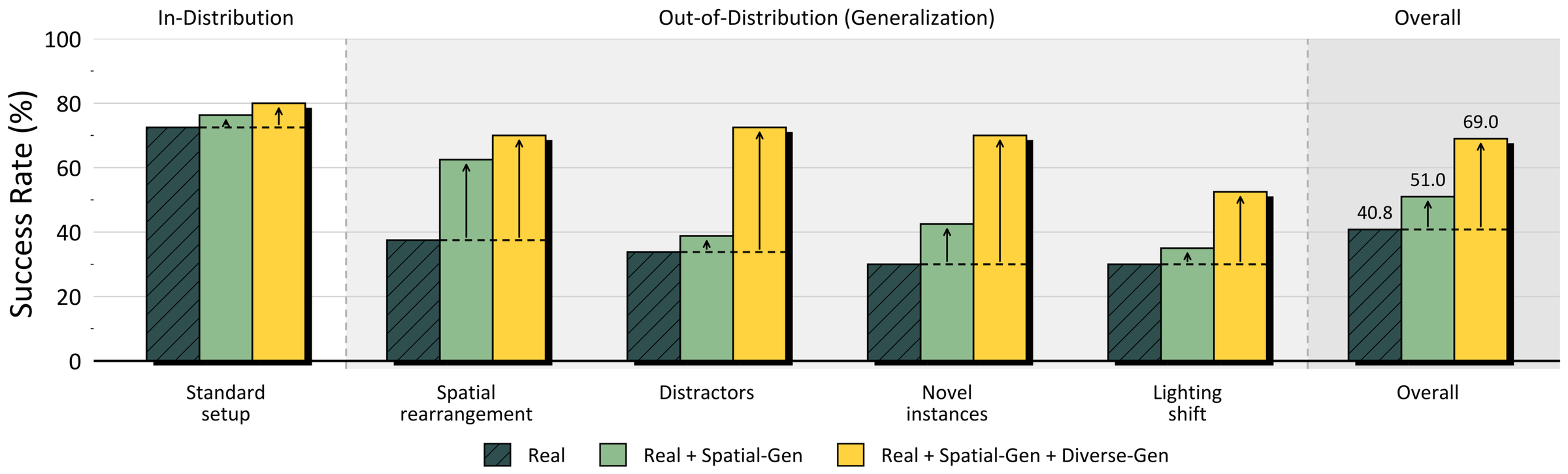
6.3 Data Synthesis: Real-Policy Overall 40.8% to 69.0%
Each task starts from 25 real demonstrations, then adds 65 spatially randomized and 65 diverse synthetic trajectories. Table III means below are compiled by this site, in %.
Training data
Standard
Spatial rearrangement
Distractors
Novel instances
Lighting
Overall
25 Real
72.5
37.5
33.8
30.0
30.0
40.8
+65 Spatial-Gen
76.3
62.5
38.8
42.5
35.0
51.0
Add another +65 Diverse-Gen
80.0
70.0
72.5
70.0
52.5
69.0
Original Figure 9: spatial and scene diversity together help most. Overall averages five settings including standard scenes, not OOD alone. Source: official author project page. Image copyright belongs to the paper's authors and publisher; reproduced here for paper analysis.
Tasks are Move Bowl, Fold Towel, Place Mug, and Open Drawer. Each task / setting has 20 trials, totaling 400 real tests per scheme, requiring whole-task completion. Displayed 40.8%→69.0% is 28.2 percentage points, not a 28.2% relative gain.
7. Strengths and limitations
Strengths
Explicit robot kinematics reduces entanglement of actions and scene appearance.
Validates video quality, policy evaluation, and real-policy improvement beyond attractive videos alone.
Synthesizes data without fully building target-object physics simulations, while supporting action replay and new interaction behaviors.
Limitations / risks
Depends on URDF, viewpoint alignment, and calibration, without systematic calibration-error ablations.
Accurate robot rendering does not guarantee accurate collision, friction, deformable-object, or invisible-contact responses.
Synthetic augmentation changes both volume and diversity, without equal-volume newly collected real-data cost controls; human interaction and filtering costs remain unclear.
The appendix omits a complete training recipe and public code is unconfirmed, so one-command reproduction is not established.
8. Research takeaways
Connection to 6D perception: projection and calibration become a generative-model conditioning interface rather than pose outputs.
Compared with Fast-WAM: Fast-WAM learns low-latency action policies; GeniWorld learns action-conditioned environment responses. Speeds and scores are not directly comparable.
Worth studying: visual actions, causal blocks, and the evidence linking world-model evaluation to real behavior benefits.
Research directions: pose / contact checks for generation errors, or reliable visual-action conditions under calibration uncertainty. These are suggestions, not demonstrated capabilities.
Available src/paper-notes/geniworld/deep.md
In-depth paper notes
Support reproduction, comparison, related-work writing, and identifying opportunities for further research.
Paper Reading Notes (Deep): GeniWorld
1. Basic information
Title: GeniWorld: A Generalizable Interactive World Model for Robotic Manipulation via Visual Actions
Affiliations: Tsinghua Shenzhen International Graduate School, Tencent Robotics X, The Hong Kong University of Science and Technology, Shenzhen Technology University
Version: arXiv:2608.06332v1, 2026-08-06; included as a preprint
Availability: on 2026-09-12 the official code section said Coming soon; project-page source is not the model implementation
Reading mode: deep. Paper reports, site compilations, and my analysis are distinguished below; no training or experimental reproduction was run
2. Positioning in one sentence
GeniWorld converts motion directly computable from robot geometry / kinematics into pixel-aligned conditions. A pretrained video model learns resulting environment responses, with autoregression supporting interactive policy evaluation and data generation.
The main question is how numerical actions condition video generation, and whether the representation improves OOD behavior modeling, beyond changing the video backbone.
Method inputs and outputs
Item
Content (compiled for this site)
Inference inputs
Initial RGB / historical observations, language, and external actions. URDF, kinematics, and calibrated cameras render actions, encoded as clean visual-action latents; future observations start from noise.
Final outputs
Future RGB conditioned on supplied actions, rolled out blockwise. Actions are inputs, not outputs; external policies use video for evaluation, interaction, or augmentation.
Training inputs
Synchronized robot video, language, and action trajectories. Rendered actions condition prediction of real future observations, initially with real history and later generated context.
Training objective
Noise observation latents and predict their flow field; clean action latents are not denoising targets. Learn action-driven visual changes rather than infer actions from video.
Output details
Observation / action latents have 48 channels each, concatenated into 96 input channels; decoding yields 480×640 RGB. Each new block contains 3 latent frames, not 3 action steps or object 6D poses.
Prerequisites
URDF / geometry, forward kinematics, rendering, intrinsics / extrinsics / hand–eye alignment are conditioning assets. Object CAD, depth, and masks are unnecessary; conversion from numerical controls to renderable states depends on the robot interface.
2.1 Guide to the paper’s figures and tables
Figure / table
Experiment / module
Reading focus compiled here
Figure 1
Overall use
Feedback between policy and synthetic environment
Figure 2
Training / inference
Clean actions, noisy observations, causal generation, cached history
Figure 3
Clean-to-Random examples
Distinguish action errors, contact-free grasping, and unrelated-object changes
Table I
Video quality and action ablations
Separate in-domain / OOD and compare six metrics
Figures 4–5
Convergence and few-step sampling
Whether priors reduce training / inference difficulty
Figure 7
Policy evaluator
Correlation supports but does not guarantee ranking new policies
Figure 9 / Table III
Real-policy improvement
Five settings, four tasks, 20 trials per cell, three complete data schemes
Table II / Table IV
Appendix implementation / protocols
3 latent frames per block; Progress is not success rate
Local illustrations are original public project figures. Markdown tables are site compilations, not paper-table screenshots; other figures / tables remain available in the original.
3. Problem setting and task boundaries
3.1 World Models and Action Policies Are Different Functions
Training pairs observation and action trajectories:
D={τi}i=1N,τi={(o0,a0),…,(oT,aT)}.
Given current observations and future actions, the paper writes the prediction target as:
ot+1:t+H=W(ot,at+1:t+H).
Conditional-generation notation does not make future worlds uniquely determined by one image and actions. Noise sampling generates video; uncertainty remains despite the simplified equation.
In closed loop, an external policy acts, the world model supplies future frames, and the policy reads them to act again. Offline quality tests may supply the whole future trajectory; interaction supplies available action segments incrementally. Keep these protocols distinct.
3.2 Inputs, Priors, and Generalization Boundaries
Item
Paper setting
Do not infer
Observations
Initial RGB and autoregressive history, with language task conditions
Complete physical state
Actions
Numerical controls rendered into robot motion
Autonomous model planning / action selection
Robot assets
URDF, structure, kinematics, renderer
Model-free or geometry-free operation
Camera
Real / rendered views aligned; real platform uses hand–eye calibration
No camera parameters or frame relationships
Scene assets
No explicit full geometry reconstruction of targets / backgrounds
Guaranteed accurate environment dynamics
OOD
New appearances, instances, positions, task-related layouts
Zero-shot transfer to every robot, task, or physical mechanism
Output
Future visual observations
Object R,t, size, segmentation, contact forces, or action distributions
This is not instance- / category-level object pose. Real novel-instance tests replace instances within the same functional category, not unseen categories. Object-pose representations and symmetry handling are not explicitly defined.
4. Research context
4.1 Numerical Controls to Pixel-Aligned Conditions
The paper discusses action-conditioned models such as Ctrl-World, IRASim, WorldEval, and WorldGym, where joint / end-effector vectors condition motion and environment generation.
Pixel-aligned approaches use projected end-effector paths, skeletons, robot masks, or point clouds to simplify action-to-image mapping. GeniWorld uses dense robot rendering for detailed geometry and interaction, without claiming to introduce geometric video conditioning first.
These approaches can complement each other, but FVD, policy success, and inference latency do not form one comparable leaderboard.
5. Research motivation
Numerical actions lack explicit image positions. Fixed-scene correlations may force the model to infer cameras, kinematics, and contact, encouraging background shortcuts.
The authors separate known kinematics for robot motion from learned scene responses. This is a structured inductive bias, not a causal-identifiability proof. It assumes robot motion drives most visual changes and rendering is sufficiently accurate.
Original Figure 1: rendered URDF motion is the input interface; external operators / policies decide actions, and the model generates interactive observations. Source: official author project page. Image copyright belongs to the paper's authors and publisher; reproduced here for paper analysis.
6. Method details
6.1 Numerical to Visual Actions
URDF and forward kinematics render an action sequence from the target camera as mt+1:t+H. The world model becomes:
ot+1:t+H=W(ot,mt+1:t+H).
Rendering supplies robot structure / motion without manipulated objects or backgrounds. It solves part of how the robot moves, not how objects are pushed, grasped, or folded.
My geometric interpretation: pixel alignment requires consistent joint-to-surface, robot-to-camera, and projection transforms. Camera parameters are external conditioning dependencies, not estimation outputs. End-effector controls additionally require a defined conversion to renderable robot states; not every control interface is specified.
6.2 Shared VAE and Channel Concatenation
The same causal 3D VAE encodes action renders and observations:
za,zv∈RC×L×H′×W′,z=[zv;za]∈R2C×L×H′×W′.
Here L is latent temporal length and H′,W′ latent spatial size; brackets mean channel concatenation. Actions and video are not independent sequences joined in time: information corresponds directly at each spatiotemporal location.
The appendix uses C=48, expanding inputs from 48 to 96 channels. The first 48 channels of the 3D convolution patch embedding inherit pretrained weights; new 48 channels use Kaiming initialization scaled by 0.1×, with the original bias.
This preserves the pretrained video path while injecting initially small action conditions. A small architectural change does not establish training only the new input layer; freezing details are insufficient for an adapter-only assumption.
Original Figure 2: training predicts observation flow; inference continuously renders actions and retains history in a KV cache. Source: official author project page. Image copyright belongs to the paper's authors and publisher; reproduced here for paper analysis.
6.3 Flow Matching: Noise Observations Only
Let zt+1 denote the next observation-latent segment, s∈[0,1] flow time, and ϵ∼N(0,I). Equation (1) uses:
z≤t is history, za,t+1 matching actions, and c language. Only observations are noised and predicted; visual-action latents remain clean conditions. This differs from jointly generating future video and actions in WAM objectives.
Here s=0 is noise and s=1 data, opposite the convention in the Fast-WAM notes. Interpolation, velocity targets, and solver direction must agree.
6.4 Causal History and Generated Feedback
Training begins with real history before including model predictions to reduce exposure bias. Self Forcing is cited without complete switching schedules, generated-history ratios, or gradient strategies; citation alone does not imply an identical implementation.
Inference uses causality across blocks, full attention within the new block. Historical key/value tokens are cached. Although the text summarizes attention to previous tokens, inference explicitly allows within-block self-attention; pixels are not all generated strictly one at a time.
The VAE compresses 121 pixel frames to 31 latent frames; the first frame forms its own block, then 3 latent frames are generated per block. Latent blocks, action steps, and decoded frames are different time scales.
6.5 Training and Inference Parameters
Compiled by this site from appendix A / Table II:
Parameter
Setting
Backbone
Wan2.2-TI2V-5B
Objective
Autoregressive causal flow matching
Input channels
Video 48 + actions 48 = 96
Learning rate
10−5
Global batch size
4
Training hardware
4 NVIDIA H20 GPUs
Noise-timestep configuration
1000; noise schedule shift 5.0
Color augmentation
Color overlay on GT video and initial frames with p=0.5
Output resolution
480×640
Temporal layout
121 pixel frames / 31 latent frames; 3 latent frames per new block
CFG scale
3.0
Sampling steps compared
50, 10, 5
1000 configures the noise process, not 1000 mandatory forward passes per inference. Total training steps, optimizer details, precision, and peak memory are not fully listed; GPU count alone cannot establish training cost.
6.6 Two Interactive Uses
Policy evaluation: render policy actions into the world model and feed generated frames back as observations. Faithful mistakes matter as much as successful demonstrations; otherwise policy ability is overestimated.
Data production: edit initial images, then replay actions or teleoperate new trajectories. Editing sets the initial scene rather than independently generating every interaction frame; GeniWorld supplies temporal consistency and action response.
The real system loads Xtrainer URDF into Isaac Sim with hand–eye calibration and matched camera views. Simulation controls / renders the robot; this does not build validated physics models for every object.
7. Experimental analysis
7.1 Three Experiments Answer Different Questions
Experiment
Data / procedure
Evaluation target
World-model quality
RoboTwin 2.0: 50 tasks, 2250 Clean training, 250 Clean / 250 Random test trajectories
Video conditioned on supplied actions
Policy-evaluation reliability
Same π0 checkpoints in world model and reality
Relationship between success rates
Data-augmentation value
25 real demos per task plus synthetic trajectories, then policy training and real tests
Downstream whole-task success
World-model OOD sequences contain 121 frames at 24 fps, given initial RGB, language, and future actions. Random changes appearance, instances, positions, and task layouts without test adaptation. Zero-shot means no target-distribution adaptation, not no prior robot-data exposure.
Real tasks are Move Bowl, Fold Towel, Place Mug, and Open Drawer. Real-data collection uses clean tables with randomized target poses. The stated 25 demonstrations per task train downstream policies; this does not establish the entire real-world-model training set as exactly 25 trajectories.
7.2 Metrics and FVD Conventions
Metric
Direction
Measures / omissions
PSNR
Higher
Pixel error, not task completion
SSIM
Higher
Image structure, not contact dynamics
LPIPS
Lower
Perceptual distance with appendix AlexNet backbone
FID
Lower
Frame-distribution difference with appendix Inception-v3
FVD
Lower
Reported video distance; verify extractor and aggregation
EWMScore
Higher
WorldArena-protocol model score, not percent success
Real-task success rate
Higher
Whether full Done conditions are met
Reproduction caution: appendix B describes FVD as Fréchet distance after concatenating temporal means / standard deviations of Inception-v3 features. Verify this against forthcoming code rather than assuming identical implementation from the metric name and citation. This page preserves the paper’s FVD label / numbers for within-protocol comparisons.
Good metrics may still miss action-response errors or implausible physics. Paired PSNR / LPIPS, distribution metrics, and real downstream tests belong together; no single video-quality score replaces behavior evaluation.
7.3 Main Results: Clean-to-Clean
Compiled by this site from Table I, preserving reported precision.
Method / action condition
LPIPS
PSNR
SSIM
FID
FVD
EWMScore
Ctrl-World
0.165
18.65
0.879
9.62
15.52
58.74
IRASim
0.323
13.26
0.801
42.98
48.98
48.83
EnerVerse-AC
0.378
10.89
0.780
40.35
54.28
52.92
Same backbone + numerical actions
0.3773
11.59
0.7836
42.69
48.03
57.69
Same backbone + EE trajectory
0.1848
17.17
0.8632
12.19
18.35
60.00
Same backbone + skeleton
0.1801
17.38
0.8609
12.49
18.82
60.04
ControlNet-style conditioning
0.094
23.99
0.927
8.82
12.36
59.26
GeniWorld visual actions
0.055
27.57
0.942
5.59
7.59
61.80
7.4 Main Results: Clean-to-Random
Also compiled here from Table I. All methods share training splits and no OOD fine-tuning; this does not equalize external backbones, parameter counts, or compute.
Method / action condition
LPIPS
PSNR
SSIM
FID
FVD
EWMScore
Ctrl-World
0.285
20.41
0.791
21.66
35.85
51.47
IRASim
0.766
8.15
0.476
174.52
191.26
46.41
EnerVerse-AC
0.751
12.25
0.433
74.55
99.14
31.28
Same backbone + numerical actions
0.3659
13.74
0.6961
40.91
53.69
51.49
Same backbone + EE trajectory
0.3000
14.17
0.7158
37.69
45.89
61.36
Same backbone + skeleton
0.2568
18.48
0.7956
31.78
39.88
61.61
ControlNet-style conditioning
0.416
14.51
0.625
40.02
59.95
56.13
GeniWorld visual actions
0.144
22.71
0.873
13.08
20.15
63.54
GeniWorld leads all six metrics in both settings; against Ctrl-World, OOD FVD drops from 35.85 to 20.15. This applies to the tested models, data, and protocols, not universal current world-model SOTA.
7.5 Ablations and Qualitative Evidence
Comparison
Evidence
My assessment
Numerical to visual actions
OOD FVD 53.69 → 20.15
Supports explicit spatial conditioning
EE / skeleton to dense rendering
OOD FVD 45.89 / 39.88 → 20.15
Supports richer structure, with different information content per representation
ControlNet-style to direct concatenation
OOD FVD 59.95 → 20.15
Better under this recipe, not proof against every ControlNet implementation
Training convergence
Figure 4 1−LPIPS curves
Supports faster convergence; full GPU-hour controls are missing
50 / 10 / 5 sampling steps
Figure 5; reported approximately 10× speedup with approximately 2% FVD degradation
Cheaper sampling, not universal end-to-end speedup across hardware / resolutions
Original Figure 3: blue boxes mark GeniWorld; other columns show author-selected action / interaction failures. These qualitative examples do not establish overall failure frequencies. Source: official author project page. Image copyright belongs to the paper's authors and publisher; reproduced here for paper analysis.
With fewer sampling steps, reported FVD degradation is approximately 22% for numerical actions and 2% for visual actions. These are generation-quality changes across sampling settings, not a 2-point robot-success drop. Approximately 8 Hz with 5 steps on H20 is interactive inference; alignment with latent blocks, VAE decoding, and low-level controls needs code and timing breakdowns.
7.6 Policy Evaluation: How Strong Is the Evidence?
The same π0 checkpoints run from corresponding first frames in reality and GeniWorld. Humans judge success and a VLM judges plausible interactions. Figure 7 shows positive success-rate correlation and better visual-distractor stability than Ctrl-World.
My analysis: useful feasibility evidence, not replacement of real evaluation. Further tests should measure prediction error, systematic optimism, policy-ranking correlation, faithful failures, and calibration on new policies excluded from model selection. Correlation coefficients, confidence intervals, and full checkpoint-wise numbers are not completely listed; this page does not invent them.
7.7 Synthetic Data Improves Real Policies
Three complete verifiable data schemes are reported per task:
Scheme
Real trajectories
Spatial synthetic
Diverse-scene synthetic
Total
Real
25
0
0
25
Real + Spatial-Gen
25
65
0
90
Real + Spatial-Gen + Diverse-Gen
25
65
65
155
Spatial-Gen broadens target-position coverage; Diverse-Gen varies scenes and instances. Image editors create initial frames, while replay / teleoperation supplies actions. All policies start from one public π0 base checkpoint and use matched OpenPI fine-tuning, varying only data. Policy horizon is 16, not the world model’s 3 latent frames per block.
Compiled here from Table III means, in %:
Scheme
Standard
Spatial
Distractors
Novel inst.
Lighting
Overall
Real
72.5
37.5
33.8
30.0
30.0
40.8
+ Spatial-Gen
76.3
62.5
38.8
42.5
35.0
51.0
+ Spatial-Gen + Diverse-Gen
80.0
70.0
72.5
70.0
52.5
69.0
Original Figure 9: full augmentation reaches Overall 69.0%, averaging five settings, not OOD alone. Source: official author project page. Image copyright belongs to the paper's authors and publisher; reproduced here for paper analysis.
Each scheme has 4 tasks × 5 settings × 20 trials = 400 real tests, resetting each time. Mean averages four tasks and Overall averages five settings. Displayed values imply a gain of 28.2 percentage points overall, while lighting still reaches only 52.5%, leaving substantial generalization challenges.
Table III per-task Overall helps expose variation hidden by means:
Task
Real
+ Spatial-Gen
Add + Diverse-Gen
Move Bowl
53
63
83
Fold Towel
32
42
59
Place Mug
43
54
73
Open Drawer
35
45
61
Fold Towel Standard is 70% with Spatial-Gen and 65% with full augmentation. Best overall does not imply monotonic gains in every task / setting. With 20 trials per cell, one outcome changes 5 percentage points; cross-training-seed variance is insufficiently reported.
Grouping inconsistency: the text says four data regimes but enumerates three, later citing a separate Diverse-Gen comparison. Figure 9 and appendix Table III fully report the three schemes above. This page uses those complete tables without inventing missing Diverse-Gen-only groups or task results.
7.8 Success Criteria and Failures
Table IV Done conditions are summarized here:
Task
Full success requires
Move Bowl
Place the bowl stably at the target
Fold Towel
Complete top-to-bottom and right-to-left folding stages
Place Mug
Grasp through the handle and place stably in the target region
Open Drawer
Open the drawer, insert a marker, then close it
Table IV Progress is the mean normalized time of stage completion in successful demos, not stage success rate. Opening the drawer alone, for example, does not complete Open Drawer.
Qualitative tests cover instances, backgrounds, distractors, and lighting, but lack systematic failure groups for occlusion, reflective / transparent materials, calibration errors, friction, or external forces. Apparent grasping may still lack contact or plausible dynamics and needs independent behavioral validation.
8. Critical analysis
8.1 Contributions and Evidence
Author claim
Experiments
My assessment
Visual actions improve generation and OOD generalization
Table I + Figure 3 + same-backbone condition ablations
Direct downstream evidence, with volume, diversity, and acquisition costs incompletely separated
Broad robot applicability
Kinematic interface and tested platforms
Insufficient for arbitrary zero-shot embodiment transfer
8.2 Strengths
Known kinematics avoids relearning all geometry from limited scenes; pixel-aligned conditions also suit pretrained video representations. Experiments reach real behavior beyond video quality, making augmentation evidence more convincing than generation demos alone.
8.3 Limitations and Assumptions
Kinematics is not dynamics. URDF describes robot occupancy, while contact forces, friction, deformation, and responses remain learned approximations without hard conservation / contact-solving constraints.
Calibration is a hidden cost. Alignment needs consistent real / rendered cameras and robot states. Camera-mount changes and calibration noise are untested; interface robustness is not automatic.
More data and better representations are not fully separated. Expanding 25 real to 155 mixed trajectories changes volume, scenes, actions, and human corrections together. Equal-budget new real demos, resampling, and alternative synthesis controls are insufficient.
Interactive synthesis retains human and external-model costs. Operators create new behaviors and image models edit scenes. Filtering, retained failure rates, and total operation time are incomplete; avoiding new physical scenes does not remove human labor.
Evaluators may hide bad actions. Generative priors could turn invalid actions into plausible interactions, overstating policies; optimizing against the model may also exploit its flaws. Current correlations do not exclude these risks.
9. Reproduction and Unresolved Details
The official page supplies demos / figures with code labeled Coming soon. This paper-based checklist is not an executed reproduction guide:
Obtain implementation, checkpoints, rendering code, and URDF; check camera parameters, hand–eye transforms, joint order, angle units, and timestamps.
Verify same-time pixel alignment and absence of extra target-object / future-scene information in conditioning.
Implement 48+48 channels and specified initialization, keeping actions clean and observations noisy.
Fix 2250 Clean training and two 250-test splits; check video sampling, preprocessing, and metrics, especially FVD / EWMScore.
Reproduce video quality, evaluator calibration, and real-policy gains separately; log human rules, generation failures, policy seeds, and real trial counts.
Unresolved details include full real-world-model dataset size, training duration, optimizer / freezing scope, generated-history schedules, camera-mismatch tolerance, filtering costs, the 8 Hz timing boundary, and complete evaluator-correlation statistics.
10. Future Work and Research Insights
The conclusion emphasizes generalizable imagined environments without a full roadmap. The following are my research suggestions:
Geometric consistency auditing: use object poses, contacts, or multiview checks to detect contact-free grasps, penetration, and spontaneous changes.
Uncertain conditioning: perturb camera parameters, joints, or silhouettes to test reliability under real calibration errors.
Evaluator calibration: retain failures / wrong actions, split by policy rather than only task, and report ranking correlations and success-prediction error.
Separate augmentation sources: fix counts while varying backgrounds, positions, instances, and actions, adding real-data baselines with equal human time.
Expand interaction boundaries: test external forces, contact changes, long occlusion, and cross-robot transfer beyond visual shifts.
For 6D research, geometry can condition generation by mapping robot controls into spatial form, beyond being an estimation output. Constraining generators with known geometry and recovering unknown geometry from images are distinct tasks.
11. Assessment
GeniWorld converts controls to pixel-aligned video conditions through dense URDF motion rendering, using closed-loop generation for evaluation and real-policy augmentation. Tables I / III provide clear generation and downstream evidence. Contact physics, evaluator calibration, cross-robot transfer, and end-to-end costs remain bounded; realistic video is not equivalent to reliable physical simulation.