GigaPose: Fast and Robust Novel Object Pose Estimation via One Correspondence
GigaPose renders only 162 out-of-plane templates, predicts scale, in-plane rotation, and translation from a single 2D–2D patch correspondence, and selects pose with RANSAC. Coarse mean AR across seven BOP datasets is 26.8 at 0.4 s/image. A single detection's coarse estimate takes 48 ms, around 35× faster than MegaPose's 1.68 s; five-hypothesis GenFlow refinement reaches mean AR 60.5.
known test-time CAD model or externally reconstructed 3D modelCNOS object detections / masks in the reported pipelinecamera intrinsicsoffline rendering and feature onboardingoptional MegaPose or GenFlow refinement
Full paper metadataAuthors, affiliations, research area, datasets, metrics, method tags, and reading statusExpandCollapse
Authors
Van Nguyen Nguyen, Thibault Groueix, Mathieu Salzmann, Vincent Lepetit
known test-time CAD model or externally reconstructed 3D modelCNOS object detections / masks in the reported pipelinecamera intrinsicsoffline rendering and feature onboardingoptional MegaPose or GenFlow refinement
Reading Notes
Overview / Deep Dive
Available src/paper-notes/gigapose-cvpr2024/coarse.md
Paper overview notes
Quickly assess the paper's scope, problem setting, core method, experimental findings, and whether to read it in depth.
Paper Reading Notes (Coarse): GigaPose
1. Basic information
Title: GigaPose: Fast and Robust Novel Object Pose Estimation via One Correspondence
Authors: Van Nguyen Nguyen, Thibault Groueix, Mathieu Salzmann, Vincent Lepetit
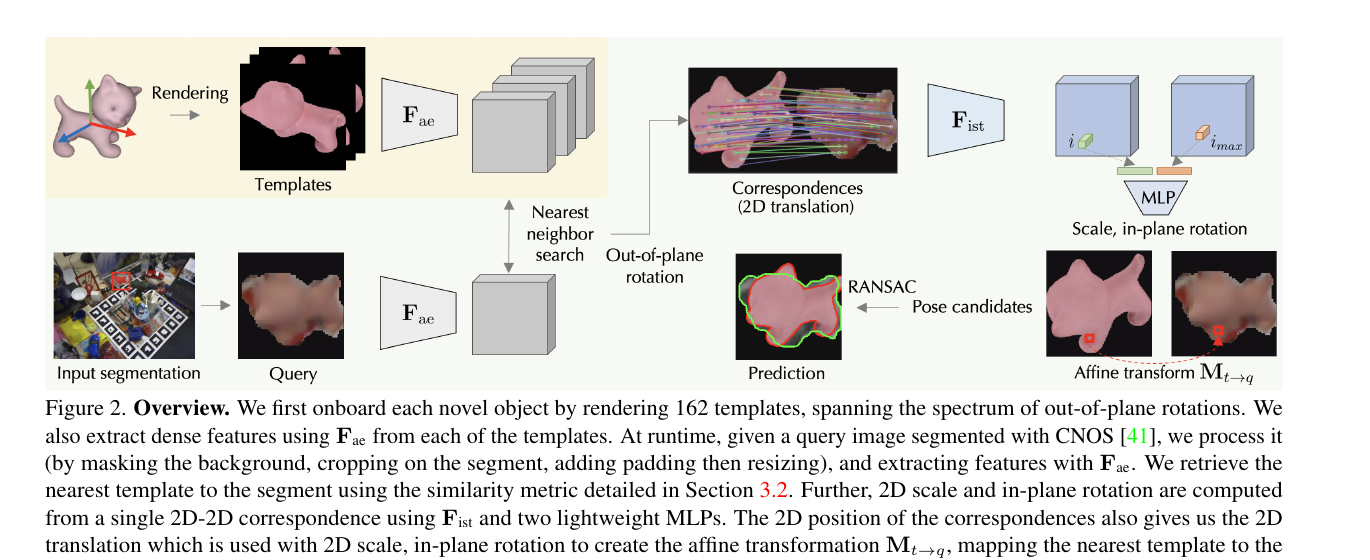
GigaPose reduces CAD templates from full 3DoF rotation to 162 azimuth / elevation views. One 2D–2D patch correspondence recovers in-plane rotation, scale, and image translation, producing fast coarse 6D poses for objects unseen during training.
3. Guide to figures and tables
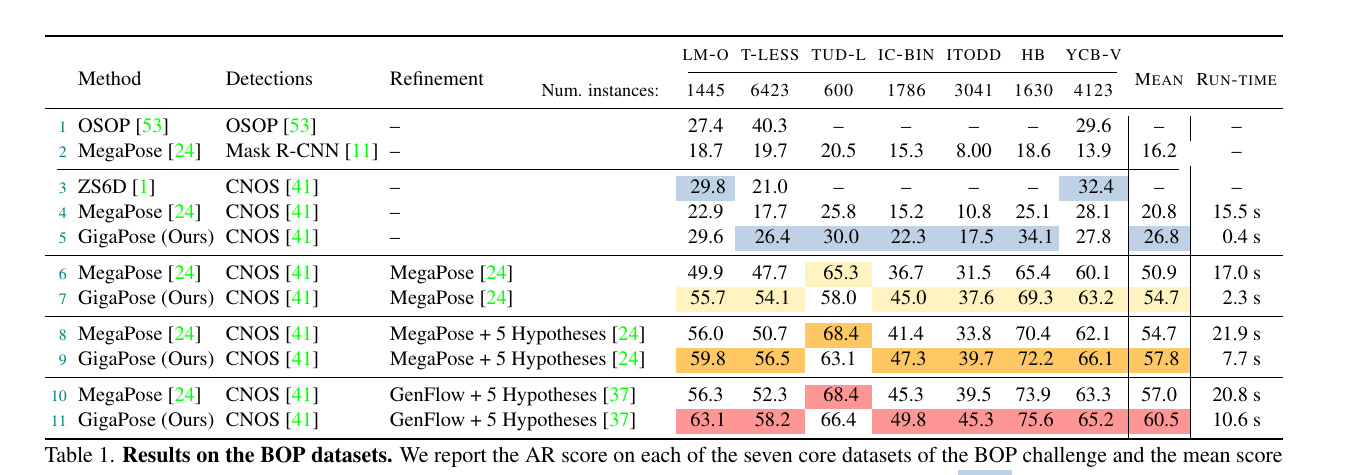
Original Figure 2: retrieval determines out-of-plane rotation. Two local feature sets enter lightweight MLPs for scale / in-plane rotation; correspondence positions give 2D translation, and RANSAC selects consistent candidates. Source: official CVPR 2024 paper. Image copyright belongs to the paper's authors and IEEE/CVF; reproduced here for paper analysis.Original Table 1: with CNOS detections and no refinement, GigaPose reaches mean AR 26.8 at 0.4 s per image. MegaPose single / five hypotheses or GenFlow five-hypothesis refinement gives 54.7, 57.8, and 60.5, respectively. Source: official CVPR 2024 paper. Table copyright belongs to the paper's authors and IEEE/CVF; reproduced here for paper analysis.
4. Problem setting
Inputs: RGB object detections / segmentations, intrinsics, and CAD of new objects supplied at test time.
Output: coarse object pose in camera coordinates; optional MegaPose / GenFlow refinement.
Shared training uses large-scale BOP / MegaPose synthetic data, without retraining for each new object.
New objects still need onboarding: render 162 templates and precompute features.
The main system uses CNOS masks; segmentation robustness does not mean segmentation-free operation.
MegaPose single-hypothesis refinement: GigaPose 54.7, 2.3 s, versus MegaPose initialization 50.9, 17.0 s.
MegaPose five-hypothesis: GigaPose 57.8, 7.7 s.
GenFlow five-hypothesis: GigaPose 60.5, 10.6 s.
Single-detection coarse stage: 48 ms, versus MegaPose 1.68 s; approximately 35–38× faster.
Onboarding: GigaPose 11.5 s / object versus MegaPose 0.82 s. Speed gains mainly concern repeated inference, not initial setup.
Wonder3D single-image reconstruction instead of GT CAD gives LM-O coarse / refined 17.6 / 27.2, near CAD-based 18.3 / 27.9.
Increasing 162 to 576 templates raises three-dataset ablation mean AR only from 27.9 to 28.5.
7. Quick assessment
Strengths: clear freedom decomposition; precomputed features / nearest neighbors replace repeated template forwards; coarse / refiner / total timings are separated; public code.
Limitations: CAD or external reconstruction, masks, and intrinsics remain. Small objects, severe occlusion, or poor CAD create outliers; onboarding is slower than MegaPose; coarse AR alone is insufficient for precise manipulation.
Timing caution: 0.4 s is whole-image BOP time including CNOS; 48 ms is coarse time per detection.
Relevant readers: CAD-based novel-object pose, template retrieval, DINOv2 correspondences, fast 6D pose, and interchangeable refiners.
Available src/paper-notes/gigapose-cvpr2024/deep.md
In-depth paper notes
Support reproduction, comparison, related-work writing, and identifying opportunities for further research.
Paper Reading Notes (Deep): GigaPose
1. Key assessment
GigaPose’s design is simple: do not discretize every rotational degree of freedom with templates.
Sampling azimuth, elevation, and in-plane rotation rapidly expands conventional template banks. GigaPose renders only 162 out-of-plane views:
Retrieval determines azimuth / elevation;
One local 2D–2D correspondence supplies scale, in-plane rotation, and 2D translation;
Scale + intrinsics recover depth / 3D translation;
RANSAC selects among one-correspondence candidates.
Precomputed dense features reduce MegaPose’s query–template scoring from 1.68 s to 48 ms / detection. Seven-dataset coarse mean AR rises from 20.8 to 26.8, retaining better initialization with matched refiners.
One correspondence does not guarantee a stable final pose alone: each match generates a candidate, selected by multicandidate RANSAC. The title refers to information sufficient to define one complete candidate.
2. Inputs, Outputs, and System Boundaries
Input:
RGB image;
CNOS object masks / detections;
Intrinsics K;
New-object CAD at test time;
Templates / features precomputed at onboarding.
Outputs:
Coarse R,t;
Optional top-1 / top-5 hypotheses;
Optional MegaPose or GenFlow refinement.
Training excludes test objects. Approximately 2M BlenderProc renderings of Google Scanned Objects / ShapeNet train shared weights, without updates for BOP test objects.
Novel means unseen instances, while CAD identities remain known and CNOS supplies discovery / segmentation. This is not open-vocabulary, model-free, or category-level pose.
3. Decomposing Degrees of Freedom
Original Figure 2. \(F_{\mathrm{ae}}\) retrieves template / query out-of-plane rotation. Paired patches use \(F_{\mathrm{ist}}\) and MLPs for scale / in-plane angle; coordinates supply translation; RANSAC selects candidates. Source: official CVPR 2024 paper. Image copyright belongs to the paper's authors and IEEE/CVF; reproduced here for paper analysis.
Full 6DoF pose is reparameterized as:
out-of-plane rotation: azimuth, elevation;
In-plane rotation α;
Image-plane translation tx,ty;
Metric scale s, converted to depth through template geometry / intrinsics.
After nearest-template retrieval, out-of-plane rotation is known. For template patch i and query patch i′:
Their positions yield image translation;
Both Fist features enter scale and angle MLPs;
Form affine transform Mt→q;
Compose with template pose into a full 6D candidate.
Where standard 3D–2D PnP needs multiple correspondences, known template viewpoint and learned scale / angle priors let one 2D–2D match define a candidate.
4. Why Separate Feature Sets?
Retrieval features Fae should:
Ignore scale, in-plane rotation, and 2D translation;
Retain out-of-plane sensitivity;
Match across synthetic templates / real queries.
In contrast, Fist must retain:
in-plane rotation;
scale.
Fully invariant features would discard the required scale / angle information. Separate representations handle retrieval invariance and remaining-DoF regression.
5. Local Contrastive Learning for Fae
Training pairs render the same CAD with:
Identical out-of-plane rotation;
Different scale, in-plane angle, and translation.
Known render geometry establishes GT 2D–2D matches. Positives have:
The same object;
The same surface patch;
Allowed scale / in-plane / translation changes.
Negatives include:
Incorrect positions on the same object;
Different out-of-plane rotations;
Other objects;
Other batch templates.
Local contrastive learning brings matching patches together and separates others. Training additionally uses:
color augmentation;
random crop;
random in-plane rotation.
These reduce synthetic-to-real gaps and teach Fae invariance. The backbone is DINOv2 ViT, not frozen off-the-shelf DINOv2: Table 4 gives mean AR 19.0 without fine-tuning versus 27.9 full, a gain of 8.9.
6. Template Count and Onboarding
162 viewpoints come from a regular icosphere, subdividing Blender triangles into four and covering camera direction / out-of-plane rotation.
For each new object:
Render 162 templates;
Extract and store Fae dense features;
Build a nearest-neighbor index.
Onboarding times:
GigaPose: 11.5 s / object;
MegaPose: 0.82 s / object.
More computation moves to onboarding for repeated-inference speed. The 11.5 s cost amortizes best when the same object is used repeatedly.
The 576-template ablation gives:
162 templates mean AR: 27.9;
576 templates: 28.5;
Only 0.6 improvement.
This supports one-correspondence recovery reducing dense template requirements for remaining degrees of freedom.
7. Main BOP Results
Original Table 1. Columns are LM-O, T-LESS, TUD-L, IC-BIN, ITODD, HB, YCB-V. Groups compare GigaPose / MegaPose initialization with matched CNOS detections and refiners. Source: official CVPR 2024 paper. Table copyright belongs to the paper's authors and IEEE/CVF; reproduced here for paper analysis.
Across seven datasets:
132 objects;
19,048 test instances;
Mixed clutter, occlusion, texturelessness, and industrial objects;
Standard BOP AR averages threshold recalls for VSD, MSSD, MSPD.
Without refinement:
Method
LM-O
T-LESS
TUD-L
IC-BIN
ITODD
HB
YCB-V
Mean
time
MegaPose + CNOS
22.9
17.7
25.8
15.2
10.8
25.1
28.1
20.8
15.5 s
GigaPose + CNOS
29.6
26.4
30.0
22.3
17.5
34.1
27.8
26.8
0.4 s
GigaPose trails only YCB-V by 0.3 and improves every other dataset. T-LESS, IC-BIN, ITODD gains exceed 5 points, supporting textureless / industrial robustness.
With different refinements:
Initialization + refiner
Mean AR
time
MegaPose init + MegaPose 1 hyp
50.9
17.0 s
GigaPose init + MegaPose 1 hyp
54.7
2.3 s
MegaPose init + MegaPose 5 hyp
54.7
21.9 s
GigaPose init + MegaPose 5 hyp
57.8
7.7 s
MegaPose init + GenFlow 5 hyp
57.0
20.8 s
GigaPose init + GenFlow 5 hyp
60.5
10.6 s
Better coarse pose also helps the same refiner avoid local minima.
8. Qualitative Results, Predicted Models, and Speed
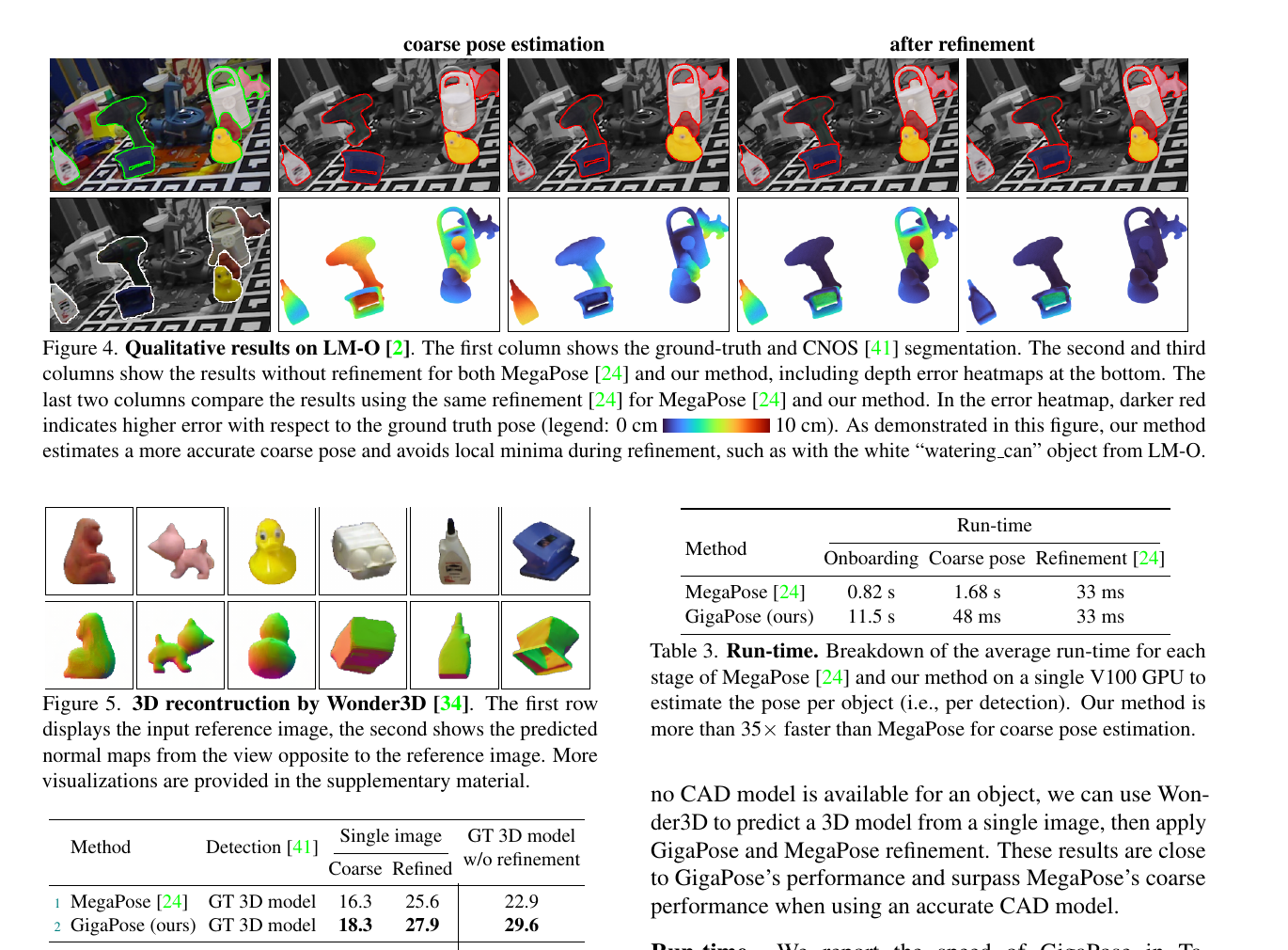
Original Figures 4–5 and Tables 2–3. Coarse / refined poses above, Wonder3D single-image reconstruction below-left, and separate onboarding / coarse / refinement timings below-right. Source: official CVPR 2024 paper. Figure and table copyright belongs to the paper's authors and IEEE/CVF; reproduced here for paper analysis.
Per detection on V100:
Stage
MegaPose
GigaPose
Onboarding / object
0.82 s
11.5 s
Coarse pose / detection
1.68 s
48 ms
MegaPose refinement
33 ms
33 ms
The paper reports approximately 35× speedup, consistent with 1.68 / 0.048 = 35×, while elsewhere saying more than 38×, possibly from unrounded timings. This site consistently uses approximately 35×.
Table 1’s 0.4 s is mean per image including CNOS and every detection, unlike 48 ms / detection.
Wonder3D predicted model, LM-O:
3D source
Method
Coarse
Refined
GT CAD
MegaPose
16.3
25.6
GT CAD
GigaPose
18.3
27.9
single-image model
MegaPose
15.4
25.2
single-image model
GigaPose
17.6
27.2
Wonder3D tests use carefully selected reference images because reconstruction is input-sensitive. They show potential, not general removal of CAD dependencies.
9. Segmentation Robustness and Ablations
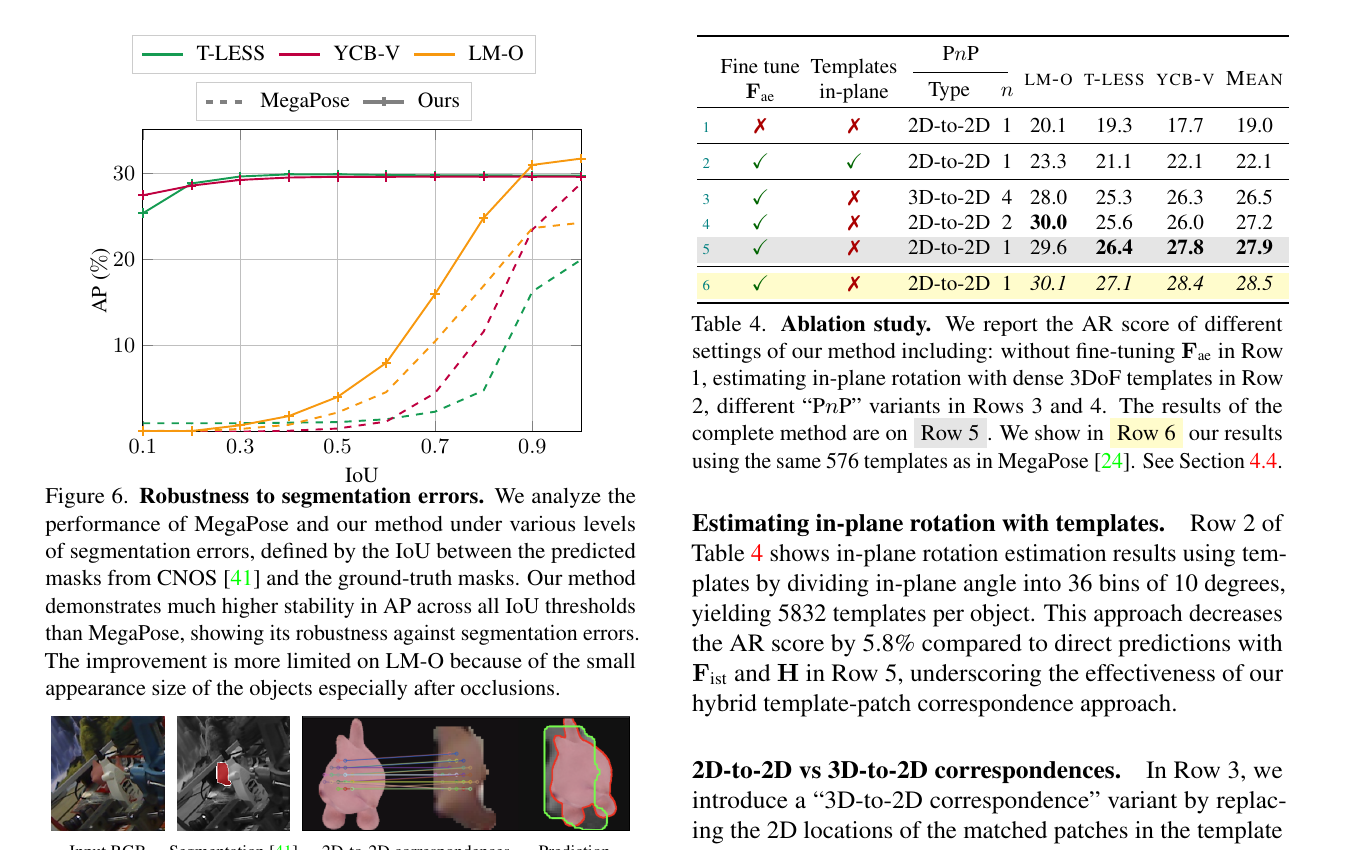
Original Figures 6–7 and Table 4. Left: AP grouped by CNOS mask IoU and small-object LM-O failures. Right: fine-tuning, dense in-plane templates, 3D–2D / two-correspondence variants, and template counts. Source: official CVPR 2024 paper. Figure and table copyright belongs to the paper's authors and IEEE/CVF; reproduced here for paper analysis.
On T-LESS / YCB-V, AP varies less with mask IoU than MegaPose, which mainly scores well at high IoU. Reasons include:
Dense-patch retrieval avoids compressing the whole crop into one score;
RANSAC ignores some boundary / background outliers;
Precomputed template features avoid joint forwards for every noisy crop / template pair.
LM-O improves less because:
Objects are small in images;
heavy occlusion;
Resized masks leave few usable patches;
Some CAD has low fidelity.
Table 4:
Setting
LM-O
T-LESS
YCB-V
Mean
Without fine-tuning Fae
20.1
19.3
17.7
19.0
36-bin in-plane templates, 5832 total
23.3
21.1
22.1
22.1
3D–2D ePnP, 4 correspondences
28.0
25.3
26.3
26.5
2D–2D Kabsch, 2 correspondences
30.0
25.6
26.0
27.2
one-correspondence full
29.6
26.4
27.8
27.9
full + 576 templates
30.1
27.1
28.4
28.5
Key conclusions:
Local-feature fine-tuning is among the largest gains;
Sampling in-plane rotation in templates creates 5832 templates yet trails learned one-correspondence recovery by 5.8 mean;
Standard 3D–2D ePnP does not beat task-specific 2D–2D parameterization;
One correspondence gives the best mean, while two are slightly better on LM-O.
10. Geometry and Learning in One Correspondence
The system is not purely analytic:
Discrete templates supply out-of-plane rotation;
MLPs learn scale / in-plane rotation;
Patch coordinates provide 2D translation;
CAD geometry and intrinsics provide depth / 3D translation;
RANSAC uses multicandidate consensus.
Features, template cameras, and learned MLPs must work consistently. Changing intrinsics, render conventions, or CAD scale requires checking affine-to-3D conversion.
11. Related Methods
MegaPose:
Coarse scoring runs per query–template pair;
More templates and slower runtime;
Strong refinement, expensive initialization.
GigaPose:
Precomputed template features;
nearest-neighbor sublinear retrieval;
162 templates;
Faster coarse estimates feeding the same MegaPose refiner.
ZS6D:
Also uses DINOv2 and correspondences;
Favors 3D–2D correspondences + PnP;
GigaPose experiments favor hybrid learned 2D scale / angle under this protocol.
FoundationPose:
Unifies CAD / model-free pose and tracking;
Heavier render-and-compare refinement;
GigaPose mainly improves CAD-based novel-object initialization and can front other systems.
Coarse mean AR 26.8 cannot replace precise refinement;
Historical V100 timings do not directly compare with current hardware;
Training requires 2M synthetic images and BOP/MegaPose data;
One-correspondence MLPs may suffer camera / rendering shifts;
BOP metrics primarily handle symmetry; the network outputs no pose distribution;
Multicandidate RANSAC leaves worst-case runtime dependent on correspondence count.
13. Reproduction Checklist
Use the same BOP synthetic / MegaPose training sets;
Match CAD units, origin, and camera conventions to BOP;
Render exactly 162 icosphere views;
Compute template features only once at onboarding;
Keep Fae and Fist distinct;
Derive positive / negative patches from actual render geometry;
Include color, crop, and in-plane augmentation;
Implement nearest-neighbor template retrieval;
Use separate scale / angle MLPs;
Verify 2D translation / scale to 3D translation and intrinsics;
Generate multicorrespondence candidates before RANSAC;
Match CNOS detections against MegaPose;
Report coarse, single-hypothesis, and five-hypothesis results separately;
Separate onboarding / object, coarse / detection, and whole-image times;
Report mask-IoU, small-object, and CAD-fidelity failure curves.
14. Overall assessment
GigaPose combines engineering practicality with clear geometry. It redesigns pose parameterization rather than simply enlarging backbones: 162 templates cover out-of-plane rotation, while local correspondence recovers remaining freedom. Table 4 strongly supports this through dense in-plane, ePnP, two-correspondence, and template-count ablations.
CAD, masks, and refinement remain necessary; coarse 26.8 AR shows speed is not final precision. Yet matched CNOS / refiners consistently receive faster, better initialization. For repeated inference on CAD objects unseen during training, decomposing template retrieval and local correspondences by degrees of freedom reduces coarse estimation from seconds to tens of milliseconds and improves attainable refinement accuracy.