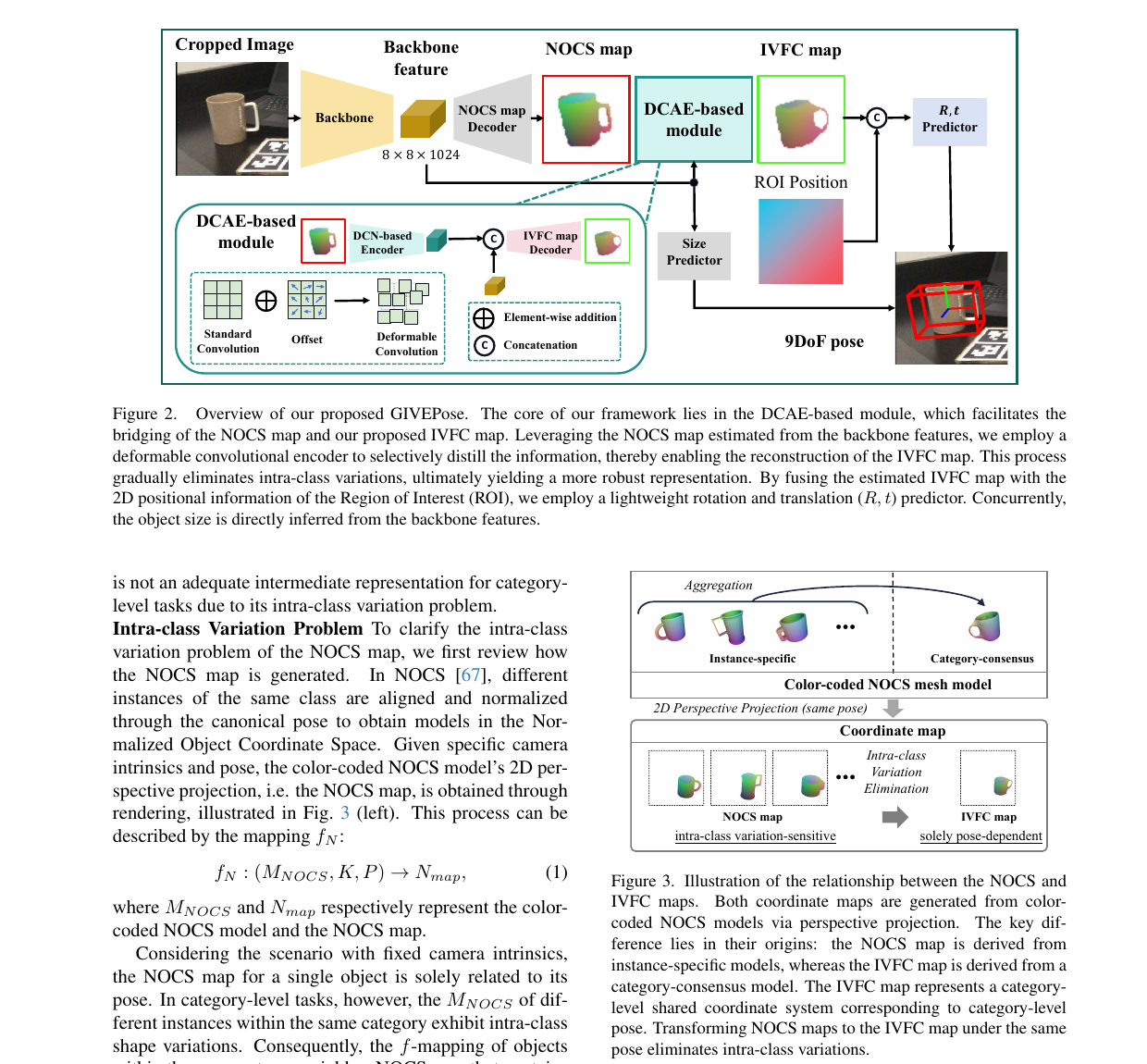
GIVEPose keeps pixel-aligned NOCS predictable while progressively decoding category-consensus IVFC maps to remove redundant instance information. Both support the pose regressor.
3. Problem and motivation
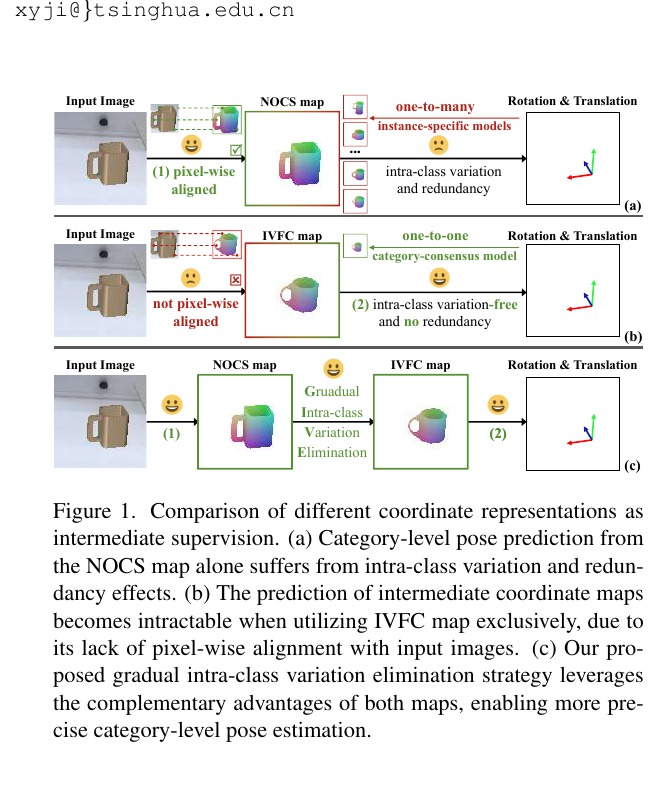
NOCS aligns precisely to individual instances but creates a one-to-many mapping: shape differences add pose-irrelevant information to the representation.
Category-consensus coordinates alone lack pixel alignment and cannot be learned directly.
Fuse both maps with pixel locations to regress category-level pose.
Original Figure 1: pixel-aligned NOCS contains instance redundancy; IVFC gives one-to-one category consensus without direct pixel alignment. Gradual elimination connects them. Source: CVPR 2025 paper PDF. Image copyright belongs to the paper's authors and publisher; reproduced here for paper analysis.
5. Experiments at a glance
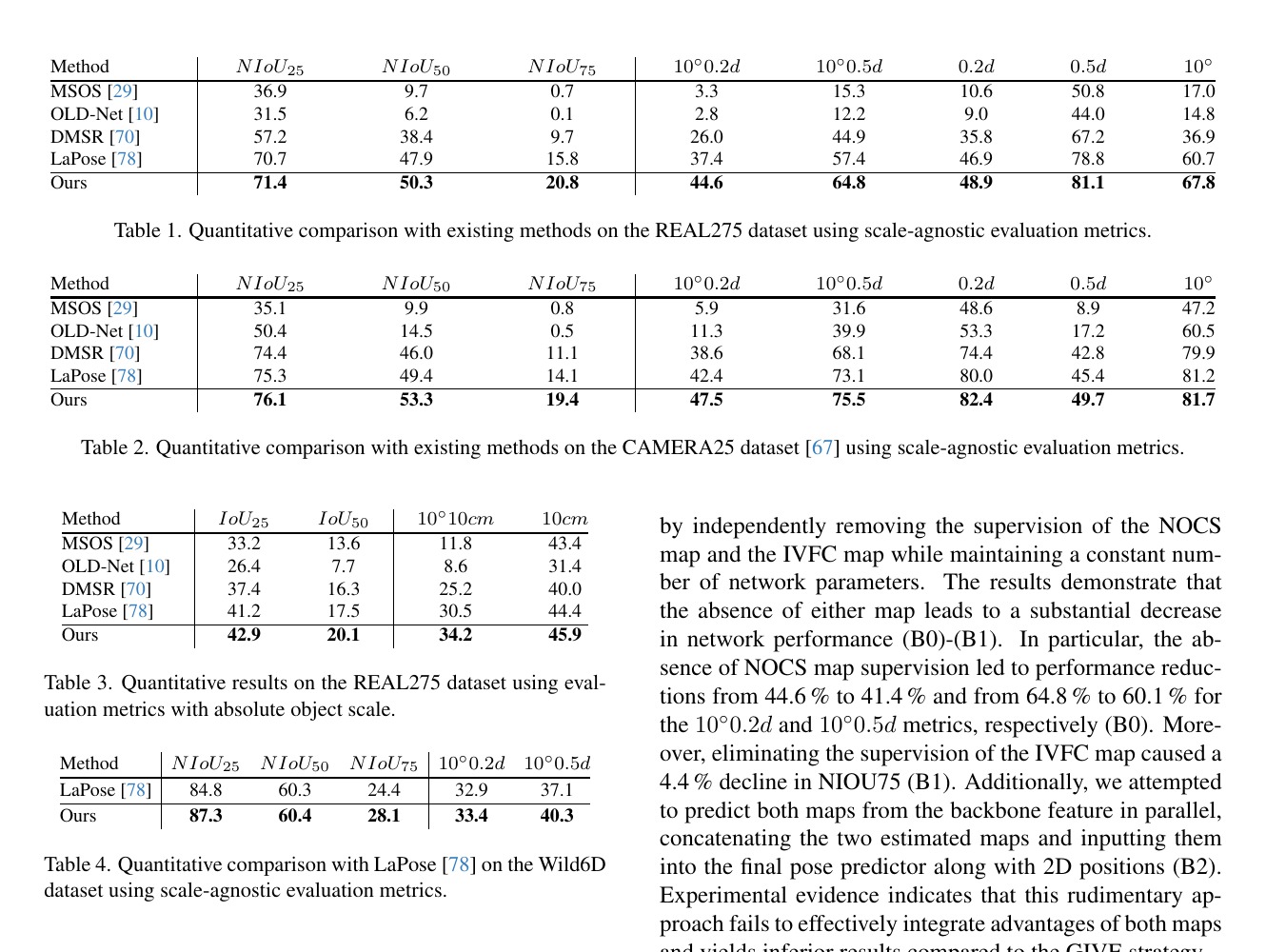
REAL275: N IoU50 / 10°0.2d / 10°0.5d is 50.3 / 44.6 / 64.8, above LaPose 47.9 / 37.4 / 57.4.
CAMERA25: corresponding N IoU50 / 10°0.2d / 10°0.5d is 53.3 / 47.5 / 75.5. Wild6D N IoU25 / 50 / 75 is 87.3 / 60.4 / 28.1, extending evidence beyond one REAL275 protocol.
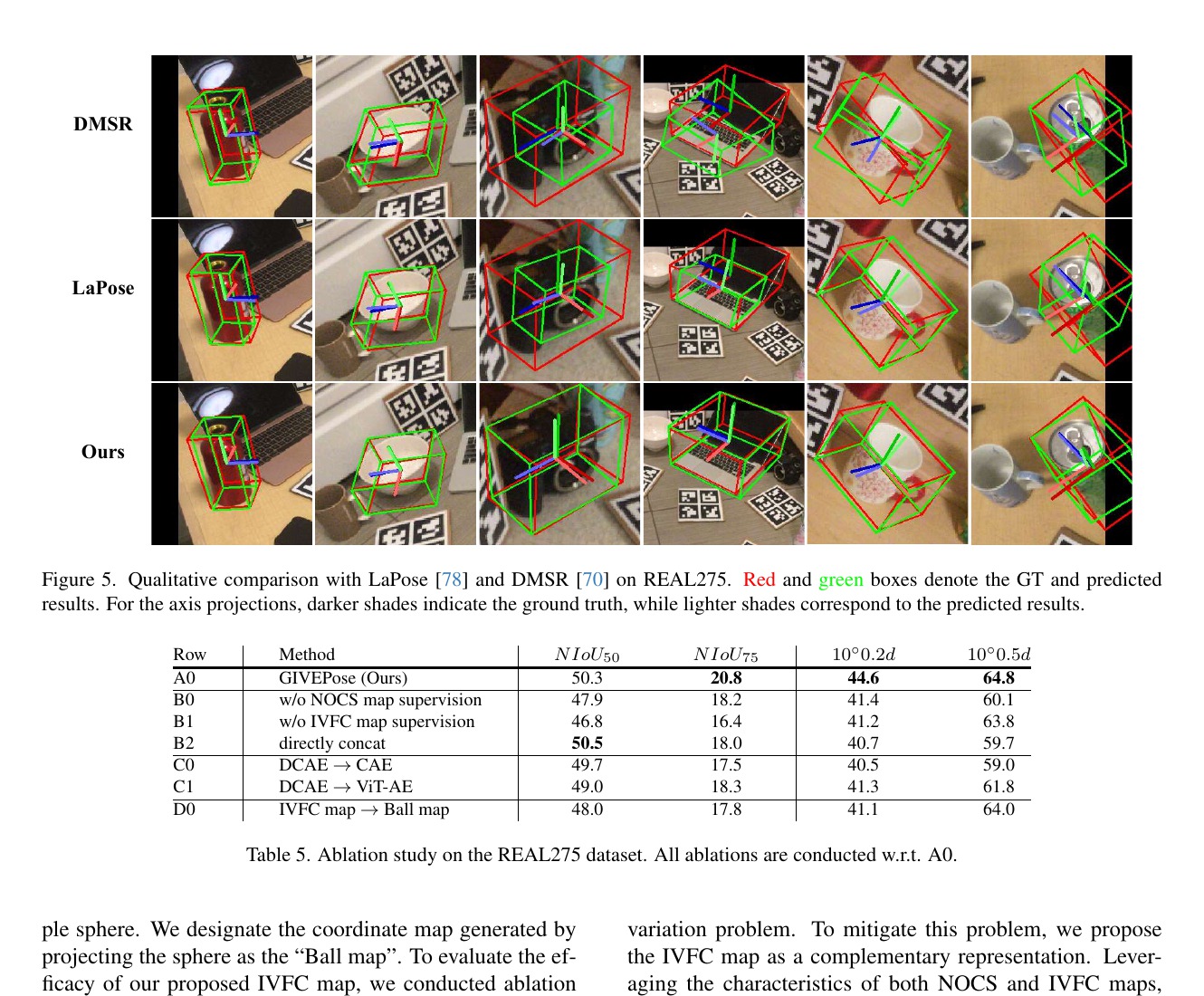
Removing NOCS supervision reduces 10°0.2d from 44.6 to 41.4; removing IVFC supervision gives 41.2; direct map concatenation yields only 40.7. Supervision and gradual transition matter beyond merely having two coordinates.
6. Quick assessment
Value: a specific, experimentally testable critique of category-pose intermediate representations.
Boundary: category training and detection remain necessary; heavy occlusion and scale ambiguity still limit RGB-only inputs.
Available src/paper-notes/givepose/deep.md
In-depth paper notes
Support reproduction, comparison, related-work writing, and identifying opportunities for further research.
Paper Reading Notes (Deep): GIVEPose: Gradual Intra-class Variation Elimination for RGB-based Category-Level Object Pose Estimation
Key problem: pixel-aligned NOCS maps different instances of one category to different canonical surfaces, adding pose-redundant intra-class variation.
Answer: category-consensus IVFC maps, progressively decoded from NOCS through DCAE rather than replacing it abruptly.
2. Positioning in one sentence
GIVEPose bridges pixel-aligned NOCS and variation-free category consensus so intermediate coordinates remain predictable while approaching pose-sufficient statistics.
2.1 Guide to the paper’s figures and tables
Figure / table
What to look for
Figure 1
Limitations of NOCS-only, IVFC-only, and gradual fusion.
Figures 2–3
DCAE generation of IVFC from NOCS and their geometric relationship.
Tables 1–4
REAL275, CAMERA25, absolute-scale, and Wild6D metrics are not interchangeable.
Table 5
Effects of NOCS / IVFC supervision, DCAE, and map design.
Original method diagram: progressive fusion of NOCS and category-consensus IVFC reduces shape-variation interference in pose. Source: CVF Open Access. Image copyright belongs to the paper's authors and publisher; reproduced here for paper analysis.
3. Problem setting and boundaries
One RGB object crop estimates unseen instances within known categories, not arbitrary unseen categories.
Requires detection / masks, intrinsics, and category-level training data; depth is not a test input.
IVFC is consensus geometry under a category prior, not freely learned per-object reconstruction.
4. Method details
NOCS branch: pixel-aligned coordinates learn local appearance–geometry relationships from RGB supervision.
DCAE / gradual elimination: a deformable-convolution autoencoder derives IVFC from NOCS, extracting consensus while preserving predictability.
Pose predictor: fuse NOCS, IVFC, and 2D locations for final pose.
5. Experimental analysis
REAL275, scale-agnostic
LaPose
GIVEPose
Gain
N IoU50
47.9
50.3
+2.4
N IoU75
15.8
20.8
+5.0
10° 0.2d
37.4
44.6
+7.2
10° 0.5d
57.4
64.8
+7.4
Original Tables 1–4: scale-agnostic / absolute-scale REAL275, CAMERA25, and Wild6D results. Distinguish normalized IoU, angle–relative-displacement thresholds, and absolute centimeters. Source: CVPR 2025 paper PDF. Image copyright belongs to the paper's authors and publisher; reproduced here for paper analysis.
CAMERA25 N IoU25 / 50 and 10°0.2d / 0.5d is 76.1 / 53.3 / 47.5 / 75.5; Wild6D N IoU25 / 50 / 75 is 87.3 / 60.4 / 28.1. Synthetic, controlled-real, and wild tests broaden evidence, but detectors, scale definitions, and samples differ; absolute scores cannot be directly ranked across tables.
Full-model N IoU75 / 10°0.2d / 10°0.5d is 20.8 / 44.6 / 64.8; no NOCS supervision gives 18.2 / 41.4 / 60.1, and no IVFC supervision 16.4 / 41.2 / 63.8. Direct concatenation gives 10°0.2d 40.7; ordinary CAE instead of DCAE gives 40.5. Neither map replaces the other, and gradual structure is substantive.
Original Figure 5 and Table 5: DMSR / LaPose / GIVEPose boxes above; removing NOCS / IVFC supervision, direct concatenation, or replacing DCAE below. Source: CVPR 2025 paper PDF. Image copyright belongs to the paper's authors and publisher; reproduced here for paper analysis.
6. Authors’ claims and my assessment
Authors’ claims
My assessment
NOCS instance variation limits category pose
IVFC / NOCS removals directly support this; correlate category shape spread with gains too.
Gradual fusion beats direct concatenation
Direct 10°0.2d 40.7 trails 44.6, supporting fusion beyond feature addition.
7. Reproduction considerations and limitations
Fix normalization, consensus construction, DCAE resolution, and crop policies.
Detection / truncation sensitivity remains; the paper identifies expensive real annotations for training.
Out-of-category instances lack defined IVFC consensus, limiting direct open-world use.