Leveraging Global Stereo Consistency for Category-Level Shape and 6D Pose Estimation from Stereo Images
The method represents shared shape within a category as an occupancy field and uses global stereo consistency to constrain coupled shape, scale, and pose optimization, targeting materials with unreliable depth sensing.
Task: category-level shape, scale, and 6D pose from calibrated stereo RGB.
Reading mode: Overview.
2. Positioning in one sentence
Learn a cross-view-consistent category occupancy field, then incorporate both cameras into global shape fitting to disentangle stereo shape / pose / scale ambiguity.
3. Problem and motivation
RGB-D can fail on transparent / reflective materials, while monocular RGB lacks metric scale.
Stereo supplies a baseline but tightly couples shape and pose optimization.
4. Method overview
Estimate an intra-category occupancy field shared across views.
Iteratively fit pose / scale with normalized-depth rendering and left–right information exchange.
Use baseline geometry to constrain optimization and reduce single-view projection ambiguity.
5. Experiments at a glance
Beyond TOD, the paper introduces / uses material-diverse S-RGBD and reports 3D_avg, 3D IoU, and real grasps.
Separate depth-friendly and depth-challenging objects rather than claiming universal RGB-D superiority.
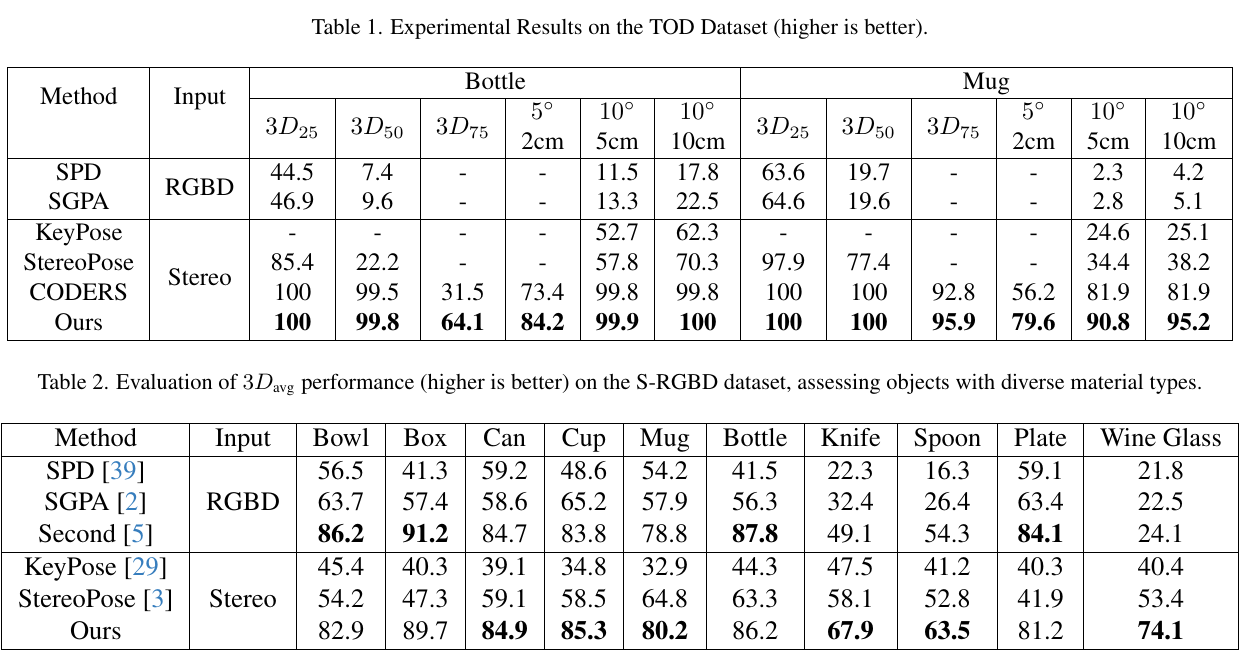
Original TOD / S-RGBD main results: bottle / mug IoU and pose thresholds on TOD; 3D_avg over ten material-diverse categories on S-RGBD. Source: original CVPR 2025 paper. Image copyright belongs to the paper's authors and publisher; reproduced here for paper analysis.
TOD bottle / mug 3D50 is 99.8 / 100 and 10°10cm 100 / 95.2. S-RGBD 3D_avg includes bowl 82.9 and wine glass 74.1; transparent / difficult-depth categories need separate analysis. RGB-D Second still reaches 86.2 / 91.2 / 87.8 on bowl / box / bottle, motivating stereo advantages specifically for challenging materials.
6. Quick assessment
Value: elevates stereo from two-image input to global geometric constraints.
Boundary: precise calibration and stable synchronization; category occupancy priors still limit generalization.
Available src/paper-notes/global-stereo-pose/deep.md
In-depth paper notes
Support reproduction, comparison, related-work writing, and identifying opportunities for further research.
Paper Reading Notes (Deep): Leveraging Global Stereo Consistency for Category-Level Shape and 6D Pose Estimation from Stereo Images
Key problem: without explicit depth, shape, scale, and pose can all explain projections. Local left–right matching leaves coupled parameters and incorrect optimization directions.
Answer: fix shared intra-category occupancy geometry, then exchange global-fitting information and impose baseline constraints.
2. Positioning in one sentence
Stereo becomes a global consistency constraint rather than an extra image, jointly converging category shape and 6D pose.
2.1 Guide to the paper’s figures and tables
Figure / table
What to look for
Figure 1
Projection ambiguity and baseline constraints on incorrect directions.
Distinct evidence from TOD, S-RGBD, depth-quality groups, ablations, and grasps.
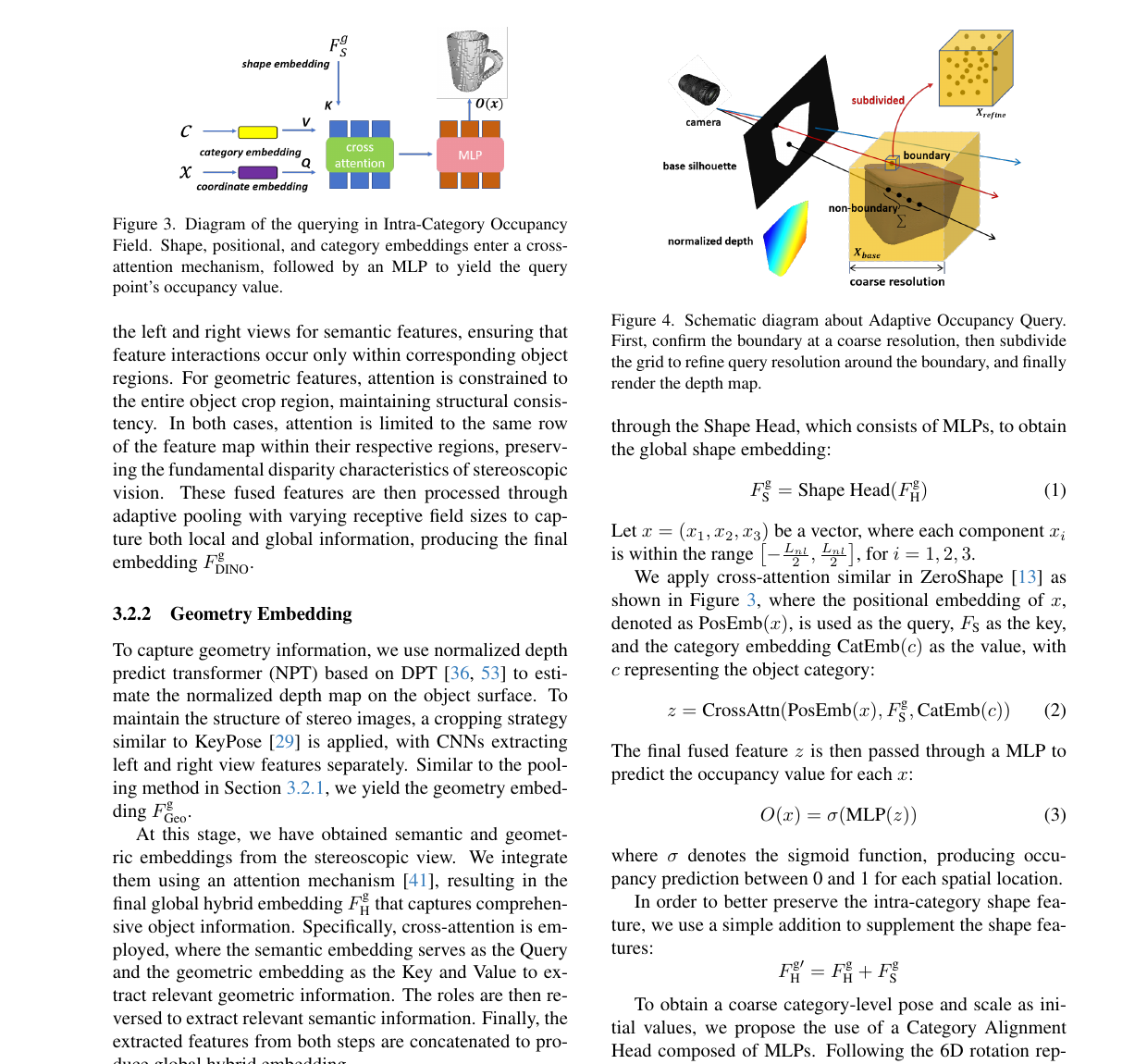
Original method diagram: a category occupancy field defines shared shape, and global left–right consistency constrains pose, scale, and fitting. Source: CVF Open Access. Image copyright belongs to the paper's authors and publisher; reproduced here for paper analysis.
3. Problem setting and boundaries
Calibrated left / right RGB produces shape, scale, and 6D pose for unseen category instances.
Neither monocular RGB nor active-depth RGB-D; baseline and synchronization are essential priors.
Categories are defined during training; occupancy is a category prior, not a universal generative model.
4. Method details
Intra-category occupancy: shared geometry lets both views constrain one latent shape, reducing ambiguity.
Divide-and-conquer fitting: begin with global shape, then iteratively render normalized depth and update pose / size, avoiding unrestricted joint drift.
Real grasping tests downstream usability without replacing strict shape / pose metrics.
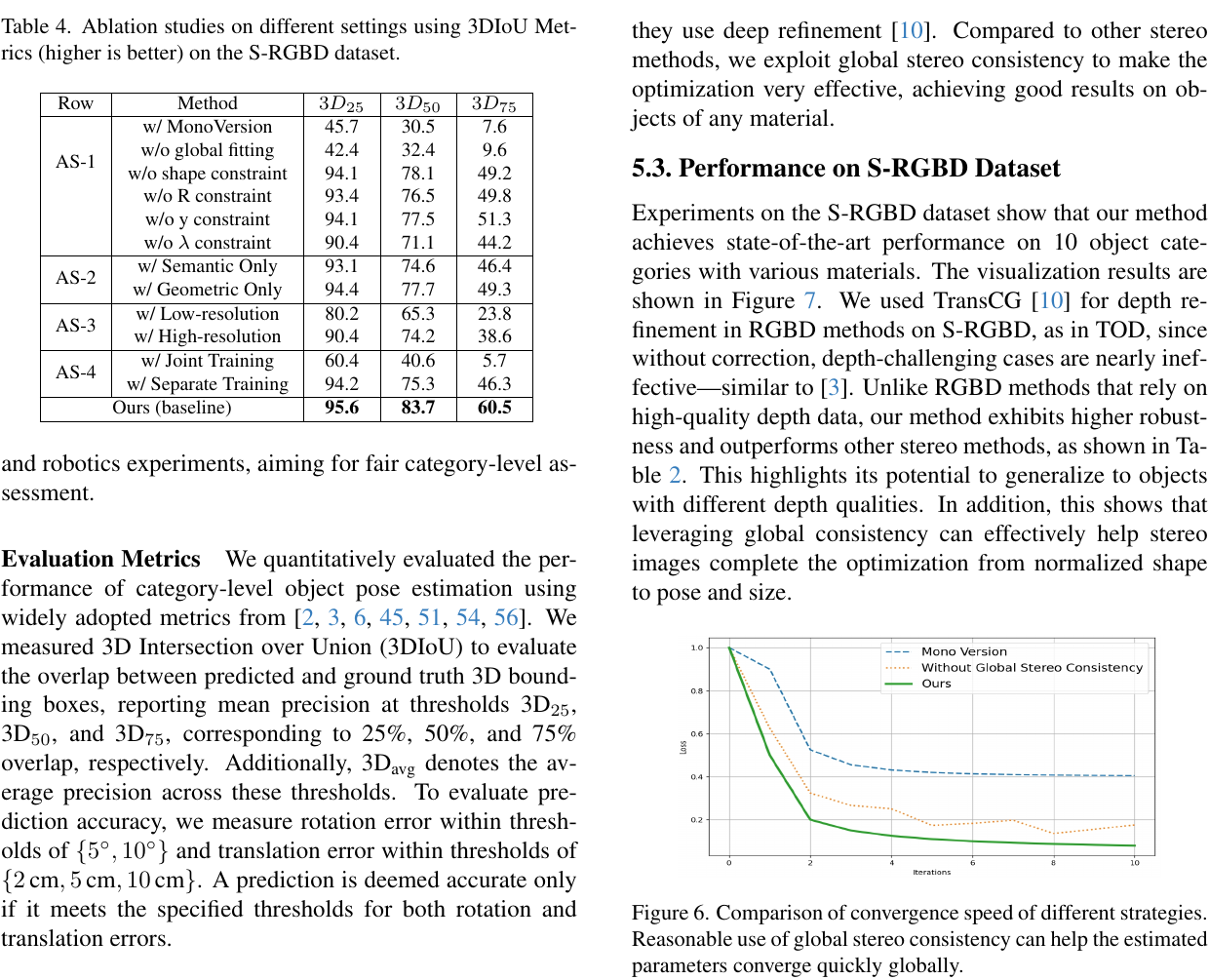
Original S-RGBD ablations and convergence: Table 4 removes monocular / global fitting, shape, rotation, y-translation, scale-ratio constraints, and training / rendering choices; Figure 6 compares convergence. Source: original CVPR 2025 paper. Image copyright belongs to the paper's authors and publisher; reproduced here for paper analysis.
Full-model 3D25/3D50/3D75 is 95.6 / 83.7 / 60.5. MonoVersion gives 45.7 / 30.5 / 7.6, and removing global fitting 42.4 / 32.4 / 9.6, supporting global stereo optimization beyond an extra image. No shape constraint gives 94.1 / 78.1 / 49.2; removing rotation, y translation, or λ constraints yields 3D75 49.8 / 51.3 / 44.2. All three shared constraints matter at strict IoU.
Rendering / training also matter: low-resolution occupancy gives 3D75 23.8, high-resolution 38.6, and adaptive queries 60.5. Direct joint training gives only 5.7, separate training 46.3, with multistage training best. Occupancy-boundary sampling and curriculum are substantive, not arbitrary end-to-end stereo choices.
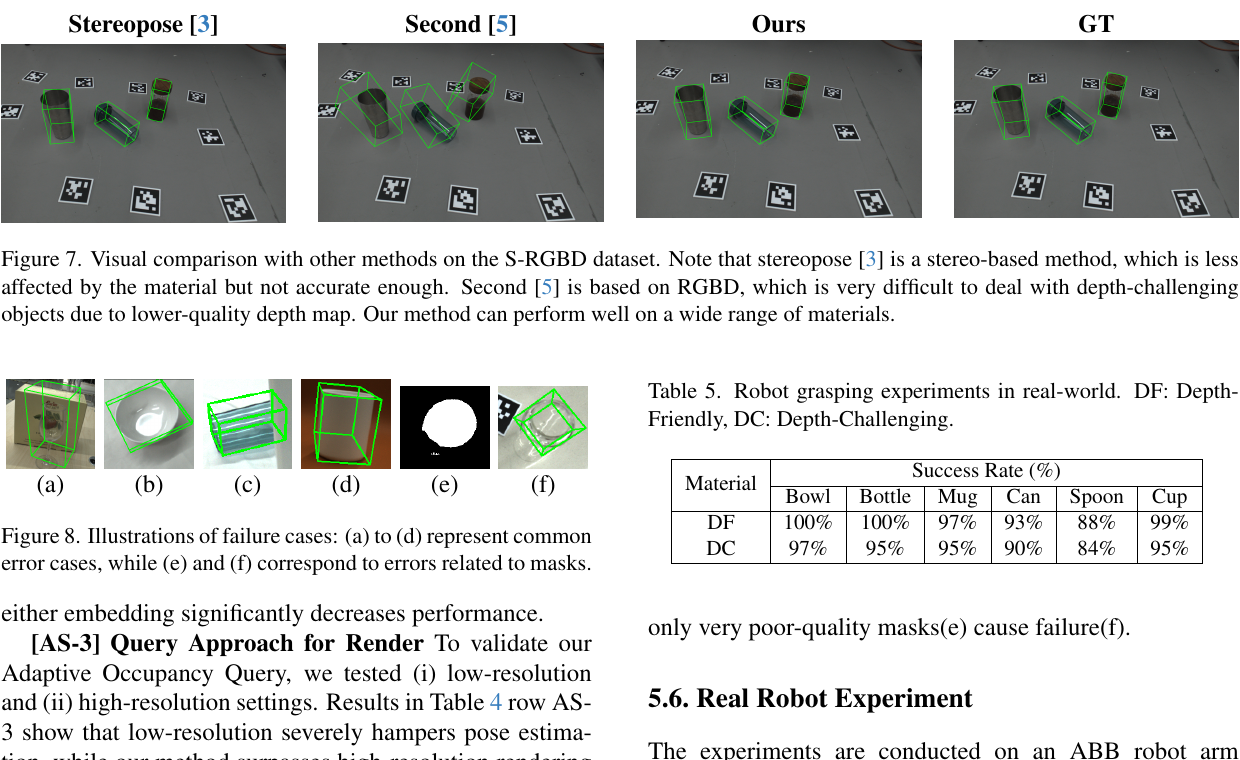
Original S-RGBD examples, failure categories, and grasp table. Friendly / challenging depth groups are separated; failures include transparent reflection, perspective-height error, mutual / self-occlusion, and mask quality. Source: original CVPR 2025 paper. Image copyright belongs to the paper's authors and publisher; reproduced here for paper analysis.
Depth-friendly bowl / bottle / mug / can / spoon / cup grasp rates are 100 / 100 / 97 / 93 / 88 / 99%, versus depth-challenging 97 / 95 / 95 / 90 / 84 / 95%. Small gaps support material robustness compared with potential active-depth degradation. Masks, planning, controls, and trial counts still matter; grasp success is not pose accuracy.
Failures reveal boundaries: transparency reflects surroundings, perspective biases height, and mutual / self-occlusion permits multiple shapes / poses. The authors report tolerance of moderately poor masks but failures with very poor masks; stereo consistency does not replace reliable segmentation.
Weak texture / reflection can create ambiguity in both matching and category priors.
Results use 5 GSF-Net iterations. Iterations, baseline, and calibration noise change accuracy–latency trade-offs and need deployment sensitivity tests.