GS-Pose: Generalizable Segmentation-Based 6D Object Pose Estimation With 3D Gaussian Splatting
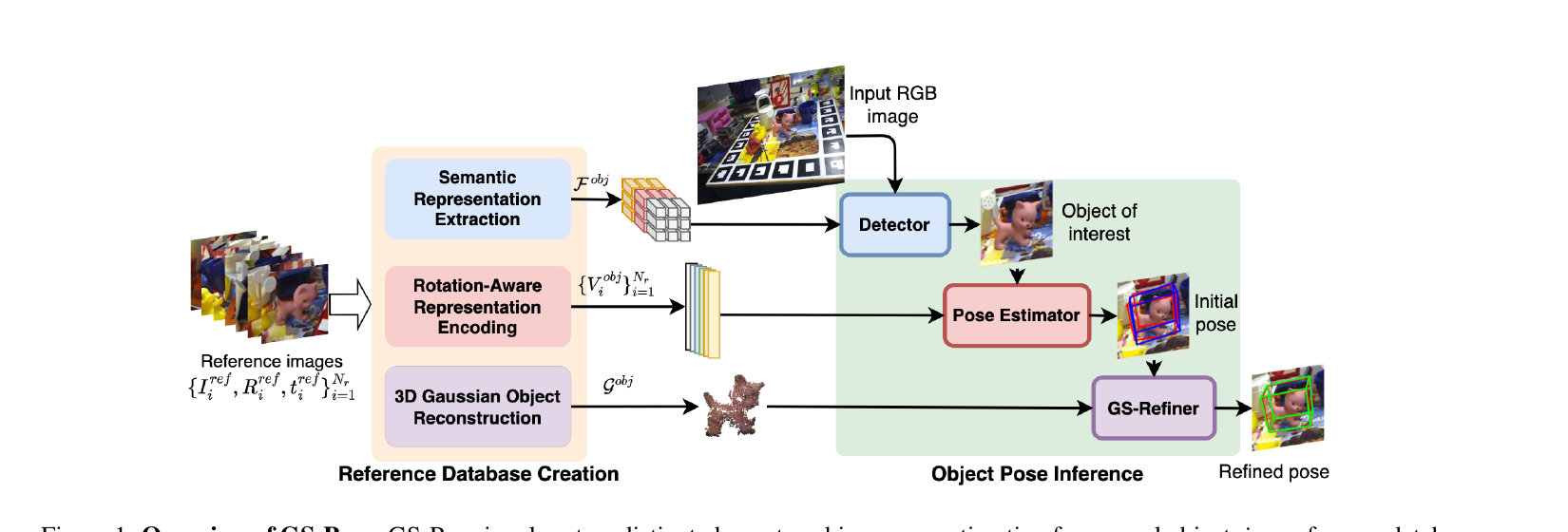
GS-Pose builds semantic, rotation-aware, and 3D Gaussian representations from a few posed RGB reference views of a new object. These support built-in object localization, template-retrieval initialization, and 3DGS render-and-compare refinement.
GS-Pose is among the works in this collection closest to standard novel-object 6D pose estimation: a small set of posed reference RGB images builds an object database; segmentation localizes the target, rotation-aware retrieval initializes the pose, and 3D Gaussian Splatting rendering refines the instance-level 6DoF pose in a query image.
3. Problem setting
Input: reference RGB images of a new object with camera intrinsics and extrinsics; a single query RGB image online.
Output: the target’s 6D pose in the query image, including object detection / segmentation and pose refinement.
No CAD model or object-specific network retraining is required, but posed reference images must be captured offline, and a 3D Gaussian representation is built for each object.
Evaluation: LINEMOD and OnePose-LowTexture; primary metrics are ADD(S)@0.1d, Proj@5pix, and 2D detection mAP.
4. Method overview
Object database creation (offline): extract semantic representations and rotation-aware vectors from posed reference views, and train the object’s 3D Gaussian Splatting representation.
Object localization: Co-Segmenter transfers object semantics from reference images to the query for detection and segmentation.
Initial pose: retrieve with rotation-aware representations and initialize rotation from a neighboring reference view; estimate initial translation from reference / query mask scales and centers.
GS-Refiner: render and compare using 3DGS to optimize the initial pose and output a refined pose.
5. Experiments at a glance
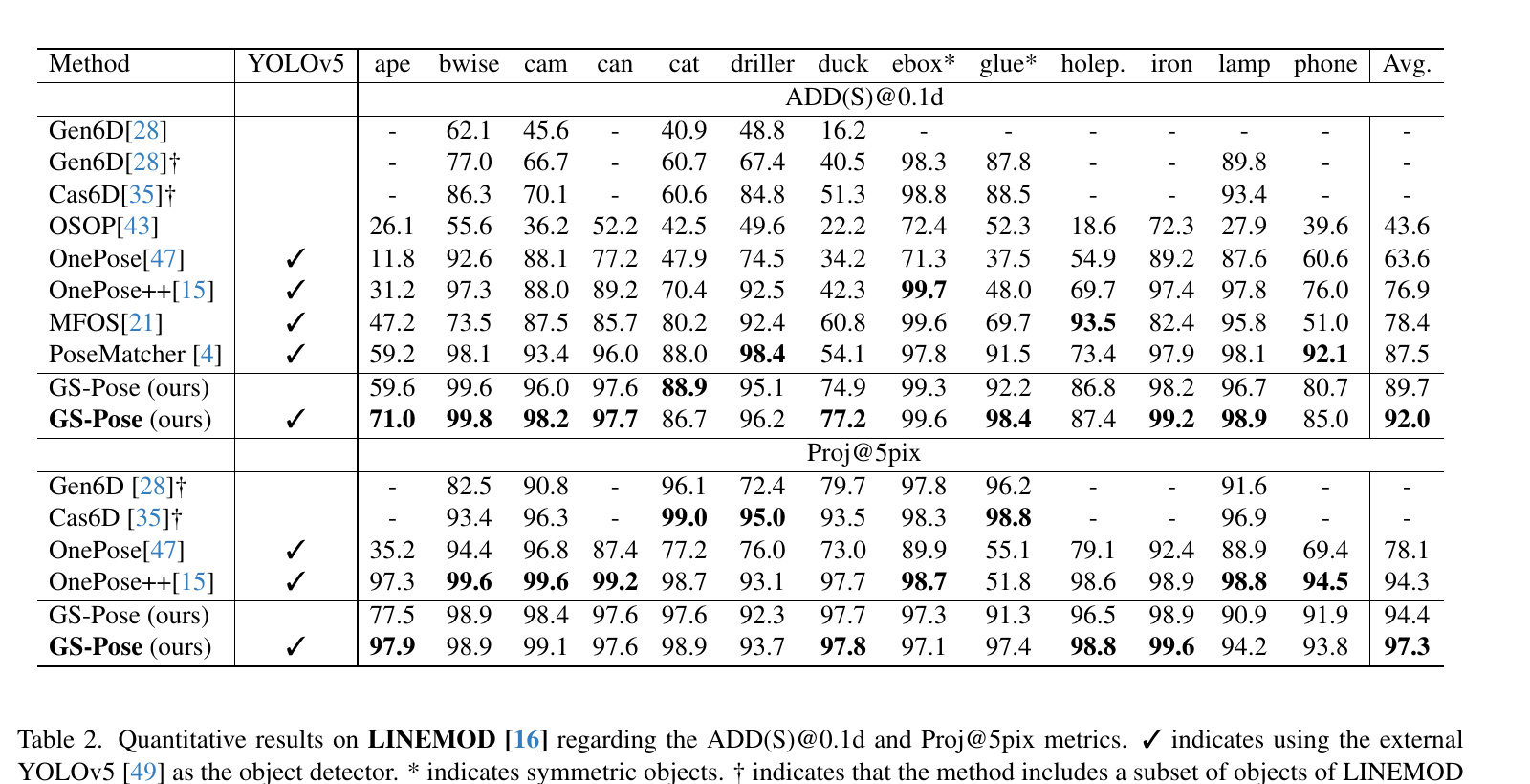
LINEMOD: without external YOLOv5, the authors report mean ADD(S)@0.1d 89.7 and Proj@5pix 94.4; the YOLOv5 version achieves 92.0 / 97.3.
OnePose-LowTexture: mean initialization performance is 70.6, increasing to 92.1 ADD(S)@0.1d after 3DGS refinement.
2D localization: LINEMOD mask mAP 72.85 and box mAP 80.54.
The authors report about 1 second per image; refinement takes about 0.96 seconds and dominates runtime.
6. Strengths, weaknesses, and reading assessment
Strengths
New-object onboarding is split into three interpretable stages: localization, initialization, and refinement, each with a distinct role.
3DGS provides a differentiable, visibility-sensitive object representation for reference-based pose refinement.
Results distinguish the built-in detector from an external YOLO detector, making the evaluation settings clear.
Risks / boundaries
Preparation is required: posed reference images, intrinsics, and offline object reconstruction are prerequisites.
Thin structures and segmentation failures directly undermine downstream pose estimation; the paper identifies segmentation as a key bottleneck.
Scores cannot be directly compared with category-level pose methods requiring neither reference images nor object capture.
7. Research takeaways
For reliable instance-level 6D pose, treating object onboarding as a separate product stage is valuable. Reference capture quality, initial-pose observability, and render-and-compare verification often matter more than simply increasing pose-head capacity.
Available src/paper-notes/gs-pose-3dv2025/deep.md
In-depth paper notes
Support reproduction, comparison, related-work writing, and identifying opportunities for further research.
Paper Reading Notes (Deep): GS-Pose: Generalizable Segmentation-Based 6D Object Pose Estimation With 3D Gaussian Splatting
1. Basic information
Method: GS-Pose
Authors / affiliations: Dingding Cai, Janne Heikkilä, Esa Rahtu; Tampere University, University of Oulu
GS-Pose splits instance-level 6D pose for new objects into three verifiable stages: a small set of posed reference RGB images produces object semantics, rotation-aware descriptors, and 3DGS; the query is localized, retrieval initializes the pose, and differentiable rendering refines it. This is an object-onboarding approach that replaces CAD with reference capture and still requires preparation.
2.1 Guide to the paper’s figures and tables
Figure / table
Question answered
Reading focus
Figure 1
How reference views onboard a new object into the online pose pipeline
Three object representations serve detection, initialization, and refinement, with distinct roles
Table 2
Whether pose improves on LINEMOD
Separate the rows without an external detector and with YOLOv5
Table 3
Whether refinement provides an independent gain
The initial-to-refined difference on OnePose-LowTexture directly shows GS-Refiner’s effect
Original Figure 1: offline object database creation and online object pose inference. Source: arXiv PDF. Image copyright belongs to the paper's authors and publisher; reproduced here for paper analysis.Original Table 2: LINEMOD ADD(S)@0.1d and Proj@5pix results; a checkmark indicates the external YOLOv5 detector. Source: arXiv PDF. Image copyright belongs to the paper's authors and publisher; reproduced here for paper analysis.
3. Problem setting and task boundaries
Input: object-centric reference RGB images {Iiref} for each new object, corresponding camera intrinsics and extrinsics, and an online query RGB image. The experiments treat reference and query images as having known camera models.
Output: 2D object localization / mask and the object-to-camera 6D pose in the query. Without supplied boxes the system performs detection itself; with a detector, it estimates pose within the box.
Core assumptions: offline posed multiview capture and construction of a 3D Gaussian representation are allowed; inference provides a sufficiently clear target region for segmentation and refinement.
Interpretation boundary: this is neither category-level zero-shot pose nor one-click model-free localization in arbitrary web images. It avoids object-specific pose-network retraining and CAD preparation, while still requiring object data capture.
4. Motivation and context
The authors identify three weaknesses in existing generalizable pose methods: direct regression is unstable under appearance changes of unseen objects; 2D–3D correspondence requires reliable, reconstructible geometric matches; and conventional render-and-compare refinement depends on CAD. GS-Pose extracts three complementary representations from a small set of posed RGB images per object.
In my assessment, the decomposition has clear engineering implications: localization failure must be diagnosed separately from the pose refiner, and rendering gradients cannot recover an initial rotation far outside the right basin. The paper reserves 3DGS for the stage that most needs pixel-level visibility.
5. Method details
5.1 Offline object database: three representations, three roles
Representation
How obtained
Online role
What it does not solve
Object semantic representation Fobj
Extracted by Co-Segmenter from reference images
Detector / object segmenter
Does not provide a complete 3D pose
Rotation-aware vectors {Viobj}
Encoded for each reference view
Nearest-view retrieval for initial rotation
Only indirect help for translation
Gaussian object Gobj
3DGS reconstructed from reference captures
Differentiable rendering for GS-Refiner
Cannot replace object localization
Online, query semantic features first match Fobj to locate the target; a rotation-aware encoder retrieves the closest view from reference embeddings. Initial translation comes from query / reference mask centers and scale relations. The initial pose is then passed to GS-Refiner.
5.2 GS-Refiner: why it belongs at the end
GS-Refiner aligns a rendering of Gobj at the current pose with the query image and mask, updating the pose through gradients. Gaussian rendering supplies dense color, opacity, and visibility signals that suit refinement better than PnP on sparse 2D–3D correspondences alone.
However, it is a local optimizer: retrieval must provide a reasonable rotation basin, and segmentation must exclude background from the target loss. Its gains should be interpreted together with the initializer, without claiming that 3DGS alone solves global pose search.
5.3 Training and runtime conditions
The paper trains with Adam, batch size 2, and RTX3090 for 100,000 steps; Nk=8 and Ngs=400. Reported detector time is about 0.16 s, initialization 0.01 s, and refinement 0.96 s / image. This breakdown makes the deployment trade-off clear: refinement dominates the cost of higher accuracy, whereas retrieval is relatively cheap.
6. Experimental analysis
6.1 Datasets, metrics, and fair comparison
LINEMOD: ADD(S)@0.1d and Proj@5pix; ADD(S) accounts for symmetric objects, and its threshold depends on object diameter.
OnePose-LowTexture: low-texture instances, evaluated using ADD(S)@0.1d for initial / refined poses.
2D localization: mAP@[0.5:0.95] for masks and mask-induced bounding boxes separately.
The two GS-Pose rows in Table 2 must be distinguished: without YOLOv5, mean ADD(S) is 89.7 and Proj 94.4; with external YOLOv5, they reach 92.0 / 97.3. The latter includes a stronger detection frontend and measures the complete system’s potential; the former better isolates the built-in segmentation-based detector and pose stages.
6.2 Main results and interpretable gains
Setting
Key values
Interpretation
LINEMOD, GS-Pose
ADD(S) 89.7; Proj 94.4
Pose system using the built-in detector
LINEMOD, + YOLOv5
ADD(S) 92.0; Proj 97.3
Separate the system gain from stronger detection from the pose estimator itself
OnePose-LowTexture init
70.6
Mean performance of the retrieval / mask-based initializer
OnePose-LowTexture refined
92.1
Refinement adds 21.5 points, the main direct evidence
2D localization
Mask 72.85; bbox 80.54 mAP
The frontend still leaves substantial room for error reduction
The reference-view ablation also matters: the paper reports about 74.5 with 32 reference images and 90.86 with 180. Thus, even a “small reference set” involves a coverage trade-off; the main results alone cannot establish robustness with few references and strong self-occlusion.
6.3 Authors’ claims and my checks
Authors’ claim: 3DGS-based refinement helps novel-object pose. Evidence: low-texture results improve from init 70.6 to refined 92.1, supporting the claim.
Authors’ claim: generalization without CAD. Qualification: this holds without CAD / per-object pose training, but reference extrinsics and object 3DGS remain strong object priors.
My analysis: the LINEMOD detector protocol, training-object subset, and external YOLO all affect the total score. Cross-paper comparisons should first check the detector, reference protocol, and use of GT boxes.
7. Failure modes, limitations, and reproducibility
Segmentation failure: thin parts, low contrast, or background confusion corrupt masks, leaving translation initialization and rendering loss without a reliable region.
Insufficient view coverage: retrieval finds neighbors only within the reference-view manifold; severe backside occlusion or uncaptured directions increases initialization error.
Compute and latency: roughly one second of refinement per image suits offline or low-frequency use rather than millisecond robot feedback loops.
Reproducibility checklist: posed reference captures, calibration, and good object crops / masks are required. Public code exists, but capture quality across objects may dominate results more than network hyperparameters.
8. Implications for 6D pose research
Treat reference acquisition, representation construction, and online verification as three explicit test points in object onboarding.
Study uncertainty-based triggering of costly rendering refinement instead of fixed iterations every frame.
For low-texture objects, stable segmentation / silhouettes may influence pose success more than stronger local RGB descriptors; mask confidence could weight the pose optimizer.