Object Pose Estimation · 2026 · ICRA / IEEE RA-L · CCF B
HIPPo: Harnessing Image-to-3D Priors for Model-Free Zero-Shot 6D Pose Estimation
HIPPo builds a complete metric mesh from the first RGB-D frame using Wonder3D + MASt3R in around 8 seconds, then estimates / tracks with FoundationPose at around 15 FPS. A viewpoint sphere triggers replacement of diffusion priors with real observations. Single-reference YCB-V / LM-O ADD AUC is 89.07 / 88.49. Rapid onboarding is the benefit, while mesh updates take around 9.87 seconds and heavy occlusion can corrupt initial generation.
RGB-D videotext prompt for object segmentationsingle first-frame observation
Requirements
Grounded SAM object maskWonder3D multiview generationMASt3R reconstructionFoundationPose refinementvalid depth and camera intrinsicsperiodic online mesh updates
Full paper metadataAuthors, affiliations, research area, datasets, metrics, method tags, and reading statusExpandCollapse
Grounded SAM object maskWonder3D multiview generationMASt3R reconstructionFoundationPose refinementvalid depth and camera intrinsicsperiodic online mesh updates
Reading Notes
Overview / Deep Dive
Available src/paper-notes/hippo-icra2026/coarse.md
Paper overview notes
Quickly assess the paper's scope, problem setting, core method, experimental findings, and whether to read it in depth.
Publication: IEEE RA-L 2025 (DOI 10.1109/LRA.2025.3585384), included in the ICRA 2026 technical program.
Authors / affiliations: Yibo Liu, Zhaodong Jiang, Binbin Xu et al.; Huawei Noah’s Ark Lab, York University, University of Toronto.
Task: when a new object first appears without CAD or pre-captured references, generate a mesh from the first RGB-D frame, estimate / track 6D pose, and continuously correct the model with subsequent real observations.
2. Positioning in one sentence
HIPPo starts with an immediately usable, potentially inaccurate complete model from an image-to-3D diffusion prior. Online RGB-D measurements gradually replace that prior, yielding a joint pose-and-model system that starts from one frame and improves over time.
3. Method overview
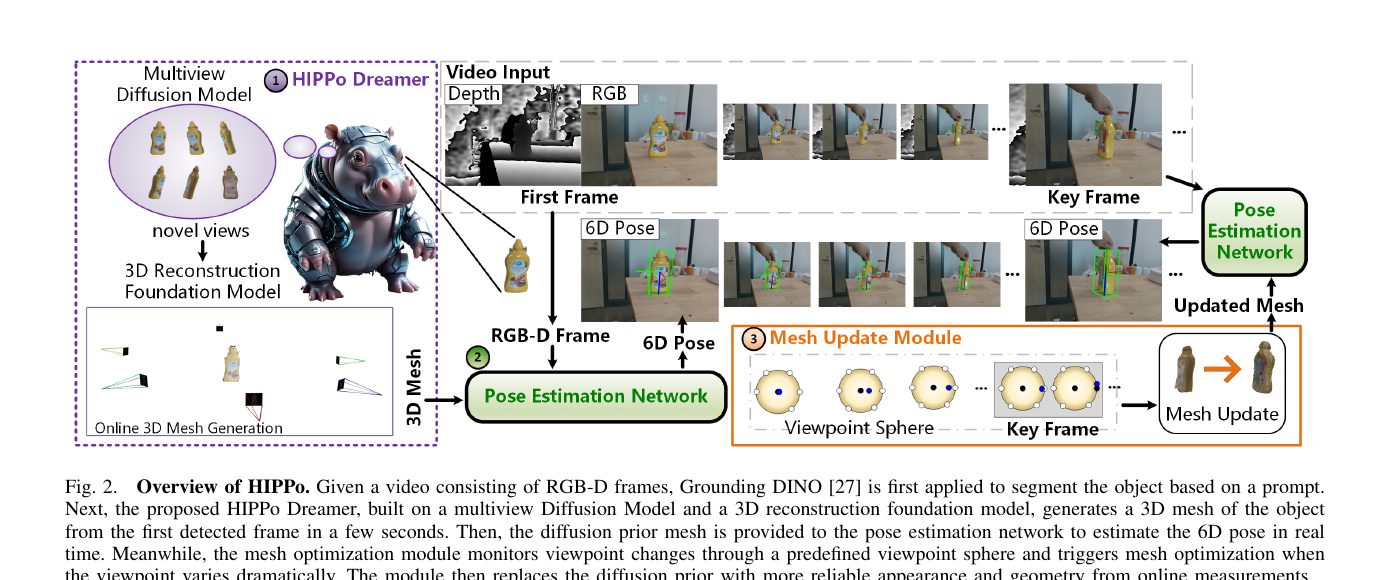
Grounded segmentation extracts object RGB / depth from the first frame.
HIPPo Dreamer synthesizes 6 novel views with Wonder3D and reconstructs a mesh using modified MASt3R; metric scale comes from the oriented bounding boxes of the original depth and generated model.
The generated mesh enters FoundationPose refinement for subsequent pose estimation / tracking at about 15 FPS.
A viewpoint sphere records observed directions and triggers keyframes for new directions.
Transform keyframe depth clouds into the object frame, denoise with SOR, find nearest neighbors with KDTree, replace prior positions / colors with real measurements, and apply Poisson reconstruction.
Original Figure 2: a complete mesh initializes pose from the first frame; measurement-guided mesh updates are then triggered only by significantly new views. Source: HIPPo paper. Image copyright belongs to the paper's authors; reproduced here for academic analysis.
4. Experiments at a glance
A single reference:
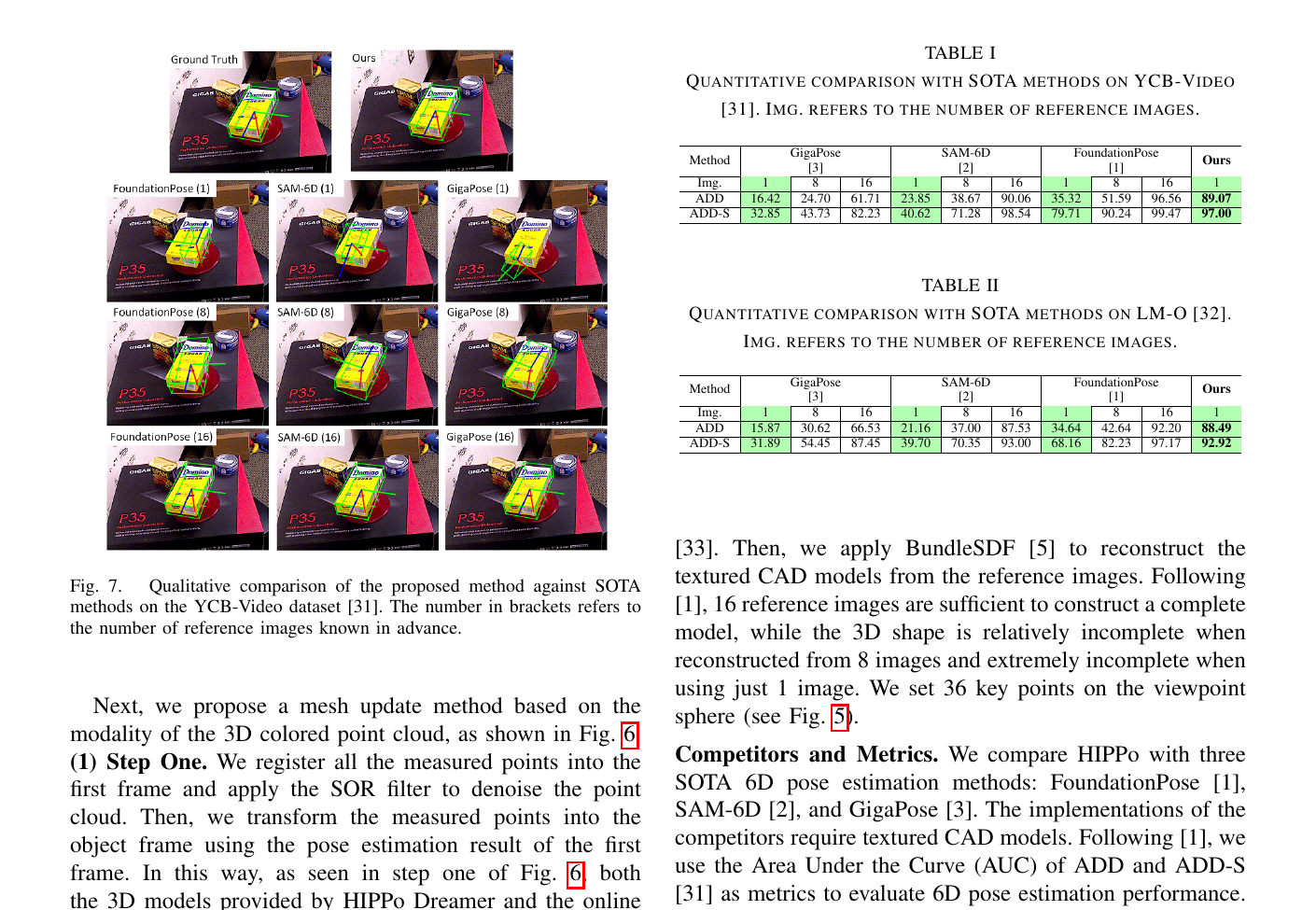
YCB-Video ADD / ADD-S AUC: 89.07 / 97.00;
LM-O: 88.49 / 92.92.
Both results greatly exceed GigaPose, SAM-6D, and FoundationPose with only 1 reference; when baselines receive 16 references and can reconstruct nearly complete models, FoundationPose / SAM-6D still lead on some metrics.
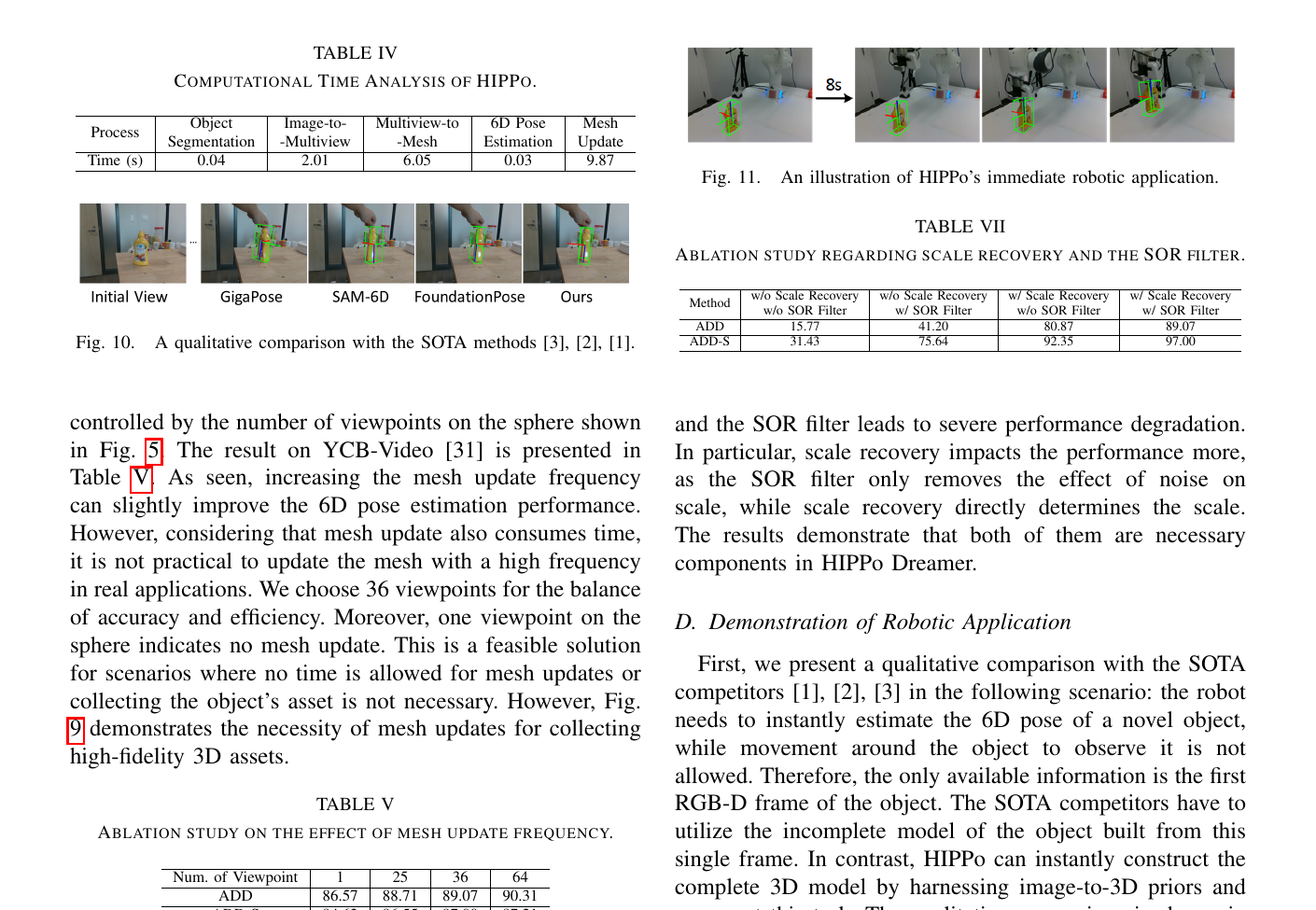
HIPPo Dreamer initialization takes about 8.06 s (image-to-multiview 2.01 s, multiview-to-mesh 6.05 s); per-frame segmentation takes 0.04 s and pose 0.03 s; one mesh update takes about 9.87 s.
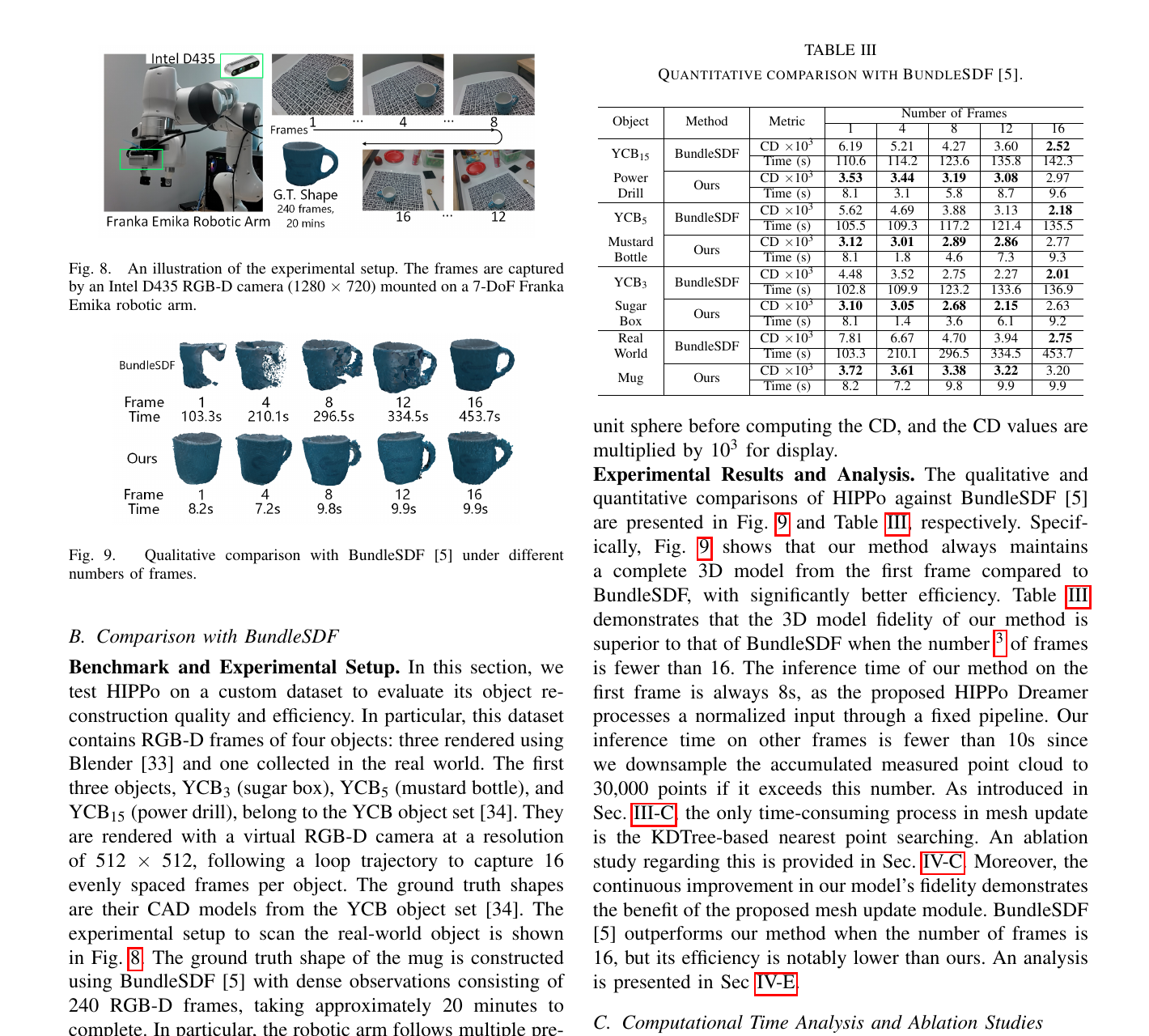
In the authors’ reconstruction experiments, Chamfer distance is generally better than BundleSDF over the first 1–12 frames. After 16 frames BundleSDF may be more detailed, but takes about 135–454 s, while each HIPPo result takes under about 10 s.
Original Figure 7 and Tables I–II: HIPPo always uses only the first frame, while baselines receive 1 / 8 / 16 references. The main evidence concerns starting with few references, rather than universal superiority with complete CAD. Source: HIPPo paper. Image copyright belongs to the paper's authors; reproduced here for academic analysis.
5. Quick assessment
Value: combines generative models and SLAM across time. The generative prior fills the incomplete first view; real measurements correct hallucinated geometry.
Key runtime qualification: real-time pose starts after about 8 seconds of initialization; mesh updates take nearly 10 seconds and do not run every frame.
Limitations: heavy occlusion can corrupt first-frame generation; nearest-neighbor replacement + Poisson updates are less detailed than long-running neural reconstruction. The project gives reproduction guidance, but IP restrictions prevent a complete click-and-run release.
Available src/paper-notes/hippo-icra2026/deep.md
In-depth paper notes
Support reproduction, comparison, related-work writing, and identifying opportunities for further research.
Project / publication: Project · RA-L 2025 / ICRA 2026.
Core problem: a new object first enters the robot’s view without CAD or time for multiview scanning. Object SLAM has only a partial first-frame surface, while image-to-3D hallucinates invisible regions. How can a system start promptly and grow more trustworthy with real observations?
Core answer: use a complete generated mesh as a usable prior at t=0, recover physical scale from depth, and initialize FoundationPose. Then select keyframes by viewpoint change and replace corresponding prior-mesh regions with real RGB-D points.
My assessment: the key lesson is the prior’s lifecycle. A foundation model supplies a cold-start placeholder rather than permanent truth. Strong pose benchmarks must be read alongside dependence on several large pretrained components, nearly 10-second mesh updates, and heavy-occlusion limitations.
2. Positioning in one sentence
HIPPo is a generative-prior-driven object-centric digital twin: Wonder3D + MASt3R produce a complete, scaled mesh in about 8 seconds; FoundationPose supplies real-time pose; viewpoint-triggered RGB-D fusion gradually replaces imagined geometry with measurements.
2.1 Guide to figures and tables
Figure / table
What to look for
Figure 2
Dreamer, the pose network, and mesh updates run at different frequencies.
Tables I–II
Baselines receive different reference counts; HIPPo’s strength is the 1-image regime.
Figure 9, Table III
First-frame completeness and long-term fidelity are different reconstruction goals.
Table IV
Report 8-second initialization, 0.03-second pose, and 9.87-second updates separately.
Tables V–VII
Efficiency–quality trade-offs for viewpoint count, point count, scale recovery, and SOR.
Original Figure 2: HIPPo Dreamer generates the mesh only during initialization; the pose network runs each frame, and new-view events on the viewpoint sphere trigger mesh updates. Source: HIPPo paper. Image copyright belongs to the paper's authors; reproduced here for academic analysis.
3. Problem setting and the boundaries of model-free inference
Input is an RGB-D sequence and a text prompt for open-vocabulary detection / segmentation. Test objects have neither manually prepared CAD nor pre-captured posed references. Outputs include:
Instance-level 6D pose in camera coordinates each frame;
A textured object mesh available from the first frame and updated online;
A metric-scale object asset usable for grasping / OBB planning.
“Model-free” means no object-specific manually prepared model. The system still relies on pretrained Wonder3D, MASt3R, Grounded segmentation, and FoundationPose, as well as query depth and camera intrinsics.
4. HIPPo Dreamer
4.1 First-frame segmentation
Grounding DINO / Grounded SAM locates the prompted object and applies the same mask to RGB and depth. Segmentation quality affects:
Foreground cleanliness for image-to-3D;
The observed OBB / scale estimate;
Subsequent FoundationPose crops;
Which mesh-update points are considered part of the object.
It is therefore a shared failure point throughout the system.
4.2 Single image to multiple views
Wonder3D synthesizes canonical novel views from the first frame. Training priors fill unseen surfaces, giving a closed model immediately but potentially plausible rather than correct backside geometry and texture.
4.3 Reconstruction with modified MASt3R
MASt3R registers generated views into 3D. Its original background optimization can incorporate inconsistent generated backgrounds / masks into geometry. The paper modifies background masking and optimization so small multiview-diffusion inconsistencies do not directly destroy the object mesh.
4.4 metric scale recovery
Image-to-3D has arbitrary scale, while 6D translation and robot grasping need metric dimensions. The authors take the maximum oriented-box edge rmax from first-frame depth and corresponding edge gmax from the generated mesh, using
s=gmax/rmax
or an equivalent inverse factor in the implementation to put both on the same physical scale. The key is injecting the first-frame metric-depth cue into the generated asset.
Table VII shows that scale recovery is essential: without scale / SOR, ADD / ADD-S is only 15.77 / 31.43; SOR alone gives 41.20 / 75.64; scale without SOR already reaches 80.87 / 92.35, and both give 89.07 / 97.00. SOR mainly denoises; scale directly determines whether pose geometry uses the correct units.
5. Pose estimation
Once a textured mesh is available, HIPPo directly uses FoundationPose’s refinement network. The mesh rendered at the current pose and the real crop enter a Siamese feature encoder, which predicts relative corrections. The innovation is rapidly preparing a usable asset for this network.
This also explains HIPPo’s performance boundaries:
More accurate visible surfaces, scale, and texture make FoundationPose refinement easier;
Heavy first-frame occlusion or mask errors can make Dreamer generate the wrong model, and the pose backend cannot identify hallucinated surfaces;
Mesh updates need sufficiently accurate poses to register depth into the object frame, creating pose–model interdependence.
6. measurement-guided mesh update
6.1 viewpoint sphere
The authors distribute N direction bins uniformly around the object. The first frame occupies one bin; relative rotation maps later views onto the sphere. Updates trigger only for a previously unoccupied bin satisfying the distance tolerance. This avoids redundant adjacent-frame fusion and decouples expensive updates from cheap pose inference.
The final choice is N=36. Table V:
Viewpoint count
1 (no update)
25
36
64
ADD
86.57
88.71
89.07
90.31
ADD-S
94.62
96.55
97.00
97.21
Frequent updates give diminishing returns: 64 versus 36 improves ADD by only 1.24 while triggering the roughly 10-second operation more often.
6.2 Replacing the prior with measurements
Keyframe depth points first undergo statistical outlier removal (SOR), then transform into the first-frame / object frame using the estimated pose. Each real point finds its nearest neighbor in the diffusion-prior point cloud using KDTree; measured position and color replace the prior values, and Poisson surface reconstruction regenerates the mesh.
This practical point replacement is simple, training-free, and updates within seconds, unlike joint NeRF / SDF photometric optimization. Its limitations include:
Wrong poses fuse real points into wrong locations;
Nearest neighbors struggle with topology changes, thin structures, and parts absent from the prior;
Surface continuity after repeated replacement depends on Poisson reconstruction;
With sufficient observations, dedicated neural reconstruction can reach higher fidelity.
To control KDTree cost, measurements above 30,000 points undergo FPS downsampling. In Table VI, 5k → 40k points changes time from 1.73 → 14.34 s and CD from 3.55 → 3.13; 30k at 9.87 s / 3.17 is the compromise.
7. Main pose results
Original Figure 7 and Tables I–II: HIPPo always sees only the first frame. GigaPose, SAM-6D, and FoundationPose receive 1 / 8 / 16 references to construct assets at different completeness levels. Source: HIPPo paper. Image copyright belongs to the paper's authors; reproduced here for academic analysis.
YCB-Video:
Method / reference count
ADD
ADD-S
GigaPose / 1
16.42
32.85
SAM-6D / 1
23.85
40.62
FoundationPose / 1
35.32
79.71
HIPPo / 1
89.07
97.00
FoundationPose / 16
96.56
99.47
LM-O:
Method / reference count
ADD
ADD-S
GigaPose / 1
15.87
31.89
SAM-6D / 1
21.16
39.70
FoundationPose / 1
34.64
68.16
HIPPo / 1
88.49
92.92
FoundationPose / 16
92.20
97.17
With only the first view for every method, directly reconstructed real-image assets are severely incomplete, and HIPPo’s generated completion brings large gains. With 16 references and nearly complete models, FoundationPose / SAM-6D remain slightly better. Thus the evidence shows a much smaller cold-start information budget, not that generated meshes outperform real CAD.
8. Reconstruction quality and time
Original Figures 8–9 and Table III: HIPPo has a complete first-frame prior; BundleSDF grows from partial surfaces and can be more detailed by 16 frames, at over an order of magnitude more time. Source: HIPPo paper. Image copyright belongs to the paper's authors; reproduced here for academic analysis.
The authors’ dataset contains 3 rendered YCB objects and 1 real mug. BundleSDF reconstructs only visible surfaces initially, while HIPPo already has a closed shape. For the power drill:
For the real mug, BundleSDF at 16 frames gives CD 2.75 in 453.7 s; HIPPo gives 3.20 in 9.9 s. These are processing costs at the corresponding frame-count stage. For the real object, BundleSDF also uses 240 frames and about 20 minutes to create the evaluation ground-truth shape.
These results distinguish two goals:
Time to first complete model: HIPPo is substantially better;
Fidelity with sufficient observations: BundleSDF can be better at 16 frames.
Immediate robot grasping prioritizes the first; digital archiving with complete scanning can prioritize the second.
9. Compute accounting and ablations
Original Tables IV / VII and Figures 10–11: Dreamer initialization takes about 8 seconds, per-frame pose about 0.03 seconds, and one mesh update about 9.87 seconds; scale recovery is a prerequisite for pose success. Source: HIPPo paper. Image copyright belongs to the paper's authors; reproduced here for academic analysis.
Table IV separates the costs clearly:
Stage
Time
object segmentation
0.04 s
image-to-multiview
2.01 s
multiview-to-mesh
6.05 s
6D pose estimation
0.03 s
mesh update
9.87 s
Thus, “around 15 FPS” is the segmentation + pose steady-state rate (about 0.07 s). The first usable pose requires about 8 seconds, and important new views may trigger asynchronous / blocking updates near 10 seconds. Deployment should report all three timescales.
10. Authors’ claims and my assessment
Authors’ claims
My assessment
Pose without CAD / pre-captured references
Asset requirements fall to the first RGB-D frame, but Dreamer takes about 8 seconds; immediate is relative to minute-long scans.
Large gains over SOTA with few references
Tables I–II provide strong evidence; at 16 references / complete models, baselines remain slightly better, as the paper also shows.
Continuous generated-model improvement
Real-point replacement gradually improves CD; this is not global joint neural optimization.
Immediate grasping use
Qualitative robot demonstrations exist, but large-scale grasp success statistics are missing.
11. Reproduction checklist and limitations
Save the first-frame mask, depth OBB, Wonder3D six views, MASt3R cloud, and scale factor to inspect failures stage by stage.
FoundationPose and mesh updates share an object frame; preserve coordinates and scale after each Poisson reconstruction.
The viewpoint sphere uses relative rotation; tracking drift can falsely trigger or miss keyframes.
Heavy occlusion, transparent / reflective depth, and wrong prompt masks can corrupt both the first-frame prior and scale.
The official project repository provides component links and key reproduction snippets but explicitly cites IP restrictions on a complete click-and-run implementation; the site therefore does not label it fully open source.
Future work could use pose / reconstruction uncertainty to decide when to trust the prior or capture new views, beyond discrete viewpoint occupancy.
HIPPo’s direction matters beyond a benchmark score: for open-world robotics, a useful role for generation is shortening the time from no information to an actionable initial estimate. Real sensors must then gradually take over.