HRDexDB: A Paired Human-Robot Dataset for Cross-Embodiment Dexterous Grasping
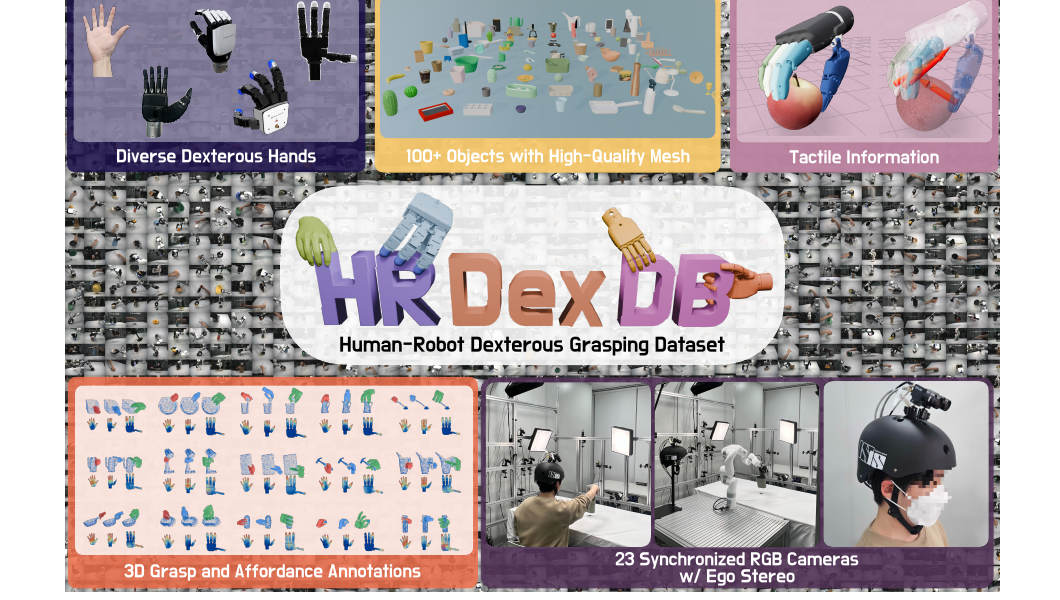
HRDexDB records 100 objects and 2.1K paired human / four-dexterous-hand grasping sequences with 21 external and 2 egocentric cameras. Around 24M frames include 3D hands, object 6D poses, robot states, and tactile annotations. Contact transfer, cross-embodiment grasp retrieval, hand reconstruction, and object pose under grasp occlusion benchmark its uses.
HRDexDB pairs grasps for human-to-dexterous-robot-hand transfer. Natural human grasps and semantically corresponding robot grasps share objects and a calibrated multiview space, with 3D hands, object 6D poses, robot states, success labels, and some tactile signals.
Method inputs and outputs
This is a dataset paper; distinguish capture / annotation pipelines from models trained on the data.
Item
Content (compiled for this site)
Capture inputs
Calibrated, synchronized multiview RGB; semantically paired human / robot grasps; object CAD, hand models, robot kinematics; robot states and tactile signals on supported hands.
Final outputs
Paired grasp data: multiview images, 3D human-hand / robot states, object 6D poses, platform-specific touch and success labels, not one unified online pose network.
Downstream inputs / outputs
Contact transfer takes human contact maps + object geometry and outputs robot contact maps; retrieval ranks robot grasp candidates for a human hand-object query. Hand / object pose baselines follow their own observation protocols.
Prerequisites
The 23 capture / annotation views do not imply 23-image inference for every model; tactile and 6D labels are not universal test inputs.
2.1 Guide to the paper’s figures and tables
Figure / table
What to examine
Quick conclusion
Figure 1
Dataset scale, hands, objects, touch, cameras
Human hands and four robot hands are paired over one object set, beyond enlarging a single modality
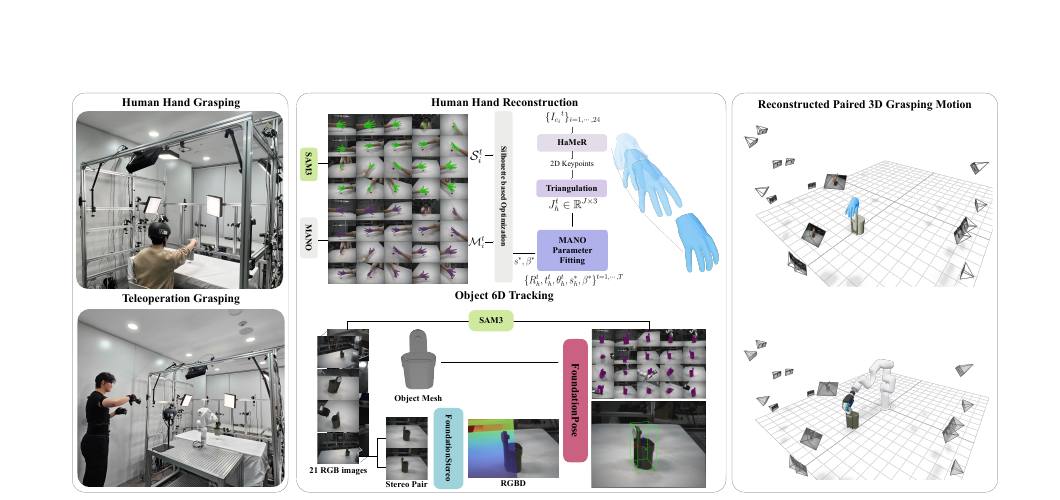
Figure 2
Human reconstruction, robot teleoperation, object 6D tracking
Hand / object annotations come from multiple models, not direct external-marker motion capture
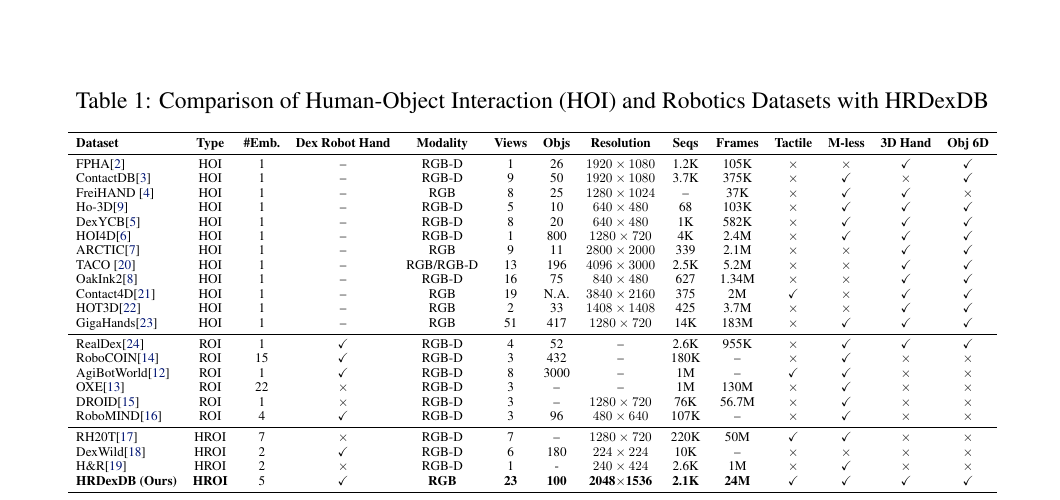
Table 1
HOI / ROI / HROI dataset comparison
HRDexDB combines 5 embodiments, 23 views, 100 objects, about 24M frames, and object 6D poses
Tables 3—8
Retrieval, grasping, hand / object pose benchmarks
Two evidence chains: manipulation transfer and interaction perception
Original Figure 1: dexterous hands, 100 objects, robot touch, 3D grasp / affordance annotations, and 23 synchronized RGB views. Source: arXiv v2 PDF. Image copyright belongs to the paper's authors and publisher; reproduced here for paper analysis.Original Figure 2: natural human grasps, robot teleoperation, and reconstruction using multiview keypoints, MANO, stereo depth, SAM3, FoundationPose, and cross-view silhouette optimization. Source: arXiv v2 PDF. Image copyright belongs to the paper's authors and publisher; reproduced here for paper analysis.
3. What problem does the dataset address?
Existing hand-object data often covers humans alone; robot data often covers one platform. Human and robot grasps also tend to use different objects, scenes, or tasks, preventing direct learning of how human grasp intent corresponds to actions for a particular robot hand.
HRDexDB establishes semantic pairing for the same object instead of directly mapping human joint angles to robot joints:
A human performs a natural grasp;
An operator observes its functional intent;
Xsens inertial motion capture and MANUS gloves teleoperate the robot;
The robot executes a semantically corresponding grasp suited to its morphology.
Shapes and postures can differ while preserving grasp purpose, contact regions, and functional outcome as closely as possible.
MANO 3D hand parameters, object 6D poses, success labels
Robot annotations
Joint states, object 6D poses, success labels, and tactile signals where supported
5. Four uses
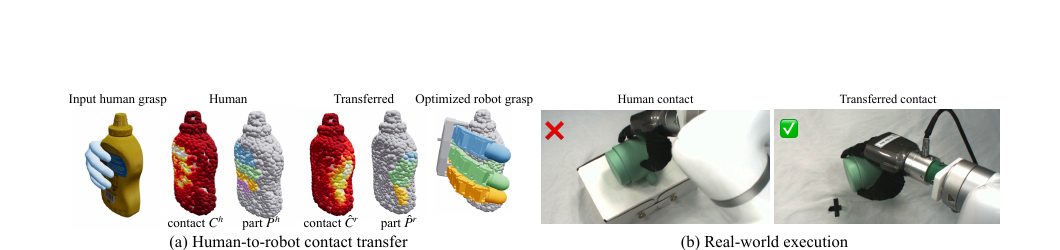
Human-to-robot contact transfer: adapt human contact / part maps to robot morphology, then optimize grasps with CEDex. Real success improves from 66.7% to 73.3% for Inspire-F1 and from 63.3% to 80.0% for Allegro-V5.
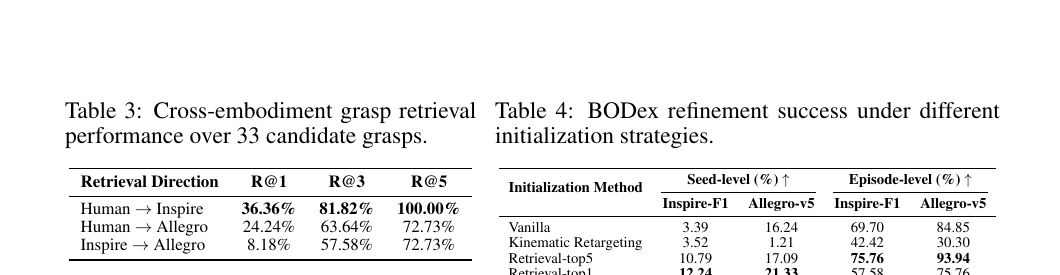
Cross-embodiment grasp retrieval: CLIP-style point-cloud encoders align human, Inspire, Allegro, and shared-object representations. Among 33 candidates, human-to-Inspire R@1 is 36.36%, and human-to-Allegro 24.24%.
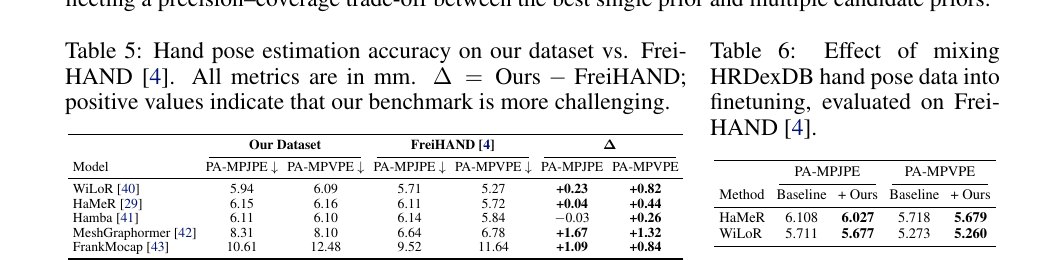
3D hand-pose benchmarks: WiLoR, HaMeR, Hamba, MeshGraphormer, and FrankMocap generally find HRDexDB harder than FreiHAND; mixing 6K HRDexDB samples slightly improves FreiHAND fine-tuning results.
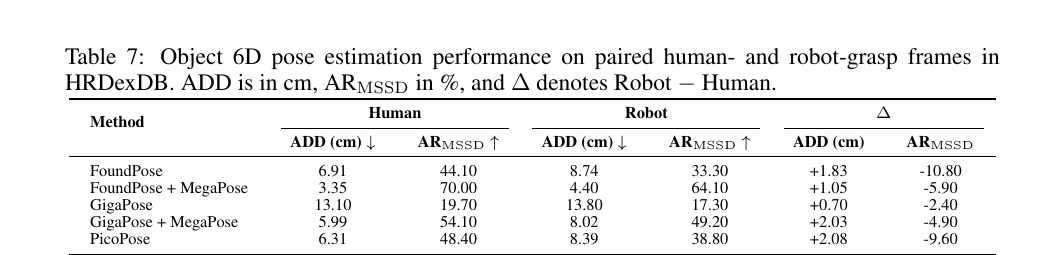
Object 6D pose under grasp occlusion: FoundPose, GigaPose, and PicoPose are worse on robot-grasp than paired human-grasp frames, showing extra localization ambiguity from rigid links / fingertips overlapping object boundaries.
21 external cameras give dense, consistently calibrated multiview evidence; ego views approximate practical human / robot observations.
RGB, 3D hands, object poses, proprioception, touch, and success labels enable varied downstream tasks.
Four benchmark types demonstrate utility beyond dataset scale.
7. Risks and boundaries
FoundationStereo, SAM3, FoundationPose, and cross-view silhouettes jointly produce object 6D poses. These are engineered annotations without independent measurement-system pose-error auditing, so metrology-grade truth is not established.
Touch is robot-only, and sensor configurations vary across platforms.
Pairing is semantic rather than exact time / contact-point alignment; cross-embodiment functional equivalence remains open.
100 objects and a controlled camera studio support systematic research but remain far from open-world, wild, long-horizon manipulation.
TB-scale data makes complete downloads, synchronized decoding, and multiview training expensive in storage / I/O.
8. Value for 6D pose research
HRDexDB moves pose research from isolated tabletop objects to objects heavily occluded by human / robot hands. Direct research questions include:
Why the same object shows systematic pose gaps under human versus robot occlusion;
Whether paired sequences, robot joints, and touch improve pose refinement;
Whether interaction data adapts general novel-object refiners to robot grasping.
Coarse-reading conclusion: HRDexDB merits close use for cross-embodiment grasp transfer, joint hand-object reconstruction, or heavily occluded object pose. Its capture / annotation complexity may exceed what ordinary static tabletop benchmarking needs.
Available src/paper-notes/hrdexdb/deep.md
In-depth paper notes
Support reproduction, comparison, related-work writing, and identifying opportunities for further research.
Paper Reading Notes (Deep): HRDexDB: A Paired Human-Robot Dataset for Cross-Embodiment Dexterous Grasping
1. Basic information
Dataset: HRDexDB
Authors: Jongbin Lim, Taeyun Ha, Mingi Choi, Jisoo Kim, Byungjun Kim, Subin Jeon, Hanbyul Joo
Data license: CC BY-NC 4.0; check the dataset repository’s current license and file documentation before use
Reading mode: Deep Dive
2. Positioning in one sentence
In one calibrated 23-view space, HRDexDB pairs natural human grasps with semantically corresponding grasps from four dexterous robot hands across 2.1K sequences. Shared 3D hand, object 6D pose, robot-state, touch, and success interfaces support both cross-embodiment grasp-intent transfer and geometric perception under interaction occlusion.
Method inputs and outputs
The main product is a dataset, not a unified online input/output covering all experiments. Capture and downstream methods are distinguished below.
Item
Content (compiled for this site)
Capture inputs
23 synchronized RGB streams, calibration, CAD, MANO / robot kinematics, robot joint states during paired grasping, and touch on supported platforms.
Final outputs
Aligned images, 3D hand / robot states, rigid object poses, touch / success labels, and human-robot pairings, not a control-action policy.
Training inputs
Contact transfer uses paired human / robot grasp representations and object clouds; retrieval uses paired hand-object geometry. Perception baselines use their own images / annotations, not automatically every capture sensor.
Training objectives
Contact transfer supervises robot pointwise contact / part maps; contrastive retrieval aligns paired embeddings; hand / object perception supervises its own 3D outputs. Capture itself has no unified training loss.
Inference inputs
Contact transfer reads human contact / part maps and object clouds; retrieval reads human hand-object geometry and a candidate library; perception conditions depend on the baseline.
Inference outputs
Robot contact / part maps or ranked candidates; executable grasps still need CEDex / BODex optimization backends, beyond contact prediction.
Output details
Object pose is a rigid transform in calibrated space; check camera / global coordinates and length units in data files. Contact probability is a scalar on each of N object points; part maps encode target-hand regions. These modalities do not form one 6D vector.
Prerequisites
Multiview images, CAD, and kinematics mainly support annotation; allowed test modalities depend on the task protocol. Pairing expresses grasp-intent correspondence, not identical framewise joints.
3D hands / object poses combine multiview constraints and pretrained models, not direct sensor readings
Figure 3, Table 2
Contact transfer
Robot-specific contact representations outperform directly applying human maps in real grasping
Figure 4, Tables 3—4
Cross-embodiment retrieval
Tests pairing recognition and BODex initialization; top-1 / top-5 trade precision against coverage
Tables 5—6
3D hand estimation
HRDexDB is harder than FreiHAND; small mixed-training additions provide complementary signals
Tables 7—8
Object 6D pose
All methods degrade on robot grasps; HRDexDB refiner fine-tuning helps an independent robot environment
Original Figure 1: human / robot hands, 100 objects, touch, 3D grasps, and 23 synchronized RGB views. Source: arXiv v2 PDF. Image copyright belongs to the paper's authors and publisher; reproduced here for paper analysis.Original Table 1: compares embodiments, dexterous hands, views, objects, sequences, frames, touch, markerless capture, 3D hands, and object 6D poses across HOI / ROI / HROI data. Source: arXiv v2 PDF. Image copyright belongs to the paper's authors and publisher; reproduced here for paper analysis.Original Figure 2: natural human / teleoperated robot capture at left, MANO reconstruction and object 6D tracking in the middle, and paired 3D grasp motion recovered in one calibrated space at right. Source: arXiv v2 PDF. Image copyright belongs to the paper's authors and publisher; reproduced here for paper analysis.
3. What does paired mean here?
3.1 Five embodiments
HRDexDB covers humans and four dexterous robot hands:
Allegro Hand V4
Allegro Hand V5 Plus
Inspire Hand RH56DFTP
Inspire Hand RH56F1
Their DoFs, link lengths, reachable contact regions, joint limits, and sensors differ. Direct MANO-to-robot retargeting often causes penetration, unreachable configurations, or unstable grasps, so identical posture is not the pairing criterion.
3.2 Semantic pairing protocol
Each pair is captured in two stages:
A human naturally grasps the given object;
A teleoperator observes it and reproduces a semantically corresponding grasp on the target hand.
Pairing retains intent and function, such as stable side grasping of a cup, rather than identical joints or point contacts. Different morphologies rarely admit exact kinematic isomorphism. This sensible choice also limits supervision strength: pairing labels alone do not define mathematical functional equivalence.
3.3 Signals in each sequence
A human sequence can be summarized as:
H={It1:23,θtMANO,TO→C,t,y}t=1T,
A robot sequence as:
R={It1:23,qt,TO→C,t,Ft,y}t=1T.
Here It1:23 denotes synchronized RGB from 21 external and 2 ego cameras; θMANO is human pose, qt robot joints, TO→C,t∈SE(3) the rigid object-to-camera / calibrated-global transform, Ft available platform touch, and y the success / failure label.
4. Capture system
4.1 Multiview and egocentric capture
Camera racks on three sides carry 21 calibrated external RGB cameras.
A custom stereo helmet captures human ego views.
Robot over-the-shoulder stereo approximates the acting agent’s viewpoint.
RGB resolution is 2048 × 1536; Table 1 reports about 24M total frames.
External views mainly support reconstruction / annotation; ego views support perception / policies closer to deployment. These are different input protocols: ego-only models cannot treat external 21-view annotation evidence as test information.
4.2 Robot teleoperation
Xsens inertial motion capture and MANUS gloves record operator upper-body / hand motion for robot mapping. Operators reimplement grasp intent within target kinematics and contact capabilities rather than mechanically copying the demonstration.
This has two effects:
Pairings retain embodiment-specific adaptations useful for cross-embodiment representations;
Operator experience shapes the data; successful samples depend on teleoperation strategy.
4.3 Interpreting scale
Statistic
Value
Meaning
Objects
100
Fixed instances with high-quality meshes / CAD
Sequences
About 2.1K
Human and robot grasp sequences combined
Embodiments
5
1 human + 4 robot hand types
RGB views
23
21 external + 2 ego
Frames
About 24M
Image total after expanding multiple views
The 24M frames include simultaneous cameras, not 24M independent action states. Group training splits by sequence, object, and paired episode to keep neighboring views of the same moment from leaking across train / test.
5. Annotation and reconstruction
5.1 Human-hand 3D reconstruction
HaMeR predicts 2D hand keypoints in each view;
Calibration enables multiview triangulation into 3D joints;
Optimize MANO pose to align projected keypoints with triangulated geometry;
Markerless capture preserves natural contact, but HaMeR, SAM3, triangulation, and MANO errors accumulate. Long-occluded fingertips depend on model priors as well as image evidence.
5.2 Object 6D pose
Object-pose pipeline:
FoundationStereo predicts depth from a designated stereo pair;
SAM3 supplies object masks;
CAD, RGB-D, and masks enter FoundationPose for first-frame global registration and later tracking;
Render the mesh at current TO→C into every calibrated view;
Minimize multiview silhouette mismatch to reduce single-view drift.
An abstract cross-view refinement objective is:
Lsil(T)=v=1∑21d(Πv(TMO),Mv),
Here MO is the object mesh, Πv the projection for camera v, Mv its object silhouette, and d silhouette mismatch. Multiple views reduce occlusion ambiguity but still depend on CAD scale, mask quality, stereo depth, and FoundationPose initialization.
Evidence boundary: the paper supplies object 6D pose annotations and demonstrates downstream utility, but reports no absolute error against external optical motion capture, calibrated robot fixtures, or manual framewise review. These are not independently measured, metrology-grade ground truth.
6. Downstream task one: human-to-robot contact transfer
Direct human-contact grasp targets ignore palm size, finger count, reachability, and joint limits. Predictions on object clouds include:
Contact probability C;
Contact-part distribution P;
Robot-specific target maps for Inspire-F1 and Allegro-V5.
PointNet++ extracts object features; contact probability uses weighted L1 and part maps use cross-entropy. The fixed physics-aware CEDex optimizer converts predicted robot contact maps into grasps.
Original Figure 3: adapt human contact / part maps to robot morphology for grasp optimization. Real examples at right fail with direct human contact and succeed after transfer. Source: arXiv v2 PDF. Image copyright belongs to the paper's authors and publisher; reproduced here for paper analysis.
Contact target
Inspire sim / real
Allegro sim / real
Human-Contact
54.6 / 66.7
60.2 / 63.3
Transferred
55.6 / 73.3
65.8 / 80.0
Simulation gains are small; real Allegro improves most, by 16.7 percentage points. This supports morphology-specific contact representations, but only 60 Inspire and 30 Allegro real trials are reported. Main tables lack confidence intervals / objectwise detail, so the aggregate ratio is not universal success.
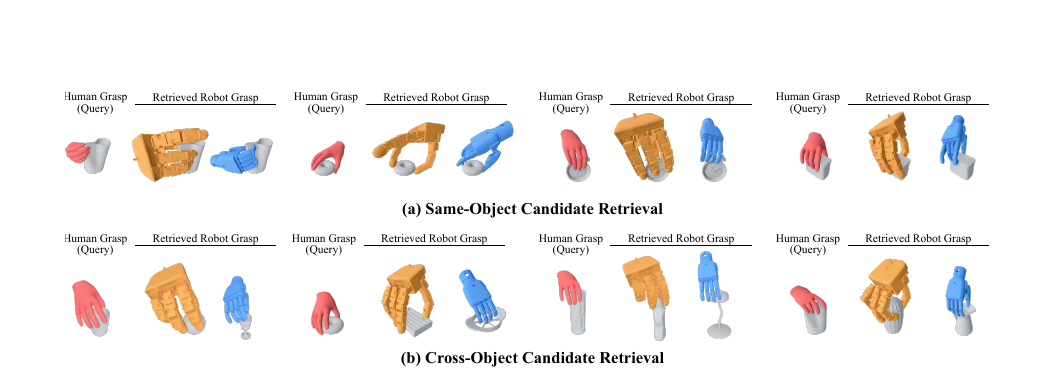
A CLIP-style multi-branch cloud model uses separate human, Inspire-F1, and Allegro-V5 encoders with a shared object encoder. Paired human-object / robot-object grasps project into one space under symmetric contrastive loss.
Original Figure 4: a human hand-object query retrieves Inspire and Allegro grasps among same-object or cross-object candidates. Orange and blue denote the two robot hands. Source: arXiv v2 PDF. Image copyright belongs to the paper's authors and publisher; reproduced here for paper analysis.Original Tables 3--4: left, R@1 / R@3 / R@5 among 33 grasp candidates; right, seed / episode success using Vanilla, kinematic retargeting, retrieved top-5, or top-1 BODex initialization. Source: arXiv v2 PDF. Image copyright belongs to the paper's authors and publisher; reproduced here for paper analysis.
Retrieval direction
R@1
R@3
R@5
Human → Inspire
36.36%
81.82%
100.00%
Human → Allegro
24.24%
63.64%
72.73%
Inspire → Allegro
8.18%
57.58%
72.73%
This uses 33 grasp candidates, not a large image-retrieval library. High R@5 can coexist with unstable top-1 ranking; Inspire → Allegro R@1 is only 8.18%, showing no automatic shared representation even between robots.
Retrieved grasps initialize BODex refinement on 7 unseen objects, 33 episodes, and 50 optimization seeds per episode:
Retrieval-top1 has best seed-level success: Inspire 12.24%, Allegro 21.33%;
Retrieval-top5 has best episode-level success: Inspire 75.76%, Allegro 93.94%.
Top-1 gives a stronger individual prior; top-5 uses diversity to improve at-least-one-success coverage. This is a clear precision—coverage trade-off.
8. Downstream task three: 3D hand-pose benchmarks
Original Tables 5--6: five methods' HRDexDB / FreiHAND PA-MPJPE / PA-MPVPE at left; FreiHAND results after adding 6K HRDexDB samples to a 2.7M-sample fine-tuning set at right. All units are mm. Source: arXiv v2 PDF. Image copyright belongs to the paper's authors and publisher; reproduced here for paper analysis.
Model
HRDexDB PA-MPJPE / PA-MPVPE
FreiHAND
Difference
WiLoR
5.94 / 6.09
5.71 / 5.27
+0.23 / +0.82
HaMeR
6.15 / 6.16
6.11 / 5.72
+0.04 / +0.44
Hamba
6.11 / 6.10
6.14 / 5.84
-0.03 / +0.26
MeshGraphormer
8.31 / 8.10
6.64 / 6.78
+1.67 / +1.32
FrankMocap
10.61 / 12.48
9.52 / 11.64
+1.09 / +0.84
HRDexDB is harder overall, especially for mesh vertices, consistent with occlusion, object contact, and complex hand shapes. The authors then mix 6K HRDexDB samples into about 2.7M fine-tuning samples:
Small but consistent improvements suggest complementary interaction signals. Since added data is a tiny fraction, this indicates usefulness rather than a full scaling study.
9. Downstream task four: object 6D pose in human / robot grasps
All methods receive RGB + SAM3 masks + intrinsics + CAD and use BOP-style evaluation. FoundPose, GigaPose, and PicoPose localize initially; refined variants pass the top 5 coarse candidates to MegaPose.
Original Table 7: ADD and AR_MSSD for FoundPose, GigaPose, PicoPose, and MegaPose-refined variants on paired human / robot grasps. Differences are Robot − Human. Source: arXiv v2 PDF. Image copyright belongs to the paper's authors and publisher; reproduced here for paper analysis.
Method
Human ADD ↓ / AR_MSSD ↑
Robot ADD ↓ / AR_MSSD ↑
Robot degradation
FoundPose
6.91 / 44.10
8.74 / 33.30
+1.83 cm / -10.80
FoundPose + MegaPose
3.35 / 70.00
4.40 / 64.10
+1.05 cm / -5.90
GigaPose
13.10 / 19.70
13.80 / 17.30
+0.70 cm / -2.40
GigaPose + MegaPose
5.99 / 54.10
8.02 / 49.20
+2.03 cm / -4.90
PicoPose
6.31 / 48.40
8.39 / 38.80
+2.08 cm / -9.60
All methods degrade on robot-grasp frames. Rigid links / fingertips cover object edges and create similar structures. Pairing controls object identity and approximate intent, making the domain gap more interpretable than comparisons across unrelated human / robot datasets.
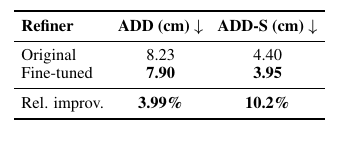
The authors fine-tune MegaPose’s refiner on 100K GSO synthetic samples and 5.3K HRDexDB robot-grasp annotations, then test in independent OmniRobotHome:
Original Table 8: adding HRDexDB robot-grasp labels reduces OmniRobotHome ADD from 8.23 cm to 7.90 cm, and ADD-S from 4.40 cm to 3.95 cm. Source: arXiv v2 PDF. Image copyright belongs to the paper's authors and publisher; reproduced here for paper analysis.
Relative gains are 3.99% ADD and 10.2% ADD-S. Independent testing strengthens evidence beyond internal fine-tuning / testing, but this is refiner adaptation, not equal end-to-end gains for detection, segmentation, coarse pose, and tracking.
Supported; multiview frames exceed independent action states, which are fewer than 24M
Cross-embodiment grasp transfer
Real contact transfer, retrieval, BODex initialization
Useful proof of concept with limited platforms, objects, and real trials
Interaction-centered 3D perception research
Hand / object 6D pose benchmarks
Task feasibility shown; absolute label accuracy still needs external auditing
Robot hands create harder pose conditions than humans
Consistent degradation across five methods on paired frames
Strong evidence; stratify further by visibility, material, and hand type
Improving external robot domains
MegaPose refiner on OmniRobotHome
Supported for one refiner and one external system
11. Strengths
Sensible pairing unit: semantic correspondence replaces invalid joint-to-joint mappings and preserves executable solutions for each morphology.
Unified capture / downstream interfaces: calibration, CAD, object poses, and hand / robot states support perception and manipulation from the same sequences.
Explicit robot-domain difficulty: pose benchmarks quantify the extra occlusion from rigid hands.
Benchmarks span levels: contact targets, retrieval representations, and 3D hand / object perception show utility beyond one network.
Substantial resources: projects, code, and public data repositories lower reproduction barriers.
12. Limitations and potential failures
Heterogeneous, asymmetric touch: robot-only sensing with differing layouts / ranges makes unified tactile encoders difficult.
Semantic pairing only: no exact timewise contacts, phase alignment, or shared functional-equivalence metric; learned correspondence may encode teleoperator preference.
Strong annotation-model dependence: SAM3, HaMeR, FoundationStereo, and FoundationPose biases can enter labels. Related models evaluated on them may inherit teacher-induced bias.
Limited objects / environments: 100 objects, controlled capture, and grasp-focused tasks do not cover 1000-scale objects, dynamic environments, or multistage functional manipulation; expansion to 1000 is future work.
Download / training costs: full multiview RGB is TB-scale; shard by modality / object / sequence rather than copying everything by default.
Split leakage: nearby views, episodes, human-robot pairs, and same-object trajectories correlate strongly; random frames exaggerate generalization.
Limited real success samples: contact transfer uses two robot hands and tens of trials; objectwise intervals and more repetition are needed.
13. Concrete implications for 6D pose
13.1 From object-centered to interaction-centered benchmarks
Unlike ordinary tabletop / clutter BOP data, grasped objects couple occlusion structure and motion. Robot geometry creates object-like rigid edges, causing systematic errors even for mask-conditioned estimators.
13.2 Additional conditions to exploit
Robot joint state: render known hand kinematics and explicitly model occlusion instead of treating the hand as unknown clutter.
Paired human sequences: easier human-frame poses can teach same-object geometry under similar intent.
Time: more visible pre-grasp objects provide pose and continuity priors for tracking / refinement after occlusion.
Multiview labels, single-view deployment: consistent 21-view supervision at training with ego / one external test view naturally uses privileged information.
13.3 Additional evaluations worth doing
Stratify pose by visibility, hand type, symmetry, material, and contact region;
Audit sampled object labels using independent external measurements;
Quantify occlusion-modeling gains from known hand meshes / joints;
Enforce object-, operator-, and embodiment-held-out splits;
Separate first-frame global localization, tracking, and recovery after failure.
14. Usage recommendations
Start with metadata, meshes, and low-rate / few-view subsets; check frames, units, timestamps, and object IDs.
Keep paired episodes indivisible, placing linked human / robot sequences in the same split.
Add object-held-out testing for unseen-object generalization rather than framewise random splits.
Check reprojection, mesh scale, and continuity across views; filter visibly drifting pose segments before training.
Report actual inference modalities, distinguishing 21-view annotation from deployment input.
Check noncommercial license compatibility before releasing models or derived data.
15. Summary
HRDexDB builds a paired interface for two connected questions:
Manipulation: how human grasp intent transfers across robot morphologies;
Perception: why 3D hand / object 6D pose degrades under different hands’ occlusion, and how to adapt.
Multiview annotation and four benchmark types make both directions actionable. Keep semantic pairing distinct from exact trajectories and model-generated labels distinct from independently measured truth. Its most valuable use explicitly exploits human-robot pairs, robot geometry, time, and touch rather than merely adding 24M RGB frames to ordinary training.