iG-6DoF: Model-free 6DoF Pose Estimation for Unseen Object via Iterative 3D Gaussian Splatting
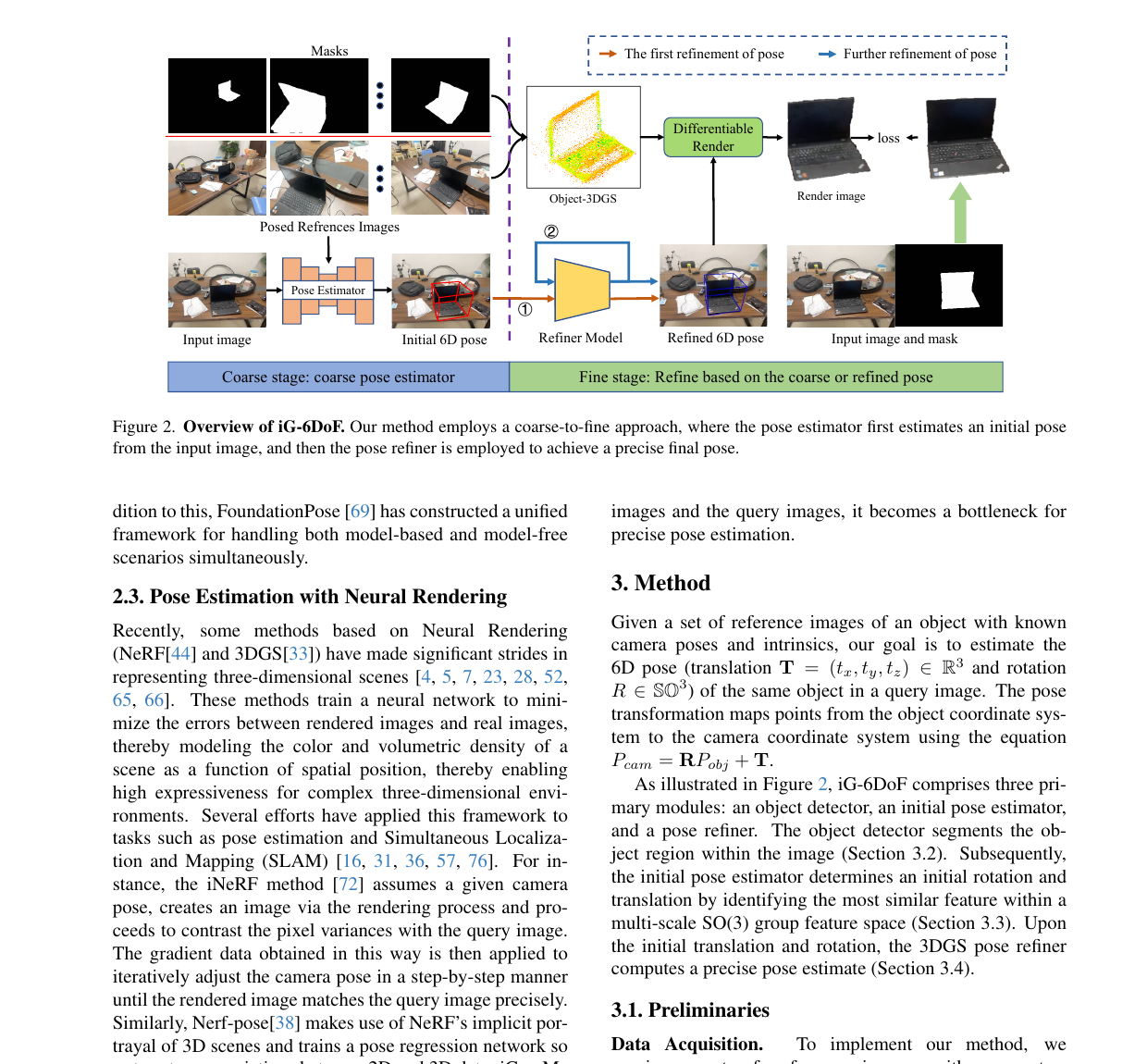
iG-6DoF constructs initial poses with multiscale rotation-equivariant features, then refines unknown-object poses through iterative render-and-compare using object 3D Gaussian Splatting.
Authors / affiliation: Tuo Cao et al.; Wuhan University.
Task: estimate unseen-object pose from reference RGB images and query RGB, without manually prepared CAD.
Reading mode: Overview.
2. Positioning in one sentence
iG-6DoF proposes coarse poses with rotation-equivariant features, then repeatedly renders, compares, and corrects using an object-level 3D Gaussian Splatting representation.
3. Problem and motivation
Incomplete references and weak texture can make direct matching / template selection initialize incorrectly.
Continuous 3DGS rendering becomes a pose estimator when iterated jointly with pose hypotheses.
4. Method overview
A detector finds the target; multiscale augmentation and rotation-equivariant features provide more reliable initial candidates.
Build 3DGS from references, render at the current pose, compare to the query, and update coarse to fine.
5. Experiments at a glance
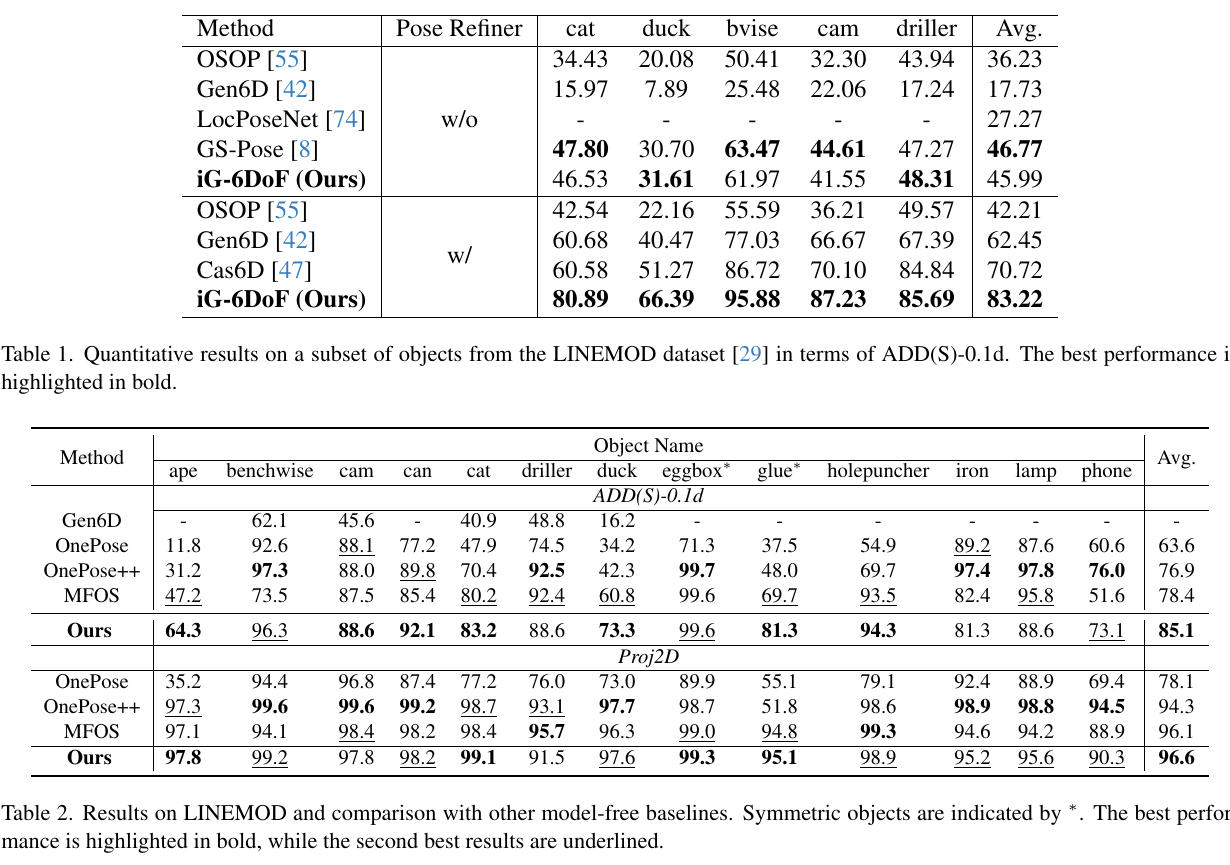
In LINEMOD model-free comparisons, full-object-set mean ADD(S)-0.1d / Proj2D is 85.1 / 96.6.
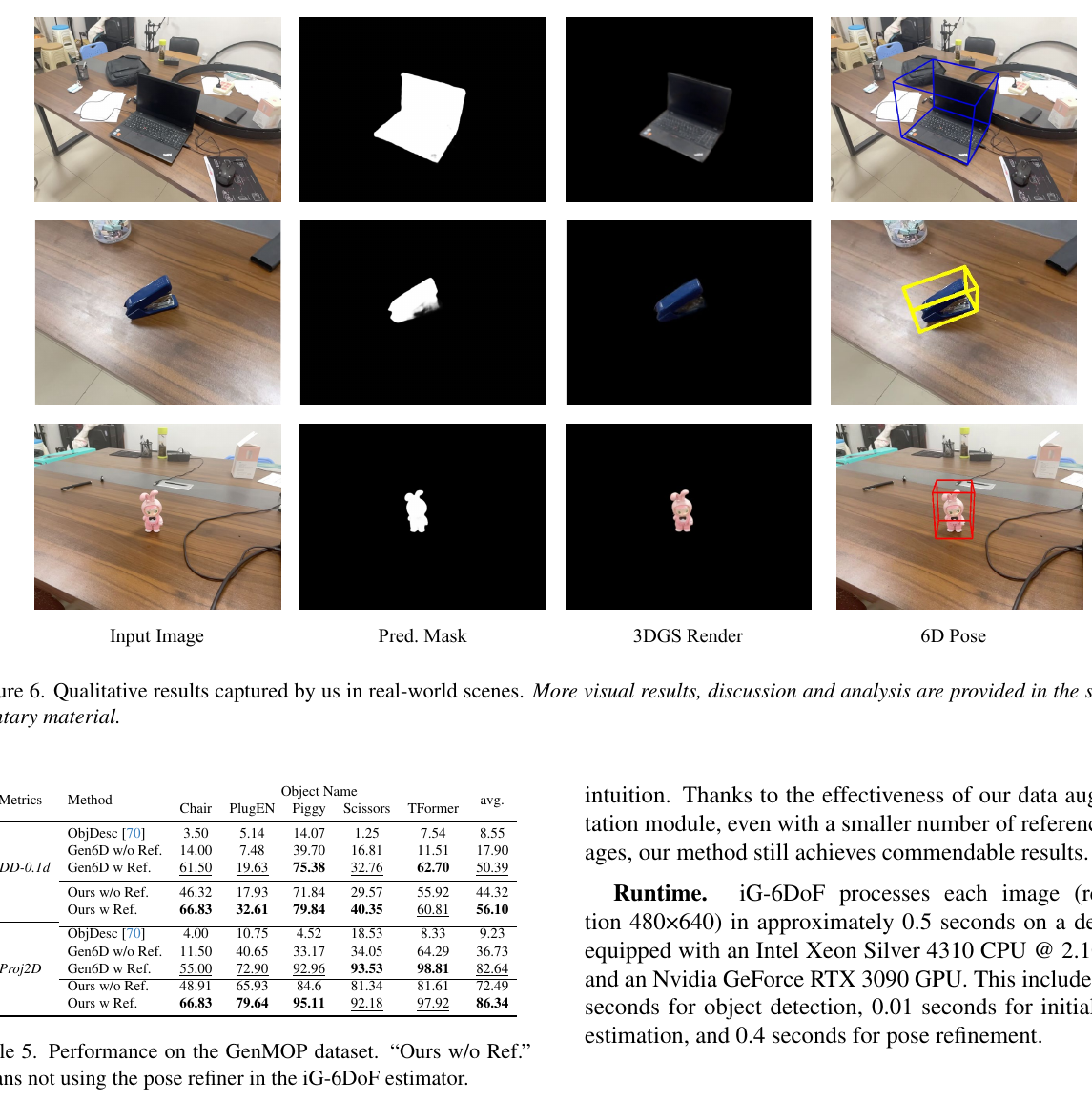
GenMOP refined ADD-0.1d averages 56.10 versus 44.32 without refinement. Reported per-frame time is about 0.5 s, including about 0.4 s refinement.
Original iG-6DoF LINEMOD results: five-object ADD(S)-0.1d above, full-set ADD(S)-0.1d and Proj2D below. The refined five-object average is 83.22. Source: CVPR 2025 paper. Image copyright belongs to the paper's authors and publisher; reproduced here for paper analysis.
The two tables cover different objects: the five-object subset averages 45.99 without a refiner and 83.22 with one; full-set ADD(S)-0.1d / Proj2D averages 85.1 / 96.6. The 96.6 score belongs to the looser image-projection metric, not full-set ADD(S)-0.1d.
6. Quick assessment
Value: 3DGS is an object representation for render-and-compare pose rather than reconstruction alone.
Cost: reference-view coverage and substantial test-time refinement; transparency, reflections, and detection errors remain difficult.
Available src/paper-notes/ig-6dof/deep.md
In-depth paper notes
Support reproduction, comparison, related-work writing, and identifying opportunities for further research.
Paper Reading Notes (Deep): iG-6DoF: Model-free 6DoF Pose Estimation for Unseen Object via Iterative 3D Gaussian Splatting
Key problem: without precise CAD, model-free pose needs reliable initialization across large rotation / translation and continuously comparable object geometry.
iG-6DoF puts 3DGS inside the pose loop, rendering at each current pose to supply a differentiable / comparable object representation for refinement beyond offline reconstruction.
2.1 Guide to the paper’s figures and tables
Figure / table
What to look for
Figure 2
Inputs, outputs, and boundaries of detection, coarse estimation, and 3DGS refinement.
Figures 4–5
How rotation-equivariant features and iterative refinement update pose.
Tables 2–5
Separate LINEMOD, OnePose-LowTexture, BOP LM, and GenMOP by references / refinement.
Figure 6
Whether 3DGS renders still match real observations in captured scenes.
Original method-figure region: rotation-equivariant features produce hypotheses, then iterative 3DGS render-and-compare refines them. Source: CVF Open Access. Image copyright belongs to the paper's authors and publisher; reproduced here for paper analysis.
3. Problem setting and boundaries
Input: reference RGB images and query RGB; output: object 6D pose in the query camera.
No manually prepared CAD, but reference capture, detection / masks, camera models, and modelable appearance remain prerequisites.
Model-free does not imply universal pose from one image without references.
4. Method details
Coarse stage: train with multiscale rotation / scale augmentation and search candidates for robust initialization under large pose change.
3DGS representation: construct object Gaussians from reference images for rendering at novel poses.
Iterative refinement: convert query–render differences to pose updates repeatedly, coarse to fine; shape constraints prevent unconstrained drift.
5. Experimental analysis
Setting
Key value
LINEMOD full-set mean ADD(S)-0.1d / Proj2D
85.1 / 96.6
GenMOP Ours w/o Ref. mean ADD-0.1d
44.32
GenMOP Ours w Ref. mean ADD-0.1d
56.10
Reported per-frame time
About 0.5 s (refinement about 0.4 s)
The 11.78-point refinement gain supports the 3DGS loop but also shows the online latency budget required for high accuracy.
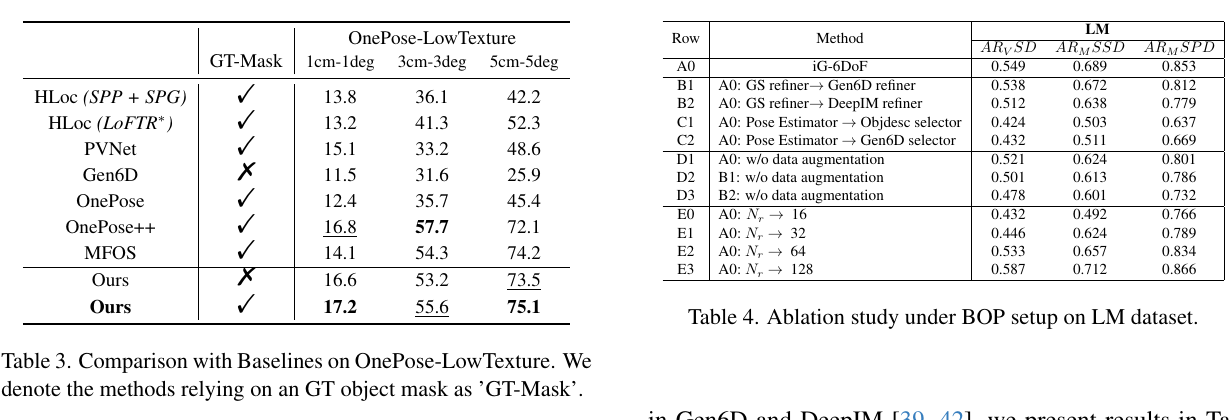
Original low-texture comparisons and BOP-LM ablations: the left table indicates GT-mask use; the right separates 3DGS refinement, pose selection, augmentation, and reference counts. Source: CVPR 2025 paper. Image copyright belongs to the paper's authors and publisher; reproduced here for paper analysis.
BOP-LM ablations clarify causality: full-model ARVSD / ARMSSD / ARMSPD is 0.549 / 0.689 / 0.853; Gen6D refinement gives 0.538 / 0.672 / 0.812, DeepIM 0.512 / 0.638 / 0.779. Replacing the coarse estimator with ObjDesc selection drops farther to 0.424 / 0.503 / 0.637. Refinement helps consistently, but initialization within its convergence basin matters more.
Augmentation matters: removing it from full model A0 (D1) gives 0.521 / 0.624 / 0.801. D2 instead removes augmentation from B1 with the Gen6D refiner, giving 0.501 / 0.613 / 0.786; it does not remove a second augmentation from the same model. Increasing references from 16 to 128 raises AR from 0.432 / 0.492 / 0.766 to 0.587 / 0.712 / 0.866. Model-free usage costs depend strongly on reference coverage, so report counts alongside scores.
Original real-scene qualitative results and GenMOP table: rows show input, predicted mask, 3DGS render, and final 6D pose; below are ADD-0.1d / Proj2D with and without refinement. Source: CVPR 2025 paper. Image copyright belongs to the paper's authors and publisher; reproduced here for paper analysis.
On five GenMOP objects, refinement raises mean ADD-0.1d from 44.32 to 56.10 and Proj2D from 72.49 to 86.34. Chair rises 46.32→66.83, PlugEN 17.93→32.61, and TFormer only 55.92→60.81. Texture, reference coverage, and initial error jointly affect convergence. Check rendered silhouettes / appearance against the query: an attractive 3D box cannot prove pose if the render is wrong.
6. Authors’ claims and my assessment
Authors’ claims
My assessment
3DGS refinement helps unknown objects
Direct GenMOP before/after evidence; evaluate convergence by initialization-error bins too.
Rotation-equivariant features improve initialization
BOP selector replacement degrades strongly, supporting a necessary frontend role.
7. Reproduction considerations and limitations
Record reference counts, 3DGS initialization / optimization, pose sampling, and per-round iterations; all affect results.
Weak texture, reflections, or poor reference coverage can make Gaussians encode wrong appearance and rendering gradients mislead pose.
The 0.5 s is hardware-specific pipeline timing, not directly a robot feedback-control frequency.
Reported about 0.5 s comprises detection 0.12 s, initial pose 0.01 s, and refinement 0.4 s. Real-time work should target repeated 3DGS render-and-update rather than only compressing the coarse network.