Object Pose Estimation · 2026 · ICRA / IEEE RA-L · CCF B
InstantPose: Zero-Shot Instance-Level 6D Pose Estimation From a Single View
InstantPose generates a coarse mesh and 400 templates from one unposed RGB reference. DINOv2 matches the query, depth from both sides lifts 3D correspondences, and RANSAC + Umeyama jointly recover rotation, translation, and scale. YCB-V BOP AR is 36.83 at around 3.9 s on an A4500. Single-view onboarding is convenient, but reconstruction quality, occlusion, and weak-texture matching limit results.
one unposed RGB reference imageone RGB-D query imagecamera intrinsics
Requirements
single-view 3D reconstruction priorquery depthobject crop or maskoffline rendering of 400 templatestest-time RANSAC correspondence solve
Full paper metadataAuthors, affiliations, research area, datasets, metrics, method tags, and reading statusExpandCollapse
Authors
Francesco Di Felice, Alberto Remus, Stefano Gasperini, Benjamin Busam, Lionel Ott, Stefan Thalhammer, Federico Tombari, Carlo Alberto Avizzano
Affiliations
Scuola Superiore Sant’Anna / Leonardo S.p.A. / Technical University of Munich / MCML / ETH Zürich Autonomous Systems Lab / UAS Technikum Wien / Google Zürich
Publication: IEEE Robotics and Automation Letters 2025, included in the ICRA 2026 technical program. The site links it from ICRA 2026 without counting two independent papers.
Authors: Francesco Di Felice, Alberto Remus, Stefano Gasperini, Benjamin Busam, Lionel Ott, Stefan Thalhammer, Federico Tombari, Carlo Alberto Avizzano.
Task: new-object instance-level 6D pose from one unposed RGB reference and one RGB-D query, without prepared CAD or posed support views.
2. Positioning in one sentence
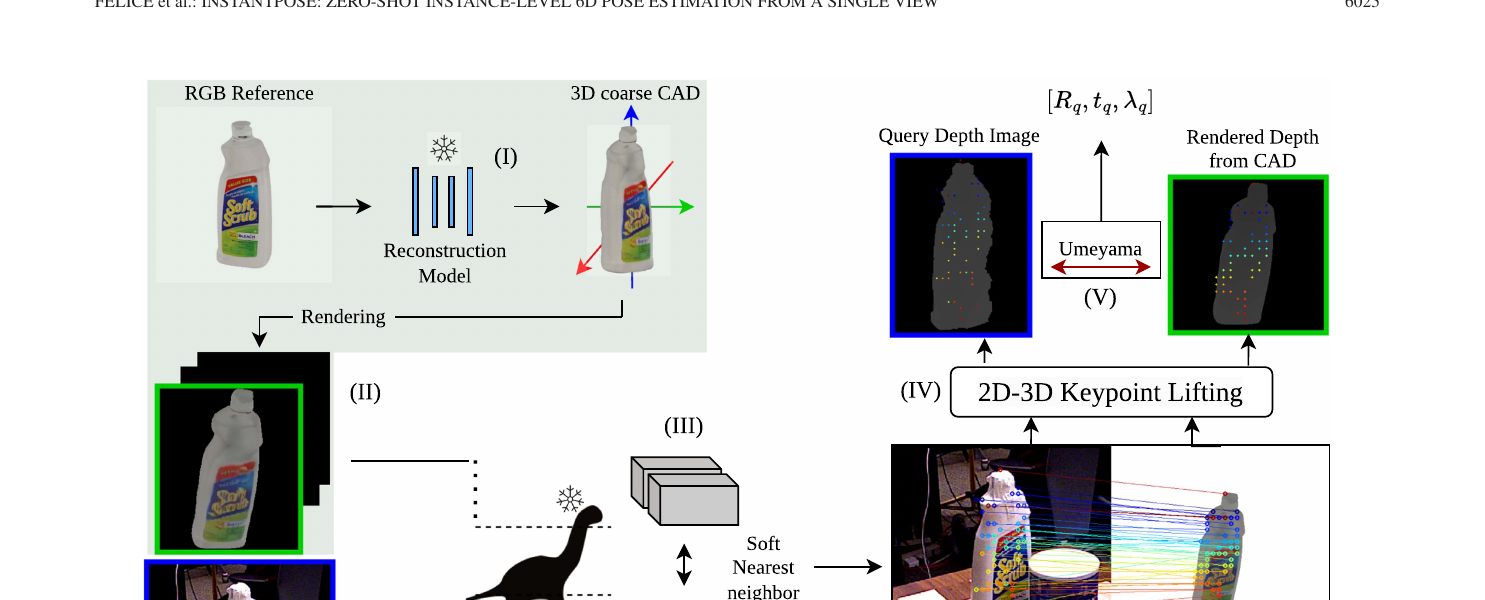
InstantMesh converts a single reference into an imperfect 3D model. InstantPose renders 400 templates, matches the query with DINOv2 soft nearest neighbors, lifts both sides using depth, and jointly solves rotation, translation, and scale with RANSAC + Umeyama.
3. Method overview
A large reconstruction model turns one RGB reference into a mesh, without its camera pose.
Render 400 templates with camera poses / depth and retrieve the closest view using query DINOv2 features.
Apply cyclic soft-nearest-neighbor matching between the query and selected template.
Rendered depth lifts template pixels to model 3D points; sensor depth lifts query pixels to scene 3D points.
RANSAC uses SVD / Umeyama to solve R,t,λ; extra scale λ compensates single-view model-size uncertainty.
Original Figure 2: single-view reconstruction handles onboarding; reference / query correspondence and geometric refinement recover final pose. Source: InstantPose paper. Image copyright belongs to IEEE and the paper's authors; reproduced here for academic analysis.
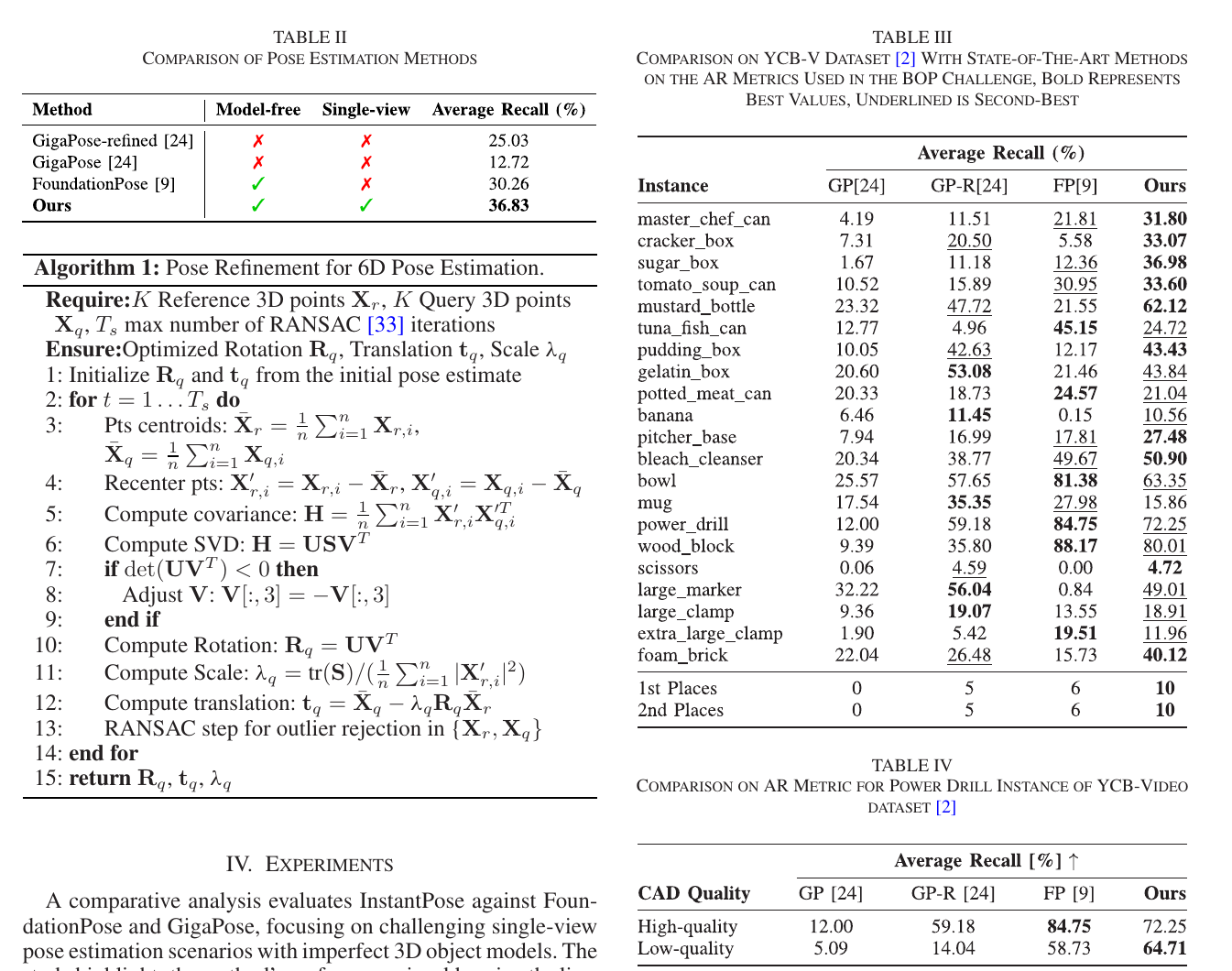
Across 21 objects, InstantPose ranks first on 10 and second on 10; it does not lead every object.
With a high-quality power-drill mesh, FoundationPose / InstantPose score 84.75 / 72.25; with a low-quality mesh, 58.73 / 64.71. The text summarizes InstantPose loss as about 8%, versus up to about 45% for baselines.
Pose inference on A4500 takes about 3.9 s; FoundationPose about 1.8 s, GigaPose about 8 s. Soft nearest neighbors dominate runtime.
Original Tables II–IV: overall AR, rankings on 21 YCB-V objects, and high / low-quality power-drill meshes. Baselines get the same generated mesh, but FoundationPose / GigaPose also need manual scale adjustment. Source: InstantPose paper. Image copyright belongs to IEEE and the paper's authors; reproduced here for academic analysis.
5. Quick assessment
Value: reduces onboarding to one ordinary RGB image while explicitly handling reconstructed scale / geometry noise.
Risk: queries still need depth, target regions, and intrinsics; reference views missing key parts damage both meshes and DINO correspondences.
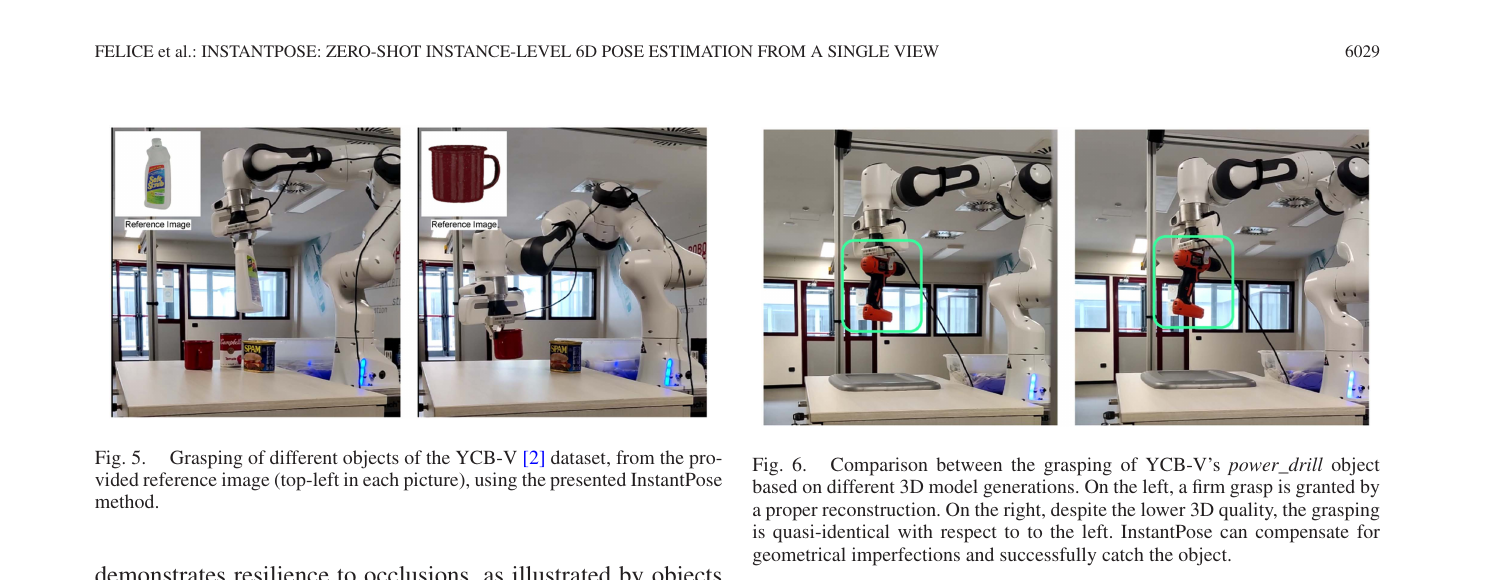
Robot demonstrations show grasp feasibility through a few open-loop qualitative examples, not a systematic grasp-success benchmark.
Available src/paper-notes/instantpose-icra2026/deep.md
In-depth paper notes
Support reproduction, comparison, related-work writing, and identifying opportunities for further research.
Paper Reading Notes (Deep): InstantPose: Zero-Shot Instance-Level 6D Pose Estimation From a Single View
Publication: RA-L Vol. 10 No. 6 (2025), also presented at ICRA 2026. The site has one canonical detail page linked from the ICRA 2026 collection.
Core problem: novel-object methods such as FoundationPose / GigaPose usually assume accurate CAD, complete scans, or posed support images. Can an incomplete mesh from one unposed RGB reference still support 6D pose?
Answer: use an LRM for coarse geometry / texture without trusting absolute scale; recover pose from DINOv2 correspondences, query depth, and scale-aware Umeyama refinement.
My assessment: the contribution connects imperfect reconstructed assets to a pose pipeline tolerant of scale / geometry noise. AR 36.83 beats tested baselines under strict onboarding, but 3.9 s inference and query-depth dependence limit real-time open-world perception.
2. Positioning in one sentence
InstantPose turns one unposed photo into a temporary asset: InstantMesh creates geometry, 400 rendered views supply pose-indexed references, DINOv2 matches pixels, and RANSAC–Umeyama corrects pose / model scale using depth on both sides.
2.1 Guide to figures and tables
Figure / table
What to look for
Figure 2
The single reference is reconstructed and rendered into posed templates before query matching, rather than directly solving two-view pose.
Algorithm 1
Joint R,t,λ refinement uses scale to handle LRM uncertainty.
Tables II–III
Overall AR and per-object results; 10 first places do not mean leading all 21 objects.
Qualitative open-loop task utility, not large-scale manipulation benchmarking.
Original Figure 2: InstantMesh reconstructs the reference and renders templates; query / best-template DINOv2 matching and bilateral depth form 3D correspondences. Source: InstantPose paper. Image copyright belongs to IEEE and the paper's authors; reproduced here for academic analysis.
3. Problem setting and the meaning of single view
Inputs include:
One object RGB reference without a camera pose;
One RGB-D query containing the object at test time;
Query intrinsics;
Pretrained detection / segmentation, InstantMesh, and DINOv2.
Output is object 6D pose in query-camera coordinates plus uniform scale λ aligning generated and real object size.
Single view means one reference for object onboarding, not RGB-only inference: the query needs depth. The generated mesh also supplies 400 offline rendered views, so the algorithm has broad template coverage without collecting posed real references.
4. Single-view onboarding
InstantMesh makes a textured mesh from one RGB image. Missing backside, cavity, and scale information can produce:
Plausible prior-filled invisible regions differing from real geometry;
Missing thin handles, holes, or sheets;
Stretched / duplicated texture;
Unreliable metric scale and inconsistent canonical orientation.
InstantPose does not fix everything during onboarding. It renders 400 RGB / depth templates with known virtual-camera poses, turning an unposed reference into broad-view, posed but geometrically noisy assets.
Unlike handing generated meshes directly to accurate-CAD render-and-compare methods such as FoundationPose, InstantPose uses local semantic features and similarity transforms to absorb some geometry / scale errors.
5. Template retrieval and cyclic soft nearest neighbors
For query Iq and template Ir, frozen DINOv2 extracts patch features Fq,Fr. For query location xq:
Find the closest reference-feature location xˉr;
Map xˉr back to query location xˉq;
Use ∥xq−xˉq∥2 as cycle-consistency distance;
Select low-distance correspondences.
Soft nearest neighbors also rank the 400 templates before fine matching. DINOv2 category / part semantics tolerate generated-to-real differences better than raw RGB texture.
This is also the main runtime bottleneck. Repetitive texture, reflection, or near symmetry can cluster matches in wrong equivalent regions. A mug’s cylindrical body can dominate while its thin handle contributes few matches.
6. From 2D matches to scale-aware pose
Template pixel xr and rendered depth Dr back-project through virtual-camera intrinsics / extrinsics to mesh point Xr; query pixel xq and real depth Dq with intrinsics yield camera point Xq. These form 3D–3D correspondences.
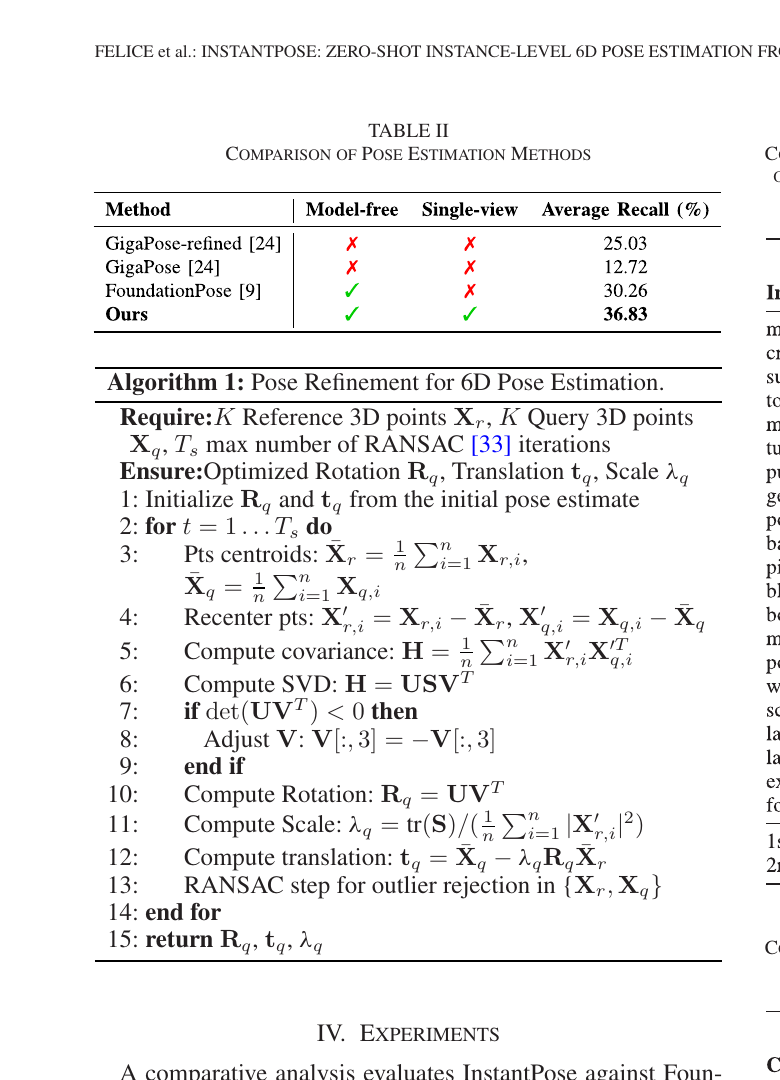
Original Algorithm 1: SVD on centered 3D correspondences, reflection checking, then uniform scale / translation; RANSAC rejects wrong DINO matches. Source: InstantPose paper. Image copyright belongs to IEEE and the paper's authors; reproduced here for academic analysis.
If det(UV⊤)<0, flip a singular vector to avoid reflection. Uniform scale λ is crucial: generation lacks true size while query depth provides metric reference. It repairs global scaling, not nonuniform stretching or local hallucination.
7. Comparison protocol
YCB-V uses mean BOP VSD / MSSD / MSPD recall. FoundationPose and GigaPose / GigaPose-refined receive the same noisy generated mesh, not GT CAD.
Two qualifications matter:
FoundationPose / GigaPose do not estimate generated-mesh scale and need manual resizing before evaluation; InstantPose estimates λ in refinement.
Generated assets need benchmark alignment to YCB-V’s canonical frame. Real applications need not pre-align canonical orientation, but this evaluation does.
Thus Table II supports greater robustness to single-view generated meshes under this adaptation, not universal superiority over FoundationPose in standard GT-CAD settings.
8. Quantitative results
Original Tables II–IV: GigaPose-refined, GigaPose, FoundationPose, and InstantPose receive the same generated mesh; Table IV varies the power-drill reconstruction view. Source: InstantPose paper. Image copyright belongs to IEEE and the paper's authors; reproduced here for academic analysis.
8.1 Overall AR
Method
Model-free
Single-view onboarding
YCB-V AR
GigaPose-refined
No
No
25.03
GigaPose
No
No
12.72
FoundationPose
Yes (generated-model condition used here)
No
30.26
InstantPose
Yes
Yes
36.83
The model-free / single-view flags classify original method capabilities; forcing baselines onto generated meshes here does not make their original settings identical. InstantPose gains 6.57 AR over FoundationPose, supporting scale-aware correspondence refinement for noisy models.
8.2 Per-object differences
Among 21 objects, InstantPose ranks first on 10 and second on 10. Strong examples include sugar box 36.98, mustard bottle 62.12, bleach cleanser 50.90, and foam brick 40.12; FoundationPose or GigaPose-refined is better on tuna fish can, bowl, mug, power drill, and wood block.
Differences fit mesh quality / symmetry: FoundationPose exploits accurately reconstructed power-drill geometry; mug matches on cylindrical bodies create axial ambiguity. Better aggregate AR does not mean every object is more stable.
8.3 Reconstruction-view sensitivity
Power drill with a high-quality mesh:
GigaPose 12.00
GigaPose-refined 59.18
FoundationPose 84.75
InstantPose 72.25
With a low-quality mesh:
GigaPose 5.09
GigaPose-refined 14.04
FoundationPose 58.73
InstantPose 64.71
InstantPose drops 7.54 points, about 10.4% relatively; the text summarizes about 8% performance loss, versus up to about 45 percentage points / much larger relative losses for baselines. Use table values precisely: InstantPose is not best with good geometry but degrades least.
9. Speed and system costs
On NVIDIA A4500:
InstantPose pose inference: about 3.9 s;
FoundationPose: about 1.8 s;
GigaPose: about 8 s.
Soft nearest neighbors dominate. The reported 3.9 s is pose-estimation inference; initial InstantMesh reconstruction / 400-template generation should be timed separately. A fair breakdown separates:
First onboarding: reconstruction + template rendering;
Each query: detection / masks, DINO features, retrieval, SNN, RANSAC;
Mesh / template-feature reuse across later queries.
This suits starting work seconds after observing a new object rather than high-rate tracking.
10. Robot-grasp evidence
Original Figures 5–6: estimated poses from a single-reference asset guide open-loop Franka grasping; both high / low-quality drill meshes succeed. This is qualitative feasibility rather than statistical grasp-success evaluation. Source: InstantPose paper. Image copyright belongs to IEEE and the paper's authors; reproduced here for academic analysis.
Grasp points come from reconstructed 3D boxes, and estimated pose maps to robot Cartesian motion. Multiple objects, occlusion, and both drill meshes have successful examples, showing usable pose error in those demonstrations. Rotation about cylindrical symmetry need not affect task success.
Trial counts, object success rates, failure distributions, and closed-loop recovery are missing; grasp policy is not the focus. This demonstrates task utility rather than established reliable grasping.
11. Authors’ claims and my assessment
Authors’ claims
My assessment
New-object onboarding from one unposed reference
Supported; queries still require RGB-D, detection / masks, and intrinsics.
Better than compared SOTA
Best aggregate AR under shared generated-mesh YCB-V testing, not proof against FoundationPose under standard GT CAD.
Robust to reconstruction noise
Direct Table IV evidence, but detailed study covers only one drill and two views.
Real grasp utility
Qualitative feasibility, without statistical experiments.
12. Reproduction checklist and limitations
Fix InstantMesh, DINOv2, and Grounding-SAM versions; save the reference, mesh, and 400 camera poses.
Distinguish mesh, template-camera, query-camera, and YCB canonical frames.
Verify λ scales mesh to the metric query, avoiding inverted model units.
Visualize SNN cycle distance, valid depth, and RANSAC inliers alongside final boxes.
Use BOP symmetry-aware metrics; report task-aware robot success separately.
Repeat Table IV over more objects and reference azimuths / elevations for genuine viewpoint-sensitivity curves.
Heavy occlusion, near symmetry, weak texture, and thin structures remain failures. Missing generated parts cannot be recovered from reference geometry by later query alignment.
No verifiable complete official code is provided; reproduction currently relies on method descriptions and external components, and the site does not mark a complete open-source release.
InstantPose uses imperfect foundation reconstruction as a startup prior, then real query RGB-D determines scale and alignment. Cheap onboarding is promising, but inference latency, reference-view sensitivity, and systematic manipulation evaluation remain next steps.