InterTrack: Tracking Human Object Interaction without Object Templates
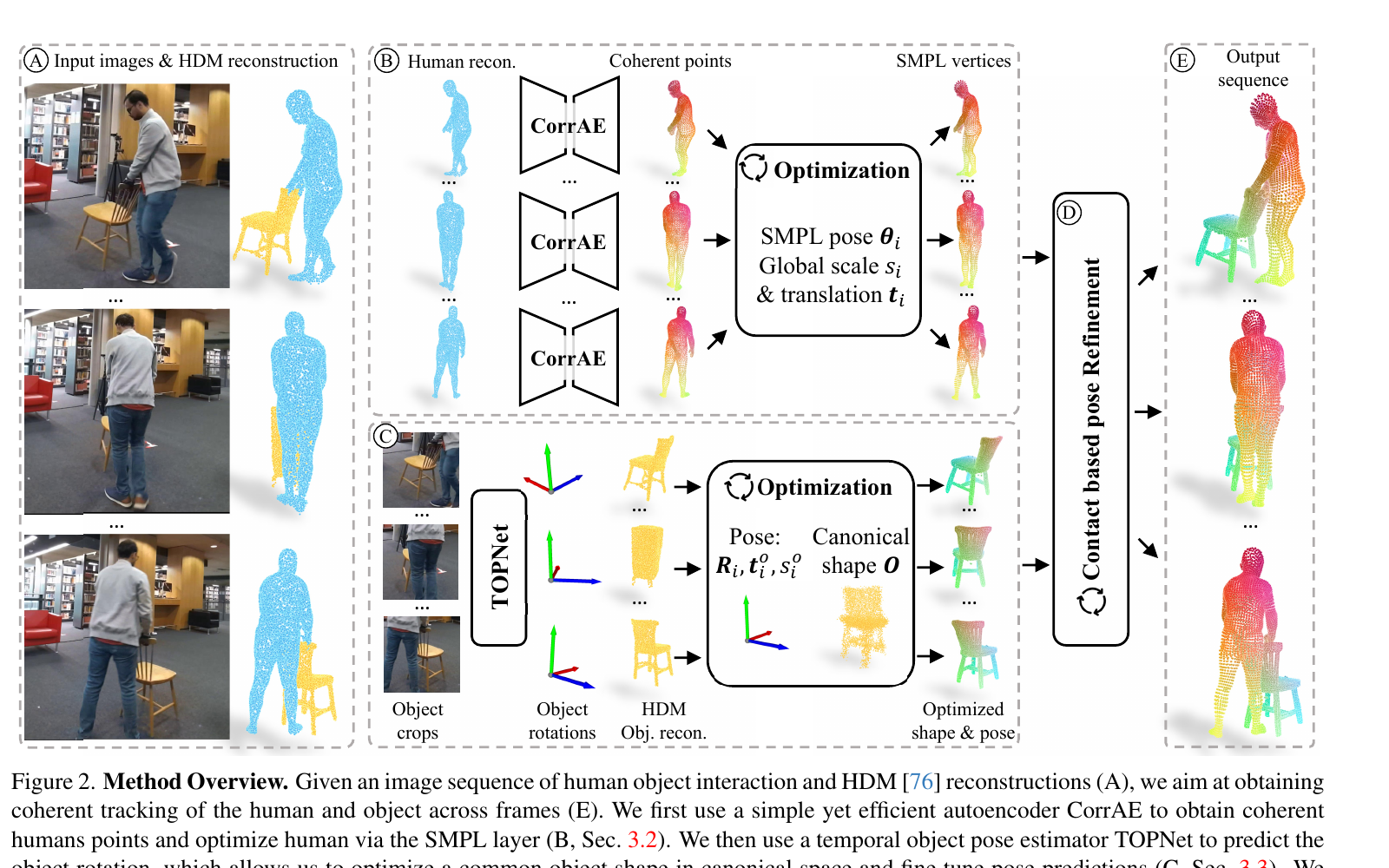
InterTrack uses CorrAE to establish SMPL correspondences for per-frame human reconstructions and TOPNet to predict occluded-object rotations from temporal and human context. It then jointly optimizes canonical object shape, per-frame transforms, and human–object contact.
InterTrack recovers consistent human and rigid-object states from monocular interaction video. Starting from HDM’s framewise clouds, CorrAE establishes human correspondences, TOPNet predicts object rotation, and joint optimization uses one canonical object shape, temporal continuity, and contact.
3. Problem setting
Input: monocular RGB interaction video; HDM supplies coarse per-frame human / object clouds, human detections, and object crops.
Output: human SMPL parameters, canonical object shape, per-frame rotation / translation / scale, and contact-consistent tracks.
Task: template-free HOI tracking; training / testing object categories still relate to BEHAVE and InterCap distributions.
4. Method overview
CorrAE: map unordered human clouds to ordered SMPL vertices, then fit per-frame SMPL pose / scale / translation.
TOPNet: a transformer combines DINOv2 image features, human motion, and visibility to predict object rotations.
Shared-shape optimization: canonicalize coarse object clouds with predicted rotations, jointly solve one shape and per-frame translation / scale.
Contact refinement: contact and temporal smoothness correct both tracks, reducing occlusion drift / interpenetration.
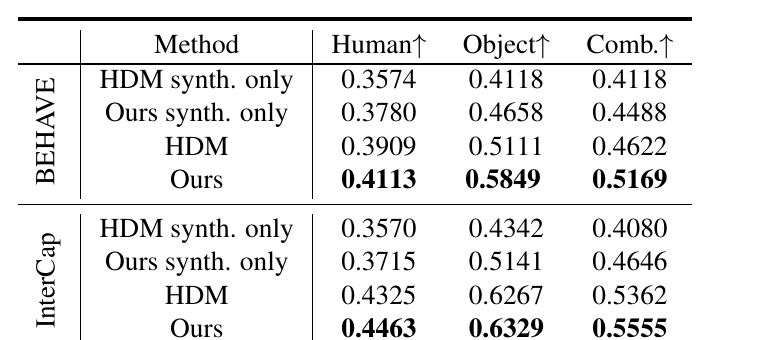
InterCap: 0.4463 / 0.6329 / 0.5555, also above HDM.
ProciGen-Video supplies about 10 hours, 8477 interaction sequences, and about 2M images for synthetic temporal pretraining.
6. Strengths, weaknesses, and reading assessment
Strengths
Explicit canonical shape and sequence consistency unify framewise object reconstructions.
Human pose, velocity, and visibility directly condition object rotation / contact optimization.
Synthetic-only and real-data training comparisons show practical temporal-module gains from synthetic video.
Risks / boundaries
Strong HDM dependence: coarse geometry’s scale, topology, and occlusion errors propagate into optimization.
Requires 2D human / object regions and SMPL priors; complex multi-person, multi-object, or deformable settings are outside the main task.
Reconstruction F-score is not equivalent to 6D pose accuracy.
7. Research takeaways
Human motion can condition object pose beyond causing occlusion. A shared canonical object representation across frames helps turn per-frame visibility into temporally stable state.
Available src/paper-notes/intertrack-3dv2025/deep.md
In-depth paper notes
Support reproduction, comparison, related-work writing, and identifying opportunities for further research.
Paper Reading Notes (Deep): InterTrack: Tracking Human Object Interaction without Object Templates
1. Basic information
Method: InterTrack
Authors / affiliations: Xianghui Xie, Jan Eric Lenssen, Gerard Pons-Moll; University of Tübingen, Tübingen AI Center, Max Planck Institute for Informatics
InterTrack combines human correspondence, human-conditioned object rotation, shared canonical shape, and contact refinement to turn independent monocular human-object clouds into template-free, temporally consistent interaction trajectories.
2.1 Guide to the paper’s figures and tables
Figure / table
Content
Reading focus
Figure 2
CorrAE, TOPNet, and joint contact refinement
Human states condition object rotation; the tracks are coupled
Table 1
Template-free BEHAVE / InterCap F-score@1 cm
Compare HDM / Ours under synthetic-only and full training
Table 2
Template-based CHORE / VisTracker comparisons
Template-free and template settings have different conditions
Tables 3–5
TOPNet, joint optimization, CorrAE ablations
Test the need for time and correspondence
Original Figure 2: HDM reconstruction, CorrAE, TOPNet, and contact-constrained joint optimization. Source: arXiv PDF. Image copyright belongs to the paper's authors and publisher; reproduced here for paper analysis.Original Table 1: template-free F-score@1 cm on BEHAVE and InterCap. Source: arXiv PDF. Image copyright belongs to the paper's authors and publisher; reproduced here for paper analysis.
3. Problem setting and boundaries
Input: monocular RGB interaction sequences; HDM first supplies coarse human / object point reconstructions, followed by crops and visual features.
Output: sequence-consistent SMPL parameters, canonical object shape O, per-frame Ri,ti,si, and contact-aware refined states.
Without object templates means no known CAD mesh at test time. Priors remain: SMPL, DINOv2, HDM geometry, ProciGen-Video category training, and real data.
Main metrics are reconstruction F-scores rather than independently labeled rotation / translation errors. Pose gains are supported mainly by consistent surfaces / shape.
4. Challenges and approach
Image-based HDM clouds lack temporal correspondence; occlusion changes local shape, scale, or orientation. InterTrack first maps humans to canonical SMPL vertices, predicts object rotations to canonicalize object points, then links both trajectories through contact rather than directly registering every cloud pointwise.
In my assessment, this decomposition fits structured humans interacting with rigid objects; those priors also define its scope.
5. Method details
5.1 CorrAE: comparable human clouds across frames
PVCNN + MLP maps HDM human clouds to ordered SMPL correspondences. Per-frame SMPL pose θi, scale si, and translation ti are optimized with Chamfer distance, pose priors, and second-order acceleration smoothing rather than latent smoothing alone. CorrAE takes about 2.553 s / image versus nonrigid ICP 72.322 s / image.
5.2 TOPNet and shared object shape
TOPNet combines DINOv2 object crops, human pose / joints / velocity, and visibility in temporal windows to predict rotations. Given Ri, coarse clouds enter canonical coordinates to jointly optimize one shape O and per-frame translation / scale, sharing shape evidence through occlusion.
5.3 Joint contact optimization
Final contact-based refinement adjusts human / object poses under contact and temporal continuity, reducing interpenetration / drift. Contact is not unconditional truth: fast sliding, soft contacts, or wrong detection can overconstrain it.
Module
Main variables
Role
Failure behavior
CorrAE + SMPL fit
θi,si,ti
Stable, interpretable human tracks
Wrong human correspondence corrupts object conditioning
TOPNet
Ri
Temporal / human-conditioned rotation
Drift with full occlusion or out-of-domain appearance
Canonical shape optimization
O,ti,si
Complete shape from sequence evidence
Deformation violates shared-shape assumptions
Contact refinement
Human-object states
Reduce penetration, retain interaction
Wrong contact assumptions overconstrain
6. Data and experimental analysis
6.1 Role of ProciGen-Video
Combining BEHAVE / InterCap motions with ShapeNet, Objaverse, and ABO shapes gives about 10 hours, 8477 sequences, 2M images, and 10 categories. CorrAE / TOPNet are pretrained there and fine-tuned on real data. Evaluation uses 66 BEHAVE test sequences (about 51k images) and 15 InterCap sequences (about 2k images).
Synthetic data supplies learnable category-level canonical rotation correspondence, beyond extra volume. The synthetic-only / full-training gap still shows domain shift.
6.2 Main results
Dataset
Training
Method
Human F-sc ↑
Object F-sc ↑
Combined ↑
BEHAVE
synthetic only
HDM
0.3574
0.4118
0.4118
BEHAVE
synthetic only
InterTrack
0.3780
0.4658
0.4488
BEHAVE
full
HDM
0.3909
0.5111
0.4622
BEHAVE
full
InterTrack
0.4113
0.5849
0.5169
InterCap
full
HDM
0.4325
0.6267
0.5362
InterCap
full
InterTrack
0.4463
0.6329
0.5555
Retain both findings: InterTrack beats HDM on both datasets / training conditions, supporting temporal joint optimization; synthetic-only remains well below full training, so ProciGen-Video does not eliminate real-video domain gaps.
6.3 Claims and evidence boundaries
Stable tracking without object templates: directly supported by Table 1, especially improved object F-score.
Humans help objects: human-dynamics TOPNet inputs and contact-refinement ablations support this, without proving every HOI needs equally strong SMPL priors.
My analysis: F-score is not a pose metric. Better canonical shape, scale, or completion also improves it. Grasping / AR need independent rotation, translation, and contact-error evaluation.
7. Limitations and failures
HDM is a key dependency; poor clouds or scale drift can make optimization consistently wrong.
Main settings use rigid objects, one person, one object; multiple people / objects, soft or articulated objects are not covered.
BEHAVE / InterCap category overlap shapes generalization; template-free does not mean data-prior-free.
HDM, SMPL fitting, transformers, and test-time joint optimization suit offline analysis rather than low-latency tracking.
8. Implications for object pose
Explore humans as pose conditions through velocity, contact, and visibility in manipulation video.
Shared canonical shape turns tracking into geometric alignment, ideally with category uncertainty / deformation detection.