JENGA: Object Selection and Pose Estimation for Robotic Grasping from a Stack
JENGA ranks YOLOv8 + ZebraPose hypotheses by object height along IMU gravity and filters occluded blocks using the area ratio of observed modal masks to pose-rendered amodal masks. Its custom synthetic top-1 precision-mAP is 0.79, excluding recall. Real Yaskawa construction-site deployment is shown only in video, without grasp-success measurements.
single RGB imagestatic IMU gravity measurementknown brick CADmodal and rendered amodal masks
Requirements
known brick identity and metric CADYOLOv8 detector and trained RGB-only ZebraPosecamera intrinsics and camera–IMU extrinsicssensor stationary enough to observe gravitypose renderervisibility threshold and top-k selection
Full paper metadataAuthors, affiliations, research area, datasets, metrics, method tags, and reading statusExpandCollapse
Authors
Sai Srinivas Jeevanandam, Sandeep Inuganti, Shreedhar Govil, Didier Stricker, Jason Rambach
Affiliations
German Research Center for Artificial Intelligence (DFKI) / RPTU Kaiserslautern
known brick identity and metric CADYOLOv8 detector and trained RGB-only ZebraPosecamera intrinsics and camera–IMU extrinsicssensor stationary enough to observe gravitypose renderervisibility threshold and top-k selection
Reading Notes
Overview / Deep Dive
Available src/paper-notes/jenga-pose-iros2025/coarse.md
Paper overview notes
Quickly assess the paper's scope, problem setting, core method, experimental findings, and whether to read it in depth.
Paper Reading Notes (Coarse): JENGA
1. Basic information
Title: JENGA: Object Selection and Pose Estimation for Robotic Grasping from a Stack
Authors: Sai Srinivas Jeevanandam, Sandeep Inuganti, Shreedhar Govil, Didier Stricker, Jason Rambach
Affiliations: German Research Center for Artificial Intelligence (DFKI); RPTU Kaiserslautern
JENGA ranks YOLOv8 + ZebraPose candidates by IMU gravity height, then filters occlusion using visible / full silhouette area. Synthetic top-1 precision-mAP is 0.79; real construction-site evidence is deployment video, without grasp success statistics or pose GT.
3. Guide to figures and tables
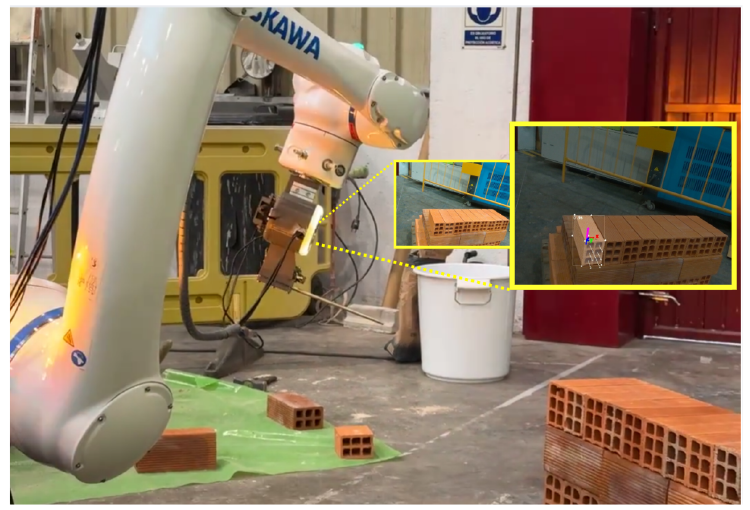
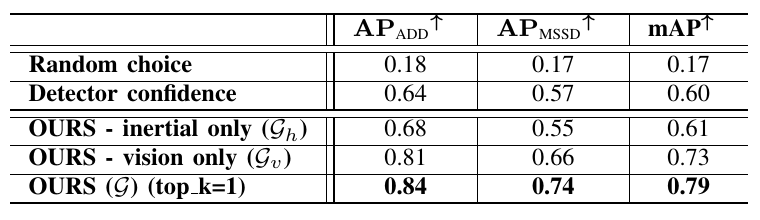
Original Figure 1: Yaskawa HC20DTP and wrist-mounted RealSense D435i at a real brick stack, with selected-brick 6D pose inset. Deployment is shown, but real trial counts, success rates, and GT errors are not reported. Source: authors' manuscript. Image copyright belongs to the paper's authors and IEEE; reproduced here for paper analysis.Original Table II: top-1 vision gives mAP 0.73, inertia 0.61, combined 0.79. Visibility supplies most gains; gravity ranking adds more. Here mAP averages two pose-error APs, not standard detection mAP. Source: authors' manuscript. Table copyright belongs to the paper's authors and IEEE; reproduced here for paper analysis.
4. Problem setting
Input: one RGB image, camera–IMU calibration, stationary gravity acceleration, known brick CAD.
Output: from all pose hypotheses Π, select top-k graspable poses G.
Graspable means prioritizing top, visible bricks with surrounding clearance, not arbitrary-hand contact prediction or full collision-free trajectories.
Synthetic data includes depth, but detection, pose, and filtering do not use it; real D435i mainly supplies RGB and IMU.
5. Method overview
Detect bricks using YOLOv8.
ZebraPose predicts RGB-crop surface codes; PnP recovers each 6D pose.
Render full amodal silhouette Ma at predicted pose; ZebraPose segmentation gives visible modal mask Mm.
Compute visibility r=∣Mm∣/∣Ma∣ and keep r≥0.8.
Camera–IMU extrinsics map object positions to sensor coordinates; gravity projections give relative height.
Keep top-k by descending height, then apply visibility filtering.
Graspability labels use bounding-box neighbors along ±X,±Y,±Z, not simulation or real grasp outcomes.
7. Results overview
Candidate strategy
APADD-S ↑
APMSSD ↑
mAP ↑
all poses
0.19
0.16
0.17
Ours top-1
0.84
0.74
0.79
Ours top-2
0.74
0.66
0.70
Ours top-3
0.68
0.62
0.65
Precision falls as k grows, showing occlusion / pose errors in later candidates. Ablations: random 0.17, detector confidence 0.60, inertia 0.61, vision 0.73, fused top-1 0.79.
8. Quick assessment
Highlight: matching jointly checks selection correctness and pose error, rather than treating every pose prediction as worth grasping.
Mechanism: modal / amodal ratios reflect occlusion better than detector confidence; IMU supplies gravity without full visual-inertial odometry.
Interpretation: 0.79 is neither grasp success nor standard detection mAP; it averages precision across ADD-S / MSSD thresholds for fixed top-1 output.
Evaluation bias: one easy output reduces false positives; graspable-object recall, stack throughput, and clearing rate are not reported.
Label limits: axial box-neighbor rules omit friction, center of mass, approach paths, and post-extraction stability.
Real evidence: paper / project videos show operation without quantitative pose / selection / grasping results.
Availability: as of 2026-07-31, the accessible project still says “Code, Dataset and more details coming soon,” with a template code link.
Available src/paper-notes/jenga-pose-iros2025/deep.md
In-depth paper notes
Support reproduction, comparison, related-work writing, and identifying opportunities for further research.
Paper Reading Notes (Deep): JENGA
1. Key assessment
A correctly posed bottom brick can still be pinned by others, and attempting it can cause collisions or destabilize the stack. JENGA therefore adds selection to standard 6D pose:
G=F(Π,I,M,αs),
Here Π is all detector / estimator hypotheses, G⊆Π the preferred graspable subset, I RGB, M the known model, and αs IMU gravity direction.
The contribution is two interpretable filters and a protocol checking graspability labels / pose together, not a new pose network. YOLOv8 and ZebraPose are replaceable.
2. Inputs, outputs, and system boundaries
Original Figure 1. Yaskawa HC20DTP, a dual-fork gripper, and flange-mounted RealSense D435i; deployment / video are described without real grasp statistics. Source: authors' manuscript. Image copyright belongs to the paper's authors and IEEE; reproduced here for paper analysis.
Required:
Known brick instance and metric CAD;
YOLOv8 detector;
Object-trained RGB-only ZebraPose;
camera intrinsics;
Camera–IMU rigid transform Tsc;
Gravity measurements while stationary or with negligible added linear acceleration;
Pose-conditioned rendering for amodal silhouettes;
Top-k and visibility thresholds.
Not required:
RGB-D depth inputs;
IMU angular velocity;
Full world pose from SLAM / VIO;
learned grasp network.
Although D435i and synthetic data provide depth, method equations do not use it. The site classifies this as RGB + IMU + CAD rather than RGB-D pose.
3. Generating pose hypotheses
YOLOv8 boxes each brick; ZebraPose processes each crop:
Encode CAD surface points with coarse-to-fine binary codes;
Predict pixel surface codes and segmentation;
Build 2D-pixel–3D-model correspondences;
PnP recovers Tcoi=[Rcoi,oci].
All results form
Π={Tco1,…,Tcon}.
JENGA neither changes ZebraPose nor refines poses. Missed detections, instance-merged masks, and wrong symmetric PnP solutions can only be filtered, not repaired.
4. Visual visibility filtering
For each predicted pose:
Amodal mask Mai renders full CAD at Tcoi, including currently occluded parts;
Modal mask Mmi is ZebraPose’s visible segmentation.
Define
ri=∣Mai∣∣Mmi∣.
Discard poses with ri<ϵvis; experiments fix ϵvis=0.80.
One pose supplies ideal full and observed visible projections, requiring no extra graspability network. Risks include:
Amodal area uses predicted pose, so pose errors change the denominator;
Severe occlusion can lose modal pixels or merge neighboring bricks;
The 80% threshold has synthetic validation but no sensitivity curve;
High visibility does not guarantee finger-approach clearance.
The ratio is a pose-conditioned confidence heuristic, not independent physical graspability measurement.
5. Gravity-height filtering
Map object positions from camera to sensor coordinates:
osi=Tscioci.
A stationary IMU measures
αs=Rsggglobal.
Only relative gravity-axis ranking is needed, using
og,zi=αs⊤osi
to score candidates and retain highest top-k set Gh. Missing acceleration normalization does not affect same-frame ranking, but robot-motion acceleration can contaminate αs. With a flange camera, inference during motion may not observe pure gravity; stationary sampling, low-pass filtering, and dynamic compensation are unspecified.
Typically height filtering precedes visibility:
G=Fv(Fh(Π,I,M,αs)).
Top-k can prematurely discard lower, more visible objects. Filter order / joint scoring are not compared.
6. Synthetic dataset
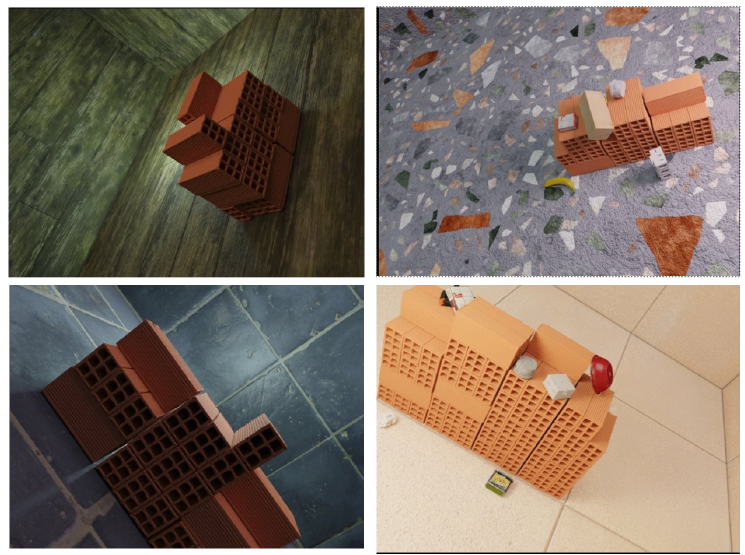
Original Figure 3: BlenderProc varies stack topology, cameras, lights, floor / wall textures, and some clutter. Source: authors' manuscript. Image copyright belongs to the paper's authors and IEEE; reproduced here for paper analysis.
A scanned brick forms 3×3 units and procedural stacks. Cameras sample a spherical shell around stack centers. Outputs:
RGB;
depth;
modal / amodal masks;
6DoF pose;
binary graspability label;
BOP and COCO formats.
The 12K images split 10K / 1K / 1K. Missing details include per-image brick counts, topology counts / split isolation, camera radii, lighting parameters, and real-training / synthetic-testing domain-gap analysis.
7. Graspability truth is geometric heuristics
Transformed eight-corner model boxes and a center KD-tree find neighbors. Shift each box one own dimension along ±X,±Y,±Z and test box intersection. The text defines:
At least four neighbor-free directions → graspable;
Exactly three also require free +Z, at least one free left / right side, and one free front / back side.
These scalable labels omit real grasp factors:
Axial / principal-direction boxes miss holes and local geometry;
Friction, mass, and center of gravity;
Finger thickness, approach direction, and collisions;
Stack dynamics after extraction;
Labels mean surrounding clearance / top access, not physics-validated grasp success.
Documentation also differs: the text includes the exactly-three rule, while Algorithm 1 shows only m≥4; pseudocode IoU conditions are unclear. Reproduction should follow author code, which was not public at review time.
8. Joint evaluation protocol
Construct ADD-S / MSSD costs between predictions G and GT graspable poses, then use Hungarian matching. Errors below θ are TP; wrong poses / unmatched predictions are FP.
Average APADD−S and APMSSD into the paper’s mAP.
This differs from detection AP:
No confidence-swept precision–recall curve;
Precision is averaged over pose-error thresholds;
Recall is not reported;
Smaller top-k means fewer outputs and naturally fewer FP;
One easy brick can score well while other graspable bricks are omitted.
It measures trustworthiness of a few returned candidates, not complete graspable-object recovery or stack-clearing efficiency.
9. Main results and ablations
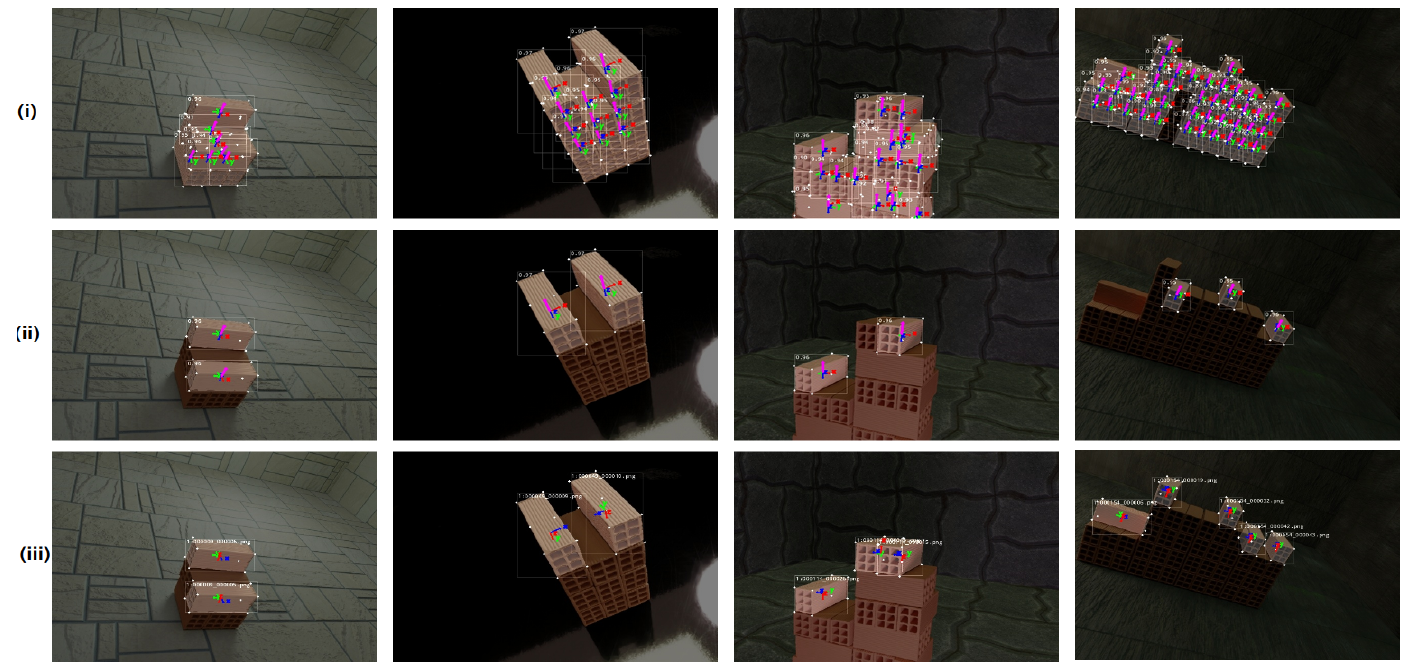
Original Figure 4: all hypotheses, JENGA selection, and GT grasps from top to bottom. Filtering removes many bottom / occluded candidates but leaves count / pose differences. Source: authors' manuscript. Image copyright belongs to the paper's authors and IEEE; reproduced here for paper analysis.
Output set
APADD-S ↑
APMSSD ↑
mAP ↑
all poses
0.19
0.16
0.17
top-1
0.84
0.74
0.79
top-2
0.74
0.66
0.70
top-3
0.68
0.62
0.65
Low all-pose precision shows why predictions need selection. However, top-1 and all-pose output counts differ greatly, so this is not a one-to-one pose-accuracy comparison. Evidence most clearly supports ranking one trustworthy brick first; later candidates are less reliable.
Original Table II: vision improves detector-confidence 0.60 to 0.73; inertia alone is similar to confidence, with fusion adding 0.06. Source: authors' manuscript. Table copyright belongs to the paper's authors and IEEE; reproduced here for paper analysis.
Strategy
mAP ↑
Random choice
0.17
Detector confidence
0.60
Inertial only
0.61
Vision only
0.73
Vision + inertial
0.79
Visibility supplies most gains, gravity a smaller complement. Confidence intervals / seeds and bins for regularity, occlusion, or camera tilt are absent.
10. Real deployment evidence
Hardware:
Yaskawa HC20DTP six-axis collaborative arm;
horizontal reach 1700 mm, vertical reach 3400 mm, payload 20 kg;
custom two-pronged gripper;
flange-mounted Intel RealSense D435i.
Project videos show real stacks / construction-site grasping, but the paper omits:
Total trials and success rate;
Selection, pose, and gripper-failure breakdowns;
Inference / robot-action time;
Post-grasp stack disturbance;
Motion-time IMU filtering;
sim-to-real pose accuracy.
Deployment is qualitative operability evidence, not real-world validation of synthetic mAP 0.79.
11. Availability and reproduction
As of 2026-07-31, the accessible video project retained github.com/YOUR REPO HERE and “Code, Dataset and more details coming soon…”; downloadable data / method code could not be verified.
Reproduction still needs:
YOLOv8 / ZebraPose training settings and synthetic-real augmentation;
camera–IMU calibration;
gravity normalization / motion rejection;
Top-k and filter order;
Amodal rasterization / clipping;
Exact threshold sets Θe;
Consistency between Algorithm 1 and the textual exactly-three rule;
Real sequences, robot commands, and grasp outcomes.
12. Limitations
One brick category / fixed CAD does not establish general stacked-object performance;
All 12K quantitative images are synthetic;
Box-neighbor labels are not physical grasps;
mAP naming can be confused with detection / BOP AP;
Precision without recall, coverage, or throughput;
Some top-1 gains come from fewer outputs;
Visual ratios depend on correct pose / masks;
Gravity ranking assumes no extra linear acceleration;
No threshold, filter-order, or stack-difficulty sensitivity;
Real robot video without success statistics;
Code / data not released at review time.
13. Overall assessment
JENGA adds a practical decision layer: prefer high, visible poses in structured stacks rather than pass every detection equally to grasp planning. Modal / amodal ratios and gravity ranking are lightweight; ablations favor visibility over confidence for ranking.
Its precise role is pose-aware stacked-object candidate selection: one trustworthy synthetic candidate and a running real robot, not a complete physical grasp benchmark. Coverage, long-term clearing, and cross-object generalization need open data, physical labels, and larger real trials.